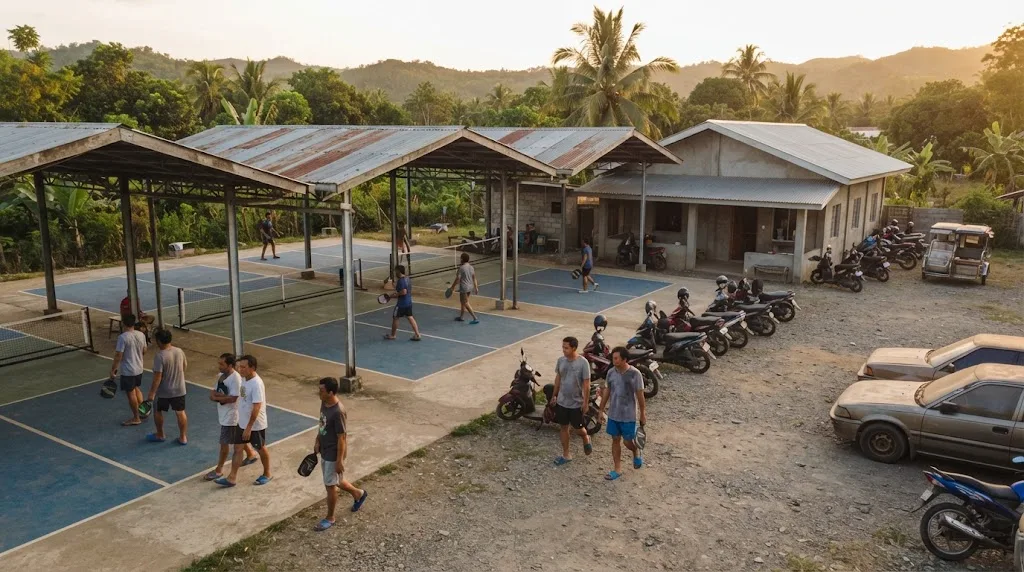
Four courts, a small clubhouse and a parking apron: the courts are the visible part, but the roof, the fill and the clubhouse decide the budget. Illustrative photo.
Short answer: a roofed 4-court club with lights, a 40 sqm clubhouse with comfort rooms and 12 parking slots comes to about ₱7.4 million to ₱10.4 million as an AEDO 2026 planning range, including a 10% contingency and a placeholder ₱300,000 for drainage, water and power service. It excludes land, nets and fencing, permits, design fees and business set-up. About half of that is the steel roof. Whether the club pays back is a different question, and we will not answer it for you: we do not have Philippine hourly rates or occupancy data we can stand behind, so the calculator below takes your numbers. With clearly labelled example inputs it shows about 77 to 108 months of payback, which mostly tells you how sensitive the answer is.
One honest limit first: AEDO builds only in Negros Oriental. Everywhere else in the Philippines we design, seal the structural plans, review remotely and check milestones. Our real court prices come from Negros Oriental and will differ elsewhere with hauling, labour and freight.
Top half: the startup budget as a low to high range. Bottom half: payback from the hourly rate, hours and occupancy you enter. The revenue and running-cost fields are example only, replace with your local numbers. A budgeting aid, not a quotation or a forecast.
This is the calculator's default case: 4 roofed courts, 0.70 m of fill, polished and painted finish, 300 lux lights on the roof frame, a 40 sqm clubhouse, 12 parking slots of 25 sqm, the ₱300,000 placeholder and 10% contingency. Every rate comes from a sibling AEDO post or is labelled a planning range.
| Line | Basis | Low | High | Where the rate comes from |
|---|---|---|---|---|
| Fill and CHB retaining wall | 493.6 cu.m (705.2 sqm × 0.70 m) | ₱493,640 | ₱789,824 | Pillar post; Manjuyod item works out to about ₱1,165 per cu.m |
| Concrete slab | 705.2 sqm | ₱574,738 | ₱705,200 | Manjuyod ₱814.71 per sqm |
| Polish and paint | 705.2 sqm | ₱251,756 | ₱317,340 | Manjuyod ₱135.82 + ₱221.64 = ₱357.46 per sqm; high end is a planning figure |
| Metal roof, columns, footings | 846.2 sqm roofed (pad × 1.2) | ₱3,723,456 | ₱4,908,192 | Canlaon ₱4,015 per sqm plan area + 10%, up to a planning ₱5,800 |
| Court lighting on the roof frame | 4 courts × 5 fixtures | ₱284,000 | ₱630,000 | Lighting guide, per court ₱71,000 to ₱157,500 |
| Clubhouse with comfort rooms | 40 sqm | ₱880,000 | ₱1,520,000 | ₱22,000 to ₱38,000 per sqm from the sibling cost bands (planning) |
| Parking slab | 12 slots × 25 sqm = 300 sqm | ₱244,500 | ₱300,000 | Court slab rate reused (planning) |
| Drainage, water, power (placeholder) | Lump sum | ₱300,000 | ₱300,000 | Example only; no source |
| Contingency 10% | On the subtotal | ₱675,209 | ₱947,056 | Your choice |
| Build budget | ₱7,427,299 | ₱10,417,612 | Excludes land, nets, fencing, permits, design | |
The court finish itself is the least of it: polish and paint are 3% to 4% of the subtotal in this case. On AEDO's own Manjuyod two-court job the polishing and painting were about 11% of the ₱1,100,000 contract, and fill, wall, footings and pedestals were half. See the pillar cost guide for the full breakdown of that job.
Take the roof out of the default case (open courts, lights on poles instead) and run the calculator: the budget falls by several million pesos. That is the entire decision. The roof does not create demand; it recovers the hours you lose to rain and to the midday sun on a bare, painted slab. How many paid hours that is on your site is a number you can only get by watching the site, or from a comparable club's booking sheet.
The way to use the calculator: run it twice, note the budget gap, then in the payback half find out how many extra court-hours per day the roof must add for that gap to earn back in a period you accept. That turns a vague "a roof is nice" into one testable number. Our sibling roof structure cost guide covers what drives the roof line: span, wind speed, columns and footings. The sheets are the smaller part of it.
If you want a roof, decide it before the lot layout is fixed. A roof needs a column grid, a design wind speed for the site (use our wind lookup tool) and footings sized to soil that has not been tested yet. The lot layout comes first in our sibling guide on how many courts fit on your lot.
A club is a business with customers, and customers need a place to wait, drink water and use a comfort room. That turns a paving-and-roof job into a building job. Three things follow.
Permits for a building with a comfort room are a bigger conversation than for an open court; see the commercial fit-out permit guide for what the neighbouring process looks like, and why plans get returned before you file.
Evening sessions are often popular in a hot climate, so lights are part of the business plan, not an extra. Our lighting guide sizes them at 150 W LED floodlights, 5 per roofed court on the roof frame and 6 per open court on poles. For four roofed courts that is 20 fixtures and 3.0 kW.
The bill is kW × hours × days × ₱ per kWh. In the default case: 3.0 kW × 4 h × 28 days = 336 kWh a month, and at ₱14 per kWh that is ₱4,704 a month. The ₱14 is an assumption between two published figures, the same one our lighting guide uses. NORECO I's residential rate was ₱13.5494 per kWh in April 2026 (as reported by a local news site), and the NORECO II website showed ₱14.3522 for residential as its current-month rate on September 24, 2026, both as recorded in our lighting cost guide. Your tariff class and month decide the real figure, and a club may be billed under a different class than a house.
The larger electrical question is the service itself: whether the existing supply can carry the lights, pumps and clubhouse loads. That is a sizing exercise, covered in electrical service sizing. The ₱300,000 placeholder is not a substitute for it.
We do not publish Philippine court-hour rates or occupancy rates because we have no source for them that we would trust with your money. The formula is simple; the inputs are yours.
| Step | Formula | Default example |
|---|---|---|
| Monthly revenue | courts × open hours × occupancy × days × rate | 4 × 12 × 30% × 28 × ₱400 = ₱161,280 |
| Electricity for lights | kW × lit hours × days × ₱ per kWh | 3.0 × 4 × 28 × ₱14 = ₱4,704 |
| Other running cost | You enter it | ₱60,000 (example only) |
| Monthly net | revenue − electricity − other cost | ₱96,576 |
| Payback | build budget ÷ monthly net | ₱7,427,299 to ₱10,417,612 ÷ ₱96,576 = 77 to 108 months |
| Break-even occupancy | monthly cost ÷ revenue at 100% | ₱64,704 ÷ ₱537,600 = 12% |
Read the default result carefully. It is not a forecast: ₱400, 12 hours and 30% are placeholders we picked to make the formula visible. What it does show is structural: with a roofed 4-court budget in the ₱7 to ₱10 million range, payback runs into many years unless your rate, hours and occupancy are considerably higher than the example, or the build is cheaper. Change one input at a time and watch which one moves the answer most. Occupancy and hourly rate usually do; a change in electricity rate barely does.
What the calculator leaves out. Land cost or rent, income tax and business taxes, loan interest, seasonal swings, membership or coaching income, food and beverage margin, and the day the paint wears out and needs redoing. The surface options guide covers recoat cycles. Put a repaint reserve in your running-cost line.
Permit. Section 301 of PD 1096 says no person, firm or corporation may erect, construct, alter, repair, move, convert or demolish any building or structure without a building permit from the Building Official. The clubhouse and any roof over the courts are structures. How a city or municipality treats an open court with fill and light poles is an LGU decision. The IRR occupancy list (Rule VII, Section 701), as read in our pillar post, names tennis, badminton and basketball courts, not pickleball, and puts membership clubs' courts "not operated primarily for gain" in a different group than commercial ones, so a paid club may be classified differently from a private one. Ask your Office of the Building Official first. That is our reading, not a ruling. Business registration, permits to operate and taxes are outside the scope of this article, and we have not researched them.
Who does what at AEDO. We build only in Negros Oriental. Everywhere else in the Philippines we do the structural design and seal it, prepare the bill of quantities, review contractor quotes and check milestones remotely or on a visit. Our published Single Milestone Check starts at ₱7,500 per visit. The 3-working-day express structural design band is ₱7,500 up to 150 sqm and ₱50 per sqm above that, up to 500 sqm; a 4-court roof is well above 500 sqm, so we quote it per project. Also look at how pre-engineered steel buildings are priced and supplied if you are comparing roof routes, and at warehouse clear height for the clearance question under a roof.
What we can send you. Tell us the lot, the number of courts and whether you want a roof and a clubhouse. Within Negros Oriental we can quote the whole job as design-build. Elsewhere we prepare the structural design and the BOQ and your local contractor builds. Compare with pickleball court construction cost and lighting cost.
Court, roof, slab, fill and finish rates are AEDO's own Manjuyod 2-court contract and Canlaon City roof estimate (anonymised), as published in our pillar cost guide. Lighting counts, 150 W fixtures and the ₱14 per kWh assumption are from our lighting guide, which records NORECO I and NORECO II published rates. Clubhouse per-sqm bands are from our construction cost per sqm guide. The permit wording is PD 1096 Section 301 and the IRR occupancy list as read in the pillar post. Revenue, occupancy, rate and running-cost inputs are examples only: we did not source Philippine figures for them and we invent none. Everything marked "planning" is an AEDO 2026 planning range, not a market fact and not a quotation.
How much does it cost to start a 4-court pickleball club in the Philippines?
As an AEDO 2026 planning range, a roofed 4-court club with lights, a 40 sqm clubhouse with comfort rooms and parking for 12 cars comes to about ₱7.4 million to ₱10.4 million including a 10% contingency, before land, nets and fencing, permits, design fees and business set-up. The steel roof alone is about half of it. Without a roof the same club is far cheaper, but the calculator lets you test both. These are budget ranges, not a quotation.
How long will a pickleball club take to pay back?
Nobody can tell you without your own numbers, and we will not invent them. The calculator on this page takes your hourly rate, opening hours, occupancy and running costs. With clearly labelled example inputs (₱400 per court-hour, 12 hours a day, 30% occupancy, 28 days a month) the roofed 4-court default pays back in about 77 to 108 months. That is arithmetic on placeholder numbers, not a forecast. Change any of those inputs and the answer moves a lot, which is the point of testing before you build.
Should I put a roof on a pickleball club?
The roof is the biggest single line in the budget, about half of the default roofed case. Whether it earns its cost depends on how many paid hours it recovers from rain and midday sun on your site. Run the calculator once with the roof and once without, and compare the extra hours you would need to book to close the gap. AEDO has no Philippine dataset for rain-lost hours and will not make one up.
What costs do people forget when budgeting a pickleball club?
Fill and drainage for the lot, nets and fencing, water and power service, the clubhouse and comfort rooms, parking slab, permits, structural and architectural design, and the monthly electricity bill for the lights. The finish paint is the cheap part: on AEDO's Manjuyod two-court job the polishing and painting were about 11% of the contract. The calculator lists these lines and a user-editable allowance for the ones we cannot price from a source.
Does a pickleball club need a building permit?
Section 301 of PD 1096 requires a building permit from the Building Official before any building or structure is erected. A clubhouse and a roof over the courts are structures. How your city or municipality classifies an open court with fill and light poles is an LGU decision, so ask your Office of the Building Official before you buy anything. Business registration and taxes are separate and are not covered in this article.
What are the running costs of court lighting?
AEDO's lighting guide uses 150 W LED floodlights, 5 per roofed court and 6 per open court. Four roofed courts is 20 fixtures, about 3 kW. At 4 lit hours a day, 28 days a month and an assumed ₱14 per kWh, that is about 336 kWh and roughly ₱4,700 a month. Negros Oriental cooperatives posted residential rates of about ₱13.5 to ₱14.4 per kWh in 2026, so your own bill and tariff class decide the real figure.
Rules, standards and project documents used. External links open in a new tab. Rates that this article reuses from other AEDO posts are cited to those posts, where their primary sources are listed.
We found no Philippine source we would trust for pickleball court-hour rates, occupancy or club operating costs, so none are given: the payback inputs are yours, and the defaults are labelled examples. We did not research Philippine business registration, taxes, a parking-slot dimension in the IRR, or a septic and water-supply cost, so those are left out or placeholders. This article is general information, not a design or business plan for your site.
Send us the lot, the number of courts and whether you want a roof and a clubhouse. An engineer will come back with a scope and a budget check, and a BOQ or design-build package if you want one.