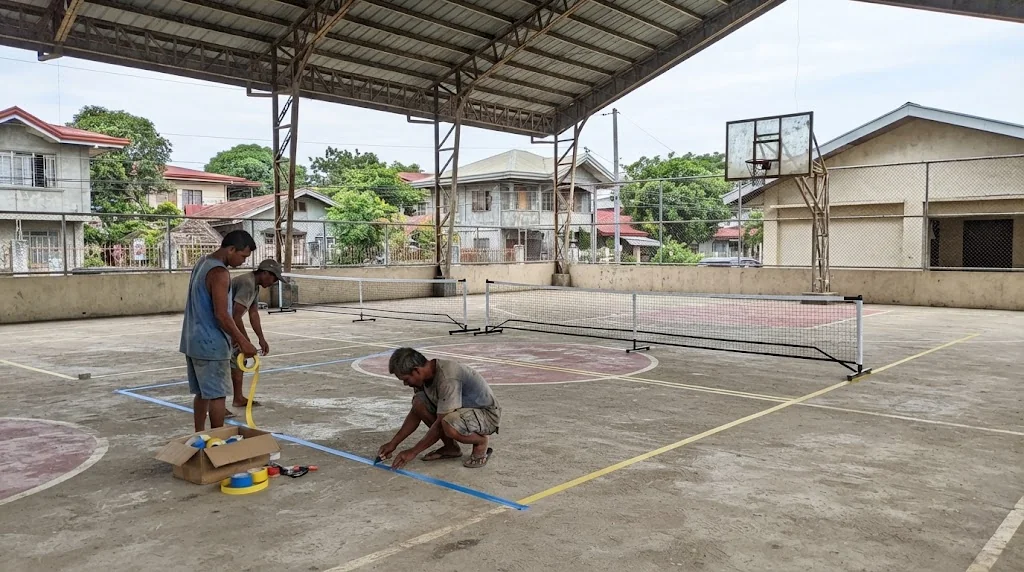
New lines and portable nets on an old barangay slab. The lines are the cheap part; the slab under them decides how long they last. Illustrative photo.
Short answer: yes, an old basketball court, a driveway or a plain concrete slab can usually be turned into pickleball courts, and the slab's condition matters more than the paint. A pickleball court is 20 × 44 ft (6.10 × 13.41 m); the USA Pickleball rulebook gives 30 × 60 ft (9.14 × 18.29 m) as the minimum playing surface, and 34 × 64 ft for new construction. Inside the 28 × 15 m court markings of a FIBA-size basketball court that fits one court (28 ÷ 18.29 = 1, 15 ÷ 9.14 = 1). On the full 32 × 19 m floor, with its 2 m run-off lane, three fit when turned across the width. For the calculator's default case, a 28 × 15 m slab (420 sqm) in fair condition, repainted with a silica-sand paint system and one portable net, the AEDO 2026 planning range is about ₱166,700 to ₱267,700, roughly ₱397 to ₱637 per sqm of slab. Lighting, fencing, a roof and structural repairs are extra. If the slab is cracked, sinking or ponding, that number is not yet the real number: check the slab first.
The calculator below works out how many courts fit your slab and a budget range with line items. After it: the official sizes and the layout working, what to check on the slab, what may be in the way, the resurfacing options with the prices we can source, nets and lines, lighting and fences, noise, the permit position, and the mistakes we see.
Enter your slab, its condition and the finish you want. You get how many pickleball courts fit and an AEDO 2026 planning range with line items. Ranges are for planning, not a quotation. Only the resurfacing rates marked as Manjuyod are from an actual AEDO contract.
Two rulebooks give us the numbers. No Philippine code sets a pickleball court size, so we use the sport's own rules. Here is what is official and what is our layout arithmetic.
| Item | Size | Status |
|---|---|---|
| Pickleball court, singles and doubles | 20 × 44 ft (6.10 × 13.41 m), lines 2 in wide | Official: USA Pickleball Rulebook 2026, 3.A.1–3.A.2 and 3.A.4.e |
| Minimum playing surface | 30 × 60 ft (9.14 × 18.29 m), 167.2 sqm | Official, 3.A.3. The rulebook words it as a minimum; some summaries call it "recommended" |
| New construction and tournament play | 34 × 64 ft (10.36 × 19.5 m), 202.2 sqm | Official recommendation, listed in 3.A.3 |
| Non-volley zone | 7 ft (2.13 m) from the net each side | Official, 3.A.4.c |
| Basketball court (FIBA) | 28 × 15 m, measured to the inner edge of the boundary line | Official: FIBA Official Basketball Rules 2024, Article 2.1 |
| Basketball floor (FIBA) | Court plus a run-off lane of at least 2 m, so at least 32 × 19 m | Official, Article 2.2 |
| Your barangay or subdivision court | Often not 28 × 15 m | Measure it. We did not find a Philippine government court-size standard we could read and cite |
| How many fit, spacing between courts, orientation | Our arithmetic, below | Layout practice, not a rule |
The 30 × 60 ft area is the 20 × 44 ft court plus 5 ft beyond each sideline (30 − 20 = 10, halved) and 8 ft beyond each baseline (60 − 44 = 16, halved). The rulebook is silent on how neighbouring courts share those margins. We count each court with its own full area, which is the safe reading.
Take the module as 9.144 × 18.288 m (30 × 60 ft). For a slab L × W, count floor(L ÷ 18.288) × floor(W ÷ 9.144) with the court's long side along L, then the same with the long side along W, and keep the larger.
| Slab | Long side along L | Long side along W | Courts at 30 × 60 ft | Courts at 34 × 64 ft |
|---|---|---|---|---|
| 28 × 15 m: FIBA court markings only | 1.53 → 1, 1.64 → 1: 1 | 0.82 → 0: 0 | 1 | 1 |
| 32 × 19 m: FIBA floor with run-off | 1.75 → 1, 2.08 → 2: 2 | 1.04 → 1, 3.50 → 3: 3 | 3 | 1 |
| 20 × 10 m driveway or yard slab | 1.09 → 1, 1.09 → 1: 1 | 0.55 → 0: 0 | 1 | 0 (10 m is under 10.36 m) |
| 24 × 12 m slab | 1.31 → 1, 1.31 → 1: 1 | 0.66 → 0: 0 | 1 | 1 |
| 18.3 × 18.3 m slab (60 × 60 ft) | 1.00 → 1, 2.00 → 2: 2 | 2.00 → 2, 1.00 → 1: 2 | 2 | 0 |
Two things stand out. First, a plain 28 × 15 m basketball court gives you one court, not the two or three people hope for; the extra courts come from the run-off lane, if your slab includes it. Second, 20 × 10 m and 24 × 12 m slabs are also one-court slabs, and a 10 m width is 36 cm short of the 34 × 64 ft new-construction width (10.36 m).
Don't pack bare 20 × 44 ft courts edge to edge. On 28 × 15 m that arithmetic gives four (28 ÷ 13.41 = 2, 15 ÷ 6.10 = 2), with nowhere to step past a baseline or sideline. It's on paper only. If you want two courts on a tight slab, ask an engineer to draw it with the real net posts and the real margins, and understand you are then below what the rulebook calls the minimum playing surface.
Paint and lines are a skin. On a basketball court that has carried 20 years of play and rain, the skin is the last thing to worry about. Walk the slab with a tape, a 3 m straightedge, a bucket of water and your phone before anyone quotes paint:
Good news is common: a slab with hairline cracks, a fall to one side and a worn surface is a routine resurfacing job. Bad news is also common: a slab with a settled corner and a puddle in the middle is not. Section 9 explains when it is worth paying for an assessment before you buy the paint. Our structural assessment report guide shows what a report contains.
Count what is standing on the slab. The USA Pickleball 2026 rulebook defines a permanent object as any object on, above or near the court that can interfere with play, and its examples include ceilings, walls, fencing, lighting fixtures and net posts. A ball that hits one is a fault (7.E.3, 10.C.4). We read the rulebook for a minimum ceiling height and did not find one. So the practical test is yours: stand at the baseline and serve a high lob. If the ball hits the roof, it's too low.
If the roof is what you want to build or upgrade, our covered pickleball court roof guide covers the structure and cost. If a roof is already there and old, ask for a structural check before you add lights or fans to it.
The pillar guide, pickleball court construction cost, covers new slabs. This section is only for a slab that already exists. Prices come from two sources: AEDO's Manjuyod contract, and AEDO 2026 planning ranges. The planning ranges are our own working numbers for budgeting. We did not find Philippine supplier price lists for sport-court systems, so anything that is not from the Manjuyod job is labelled a planning range and needs a quote before you commit.
AEDO's 2-court open court in Manjuyod, Negros Oriental has a court pad of 352.63 sqm. The contract prices, all-in (materials, labour and equipment) at provincial Negros Oriental rates, are:
| Item | Amount | Per sqm of 352.63 | What it contains |
|---|---|---|---|
| Concrete flooring (new) | ₱287,289 | ₱814.71 | 100 mm slab, Class A (3,000 psi) concrete, 50 mm gravel bedding, 10 mm bars at 400 mm both ways, saw-cut joints |
| Concrete polishing | ₱47,895 | ₱135.82 | Machine trowelled and polished court surface |
| Painting | ₱78,158 | ₱221.64 | Nippon paint system with silica sand mix, including game line markings |
Polishing plus painting is 135.82 + 221.64 = ₱357.46 per sqm. These are prices for a new slab that AEDO poured. On an existing slab the prep is different: it can be less (the slab is already cured) or more (old paint, stains, cracks, spalls, high spots). That is why the calculator adds a separate prep line by slab condition. The whole Manjuyod job is a fixed price of ₱1,100,000, and it includes footings, pedestals, backfill and a retaining wall for a raised pad, so don't divide it by area for a cost per sqm of resurfacing.
| Slab condition | Typical prep | Planning range per sqm of slab | Example, 420 sqm |
|---|---|---|---|
| Good | Pressure wash, degrease, seal hairline cracks, prime | ₱40 to ₱70 | ₱16,800 to ₱29,400 |
| Fair | Grind high spots and old paint, route and seal cracks, patch spalls, fill low spots, prime | ₱120 to ₱220 | ₱50,400 to ₱92,400 |
| Poor | Structural or drainage repair first. This is the prep range only and it assumes the slab is not replaced | ₱350 to ₱600 | ₱147,000 to ₱252,000 |
A poor slab has no reliable price until someone has looked at it. If it has to be replaced, AEDO's Manjuyod new-slab price of ₱814.71 per sqm is a reference for the concrete alone. That is ₱342,178 for 420 sqm, before demolition, fill, drainage and finishing.
The table gives the surface cost per sqm and for one 30 × 60 ft area (167.2 sqm). Prep is extra and is priced in the calculator by condition.
| System | ₱ per sqm | One 30 × 60 ft area (167.2 sqm) | Re-coat cycle | Suitable when | Slip and heat |
|---|---|---|---|---|---|
| Repaint only: clean, prime, paint system with silica sand, lines | ₱221.64 (Manjuyod painting) to ₱300 (planning) | ₱37,100 to ₱50,200 | Ask the supplier; we have no verified figure | Sound slab, hairline cracks, no ponding, old paint still bonded or removed | The Manjuyod system carries a silica sand mix in the paint. Colour decides how hot it runs (judgement) |
| Multi-coat sports acrylic (crack filler, resurfacer, colour coats, textured top coats) | ₱500 to ₱900 (planning; quote required) | ₱83,600 to ₱150,500 | Ask the supplier; we have no verified figure | Sound, flat slab where you want a full sports-court system rather than one paint coat. Cracks can still show through a moving slab | Textured top coat. Colour decides how hot it runs |
| Polished concrete + paint (the Manjuyod system) | ₱357.46 (Manjuyod) to ₱450 (planning) | ₱59,800 to ₱75,200 | Ask the supplier; we have no verified figure | Rough, dusty or laitance-covered slab that needs grinding and a tight surface before paint | Plain polished concrete can be slick when wet (judgement), and the Manjuyod paint carries a silica sand mix |
| Cushioned acrylic | ₱1,200 to ₱2,200 (planning; quote required) | ₱200,600 to ₱367,800 | Ask the supplier; we have no verified figure | Flat, sound slab where players want more comfort on the joints. Confirm with the supplier whether the system bridges cracks; a moving crack can still show through | Softer underfoot (judgement). Colour decides how hot it runs |
| Epoxy coating | ₱900 to ₱1,600 (planning; quote required) | ₱150,500 to ₱267,500 | Ask the supplier; we have no verified figure | Dry, prepared slab. Check the product's data sheet for outdoor use and for the anti-slip version | Depends on the product: some are not non-skid, so read the data sheet. Colour decides how hot it runs |
| Modular tiles | ₱2,500 to ₱4,500 (planning; quote required) | ₱418,000 to ₱752,400 | Tiles are replaced as they wear; life is a supplier data-sheet question | Slab with cracks or ponding trouble you can't fix, but only if it is flat enough and drains. Tiles sit on the slab, they don't repair it | Open designs may let air move (judgement); surface grip is a data-sheet question |
Sources for the table: ₱221.64, ₱135.82 and ₱357.46 are AEDO's Manjuyod contract prices (new slab, Negros Oriental, all-in). Every other figure, including the ₱300 and ₱450 upper ends, is an AEDO 2026 planning range that we set for budgeting; it is not a supplier price list, and the ranges for multi-coat acrylic, cushioned acrylic, epoxy and tiles match those in our construction cost guide. We searched for Philippine supplier prices for court systems (Boysen, Davies and Nippon Paint Philippines price lists and listings) and found no unit price for a court system, so none is quoted. We give no re-coat life because we have no manufacturer figure. Areas are 167.2 sqm per court. Foreign court prices are not used. Get a written quote and the manufacturer's data sheet for whichever system you choose.
Why repainting looks so much cheaper than the ₱500 to ₱900 acrylic in the construction cost guide: the Manjuyod price is one paint system with silica sand on a slab AEDO had just poured, while the ₱500 to ₱900 range is a multi-coat sports acrylic (crack filler, resurfacer, colour and textured coats), which is the second row of the table. Same slab, different scope of coating, so compare like with like.
How to read it: for a sound slab, repainting is where most of the value is, and the difference between it and polished concrete plus paint (about ₱136 per sqm) is worth paying only if the surface really needs grinding to get paint to hold. Cushioned systems and tiles are comfort upgrades. They are also the two where we can't give a solid Philippine price, so get quotes, not our range.
Lines. USA Pickleball 3.A.4.e has lines 2 inches (5.08 cm) wide, all the same colour and clearly contrasting with the playing surface; per 3.A.2, measurements go to the outside edge of the perimeter and non-volley zone lines. On a shared basketball court the old lines are still there. Paint pickleball lines in a colour that stands out from both the surface and the basketball lines, or use removable tape if the court will keep both games. Tape is the cheaper way to share; it wears out and has to be re-laid.
Nets. Per 3.B of the rulebook, posts are 22 ft (6.71 m) apart, inside to inside, within 1 inch; posts are at most 3 inches (7.62 cm) in diameter; the net is at least 21 ft 9 in long and is edged with a 2 inch white tape binding; the top is 36 inches (91.44 cm) high where the net crosses the sidelines and 34 inches (86.36 cm) at the centre, each within a quarter inch. Portable net systems and permanent posts both meet that.
Don't hang a net from a basketball hoop, a pole or a roof column. The net height tolerance is a quarter inch, and a post that moves in the wind will not hold it.
The sound of a pickleball paddle on a hard ball is short and sharp, and it repeats every few seconds for hours. Neighbours notice it. In the Philippines this is mostly a local question. Secondary sources point to a 1980 national ambient noise standard by area class (NPCC Memorandum Circular 002, enforced by DENR), which we could not open and read, so we don't quote its limits or say how it applies to a sports court. Many LGUs and subdivisions also have their own noise ordinance, curfew and HOA rules, and we did not find one that names pickleball. Ask your barangay hall, your LGU and your HOA before you build. Practical steps we suggest, from experience and not from a code: keep the courts as far from bedrooms as the slab allows, agree playing hours in writing, add a solid fence or planting on the side facing houses, and don't put lights on after the agreed hour. If you are a subdivision or resort, put the hours in your house rules from day one.
We read the 2004 Revised IRR of PD 1096 (the National Building Code). This is what it says, and where we can't tell you what your Building Official will decide.
The Amended JMC 2021-01 covers how construction-related permits are processed. We could not open the official file and did not read RA 11032, so we can't say whether either changes the Section 301 exemption list. Treat the above as the 2004 IRR position and confirm with your OBO. If you do need a permit, our guides on why plans get returned and commercial fit-out permits show what OBOs actually ask for.
AEDO's Structural Assessment is ₱5,000 flat per the services page: a licensed-engineer site visit, an NSCP 2015 evaluation and a written report within 5 business days. Testing such as cores, if the report calls for it, is scoped and quoted separately. It is worth it when:
It isn't needed for a sound slab that only needs new paint. Site visits are listed for Negros Oriental, Cebu, Luzon and NCR; elsewhere in the Philippines we work remotely from your photos and plans, and design and review from there. What the report finds decides whether you resurface, repair first or replace. AEDO builds only in Negros Oriental, so outside it the work itself goes to your own contractor, and our Project Oversight checks their milestones from ₱7,500 per visit. If you'd like a fee reference for design work, see our structural engineer fee guide.
What AEDO does. AEDO's licensed civil engineers assess existing slabs and structures (from ₱5,000, above) and prepare the design and a bill of quantities for the conversion. We build only in Negros Oriental, where we can take the resurfacing and court works as a fixed-price contract. Everywhere else in the Philippines we design, seal, review remotely and check your contractor's milestones. Send the slab size, photos and what you want to play on it, and we'll tell you honestly what fits and whether it needs work first.
Court sizes, lines and nets were read from the USA Pickleball Official Rulebook (2026), Section 3 and its permanent-object definition; basketball sizes from the FIBA Official Basketball Rules (October 2024), Article 2. The layout arithmetic is ours. Permit text is from Sections 212, 301 and 702 and Rule VII of the 2004 Revised IRR of PD 1096. Manjuyod prices are from AEDO's own contract; every other peso range is an AEDO 2026 planning range, not a supplier quotation. The calculator's rounding and assumptions are listed under it.
Can I turn a basketball court or concrete slab into pickleball courts?
Usually yes, if the slab is sound and drains. A pickleball court is 20 x 44 ft (6.10 x 13.41 m) and USA Pickleball's rulebook gives 30 x 60 ft (9.14 x 18.29 m) as the minimum playing surface. What decides it is the slab: cracks, settlement, ponding and thickness. Paint on a failed slab fails with it. A short check first, and a structural assessment if the slab is doubtful, is cheaper than repainting twice.
How many pickleball courts fit in a basketball court?
Inside the 28 x 15 m markings of a FIBA-size basketball court, one pickleball court with the 30 x 60 ft minimum playing surface fits (28 / 18.29 = 1 and 15 / 9.14 = 1). On the full 32 x 19 m FIBA floor, which adds a 2 m run-off lane all round, three fit if the courts are turned so their 60 ft length runs across the 19 m width. Many barangay courts are not FIBA size, so measure yours.
How much does it cost to convert a basketball court to pickleball?
For a 28 x 15 m slab in fair condition (420 sqm), repainted with a silica-sand paint system and fitted with one portable net, the calculator above gives an AEDO 2026 planning range of about ₱166,700 to ₱267,700, or roughly ₱397 to ₱637 per sqm of slab. That covers slab prep, resurfacing, lines, one net and a 10 percent contingency. Lighting, fencing, a roof and any structural repair are extra. Polished concrete plus paint, multi-coat or cushioned acrylic, epoxy and tiles cost more.
Do I need a building permit to convert a basketball court to pickleball?
It depends on the work and the Building Official. Section 301 of the 2004 Revised IRR of PD 1096 exempts repair or replacement of flooring, so repainting or resurfacing a slab is likely exempt. A new roof, lighting poles, retaining walls or a fence over 1.80 m are different, and the IRR groups basketball courts under Group J Division 3 without naming pickleball. Ask your Building Official before you start.
Can I paint pickleball lines on a cracked or sloped slab?
You can, but the lines will not fix the slab. Hairline cracks can be routed, sealed and painted over. Wide cracks, steps between slab panels, settlement or ponding water point to a subgrade or drainage problem that paint will not cure, and the cracks will telegraph through within a season. Have the slab checked before you buy paint.
Permanent net posts or portable nets on a converted court?
Portable nets suit a shared court where basketball must still be played, since they can be moved off. Permanent posts need core-drilled sleeves or footings and are better on a court used only for pickleball. Either way the net must be 36 inches high at the sidelines and 34 inches at the centre, with posts 22 ft apart, per the USA Pickleball rulebook. Never hang the net from a basketball hoop or pole.
Codes, rules and AEDO documents read for this article. External links open in a new tab.
We did not find a Philippine government standard for pickleball or basketball court sizes, a Philippine noise limit for pickleball, or a Philippine supplier price list for sport-court systems, so none is quoted; the FIBA and USA Pickleball sizes are the sports' own rules, not Philippine law. We could not open the Amended JMC 2021-01 file and did not read RA 11032, so neither is quoted. The 1% slope figure and every peso range other than the Manjuyod prices are AEDO planning practice. This article is general information, not a design for your slab.
Send us the slab size and a few photos. A licensed civil engineer will tell you how many courts fit and whether the slab needs work before you paint.