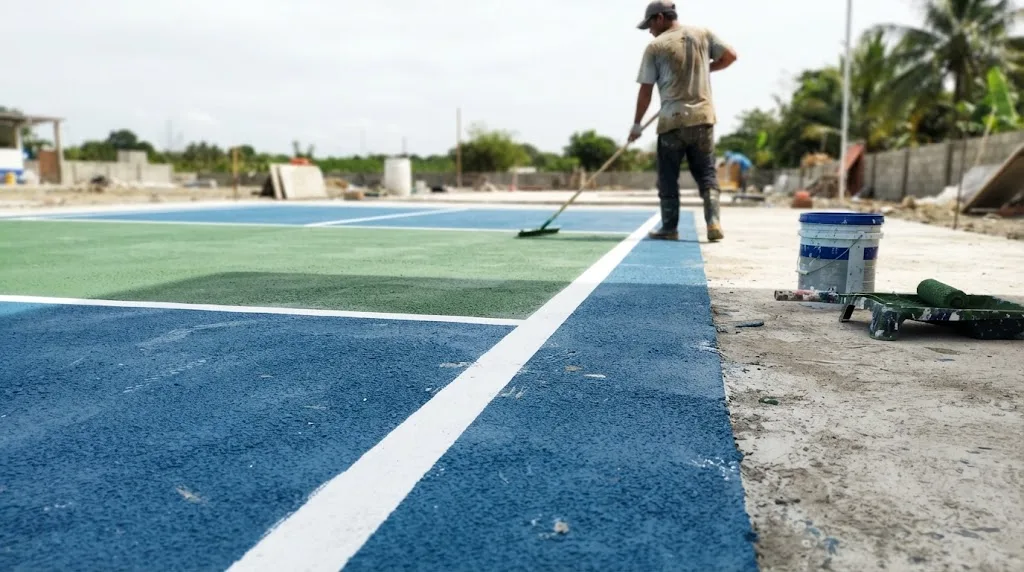
The colour you see is a few millimetres of coating. What it sits on decides whether it lasts. Illustrative photo.
Short answer: the surface is the cheap layer, and the slab and the slope under it decide how long it lasts. AEDO's own 2-court job in Manjuyod, Negros Oriental priced machine polishing at ₱135.82 per sqm and a paint system with silica sand at ₱221.64 per sqm, together ₱357 per sqm, over a ₱814.71 per sqm slab. Those are the only Philippine prices we could source. Every other system here (plain acrylic, epoxy hybrid, cushioned acrylic, modular tiles) is an AEDO 2026 planning range, because we found no Philippine supplier price list. For the calculator's default case, two courts with a new slab, the Manjuyod system and an example 4-year recoat cycle, the slab plus surface plus 10 years of recoats and upkeep comes to about ₱664,300 to ₱801,700, of which recoats and upkeep are about 36% to 38%. Slope matters as much as paint: the manual we read recommends a fall of 0.83% to 1.00% in one plane.
One honest limit first: AEDO builds only in Negros Oriental. Everywhere else in the Philippines we design, seal, review contractor quotes and check milestones remotely. Prices elsewhere will differ with hauling, labour and freight. For the whole court budget, see the pickleball court construction cost guide; this post goes deeper on the surface only.
Pick the courts, the surface and the slab condition. You get the up-front cost and a recoat and upkeep view over the years you choose. Recoat cycle, recoat cost and upkeep start as clearly labelled examples: replace them with your supplier's written numbers. A budgeting aid, not a quotation.
A court surface is a stack. The coating is the top few millimetres; everything below it is earthwork and concrete. The manual we read (details in Sources) describes the colour-coat sequence on a hard court as: clean the pavement, flood it to find low spots, patch and level, apply textured filler coats, then two or three colour coats, then one or two coats of textured line paint. It says to allow at least 72 hours for an acrylic surface to cure before play, and that the patching work needs at least 55 degrees F (about 13 degrees C) and no rain in the immediate forecast. AEDO's Manjuyod slab, from our proposal, is a 100 mm slab over 50 mm of compacted gravel with 10 mm temperature bars at 400 mm both ways and saw-cut joints, on a pad raised about 0.70 m with fill.
Two practical points from the same manual. First, when you add fill, place it in 8 inch lifts and compact each before the next, and call a geotechnical engineer if the soil is suspect or unknown. Second, the slab has to be dry enough that moisture vapour does not hurt the coating's adhesion; the manual says the surfacing manufacturer sets the test method for when a slab is ready. AEDO's own job plan for Manjuyod makes the same fill point from experience: loose fill settles more than well-compacted fill, and a slab telegraphs that settlement as cracks. See our lot filling guide and concrete mix ratio post for what goes into the earthwork and the pour.
This is the one item where we found a real, written number from a primary industry source. It is a US-published manual, so it is a design reference, not a Philippine code. No Philippine standard we found sets a pickleball court slope.
| Item | What the manual says |
|---|---|
| Fall for a hard court | Between 0.83% (1:120) and 1.00% (1:100). Less than 0.83% risks leaving excessive water on the surface after rain |
| Direction | One plane for the whole court, sloping the shortest direction. Side to side or end to end is best, corner to corner third. Never from the net toward a baseline, baseline to net, or centre line to the sides |
| Drains | Outside the fenced or playing area; not under the surface, because it could lead to settling. For long rows of courts, consider grated trench or channel drains in the out-of-bounds strip between courts |
| Groundwater | Consider a French drain (gravel-filled trench with perforated pipe) between the courts and incoming underground water |
| Checking the finished slab | Flood the clean pavement. A "birdbath" is standing water at least 1/16 inch thick. Check with a string line whether it is a real low spot; patch and level low areas, grind or scrape high ones |
What that fall means in your lot: 1% over a 6.10 m court width is about 61 mm of level difference across the court; over the 9.14 m width of the 30 x 60 ft playing surface it is about 91 mm. That is arithmetic on the manual's number, and it is easy to build into a pad while the levels are still open, and hard to fix in the coating. Tell your contractor the fall direction before the fill and the forms go in, and check it again on the finished slab. The slab thickness alone can't fix a flat slab: a court that drains to nowhere still needs a drain at its low side.
Read the price column with the Source column in mind. Only the Manjuyod polishing and painting rates are Philippine prices from a real contract. The other four are AEDO 2026 planning ranges (the same ones as our pillar guide), because the Philippine paint suppliers we searched publish no per-sqm prices. Descriptions of the systems come from the manual and from Nippon Paint's Malaysian professional site, not from a Philippine data sheet.
| System | ₱ per sqm (finish only) | Two courts, 334 sqm | What it is | Source for the description |
|---|---|---|---|---|
| Polished concrete + paint with silica sand | ₱357 (Manjuyod); planning up to ₱450 | ₱119,400 to ₱150,500 | Machine-troweled and polished slab, then a Nippon paint system with silica sand and line marking. AEDO's job plan: one epoxy primer, two rubberized top coats, silica in the second coat over the playing area only | AEDO proposal and job plan. Not a system the manual describes; a local practice |
| Plain acrylic colour coats | ₱500 to ₱900 (planning) | ₱167,200 to ₱301,000 | Textured filler coats, two or three colour coats, textured line paint. AEDO's Canlaon specification lists crack filler, resurfacer, two colour coats and two textured playing-surface coats | ASBA/USA Pickleball manual; AEDO Canlaon specification |
| Epoxy hybrid sports coating | ₱900 to ₱1,600 (planning) | ₱301,000 to ₱535,000 | Nippon FloorSports 1K Epoxy Hybrid: 3 coats, 0.15 to 0.20 mm; the anti-slip version 1.4 to 2.2 mm. Nippon lists it as recommended for pickleball | Nippon Paint (Malaysia) professional site |
| Cushioned acrylic | ₱1,200 to ₱2,200 (planning) | ₱401,300 to ₱735,700 | Liquid-applied (4 to 8 coats of rubber-granule mix), acrylic-coated shock pad (4 to 8 mm, up to 30% force reduction) or poured-in-place (4 to 12 mm), all topped with acrylic colour coats. The manual recommends adhering the system, since floating systems may hurt ball bounce | ASBA/USA Pickleball manual |
| Modular interlocking tiles | ₱2,500 to ₱4,500 (planning) | ₱836,000 to ₱1,504,800 | Polymer tiles, generally 10 to 12 in square, laid over concrete or asphalt; open-grid design lets water drain through; damaged tiles can generally be replaced | ASBA/USA Pickleball manual |
Same slab, five answers. Every system above needs a sound slab, so the ₱815 to ₱1,000 per sqm slab line is the same for all of them. On two courts the finish range runs from about ₱119,400 to over ₱1.5 million, a gap of ten times or more, while the slab stays around ₱287,000 to ₱353,000. That is why we tell owners to settle the slab and the slope first and the finish second: you can change the finish in ten years; you can't change the slab.
Comfort versus ball behaviour. The manual says cushioned hard courts generally let players play more often by lessening physical impact. The 4 to 8 mm shock pad figure above is its own number. How much comfort your knees gain is personal, and we did not measure it. If your club is older or plays long sessions, ask to walk on a sample board before you decide. ASTM F2772 exists as a performance standard for multi-purpose indoor sports floor systems, so it does not rate an outdoor slab; if you are paying for an indoor floor, see our indoor pickleball facility guide.
Lines. The manual says white textured lines are best for dedicated pickleball courts, and that on multi-sport surfaces "tone on tone" lines in the same colour family should stop 3 inches short of the white pickleball lines. If you are marking pickleball on a basketball court, our basketball to pickleball conversion guide covers the layout side.
We found no source that ranks surfaces for Philippine rain or heat, so we say plainly what is sourced and what is reasoning.
If you are painting an existing slab, this is the section that saves money. The manual is blunt: all courts will crack eventually, and once a crack has been repaired it will eventually reappear. What it says you can do:
Our reading for the Philippines: heavy cracking on an existing slab is a structural question before it is a paint question. A slab that has settled into fill, or a basketball court whose subgrade was never compacted, will crack through any coating. That is why the calculator has a "heavy cracking or settlement" option and why it prints a warning instead of pretending the number is reliable. The repair allowances in the calculator (₱80 to ₱200 per sqm for minor cracks and low spots, ₱200 to ₱450 for heavy) are AEDO judgement with no published source; treat them as a placeholder until a contractor has walked the slab. Our structural engineer fee guide shows what an inspection costs.
We found no recoat interval. The manual we read gives none: it says regular inspection, cleaning, stain removal, recoating and minor repairs extend the surface's life, that it is possible to resurface acrylic more than once, and that the owner should keep a maintenance schedule and note wear year to year. No Philippine source gave us one either, and the supplier pages we read state none for a tropical climate. So the calculator does not claim to know. It takes an interval and a percentage of the first finish cost from you and shows what happens over the years you choose. The starting values, all examples only:
| System | Example recoat or replacement every | Example cost of each, % of first finish |
|---|---|---|
| Polished concrete + paint | 4 years | 60% |
| Plain acrylic | 5 years | 60% |
| Epoxy hybrid | 6 years | 50% |
| Cushioned acrylic | 6 years | 40% (colour coats over the cushion; a cushion layer replaced costs more) |
| Modular tiles | 5 years | 10% (10% of the tiles replaced) |
These are our own placeholders. They exist so the calculator has something to show, not because any source says a Philippine court needs recoating that often. Replace them with the interval and recoat price in your supplier's written quotation. The lesson from running the numbers is structural, not numerical: a cheap surface with frequent recoats can cost more over ten years than a dearer one that lasts, and the reverse can also be true. Only a written interval from the supplier tells you which.
Default case, worked. Two courts, 176.3 sqm each = 352.6 sqm. Slab at ₱815 to ₱1,000: ₱287,369 to ₱352,600. Manjuyod finish at ₱357 to ₱450: ₱125,878 to ₱158,670. Ten years at a 4-year cycle is 2 recoats (at years 4 and 8), each 60% of the finish: ₱75,527 to ₱95,202 each, ₱151,054 to ₱190,404 for both. Upkeep example: ₱5,000 x 2 courts x 10 years = ₱100,000. Total ₱664,301 to ₱801,674. Change any assumption and the calculator redoes it.
AEDO's fixed-price contract for a 2-court open court in Manjuyod, Negros Oriental was ₱1,100,000 all-in at provincial Negros Oriental rates. These are the three lines that make up the floor, on a 352.63 sqm pad:
| Item | Scope | Amount | Per sqm |
|---|---|---|---|
| D. Concrete flooring | 100 mm slab over 50 mm compacted gravel, 10 mm temperature bars at 400 mm, saw-cut joints | ₱287,289 | ₱814.71 |
| E. Concrete polishing | Machine troweled and polished | ₱47,895 | ₱135.82 |
| F. Painting | Nippon paint system with silica sand mix, including game lines | ₱78,158 | ₱221.64 |
| Slab, polish and paint | ₱413,342 | ₱1,172.17 | |
Per sqm: 287,289 / 352.63 = 814.70 (carried in our BOQ as 814.71); 47,895 / 352.63 = 135.82; 78,158 / 352.63 = 221.64. The 6-month workmanship warranty in that proposal covers the paint's adhesion and application, with manufacturer warranties on the paint system passed through to the owner; it is not a recoat interval. The contract does not include nets, fencing, the roof or poles, lights beyond the court's lighting points, drainage beyond the pad, or permits. The finish (polish plus paint) was ₱126,053, about 11% of the contract; fill, wall, footings and pedestals were half. That is the same point as this post: on an open court the surface is the smallest of the big lines, and the one you will pay for again. The full breakdown is in our court construction cost guide.
If you want an engineer to look at the slab, the slope or the quotation before you sign, that is what our Single Milestone Check (from ₱7,500 per visit) is for, and for a court in Negros Oriental we can price the whole job (elsewhere we design and check remotely). The structural roof design side is in our design package fee guide. Two other posts in this cluster may help: how many courts fit on your lot and the club startup budget.
Common mistakes. Choosing the finish before fixing the levels. Coating over a slab that has never been flood-tested. Using driveway crack filler. Picking a dark colour for an open court. Assuming a "10-year" brochure claim applies in your climate without asking for it in writing. Treating the slab as a paint problem when the fill under it is what moved.
Slope, drainage, colour-coat sequence, cushion types, tiles, crack and maintenance guidance are from the ASBA and USA Pickleball manual, Pickleball Courts: A Construction and Maintenance Manual, 2020 edition (page numbers in Sources). Epoxy hybrid coat counts and thicknesses are from Nippon Paint's Malaysian professional site. Manjuyod figures are from AEDO's own proposal, anonymised. The Canlaon specification is AEDO's own. Every other peso figure is an AEDO 2026 planning range, not a market fact and not a quotation. The recoat cycle, recoat cost, upkeep and repair allowances are examples or judgement with no source.
How much does a pickleball court surface cost per square metre in the Philippines?
The only Philippine prices we can source are AEDO's own for a 2-court job in Manjuyod, Negros Oriental: machine polishing at ₱135.82 per square metre and a paint system with silica sand at ₱221.64, together ₱357 per square metre, on top of a ₱814.71 slab. Other systems are AEDO 2026 planning ranges with no published Philippine price list behind them: plain acrylic ₱500 to ₱900, epoxy hybrid ₱900 to ₱1,600, cushioned acrylic ₱1,200 to ₱2,200 and modular tiles ₱2,500 to ₱4,500 per square metre. Get a written supplier quote before you commit.
What slope should a pickleball court have for drainage?
The ASBA and USA Pickleball construction manual (2020 edition, which we read) recommends a hard court fall of 0.83 percent (1 in 120) to 1.00 percent (1 in 100), in one plane, sloping across the shortest direction of the court, never from the net toward a baseline. It warns that less than 0.83 percent risks leaving excessive water after rain. It also says drains belong outside the playing area, not under the surface. No Philippine code sets a slope for pickleball courts.
Is acrylic or epoxy better for a pickleball court?
The ASBA and USA Pickleball manual describes textured acrylic colour-coat systems as the common outdoor surface for pickleball. Epoxy hybrid systems are sold for pickleball too; Nippon Paint's Malaysian professional site lists its FloorSports 1K Epoxy Hybrid as recommended for pickleball. We found no Philippine test data comparing the two, so choose by the supplier's written recoat interval, warranty and a sample board on your own slab, not by the name of the resin.
Can I paint an existing concrete slab or basketball court for pickleball?
Often yes if the slab is sound, but the coating only hides what is under it. The manual says fine cracks may be covered by recoating, most cracks need a court contractor, driveway crack fillers are not recommended, and a repaired crack will eventually reappear. The slab must also be dry enough that moisture vapour does not spoil adhesion, and any low spot holding water needs patching first. Have the slab checked before you buy paint.
How often does a pickleball court need recoating?
We could not find a recoat interval in the ASBA and USA Pickleball manual or in any Philippine source we read. The manual only says courts fade and wear over time, that acrylic can be resurfaced more than once, and that the owner should keep a maintenance schedule. The interval in our calculator is an editable example, not a fact. Ask the supplier for the interval in writing for your climate and traffic.
Which pickleball surface is best for a hot, rainy climate like the Philippines?
No source we read ranks surfaces for tropical conditions. What we can say from physics and the manual: dark colours absorb more sun, water must be able to leave the surface through a proper fall, and standing water thicker than about 1/16 inch after a flood test is a low spot to patch before coating. A roof or a lighter colour does more for heat than the choice of resin, and the manual describes textured filler and line coats.
Rules, manuals and project documents used. External links open in a new tab.
We could not find a Philippine supplier price list or data sheet with per-sqm prices for court coatings, so every rate except the Manjuyod polishing and painting is an AEDO planning range. We found no recoat interval, no Philippine slope standard for pickleball courts, and no source ranking surfaces for tropical heat or rain, so those are stated as gaps. The rulebook sets court dimensions but not the surface. This article is general information, not a specification for your site.
Send us the lot or the existing slab, the court count and the surface you are leaning toward. An engineer will come back with what to check on the slab and slope and a budget range, and a BOQ or design-build package if you want one.