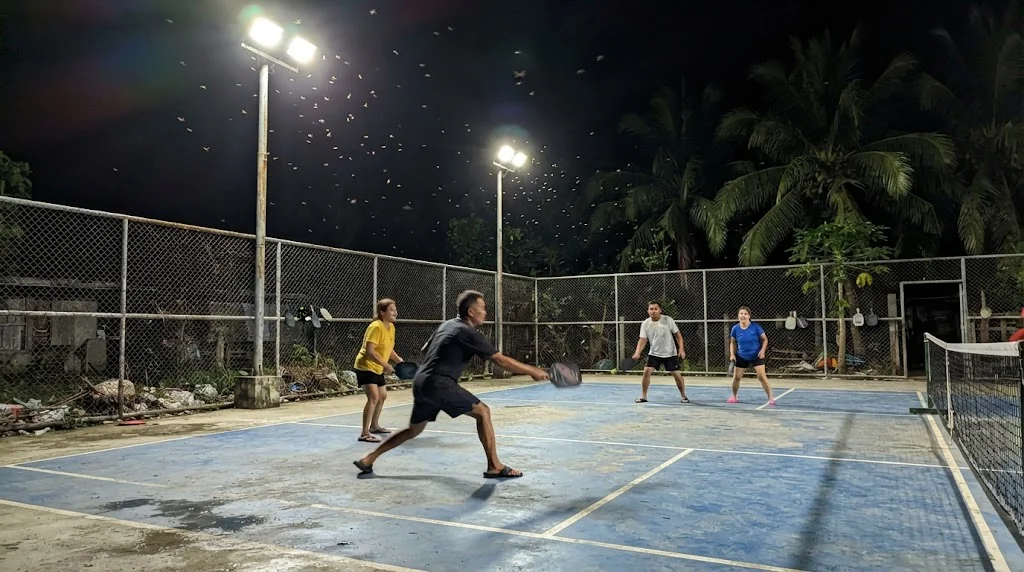
Four poles just outside the sidelines, fixtures aimed across the court, and nothing hanging over the playing lines. That is the basic single-court layout the industry manual draws. Illustrative photo.
Short answer: lighting two open pickleball courts to a recreational 300 lux (30 footcandles) with pole-mounted LED floodlights comes to about ₱328,000 to ₱742,000 for both, or roughly ₱164,000 to ₱371,000 per court, in AEDO's 2026 planning range for fixtures, poles and footings, wiring and a control panel. By the simple lumen method that is six 150 W fixtures per court on four poles, 12 fixtures and 1.8 kW in all. Run 4 hours a night, 5 nights a week, that is about 156 kWh a month, or ₱2,184 at an assumed ₱14.00 per kWh. So the lights are a modest running cost and a much larger build cost, and most of the build cost is poles and footings, not the fixtures. The number that decides whether the court is playable at night is the light level, and the pickleball-specific source we could read, the ASBA and USA Pickleball construction manual, recommends 300, 500 or 750 lux depending on who plays. We found no Philippine code that sets a lux level for a court.
Plug your own case into the calculator below: courts, open or covered, poles or roof mounting, fixture watts, hours and your kWh rate. After it: the light levels and what the Philippines does and does not regulate, how the fixture count is worked out, layout and glare, poles and footings, wiring and permits, timers, what AEDO priced on a real two-court job, and what to send us.
Pick your target level and fixture. You get a fixture count by the simple lumen method, the load in kW, the monthly electricity bill at your rate, and an AEDO 2026 planning range for the build. The count is a first sizing, not a photometric design.
The pickleball-specific source we could read is Pickleball Courts: A Construction & Maintenance Manual by the American Sports Builders Association (ASBA) with USA Pickleball. We read Chapter 6 (Lighting) of the 2020 (second) edition. USA Pickleball's manual page lists a 2023 edition (182 pages, published every three years, next one slated for 2026); we could open only its table of contents, whose Lighting chapter has the same headings, and not its lighting tables, so check the current edition before you lock a design. The manual says that pickleball is a fast sport, that players need higher light as they get older, and that, when adding lights, you should "strive to get as much light as you can afford." It sets three categories of average maintained horizontal illumination, measured 3 ft above the court within the primary playing area (PPA):
| Category III | Category II | Category I | |
|---|---|---|---|
| Average maintained horizontal | 30 fc (300 lux) | 50 fc (500 lux) | 75 fc (750 lux) |
| Minimum maintained horizontal | 20 fc (200 lux) | 40 fc (400 lux) | 60 fc (600 lux) |
| Maximum uniformity ratio, horizontal (max ÷ min) | 2.0 | 2.0 | 1.7 |
| Average maintained vertical | 20 fc (200 lux) | 30 fc (300 lux) | 50 fc (500 lux) |
| Maximum uniformity ratio, vertical | 3.0 | 2.5 | 2.0 |
| Typical facilities listed | Clubs, parks and recreation, residential | Clubs, parks and recreation, residential, indoor clubs | Clubs, parks and recreation, residential, tournament venues, indoor clubs |
Three points from the same chapter matter for an owner. "Maintained" means after the light loss factor (LLF): the manual says LLF normally varies between 0.6 and 0.9, so a fixture that reads 300 lux on day one is not what you have in year three unless the plan accounts for it. The PPA in this edition is the court plus 2 ft beyond the sidelines and baselines, 24 × 48 ft for a 20 × 44 ft court. And the manual says facility levels should be chosen "based on the highest skill level" that will play there, with a note that facilities with older players should get more light. Broadcast-quality tournament venues are a different animal, at 125+ fc.
For colour, the manual recommends a CRI between 65 and 80 and a colour temperature of 3800 K to 5000 K, and says sources above 5000 K look bluish and should not be used for court lighting. That rules out the cheapest "daylight 6500 K" floodlights, which is worth writing into any supplier quotation.
A private court or subdivision court played by friends after work: Category III, 300 lux, is the manual's recreational and residential level. A club or resort with organised games and better players: Category II, 500 lux. Paying for 750 lux only makes sense if you host tournaments. Going from 300 to 500 lux needs about two-thirds more light, so more fixtures and a bigger power bill. The calculator shows both.
We looked for a Philippine number to quote for a court and did not find one. What we could and could not read:
So for a Philippine court the sensible basis is the manual's categories, chosen deliberately and written into the specification, with the Philippine Electrical Code and RA 7920 governing the electrical work itself (section 8). The same absence of a national number applies to court dimensions, which we cover in our pickleball court construction cost guide.
The calculator uses the classic lumen method. Multiply the target lux by the area to get the light that must land on the court, then divide by how much of a fixture's light really arrives and stays:
Fixtures = (lux × area) ÷ (lumens per fixture × utilisation × light loss factor)
For the default case, 300 lux over the 107 m² primary playing area is about 32,100 lumens on the court. A 150 W fixture at 120 lm/W gives 18,000 lumens. With utilisation 0.40 and LLF 0.80 each fixture puts 5,760 lumens on the court, so 5.6 fixtures, rounded to 6 per court, which checks back at about 323 lux maintained. Our two assumptions carry the answer: utilisation is the share of the fixture's light that lands on the playing area rather than the fence, the neighbour's yard or the sky, and for a floodlight beside a small court it is well under half; and efficacy is on the data sheet, and honest suppliers give it for the whole fixture, not the bare LED chip. Our 120 lm/W is on the optimistic side for cheap retail floodlights: a 150 W IP65 flood listed at Wilcon for ₱5,989 is rated 15,000 lm (100 lm/W) at 6500 K, and at 100 lm/W the default case needs 7 fixtures per court, not 6. It is also a 6500 K light, above the manual's 5000 K ceiling.
Where the method breaks: the simple count says nothing about uniformity (the manual wants the brightest spot no more than 2.0 times the darkest), glare or vertical illuminance (light on the ball, not the floor). Those depend on the fixture's optics and where it sits and is aimed, which is why a real job gets the supplier's computer plot. Use our number to budget and to check a quotation: if a supplier proposes far fewer lumens than the count above, ask to see their calculation.
A cheap sanity check on watts: at 120 lm/W, four 100 W fixtures give 48,000 lumens, about 48% of the 100,000 the default court needs. That's why "four 100 W lights" quoted for a court to 300 lux deserves a follow-up question.
What the manual says, in its own terms:
Glare is what players notice first. The manual defines glare as harsh, bright light that can affect a player's ability to follow the ball, and its high-mast drawing marks a "critical glare zone" and says fixtures should be 35 ft or more up to keep glare out of players' eyes. For low-mast layouts that height isn't available, so the answer is the layout above: poles on the sides, fixtures aimed across the court and downward, and shielded optics. The rule of thumb that you should not aim fixtures along the long axis of the court, from a baseline pole straight down the court into the face of a player at the other end, is design practice from lighting suppliers, not a sentence we found in the manual. It also follows from the pole positions the manual draws, all along the sidelines.
Lighting a court to the manual's uniformity ratio of 2.0 also depends on the colour of the floor and the walls: a dark court and dark windscreens give the white ball more contrast, as the manual notes, and, in our experience and not from the manual, a glossy floor finish can reflect the fixtures back into players' eyes. Raise it when you choose the floor finish; our court construction guide covers surfaces.
Open court: there is nothing to hang fixtures from, so it is poles. That is the case where the pole and footing cost dominates the lighting budget, and the default case above shows why: about 8 poles and footings are the largest line.
Covered court: you can mount fixtures on the roof structure, on brackets from purlins, truss chords or roof columns, and skip the poles. It is cheaper if the roof was designed for it. Three conditions:
Pole mounting on a covered court is also possible if columns or roof heights are wrong for fixtures; it costs more but gives better control of aim. Clear-height planning for large roofed spaces is covered in our clear height guide, and roof framing options in pre-engineered steel buildings and concrete vs steel frame.
A light pole is a cantilever: a tall thin column fixed only at the ground, with the fixture and its bracket catching wind at the top. Wind on the pole and fixture creates an overturning moment at the base (the wind force multiplied by its height above the base), so the footing does the real work. Taller pole, larger fixture area, higher wind speed or softer soil all make the footing bigger. The manual says only "check with local codes regarding necessary wind loads for the light poles."
Load in kW is simply fixtures times watts. The default case: 12 fixtures × 150 W = 1.8 kW. At an assumed power factor of 0.90 that is 2.0 kVA, about 8.7 A at 230 V, or about 10.9 A with a 125% allowance for continuous loads. That allowance is standard design practice and our service sizing guide uses it; a transcription of PEC 2017 Article 2.10 states the 125% rule for continuous loads on branch circuits, but we did not read the printed code, so confirm the clause with your electrical engineer. The 230 V single-phase supply and 0.90 power factor are our assumptions. That is small: in most cases court lights are a minor addition to an existing service, not a new transformer. It matters more if you are also adding a clubhouse, air conditioning or a pump.
The bill is kW × hours × days × ₱ per kWh. We take the rate from what Negros Oriental cooperatives publish, and label it an assumption:
| Source | What it shows |
|---|---|
| NORECO I, as reported April 19, 2026 (Breaking News Negros Oriental, a news site, not the coop's own page) | April 2026 residential ₱13.5494 per kWh, up from ₱12.3105 in March; low voltage ₱12.2162, high voltage ₱9.5361. Five months old at the time of writing. |
| NORECO II website (noreco2.com.ph), read September 24, 2026 | Current-month rates: residential ₱14.3522, low voltage ₱13.5024, high voltage ₱10.9692 per kWh, down ₱0.7345 from the previous month's residential ₱15.0867. The page does not print a month name; its data was last updated September 22, 2026. |
| Our calculator default | ₱14.00 per kWh, a round assumption between the NORECO II current residential figure and NORECO I's April one, as of September 2026 |
Rates change every month with the generation charge: NORECO II's residential figure moved by about ₱0.73 per kWh in the last month alone. Your bill also depends on your customer class and which cooperative or utility serves the site, so check a recent bill and put your own rate into the calculator. Default case: 1.8 kW × 4 h × 5 nights × 52 ÷ 12 = 156 kWh a month, at ₱14.00 = ₱2,184 a month, about ₱26,000 a year. Double the hours or the courts and the bill doubles. Lighting one court for a family is a small cost; lighting six courts for 6 hours every night is a real line in a club's budget: 6 courts × 6 fixtures × 150 W = 5.4 kW, and 5.4 kW × 6 h × 30 days is about 972 kWh, roughly ₱13,600 a month at ₱14.
Controls are design practice, not a code requirement we could cite. What works on courts:
These are AEDO 2026 planning ranges for Philippine work, kept in line with the calculator, not market facts and not quotations. They exclude VAT, design, permits, the utility service and meter, and the court pad itself. We did not port any US price; the manual and the US suppliers we read do not give Philippine costs.
| Item | AEDO 2026 planning range | Basis |
|---|---|---|
| LED sports floodlight, supplied | ₱45 to ₱90 per watt (a 150 W fixture: ₱6,750 to ₱13,500) | Optics, shielding and brand drive the spread |
| Steel pole, supplied and erected | ₱15,000 to ₱35,000 each | About 6 to 8 m, galvanised, with base plate |
| RC footing per pole | ₱6,000 to ₱15,000 each | Depends on pole height, wind and soil |
| Roof brackets, per fixture (roof-mounted) | ₱1,500 to ₱4,000 each | Excludes checking the roof structure |
| Wiring per court, open | ₱30,000 to ₱70,000 | Trenching, conduit, pull boxes, cable |
| Wiring per court, covered | ₱20,000 to ₱50,000 | Runs along the roof frame |
| Panel, breakers, contactor, timer | ₱15,000 to ₱30,000, plus ₱4,000 to ₱10,000 per extra court | Per installation |
What we could and could not check against the market. For fixtures we spot-checked Philippine retail listings read on September 24, 2026: 150 W IP65 LED floodlights at ₱5,989 (Wilcon, 15,000 lm, 6500 K) and ₱5,999.75 (Lightforce Corporation), and a 150 W "Ironman" model at ₱8,649.75 (Lightforce). The ₱45 per watt low end (₱6,750 for 150 W) sits just above those generic listings because a sports fixture with shielding and a suitable colour temperature costs more than a generic flood. We found no published peso prices for 6 to 8 m sports light poles, anchor-bolt footings or court wiring, so the pole, footing, wiring and panel lines are AEDO's own planning judgement, not market quotes; get supplier quotations before budgeting.
Add them up for two open courts at 300 lux and you get the default answer: fixtures ₱81,000 to ₱162,000, poles and footings ₱168,000 to ₱400,000, wiring ₱60,000 to ₱140,000, panel ₱19,000 to ₱40,000, ₱328,000 to ₱742,000 in all. The same two courts covered, with roof-mounted fixtures at 7 m, drop the poles for brackets and come out at about ₱142,000 to ₱315,000 (5 fixtures per court, because roof-mounted light is assumed to be used better), because the roof is doing the work; ask your roof designer to price the roof and the lighting together. The court pad, footings for a roof, flooring and paint are in our court construction cost guide, and the whole-project view in construction cost per square metre 2026.
Design of the lighting and electrical is a separate fee. AEDO's engineering fee guide covers how our fees work, and lighting and electrical design is quoted per project under MEPFS.
AEDO's proposal for a two-court open pickleball court in Manjuyod, Negros Oriental (court pad of 352.63 sqm) is a fixed-price proposal (Rev 2) for footings, pedestals, backfill, slab, polishing and paint, plus lighting. The lighting line reads: "Supply and installation of court lighting, ten (10) sets of 100-watt anti-glare LED floodlights, including light fixtures, mounting hardware, and electrical wiring up to the court's lighting points." Three things to take from it:
We use this only to show what is and is not in a real lump sum. Our planning ranges above are not derived from it.
What AEDO does. AEDO designs lighting and electrical for courts and sports facilities nationwide under our MEPFS service: fixture selection and layout, pole and footing structural design, the load schedule and panel, and sealed electrical plans for the permit. We build only in Negros Oriental. Everywhere else in the Philippines we design, seal, review your contractor's work remotely and check milestones, with installation by a local electrical contractor you choose. If you are also planning a roof, we can design the roof structure and the fixture supports together so they don't fight.
Light levels, layouts, mounting heights, clearances, wiring and pole guidance are from the 2020 edition of the ASBA and USA Pickleball manual, Chapter 6, read from the scanned pages. RA 7920 Section 34 was read on LawPhil. The electrical fee schedule is from the 2005 Revised Edition of the IRR of PD 1096. Electricity rates are dated in section 7, and the fixture prices in section 10 were read on September 24, 2026. Everything labelled AEDO is our assumption or planning range.
How much does it cost to light a pickleball court in the Philippines?
Our calculator's default case, two open courts lit to 300 lux with pole-mounted 150 W LED floodlights, comes to about ₱328,000 to ₱742,000 for both, or roughly ₱164,000 to ₱371,000 per court. That is an AEDO 2026 planning range for fixtures, poles and footings, wiring and a control panel. It excludes VAT, design, permits, and the utility service and meter. The spread is wide because pole quality, wire runs and fixture optics vary a lot; a supplier quotation replaces it.
How bright should a pickleball court be?
The ASBA and USA Pickleball construction manual (2020 edition) recommends an average maintained horizontal 30 footcandles (300 lux) for recreational and residential courts, 50 (500 lux) for clubs and 75 (750 lux) for tournament venues, measured 3 ft above the court within the primary playing area, with a maximum-to-minimum ratio of 2.0 for the first two and 1.7 for the top category. We found no Philippine code that sets a lux level for pickleball courts.
How many LED floodlights does one pickleball court need?
By the simple lumen method with our stated assumptions (primary playing area 107 square metres, 120 lm/W, utilisation 0.40 for poles, light loss factor 0.8), a 300 lux court needs about 100,000 lumens, which is 6 fixtures of 150 W. A supplier's photometric layout should replace this; the manual's single-court layouts use 4 or 6 fixtures.
How much is the monthly electricity bill for pickleball court lights?
Two courts with twelve 150 W fixtures draw 1.8 kW. At 4 hours a night, 5 nights a week, that is about 156 kWh a month, and at an assumed ₱14.00 per kWh about ₱2,184 a month. NORECO I's residential rate was ₱13.5494 per kWh in April 2026 (as reported by a local news site), and the NORECO II website shows ₱14.3522 for residential as its current-month rate on September 24, 2026, down from ₱15.0867 the month before. Your tariff class and month decide the real number.
Are poles or roof-mounted lights better for a pickleball court?
An open court needs poles. On a covered court, mounting on the roof structure saves the poles and footings, but the fixtures must be high enough (the manual recommends 30 ft above an indoor court, with a minimum of 20 ft) and the roof structure has to be designed to carry them. Either way the fixtures should not hang over the court lines.
Do pickleball court lights need an electrical permit and an electrical engineer?
Section 34 of RA 7920 says electrical installation plans must be prepared by or under the responsible charge of, and signed and sealed by, a professional electrical engineer, and that a construction permit for the work is first secured. The schedule of fees in the 2005 Revised Edition of the IRR of PD 1096 prices electrical permits by total connected load, from ₱200 for 5 kVA or less. The IRR does not name pickleball, so whether the court itself needs a building permit is the Building Official's call and varies by LGU; ask before you build.
Codes, manuals and rate sources read for this article. External links open in a new tab.
We could not read the printed Philippine Electrical Code, EN 12193, IES RP-6 or the DOE Guidelines on Energy Conserving Design of Buildings tables, so no value is quoted from them. Utilisation, efficacy, power factor, voltage and every peso range are AEDO assumptions or planning figures, not code numbers. The Manjuyod court is described only from AEDO's own Rev 2 proposal. This article is general information, not a lighting design for your court.
Send us your court layout, whether it is open or roofed, and where the power comes from. AEDO sizes the lighting and the electrical service, designs the pole footings or roof supports, and gives you a written quote.