Short answer: a 6-inch (150mm) CHB perimeter fence — unplastered — costs roughly ₱2,250–₱3,342 per linear meter at 5 feet (1.5m) height, or ₱2,560–₱3,790 per linear meter at 6 feet (1.8m), including footing, blockwork, RC columns, and coping. Plastered both sides, expect roughly ₱2,700–₱4,870 per linear meter. A cyclone wire (chain-link) fence at the same 6ft height runs far less — roughly ₱950–₱1,250 per linear meter — since it skips almost all the concrete and masonry. Both are priced per linear meter, not per square meter, which is how fence quotes are actually given.
CHB 5ft, bare: ₱2,250–3,342/lm · CHB 6ft, bare: ₱2,560–3,790/lm · CHB, plastered both sides: ₱2,700–4,870/lm · Cyclone wire, 6ft: ₱950–1,250/lm
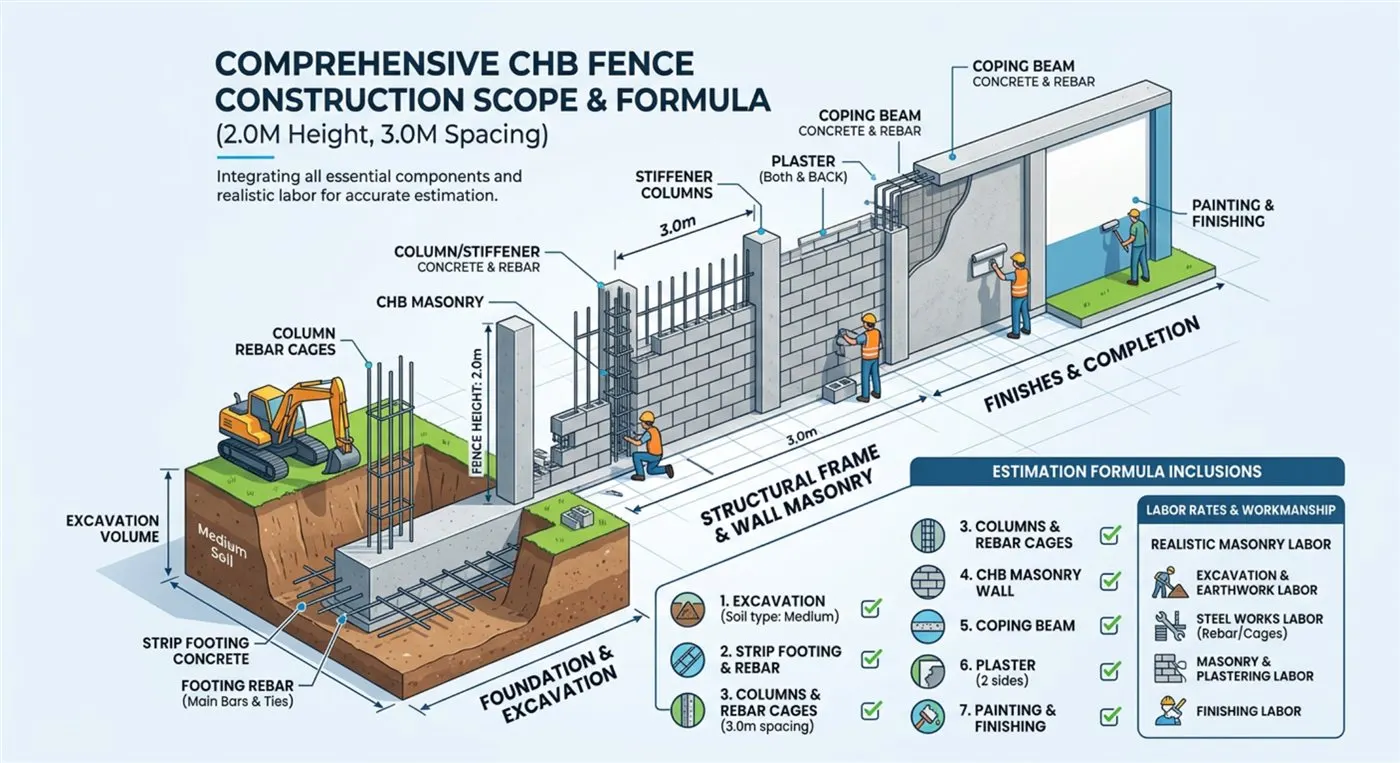
Every component in a real CHB perimeter fence estimate — from AEDO's Unit Cost Analysis engineering model.
Our own CHB wall cost guide puts a 6-inch CHB wall at ₱700–1,050 per square meter — but that figure is for a wall built as part of a house or building, where the structure above and below (grade beam, tie beam, slab) already carries the lateral load. A perimeter fence has none of that. It stands alone against wind, and in the Philippines, that means it needs its own foundation and periodic reinforced concrete columns — not just blocks and mortar.
It's also why fences are specced in 6-inch (150mm) CHB, not the 4-inch (100mm) block commonly used for house partitions or light exterior walls — AEDO's own Unit Cost Analysis engineering model, which computes full material and labor takeoffs for this exact activity, specs 150mm as the fence standard. Skip the columns and footing to save money, and you get the fence that ends up in the news every typhoon season: a long, unbraced block wall that topples in one piece because nothing was tying it down or breaking up its span.
| Component | Cost per linear meter |
|---|---|
| Strip footing (reinforced) | ₱450–650 |
| CHB blockwork (1.5m height × ₱700–1,050/m²) | ₱1,050–1,575 |
| RC columns (200×200mm, spaced ~3m o.c., amortized) | ₱600–870 |
| Concrete coping cap | ₱150–250 |
| Total, bare/unplastered | ₱2,250–3,342/lm |
| Component | Cost per linear meter |
|---|---|
| Strip footing (larger, for added height) | ₱500–700 |
| CHB blockwork (1.8m height × ₱700–1,050/m²) | ₱1,260–1,890 |
| RC columns (taller, more concrete + rebar) | ₱650–950 |
| Concrete coping cap | ₱150–250 |
| Total, bare/unplastered | ₱2,560–3,790/lm |
Cement plastering (materials + labor, per our plastering cost guide) runs ₱150–300 per square meter, per side. On a fence, both faces are typically plastered for a finished look, which adds:
| Fence height | Plaster addition (both sides) | New total per linear meter |
|---|---|---|
| 5ft (1.5m) | +₱450–900 | ₱2,700–4,242/lm |
| 6ft (1.8m) | +₱540–1,080 | ₱3,100–4,870/lm |
For a boundary marker or agricultural/lot perimeter where a solid wall isn't required, a cyclone wire fence is the standard lower-cost option in the Philippines. Instead of concrete blockwork, the structure is GI pipe posts set in concrete footings, cyclone (chain-link) wire mesh, a top rail, and barbed wire strands along the top for security.
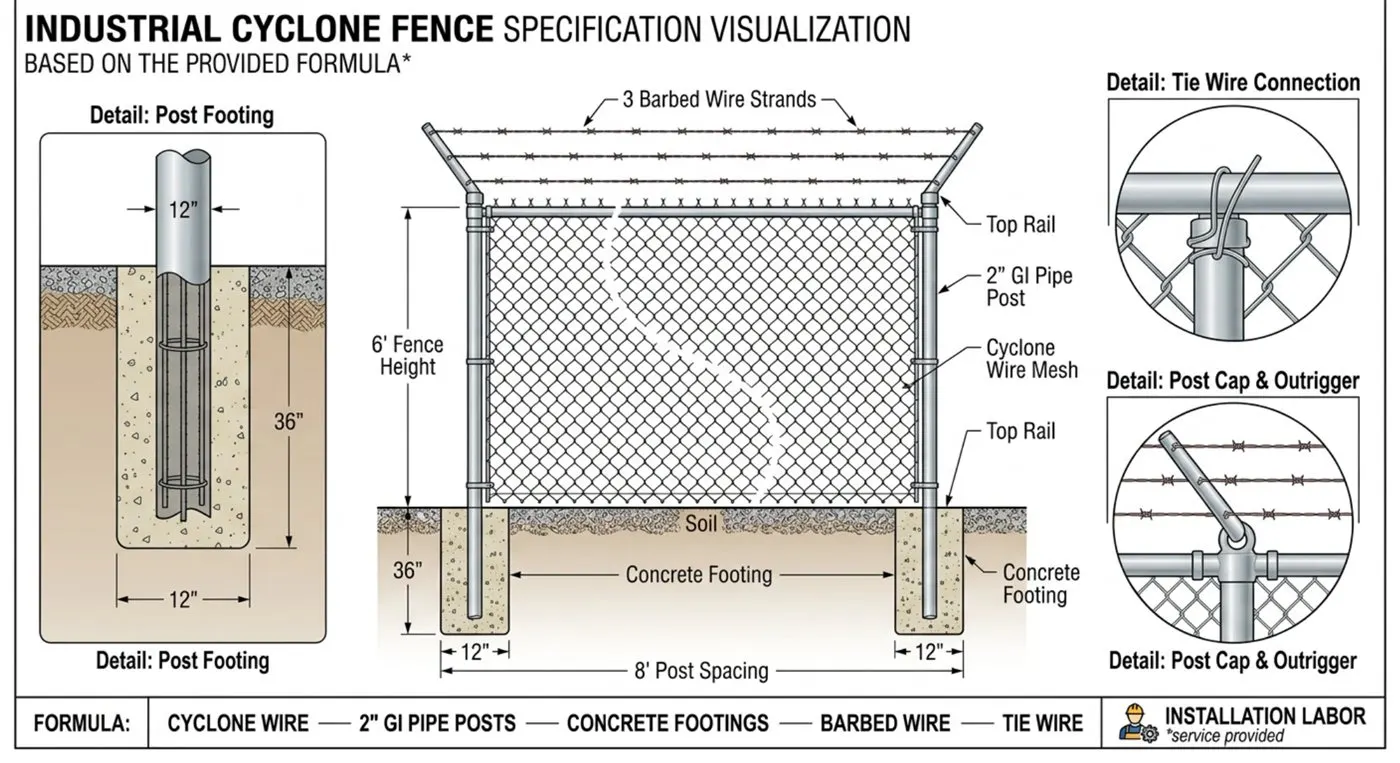
Cyclone wire fence components, per AEDO's Unit Cost Analysis engineering model.
| Component | Notes |
|---|---|
| Cyclone wire mesh, GI pipe line posts + top rail | Scales with height and post spacing |
| Concrete post footings | One per post, spaced ~3m o.c. |
| Barbed wire (3 strands) + tension wire + caps/clamps | Standard security top detail |
| Total, materials + labor | ≈₱950–1,250/lm |
That's roughly a third of the cost of an equivalent 6ft CHB fence — the trade-off is no privacy, no solid barrier against foot traffic or debris, and a shorter typical service life before posts or mesh need replacement. Use it for lot boundaries, agricultural perimeters, or temporary/interim fencing rather than a security or privacy wall.
Want exact material quantities for your specific fence length instead of a per-linear-meter rate? Use the calculator below, the free CHB Quantity Estimator, or contact AEDO for a full structural takeoff.
Enter your fence length, height, and spacing for an indicative cost range — CHB or cyclone wire.
The CHB figures above are AEDO's own engineering cost model, built on the same material and labor rate basis as our published CHB wall and plastering guides, cross-checked against our Unit Cost Analysis app's Perimeter Fence Construction activity. The cyclone wire figure is computed directly from that same activity's material and labor formulas. Actual cost depends on soil condition (footing size may need to increase on soft ground), gate allowances, and finish level. Always get a written, itemized quote — and for CHB, confirm your fence design includes columns, not just blocks — before committing to a budget.
Height
The single biggest lever for either fence type — every additional foot of height adds blockwork or wire mesh, taller posts or columns, and a larger footing. Confirm your target height against any HOA or subdivision rules before pricing.
Post / Column Spacing
Closer spacing (e.g. every 2m instead of 3m) increases cost but improves wind resistance for CHB, and rigidity for cyclone wire — worth discussing with your engineer for exposed or typhoon-prone sites rather than defaulting to the widest spacing quoted.
Soil Condition
Soft or filled ground needs a wider or deeper footing than the standard figures above — this is one of the most commonly underestimated cost drivers on fence projects built on reclaimed or newly-filled lots.
Gates
A steel gate (pedestrian or vehicular) is priced separately from the fence run itself and varies widely by size and material — get it quoted as its own line item, not folded into the per-linear-meter fence rate.
How much does a CHB perimeter fence cost per linear meter?
Roughly ₱2,250–₱3,342/lm bare at 5ft height, or ₱2,560–₱3,790/lm at 6ft, using the 6-inch CHB standard for free-standing fences. Plastered both sides, ₱2,700–₱4,870/lm depending on height.
How much does a cyclone wire fence cost per linear meter?
Roughly ₱950–₱1,250/lm at 6ft height — about a third of an equivalent CHB fence, since it needs far less concrete and masonry.
Why 6-inch CHB instead of 4-inch for a fence?
A fence is free-standing with no beam or slab bracing it, so it needs a thicker block to resist wind load on its own — AEDO's own cost engine specs 6-inch (150mm) as the fence standard.
What's the standard fence height in the Philippines?
5ft (1.5m) and 6ft (1.8m) are the most common. Check local HOA or zoning rules before finalizing height.
AEDO's design-build service covers structural design and construction of perimeter fences — CHB or cyclone wire, footing, columns, and blockwork — under one contract, for projects located in Negros Oriental. For projects elsewhere in the Philippines, AEDO provides complete structural design with remote engineering oversight, and can refer you to a vetted local contractor for the actual construction.