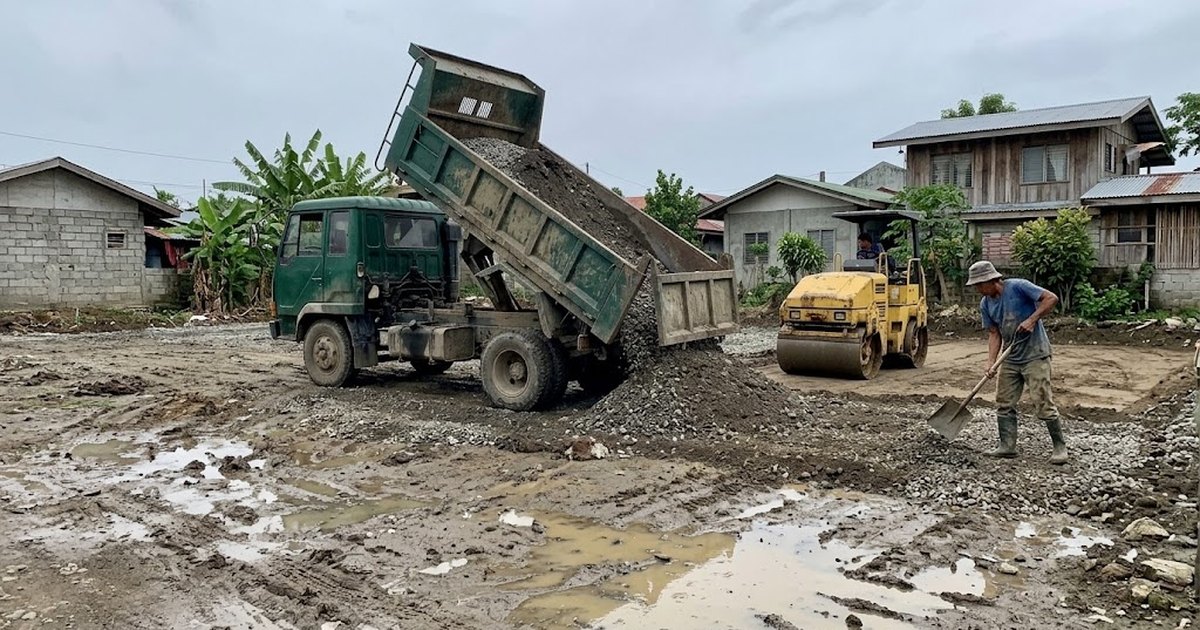
Fill has to be placed and compacted in layers, or the slab settles later. Illustrative photo.
Short answer: for an ordinary residential lot, raising the ground by 30 to 80 centimetres with common fill usually lands somewhere between a few hundred and a couple thousand pesos per square metre of lot area, once material, compaction, and drainage are all counted — and it can jump sharply higher the moment the fill gets tall enough to need a retaining wall. The calculator below does the actual arithmetic for your lot instead of a rule of thumb.
If your lot floods every rainy season, sits visibly below the road crown, or a neighbor's fence line, "just fill it" is usually the right instinct — but it is bought by the cubic metre, and a cubic metre is bigger than most people picture until they've priced one. A 200 sqm lot raised half a metre is 100 cubic metres of finished fill before you even account for what gets lost to compaction. Knowing that number before you buy the lot, not after, is the whole point of this page.
Enter your lot area and how much you need to raise it. This prices the fill material, the placing and compaction, and flags drainage and retaining costs separately — it does not fold them into one number, because they are decided by different things.
The arithmetic has two steps, and skipping the second one is the most common way a fill budget comes in short.
Two materials cover most residential lot-filling jobs, and they are not interchangeable — one is cheaper and compresses more under load, the other costs more and carries a slab better.
| Material | Typical use | Price delivered (₱/m³) |
|---|---|---|
| Common select / gravel fill (sand, select borrow, ordinary gravel) | Bulk raising of yard/landscape areas, areas not directly under a slab or footing | ₱450 – ₱800 |
| Escombro / boulders base course | Structural base under a slab-on-grade, driveway, or where the fill also has to resist settlement under load | ₱900 – ₱1,400 |
On top of the material itself, spreading and compacting it in layers — not just dumping it and grading the top — typically runs ₱180 to ₱320 per cubic metre of finished volume. Skipping this step is the single most common way a filled lot ends up with a cracked slab or a driveway that dips two years later: dumped fill is not engineered fill, no matter how flat the surface looks the day it's placed.
These bands are AEDO's own published 2026 material rates (see Sand & Gravel Price Philippines 2026), cross-checked against several other publicly listed Philippine aggregate price references — actual quotes vary meaningfully by province and by how far the fill has to be hauled from the source, sometimes by a wide margin, so treat these as a planning range to confirm against a local supplier quote, not a fixed national price.
There's no single code table that answers this for a residential lot — it's an engineering judgment made against how much room the lot actually has, not a number you can look up. The working guideline AEDO applies: a fill can usually be sloped back at roughly 1.5 horizontal to 1 vertical and still sit inside an ordinary urban lot boundary while it's a low rise. Once the fill needed at a boundary or against a structure runs to roughly a metre or more with no room for that slope, a sloped edge simply doesn't fit inside the property line anymore — at that point a retaining wall, or riprap slope protection where a wall isn't needed structurally, is usually the only way to hold the fill without spilling onto the neighbor's lot or undermining the platform you just built. Retaining wall pricing by height band is in our Retaining Wall Cost Philippines 2026 guide, and the calculator above pulls from the same bands.
This is the part that gets skipped most often, and it's the reason "just raise the lot" can quietly create a worse problem than the one it solved. Raising your lot above a flooding street or a neighbor's yard doesn't make the water disappear — it changes where it goes, and if that's not designed on purpose, it usually goes wherever is now lowest, which can be a neighbor's property line, your own driveway low point, or straight back against your new foundation wall during the next downpour. A filled platform still needs a drainage line graded to an actual outfall, sized for the roof and paved-area runoff it will now be collecting. Budget roughly ₱900 to ₱1,800 per linear metre for a proper drainage channel along the low side of a filled lot — the calculator includes this as its own line item.
The permit side. Section 304 of the 2004 Revised IRR of PD 1096 lets the Building Official issue a Ground Preparation and Excavation Permit while the building permit application is still being processed — the mechanism that lets earthworks legitimately start early. Local government units commonly require their own earthmoving or fill clearance on top of that, usually tied to the volume being moved, and it's worth checking with your LGU engineering office before trucks start arriving.
Nationwide, AEDO reviews the lot, designs the fill and drainage platform, and specifies compaction requirements a contractor can be held to — plus remote oversight of an earthworks contractor the client hires locally. In Negros Oriental, AEDO designs and self-performs the earthworks, fill and platform construction directly.
How much fill material do I need for my lot?
Multiply the lot area by how much you need to raise it to get the compacted, finished volume. Then add a compaction allowance, because fill delivered loose occupies more space than it does once compacted — Philippine practice typically buys twenty to twenty five percent more loose material than the finished volume calls for. A 100 sqm lot raised 50 cm needs 50 cubic metres finished and therefore roughly 60 to 63 cubic metres delivered.
What does fill material cost per cubic metre in the Philippines?
As of 2026, common select or gravel fill runs roughly ₱450 to ₱800 per cubic metre delivered, while a heavier escombro or boulders base course runs roughly ₱900 to ₱1,400 per cubic metre delivered, both varying by province and hauling distance. Placing and compacting the fill in layers typically adds ₱180 to ₱320 per cubic metre of finished volume on top of the material cost.
When does a filled lot need a retaining wall?
There is no fixed code table for this — treat it as an engineering judgment call. A low fill can usually be sloped back at roughly 1.5 horizontal to 1 vertical and stay inside an ordinary urban lot. Once the fill at a boundary or a structure needs to stand roughly a metre or higher with no room for that slope, a retaining wall or riprap slope protection is usually the only way to hold it without spilling onto a neighbor's property.
Does filling my lot solve flooding by itself?
Not on its own. Raising a lot moves water rather than removing it — fill without somewhere for runoff to go can push flooding onto a neighbor or back onto your own driveway. A filled lot still needs drainage designed into it, and if the ground underneath is soft, the fill itself becomes a surcharge that can keep settling for years.
Do I need a permit to fill or raise a lot in the Philippines?
Earthworks are regulated. Section 304 of the 2004 Revised IRR of Presidential Decree 1096 lets the Building Official issue a Ground Preparation and Excavation Permit while the building permit itself is still being processed, and local government units commonly require their own earthmoving or fill clearance on top of that, usually tied to the volume being moved.
Does AEDO build lot-filling and platform works outside Negros Oriental?
AEDO designs and self-performs earthworks, fill and platform construction directly in Negros Oriental. Outside that province, AEDO's role is the site and platform design plus remote oversight of an earthworks contractor the client hires locally.
Statutes, standards and references used or referred to in this article, linked to their source where a public link exists. Links open in a new tab.
Prices, cost bands and the retaining-wall height threshold in this article are AEDO Construction's own published market and engineering-judgment figures for Philippine site work, stated as such — they are not fixed by any single code table, and a project-specific quote should always be confirmed against a local supplier and, where a retaining structure is involved, an engineer's design.
A site visit tells you the real depth of fill needed, whether the ground underneath can carry it, and whether a retaining wall is actually required — before you commit to a truck order.