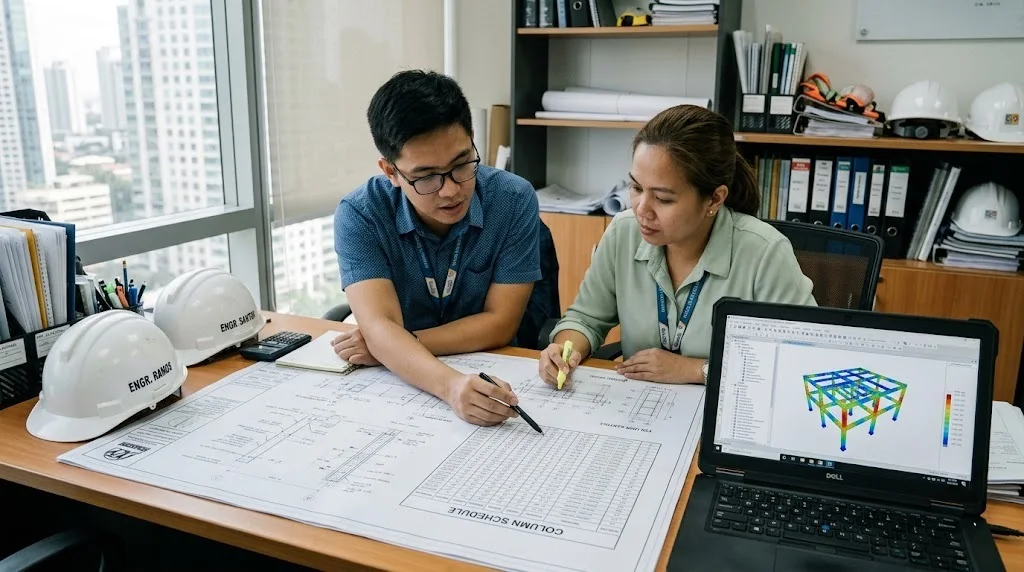
This is what the fee actually buys: an analysis model behind every member size on the drawings, a column schedule that came out of it, and computations a Building Official will accept.
Short answer: no Philippine law sets an engineering fee. RA 544, the Civil Engineering Law, regulates who may practise, how they register, and that plans must be sealed. It contains no fee schedule at all — its only mentions of money are the examination and registration fees payable to the Board. What everybody quotes instead is a professional association's guideline, and the version circulating online fails its own arithmetic.
The PICE Schedule of Minimum Basic Fee sets the civil engineer's fee as prime professional at 6, 7 or 8 per cent of construction cost depending on the complexity of the structure. But it also says that where the engineer is not the prime professional and renders basic civil engineering services only, the fee is a minimum of 25% of the prime professional fee. That is the number that applies when a structural engineer works under an architect — which is most residential and commercial projects in the country.
Before any percentage, it is worth being precise about where the obligation comes from, because owners are frequently told that a fee is "required by law."
| Source | What it does | Does it set a fee? |
|---|---|---|
| RA 544 — Civil Engineering Law | Defines the practice of civil engineering, regulates registration, requires a seal on plans and specifications | No |
| PD 1096 — National Building Code | Requires signed and sealed plans and computations to support a building permit | No — it sets government fees, not professional fees |
| PICE Schedule of Minimum Basic Fee | An association guideline, widely used as a reference in negotiation | It proposes one. It is not a statute |
RA 544 Section 2(a) defines civil engineering services to include "consultation, design, preparation of plans, specifications, estimates, erection, installation and supervision of the construction" of buildings and fixed structures. Section 14 requires a registered civil engineer to obtain a seal, and requires plans and specifications prepared by or under their direct supervision to be stamped with it. That seal is the thing your Building Official is checking for.
The same distinction applies on the architectural side, where the 2010 Standards of Professional Practice are the supplemental implementing rules of RA 9266 — and, as we found when writing our house design fee guide, even that document does not print a percentage in the section everyone cites for one.
The Arithmetic Error in the Version Everyone Copies
Two versions of the Group I schedule circulate. Both agree the fee is 6% up to ₱10M, and both agree the bracket bases are ₱600,000 at ₱10M, ₱1,150,000 at ₱20M and ₱1,600,000 at ₱30M. They disagree on the marginal rates — one says 5 / 4 / 3 per cent, the other 5.5 / 4.5 / 3.5.
Only one of them can be right, and the schedule settles it against itself. Starting from ₱600,000 at ₱10M, a 5% marginal rate reaches ₱1,100,000 at ₱20M — not the ₱1,150,000 the same table prints. A 5.5% rate reaches ₱1,150,000 exactly. The same test on Groups II and III confirms 6.5 / 5.5 / 4.5 and 7.5 / 6.5 / 5.5.
The widely-copied 5 / 4 / 3 version is wrong, and it understates the fee in every bracket above ₱10M. The tool below uses the self-consistent figures.
Applies the PICE Schedule of Minimum Basic Fee brackets to your project, including the 25% rule for engineers who are not the prime professional. Enter the construction cost if you know it, or let the tool derive one from floor area. This is a reference figure for negotiation, not a quotation and not a legal minimum.
These are the self-consistent figures, expressed the way the schedule expresses them — a base amount at the start of each bracket plus a marginal rate on the excess.
| Construction cost | Group I 1–2 storeys, sheds, warehouses, market buildings | Group II 3–14 floors, towers, tanks, industrial | Group III 15+ floors, complex bridges, dams, power plants |
|---|---|---|---|
| ₱10M and less | 6% | 7% | 8% |
| Over ₱10M to ₱20M | ₱600,000 + 5.5% | ₱700,000 + 6.5% | ₱800,000 + 7.5% |
| Over ₱20M to ₱30M | ₱1,150,000 + 4.5% | ₱1,350,000 + 5.5% | ₱1,550,000 + 6.5% |
| Over ₱30M | ₱1,600,000 + 3.5% | ₱1,900,000 + 4.5% | ₱2,200,000 + 5.5% |
| Not the prime professional, basic civil engineering services only — minimum 25% of the prime professional fee | |||
Percentages apply to the amount in excess of the bracket floor, not to the whole cost. And note the shape: the rate falls as the project grows, because the effort does not scale linearly with the contract value.
Honestly: the brackets are consistent across every copy we could find and they pass their own internal arithmetic test, which is a meaningful check. But we could not obtain a primary copy from PICE itself — the schedule circulates as extracts from the Manual of Professional Practice, undated. So treat it as a benchmark both sides of a negotiation recognise, and not as a current tariff. It is also not enforceable as a price floor. If a figure on this page matters to a contract you are signing, ask PICE or your engineer for the source document rather than citing us.
Run the estimator on a ₱3M house as a structural sub-consultant and the schedule produces about ₱45,000. That is at or below what a sealed structural design can realistically be delivered for, and the reason is structural rather than commercial.
The work does not scale with the contract value. A two-storey house and a two-storey house costing twice as much need the same load takedown, the same seismic analysis under NSCP Section 208, the same wind check, the same foundation design against the same soil data, and the same drawing set. The expensive house has bigger members on the schedule; it does not have more thinking in it.
Which is why almost every residential structural engagement in the Philippines is quoted as a lump sum, with the percentage schedule used only to sanity-check whether the lump sum is reasonable.
A structural fee is a low single-digit percentage of a build. The design it buys decides a much larger number. Three ways the saving comes back:
Everything above prices a new design. Checking a building that already stands is a different job, and it is priced differently: by visit and report, not as a percentage of construction cost.
Our structural assessment is ₱5,000 flat. A licensed engineer inspects the building on site, evaluates it against NSCP 2015, and gives you a written report within 5 business days. Most houses and small buildings stop there.
When the report needs proof of what is inside the concrete, that becomes a structural investigation with testing. Our 2026 practice bands, excluding access equipment and out-of-town mobilisation:
| Item | Band |
|---|---|
| Concrete core extraction and compression test, per core | ₱3,500 – ₱8,000 |
| Rebound hammer survey, per visit | ₱8,000 – ₱20,000 |
| Rebar locating before drilling, per visit | ₱6,000 – ₱15,000 |
| Written engineering evaluation of test results | ₱25,000 – ₱90,000 |
A rebound hammer on its own cannot pass or fail concrete; our core testing guide explains why cores decide.
Two structural quotations are only comparable if both answer these. Ask in writing:
If you are on the other side of this — a firm buying structural capacity rather than an owner buying a design — our outsourced structural engineering and drafting cost pieces cover how that is priced, and what goes wrong covers why the cheapest hour is rarely the cheapest project.
The statement that no fee is set in law comes from the text of RA 544, the Civil Engineering Law — Section 2(a) defines the practice, Section 6 sets the examination and registration fees payable to the Board, Section 14 requires the seal on plans and specifications, and Section 23 requires public structures to be designed under the responsible charge of a registered civil engineer. There is no fee schedule anywhere in it. The percentage brackets are the PICE Schedule of Minimum Basic Fee from the Manual of Professional Practice, reproduced here in the form that reproduces the schedule's own bracket bases; we could not obtain a primary copy and say so above. The architectural comparison is the 2010 Standards of Professional Practice, the supplemental IRR of RA 9266, covered in our design fee guide. Inclusions and exclusions are ordinary practice, not code.
How much does a structural engineer charge in the Philippines?
There is no legal rate. Republic Act 544, the Civil Engineering Law, regulates practice, registration and the sealing of plans, and sets no professional fee schedule at all. What circulates is the Philippine Institute of Civil Engineers Schedule of Minimum Basic Fee, which is an association guideline. It prices the civil engineer as prime professional at six per cent of construction cost for simple structures up to ten million pesos, seven per cent for buildings up to fourteen floors, and eight per cent for complex structures, with the percentage stepping down in higher brackets. Where the engineer is not the prime professional and renders basic civil engineering services only, the schedule sets a minimum of twenty five per cent of the prime professional fee.
Is the PICE fee schedule mandatory?
No. It is a professional association's published guideline, not a statute and not a regulation issued under one. RA 544 contains no fee provision, and its only mentions of money are the examination and registration fees payable to the Board. Treat the schedule as a reference point that both sides recognise, useful for sanity-checking a quotation, rather than as a price you can be compelled to pay or a floor a competitor can be held to.
What is the difference between the architect's fee and the structural engineer's fee?
They are separate fees for separate services, governed by separate professions. The architect's fee covers the architectural design and, under the 2010 Standards of Professional Practice issued as the supplemental implementing rules of RA 9266, the architect engages and pays consultants only where the agreement says so. The structural engineer's fee covers the analysis, the member design, the structural drawings and the computations that carry the engineer's seal. Where the engineer works under the architect rather than directly for the owner, the PICE schedule sets the fee at a minimum of twenty five per cent of what the prime professional fee would have been.
What does a structural engineering fee include?
At a minimum it covers the structural analysis, the design of the members, the structural drawings, the general notes and specifications, and the computations, all signed and sealed. What is conventionally outside it is what catches people out. The lot survey and the soil investigation are the owner's cost and the owner's risk. Permit filing, government fees, printing beyond an agreed number of sets, site visits beyond an agreed number, and redesign caused by a change of brief after the design is fixed are all normally chargeable separately, and value added tax is usually on top.
Why is a cheap structural fee expensive?
Because the fee is a fraction of the construction cost and the design decides the construction cost. A structural design fee on a residence is typically a low single digit percentage of the build, while a conservatively oversized frame can add far more than that to the concrete and steel alone. A fee saving bought by skipping the analysis, reusing a schedule from another building, or designing without a soil investigation is recovered from the owner in material, in redesign at plan check, or in a structure that does not do what it was assumed to do.
Do structural plans have to be signed and sealed?
Yes. Section 14 of RA 544 requires a registered civil engineer to obtain a seal, and requires that plans and specifications prepared by or under the direct supervision of a registered civil engineer be stamped with that seal. The seal is also what a Building Official is checking for when a structural set is submitted with a building permit application, and a set of structural drawings with no computations behind it is one of the most common reasons an application is returned.
Statutes, codes, official tools and references used or referred to in this article, linked to their source. Links open in a new tab.
Prices, cost bands and rate figures in this article are AEDO Construction's own market and practice figures for Philippine work unless a source is named beside them. Code and statute references above link to the primary text.
We quote structural design as a lump sum against a written scope, so you know what the drawings include before you commit.