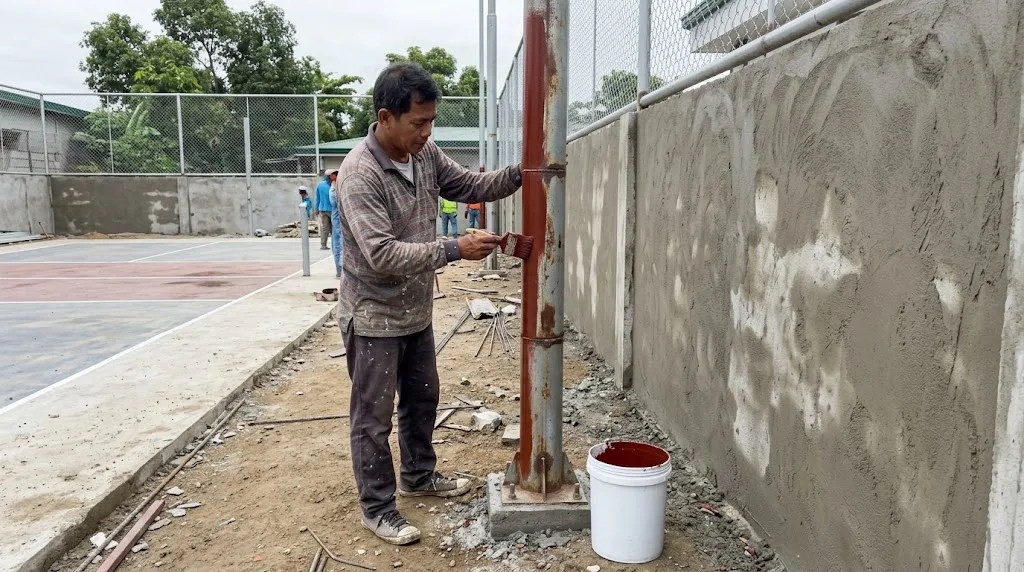
Red-oxide primer on a steel pole beside a newly plastered block wall. Two surfaces, two different paint systems, and two different ways to fail. Illustrative photo.
Short answer: a pickleball court is mostly not the slab. Around the playing surface you have block walls, steel fence posts and rails, net posts, perhaps light poles and, on a covered court, a roof, and each one wants a different paint system. On new plaster the data sheets we read ask for dry, low-alkali masonry, not a day count. On black steel they ask for a prepared surface, a primer and a topcoat built up to a film thickness, with the edges, welds and bolts getting extra. Galvanised steel needs a different primer or none. A roof can be bought already painted, which usually beats recoating it. For the calculator's default case (69 m of 0.75 m wall plus a 2.44 m chain-link fence on 24 steel posts and four net posts, open court), AEDO's own Canlaon unit rates give about ₱12,700 all-in for about 52 m² of wall and 30 m² of steel, before contractor overhead, profit and VAT. Those rates come from a roof estimate (concrete columns and roof steel) and are applied here to a plastered wall and to fence pipe, so read the figure as a floor, not a price. That is small money next to the slab, which is the reason to ask for it as its own line in a quotation.
AEDO designs and checks nationwide and builds only in Negros Oriental. If your court is in Dumaguete, Bais, Sibulan, Tanjay, Canlaon, Manjuyod, Bayawan or anywhere else in the province, the paint specification for the walls, steel and roof can be written into one design-build contract, or priced as construction from your plans. Elsewhere in the Philippines we do the complete design, review the quotations and check milestones on the contractor you hire. This post covers everything around the slab; the paint on the slab itself is in our court paint types guide and the surface options guide, why coatings fail is in the peeling and blistering guide, when the court can be painted is in the painting schedule guide, and the lines are in the line marking guide.
Enter the wall run, the fence, the steel posts and any roof. You get the areas, the litres to buy from published data-sheet coverage, and an all-in cost from AEDO's own Canlaon unit rates. An elevation drawing of the enclosure redraws from your inputs. A planning estimate, not a quotation and not a paint specification.
Drawn from the wall height, fence height, post spacing, net post and roof you entered. The numbered tags match the key below and the rows in the estimate.
Planning sketch, not for construction. Heights are exaggerated against the side length (the key says by how much) and the roof height is nominal. Post sizes, footings, rail details, fence fabric, wind bracing, roof columns and roof height are per design. The net post is drawn at the middle of the side, where the net line meets this side. Light poles are not drawn.
The table is the whole post in one place. The sections after it explain each row and say which parts are sourced and which are our reading. Product names are the ones whose data sheets we read; we are not recommending a brand, and AEDO is not a paint supplier and has no agreement with any brand named here.
| Surface | What the sheets we read ask for | Source | AEDO record |
|---|---|---|---|
| Plastered block wall | Clean, dry, pH below 10, moisture within the sheet limit, no painting below 5 °C, above 85% humidity or with rain expected. Boysen: 14 to 28 days for new concrete. Sealer or primer, then topcoats. | Nippon Paint (Hong Kong) sealer and Weatherbond sheets; Boysen Permacoat and Acrytex pages | Canlaon K.1: concrete columns, neutraliser, primer, 2-coat acrylic latex, ₱144.87 per m² |
| Black steel posts, rails, frames, trusses | Clean and prepare the steel (Jotun recommends Sa 2½ blast, minimum St 2), prime, build the film, finish. Brush an extra coat on edges, welds and bolts. | Jotun Penguard Express MIO sheet; Hempel edge-coating guideline; Boysen B-310 and Quick Drying Enamel pages | Canlaon K.2: steel, red-oxide primer and enamel, ₱172.10 per m²; specification: wire-brush, shop and field primer coat |
| Galvanised posts and fence frames | A paint made for zinc, a prepared surface; new zinc is etched, zinc weathered 6 months or more is not (Boysen). | American Galvanizers Association; Boysen Roofgard and B-310 pages; Jotun sheet | No AEDO paint rate for galvanised steel |
| Roof sheets | Buy them pre-painted, or recoat: etch new galvanised, wire-brush and prime rust, two topcoats of roof paint. | Boysen Roofgard and Cool Shades pages | Canlaon: 0.6 mm pre-painted rib-type roofing, ₱737.94 per m² all-in; no field paint on the sheets |
| The court slab | A separate system, covered in our other posts. | ASBA and USA Pickleball manual (2020) | Manjuyod: painting ₱221.64 per m² of pad |
New cement plaster is alkaline, and a damp block wall pushes paint off from behind. The sheets we read deal with that in two different ways.
Read together, the practical test for a new wall is a moisture and pH reading with the product's limits in hand, not the calendar. AEDO practice, not a sourced rule: in the Manjuyod job plan the plastering is done after the floor pour so the finish is not wrecked by the fill operation and the delivery truck; the plan puts plaster on the outer face above ground only, 52.06 m² of block face plus 5.48 m² of beam face. (The plan's own wall table, 32.58 m at 0.70 m and 36.56 m at 0.75 m above ground, multiplies out to about 50.2 m², so the 52.06 includes something the table does not show; we have not resolved the difference.) The proposal we read has no separate paint line for that wall, and the painting line (Item F) is for the court slab.
Coverage. Boysen gives 25 to 30 m² per 4 L as a primer and 30 to 35 m² per 4 L as a topcoat for Permacoat flat latex, at 1.4 to 1.7 mils, and says the figure depends on surface texture and porosity. Nippon Hong Kong gives 12 m² per L for the sealer, and 10 m² per L per coat at 30 µm for Weatherbond. Plaster is rough and thirsty, so the calculator starts at the low end of each range. Primer and topcoat times are short (Boysen flat latex: touch dry 30 minutes, recoat 1 hour at 25 °C and 50% humidity; Weatherbond overcoat 2 hours at 25 °C, full cure 7 days), so the wall is not what holds up the programme.
A wall that holds back fill is wet from behind. A court raised on fill, like Manjuyod, has block walls with soil on one side. Paint on the exposed face will not stop water coming through from behind, and our damp wall guide explains why a fresh coat over an active moisture source often peels again within a rainy season. Find and stop the water first; our waterproofing guide prices an external wall coating at ₱530 to ₱720 per m², which is a different job from a paint coat. The plaster itself is priced in the CHB and plastering guide, and a free-standing perimeter wall in the CHB perimeter fence guide.
On masonry the paint is mostly a finish. On steel it is the rust protection, and what decides how long it lasts is what you cannot see once the job is done: the preparation, and the film thickness.
What AEDO's Canlaon record says. The Canlaon roof estimate prices the steel surfaces (truss, purlins, bracing and base plates) at 481.85 m² and ₱172.10 per m² all-in for red-oxide primer and enamel, and the concrete columns at 170.80 m² and ₱144.87 per m² for neutraliser, primer and a 2-coat acrylic latex. Those are the two rates the calculator uses. They are unit rates in an estimate that excludes VAT, contractor overhead and profit, and they were built for large, open areas (columns, trusses, purlins). Thin pipe posts, rails and fittings with edge coats take more hand work per m², so a contractor's quotation on your court will likely come in higher; treat them as a floor for planning, not a market price. Our steel fabrication guide converts the same rate to about ₱12 per kg for angle sections.
Maintenance is part of the system. The manual tells owners to touch up nicks and scratches on coated net posts as soon as they occur, and to examine fence posts at the footings for deterioration of the coating and patch where needed. It also warns that a rusting portable net frame left on the court may stain the court surface. For the cost of repainting a rusted roof frame and when it is no longer a paint job, see our rusty roof truss and purlin guide.
The manual describes most court fencing as a vinyl, polyester or polyolefin coated frame with matching coated mesh, says coated fencing usually costs more than galvanised but has long-term benefits, and says to consider coated materials where pollution is high or the court is close to salt water. As a saving it allows a galvanised frame and fabric, or coated fabric on a galvanised frame, and says the galvanised frame can be painted to match the vinyl fabric. It sets the standard mesh at a 2 in diamond, most often 9 gauge, and says a 7 to 8 ft fence is commonly used for most courts. It also says that if windscreens will be attached to the fence frame, the fencing should be engineered for wind loads by a professional engineer (printed page 64), which matters before any post size in the calculator is trusted.
On a covered court the roof is the largest painted surface, and the cheapest way to deal with it is usually not to paint it: pre-painted sheets are available. AEDO's Canlaon roof estimate prices 0.6 mm pre-painted rib-type roofing at ₱737.94 per m² all-in, including flashings, ridge, screws and insulation, and has no paint line for the sheets; its painting items cover only the steel and the concrete columns. Choosing the colour when you buy the sheet is a decision, not a paint job. The structure under it is in our covered court roof guide.
If you recoat. Boysen's Roofgard page describes a gloss, water-based acrylic roof paint for galvanised iron, pre-painted galvanised sheets and unglazed roof tiles, at 30 to 35 m² per 4 L at 1.4 to 1.7 mils, recoat after 2 hours at 25 °C and 50% humidity, with at least 2 coats, a VOC of 12.3 g/L, and the same new-zinc etch and rust preparation as above. Painting a rusted roof is a repair question first: if the purlin lips are gone, paint is not the fix, and our rusty roof guide shows how to measure what is left.
Cool-roof paint: what the maker says and what independent sources say. Boysen's Cool Shades page says a film with infrared-reflecting pigments stays cooler because it reflects infrared light before it turns into heat, and gives no reflectance number on the page we read. We did not find an independent rating for that product. The independent sources we read describe the physics and the limits:
Our reading, which is reasoning and not a measured Philippine result: an open-sided pickleball roof has no air conditioning, so the "up to 15%" figure does not apply. DOE says a cool roof can make a non-air-conditioned building more comfortable but gives no figure, so how much cooler the court feels is unquantified here. A reflective colour on new sheets is cheap to choose; paying to recoat a sound roof for it is the case DOE says is rarely economical. A coat of paint is also not the cure for a roof that drips on cool nights; our condensation guide covers what is.
If your court is near the sea, salt changes what a paint job has to do. We did not classify any particular site, and the standard that does the classifying, ISO 12944, is a paid document that we have not read. What we read is vendor summaries of it. The older extract labels its example environments as typical of a temperate climate, so neither sheet classifies a Negros Oriental site:
The practical use is a question for the painter: which corrosivity category and durability range is this system meant for, and where is that written? The manual's own advice for fencing is to consider coated materials near salt water or heavy pollution. Humidity matters on the day too: Nippon's limit is 85% relative humidity, and Jotun's topcoat sheet asks for a substrate 3 °C above the dew point. Our condensation guide works out dew points from PAGASA station data, and the same arithmetic tells you whether a steel member is too cold to paint at dawn.
The manual says nothing about the colour of a painted block wall. What it says is about windscreens, the screens hung on the fence: for the best ball visibility the darker the windscreen the better, with black or dark green preferred, and a windscreen reduces sun glare off chain-link fencing and posts. Glare from the light fixtures is a separate subject, covered in our lighting guide along with the poles; the manual recommends light poles be centred on or immediately outside the fence or court.
Our reading, labelled as common practice and not a sourced finding: a matte mid or dark colour behind the baselines is a calmer background for the ball than a bright white wall in full sun, and posts and fence frames in a dark coated finish cut the glare the manual mentions. A bright wall is fine on the sides, away from where players look. The manual also notes some manufacturers offer poles with baked-on polyester or vinyl finishes in colours matched to net posts and fencing, which is an option when you would rather not paint poles on site.
Every line can be checked by hand. For the default case:
The default case is not the Manjuyod job. It borrows the Manjuyod wall run, but the proposal we read excludes nets and fencing and its painting line is for the slab. The fence on 24 posts and the four net posts are our additions so the steel rows have something to show.
What AEDO does. We design, check and review structures nationwide and build only in Negros Oriental. Inside the province the paint specification for walls, steel and roof can sit inside a design-build or a construction contract. Elsewhere we do the complete design (₱250 to ₱450 per sqm) and can review a painter's specification and quotation remotely, and a Single Milestone Check (from ₱7,500 per visit, one site visit tied to a milestone you choose; the services page lists foundation, columns and roofing as examples) can be pointed at the steel before the primer goes on. If a wall is cracked, that is a structural question: the structural assessment is ₱5,000 flat for a site visit and written report. There is no AEDO painting price beyond the Manjuyod contract line already published; we quote painting after a plan review or a site visit. AEDO is not a paint supplier and has no agreement with any paint brand: Nippon is named only as the system used on one AEDO job and as the source of a data sheet.
Before you accept a quotation for the enclosure:
Product facts, read this month: Boysen Philippines product pages for Permacoat Latex, Acrytex, Red Oxide Metal Primer B-310, Quick Drying Enamel, Roofgard and Cool Shades; Nippon Paint (Hong Kong) data sheets for its alkaline-resistant exterior wall sealer (issue mark UD12092025) and Weatherbond (these are Hong Kong sheets; Philippine availability and local formulation were not verified); Jotun data sheets for Penguard Express MIO (22 March 2021) and Penguard Topcoat (March 2005, Jotun Saudia), as hosted on retailer sites; Cloverdale's ISO 12944 systems guide and an extract of the standard's categories; Hempel's edge-coating guideline (May 2020) and KTA's note on edge coating; the American Galvanizers Association pages on painting over galvanised steel; the US Department of Energy cool roof guide, the Lawrence Berkeley National Laboratory cool roofs page and the Cool Roof Rating Council home page. Court and fence facts: ASBA and USA Pickleball, Pickleball Courts: A Construction and Maintenance Manual, 2020 edition (printed pages 5, 6, 63 to 65, 76, 83, 86, 112 and 113); the 2026 USA Pickleball Official Rulebook, Section 3, rule 3.A.3 (read on the Pickleball Canada copy) for the 60 ft minimum playing-surface length. AEDO records: the Canlaon roof estimate (items I, K.1 and K.2), the Manjuyod job plan (geometry, plaster areas, painting item F) and proposal, and the sibling guides linked in the text. What we could not do: read ISO 12944, ASTM D6386 or ISO 8501-1 (paid standards: we read vendor and association summaries only); open usapickleball.org's own copy of the 2026 rulebook; find a Philippine price for steel primers, enamels or roof paint; or find an independent rating for any cool-roof paint. Our own, with no source: 10% wastage; post spacing 3.0 m; fence post 60 mm diameter and net post 75 mm (the manual's maximum is 76.2 mm); light pole 100 mm diameter; net post painted height 1.0 m; using the low end of each coverage range; using the Canlaon concrete rate for plaster and the steel rate for galvanised steel painted over; the default fence, which Manjuyod did not have. The Canlaon rates exclude VAT, contractor overhead and profit and sit before that estimate's 3.2% provisional labour correction.
How long should new plaster cure before I paint a court wall?
Boysen's Philippine product pages for Permacoat Latex and Acrytex say to let new concrete dry for 14 to 28 days under normal weather before painting, and the Permacoat page says no neutraliser is needed after 28 days. Nippon Paint's Hong Kong data sheets for its exterior wall sealer and Weatherbond give limits to measure instead of a day count: pH below 10, moisture inside a stated Protimeter limit, no painting below 5 degrees C or above 85 percent humidity, and none when rain is expected while the paint dries. So the safer test for a new wall is a moisture and pH reading against the product's own limits, not the age of the plaster alone.
What paint goes on steel court posts, net posts and fence frames?
For black steel, the data sheets we read ask for a prepared surface, a rust-inhibiting primer and a finish coat, built to a stated film thickness. Boysen's pages pair Red Oxide Metal Primer B-310 with Quick Drying Enamel for the 2nd and 3rd coats, and AEDO's Canlaon roof specification calls for wire-brushing, one shop and one field coat of red-oxide or epoxy primer, then finish coats. Industrial epoxy systems such as Jotun's Penguard Express MIO recommend a blast-cleaned surface (Sa 2.5, minimum St 2) and film thicknesses of 75 to 250 microns per coat. Ask the painter which preparation grade, how many coats and what film thickness the price assumes, and whether edges, welds and bolts get a edge coat.
Do galvanised fence posts need paint?
Not to start with, because the zinc is the protection, and the calculator has an option that leaves galvanised posts unpainted. Painting over zinc, called a duplex system, is done for colour matching or extra life, and the American Galvanizers Association says it needs a paint formulated for zinc and a prepared surface. Boysen's pages say new galvanised steel is etched with a 10 percent solution of its Metal Etching Solution B-71, while steel weathered for 6 months or more needs no etching. The ASBA and USA Pickleball manual also says a galvanised fence frame can be painted to match vinyl-coated fabric.
Is cool roof paint worth it on a covered pickleball court?
We could not find an independent rating for the cool-roof paint we read about, and the maker's page gives no reflectance number. The US Department of Energy says a cool roof can cut the air-conditioning energy use of a single-storey building in a warm climate by up to 15 percent, but an open-sided pickleball court has no air conditioning, so that figure does not apply. It says a cool roof can make a building without air conditioning more comfortable but gives no number, and that replacing a sound roof just to raise its reflectance is rarely economical. Berkeley Lab reports that a roof reflecting 80 percent of sunlight stays about 31 degrees C cooler at the surface than one reflecting 20 percent, which is a surface temperature and not a room temperature. Choosing a light colour when you buy pre-painted sheets is the cheap decision; recoating a sound roof for it usually is not.
What colour should the walls and fence around a pickleball court be?
The ASBA and USA Pickleball manual does not give a colour for painted walls. It says that for the best ball visibility a darker windscreen is better, with black or dark green preferred, and that windscreens reduce sun glare off chain-link fencing and posts. Our own reading, labelled as common practice and not a sourced finding, is that a matte mid or dark colour behind the baselines is a calmer background than a bright wall in full sun, and that bright colours are fine on the sides away from where players look.
How much does it cost to paint the walls, fence and posts around a court?
From AEDO's Canlaon roof estimate, painting concrete surfaces with neutraliser, primer and two coats of acrylic latex is 144.87 pesos per square metre and painting steel with red-oxide primer and enamel is 172.10 pesos per square metre, all-in for paint and labour but before VAT, contractor overhead and profit. For the calculator's default case of 69 metres of 0.75 metre wall, a 2.44 metre chain-link fence on 24 steel posts and four net posts, that is about 12,700 pesos. Our tile and painting guide puts an exterior wall system at 290 to 480 pesos per square metre supplied and installed, which is 2.0 to 3.3 times the wall figure above, so treat the Canlaon rates, which were built for roof steel and concrete columns, as a floor. AEDO has no other painting price beyond its published Manjuyod contract line, and quotes painting after a plan review or site visit.
Does AEDO paint courts outside Negros Oriental?
AEDO designs, checks and reviews structures nationwide and builds only in Negros Oriental. Elsewhere in the Philippines we can do the complete design at 250 to 450 pesos per square metre, review a painter's specification and quotation remotely, and do a Single Milestone Check from 7,500 pesos per visit on a contractor you hire. We are not a paint supplier and have no agreement with any paint brand.
Data sheets, guides and project documents read for this article. External links open in a new tab.
We read manufacturer data sheets and association guides, not the standards they cite (ISO 12944, ISO 8501-1, ASTM D6386 are paid documents). Several data sheets are from Hong Kong, Singapore-hosted or older copies, and product formulations and approvals can differ in the Philippines, so ask the supplier for the current sheet. We found no Philippine price for steel primer, enamel or roof paint, no independent rating for any cool-roof paint, and no source for the colour of a painted block wall. This article is general information, not a paint specification and not an engineering design for your court.
Send the wall and fence sizes, the steel type and any quotation. A licensed engineer will tell you what the paint specification is missing, and in Negros Oriental we can price it with the build.