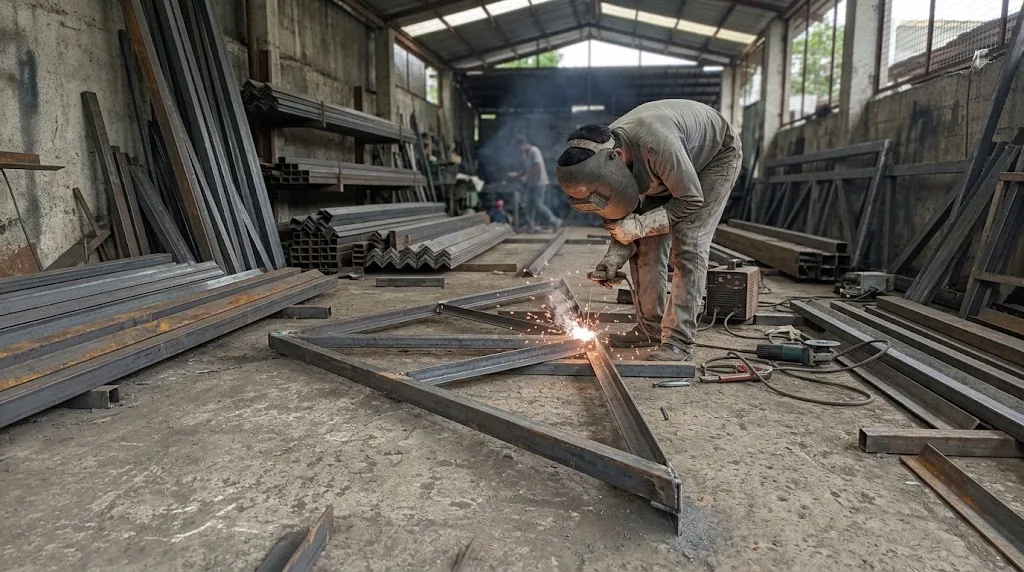
Truss sections laid out flat in the shop, tack-welded and checked before they are welded out, primed and trucked to site. Most of the labour in a steel job happens here, not on the roof. Illustrative photo.
Short answer: contractors price structural steel by the kilogram because steel is bought, cut, welded and lifted by weight. AEDO's 2026 planning range for supply, fabrication and erection is about ₱115 to ₱185 per kg of hot-rolled steel, before paint, VAT and contractor profit (the same band as our pre-engineered steel building guide). Our own roof estimate for seven welded angle-bar trusses, each spanning 19.5 m, works out to about ₱141 per kg for the truss steel, all-in but before paint and contractor profit. Material is the smaller part: retail angle bar prices out at about ₱58 per kg, so the rest, more than half the price, is cutting, welding, priming, hauling and lifting. To use those numbers you need the weight, and the weight is a formula, not a guess: an equal angle weighs (A + B − t) × t × 0.00785 kg per metre. The calculator below takes your member lengths, adds waste, and gives a line-item price. For the truss in our example (about 2,518 kg net, 4.5 kg per m² of plan area) it returns about ₱362,500 erected and painted, or ₱144 per kg.
Below the calculator: how a steel quotation is built up, the weight table, what NSCP 2015 says about fabrication, painting and inspection, and the traps in per-kg quotes.
Enter the total length of each section from your take-off (net, before waste), plus any extra kilograms for plates, beams or purlins. You get the weight, then material, fabrication, coating, erection and hardware at AEDO 2026 planning rates you can change. The defaults reproduce the angle-bar truss take-off of one real AEDO roof, net of its 10% waste.
A steel contractor's per-kg rate is a stack of five things, and a good quotation shows them separately:
Contractor overhead and profit, VAT and the engineer's design are on top of all five. When two quotes differ by ₱30 per kg, the first question is which of these the cheaper one left out.
You don't need a mill catalogue to weigh common shapes. Steel weighs about 7,850 kg per cubic metre, so the weight of a section in kilograms per metre is its cross-section area in mm² times 0.00785. For the shapes this article uses, published supplier formulas reduce to:
Those ignore the small root radius, so results sit slightly under a mill's catalogue figure. As a check, the tube formula gives 6.78 kg per metre for a 100 × 50 × 3 mm tube, which is exactly what the supplier chart we read lists for it.
| Section (mm) | Formula | kg per metre | 6 m piece (kg) |
|---|---|---|---|
| L36 × 36 × 3 angle | (36 + 36 − 3) × 3 × 0.00785 | 1.62 | 9.7 |
| L50 × 50 × 5 angle | (50 + 50 − 5) × 5 × 0.00785 | 3.73 | 22.4 |
| L65 × 65 × 6 angle | (65 + 65 − 6) × 6 × 0.00785 | 5.84 | 35.0 |
| L75 × 75 × 5 angle | (75 + 75 − 5) × 5 × 0.00785 | 5.69 | 34.1 |
| L100 × 100 × 8 angle | (100 + 100 − 8) × 8 × 0.00785 | 12.06 | 72.4 |
| 50 × 50 × 2.0 square tube | 0.00785 × 2 × (100 − 4) × 2 | 3.01 | 18.1 |
| 100 × 50 × 3.0 rectangular tube | 0.00785 × 2 × (150 − 6) × 3 | 6.78 | 40.7 |
| 100 × 100 × 4.0 square tube | 0.00785 × 2 × (200 − 8) × 4 | 12.06 | 72.4 |
Computed by AEDO from nominal dimensions. Rolled I and H beams and cold-formed C-purlins are left out on purpose: their weights depend on the exact profile, so take them from the mill catalogue or the supplier's data sheet and enter them as "extra weight" in the calculator.
Use it to convert retail prices. Our steel vs wood truss guide lists two retail angle-bar prices read on 18 September 2026: 2 in × 5 mm at ₱1,314 per 6 m and 1½ in × 4.5 mm at ₱887 per 6 m. By the formula those pieces weigh about 22.7 kg (50.8 mm legs) and 15.2 kg (38.1 mm legs), so both come to about ₱58 per kg. That's the bare material at retail, and the anchor for the material rate here. Rebar, for comparison, runs ₱37 to ₱47 per kg in our rebar price guide: it's mill product with no cutting or welding.
There's no code table of "kg per m²" for steel roofs, and we don't offer one. The weight depends on span, spacing, wind and the load. What we can give you is one real design, from AEDO's own signed estimate and structural report for a roofed pickleball facility in Canlaon City, Negros Oriental (described in our covered pickleball court roof post).
The truss is an angle-bar truss spanning 19.50 m, one at each of seven frames at 4.95 m centres, over a 29.71 m × 18.80 m roof (558.55 m² of plan area). The chords are L75 × 75 × 5 mm and the webs L36 × 36 × 3 mm, ASTM A36, all joints continuously welded. The estimate's steel take-off, taken from the STAAD model plus 10% cutting waste, counts 64 pieces of the larger angle and 60 of the smaller, 6 m long. Weighing that:
| Step | Working | Result |
|---|---|---|
| L75 × 75 × 5 | 64 pcs × 6 m × 5.691 kg/m | 2,185 kg |
| L36 × 36 × 3 | 60 pcs × 6 m × 1.625 kg/m | 585 kg |
| Truss angles, with 10% waste | 2,185 + 585 | 2,770 kg |
| Without the waste | 2,770 ÷ 1.10 | 2,518 kg |
| Per m² of plan area, with waste | 2,770 ÷ 558.55 | 4.96 kg/m² |
| Per m² of plan area, net | 2,518 ÷ 558.55 | 4.51 kg/m² |
| Estimate for the truss angles (items D.1 and D.2) | ₱307,358.72 + ₱83,917.20 | ₱391,275.92 |
| Cost per kg, all-in, on the with-waste weight | 391,275.92 ÷ 2,770 | ₱141 per kg |
| Per m² of plan area | 391,275.92 ÷ 558.55 | ₱701 per m² |
Read it carefully. That's the angle-bar trusses only. The purlins (126 cold-formed C-purlins), bracing, base plates and anchor bolts are separate estimate items, and we haven't weighed them because the purlin profile isn't dimensioned in the file. The ₱141 per kg is an "all-in" unit cost from AEDO's estimate: it prices the steel and the work to put it up, but excludes paint (a separate line), contractor overhead and profit, VAT and permits, and the estimate doesn't split it into material, fabrication and erection. Its labour is at the ₱500 laborer and ₱550 skilled day rates we use for Negros Oriental (see construction labor rates). And it's one span, one wind speed (250 kph design value) and one load case: a 12 m span in a calmer area will weigh less per m², a 30 m span with a crane will weigh a lot more. For AEDO's practice bands on portal-frame weights, see the pre-engineered steel building post; we don't restate them here.
| Component | Calculator default | Basis |
|---|---|---|
| Material | ₱58 per kg | Derived from the two retail angle-bar prices above (₱58.0 and ₱58.4 per kg). Read 18 September 2026 and reported in our steel vs wood truss post. |
| Fabrication | ₱35 per kg | AEDO 2026 planning rate. Not separately published by anyone we could cite; set so material + fabrication + erection sits inside the band below. |
| Erection | ₱25 / ₱30 / ₱45 per kg | AEDO 2026 planning rates, low-rise / standard / crane or tall. |
| Primer + enamel | ₱12 per kg | Derived: AEDO's Canlaon estimate prices red-oxide primer + enamel on steel at ₱172.10 per m² of steel surface. A 75 × 75 × 5 angle has about 0.30 m² of surface per metre (4 legs of 75 mm, roughly) and weighs 5.69 kg, so about 0.053 m² per kg, or ₱9 per kg. A 36 × 36 × 3 angle is about 0.089 m² per kg, or ₱15 per kg. ₱12 splits the difference. |
| Galvanizing | Your quote | No published Philippine price read. Left as an input. |
| Bolts, plates, anchors | 5% of material | AEDO planning allowance. |
| Supply + fabricate + erect | ₱115 to ₱185 per kg | The AEDO band used in the pre-engineered steel building post. The default case here lands at ₱132 per kg before paint and ₱144 with it. |
The real Canlaon figure (₱141 per kg on gross weight, before paint) sits inside the planning band, and the calculator's default (₱132 per kg net before paint, roughly ₱332,000 against ₱391,000) is a little lower than what AEDO actually estimated. We'd rather show you that gap than tune the rates until they match: the estimate carries the provincial labour correction and the finer pricing of a signed job, and your own quotations will differ again.
Bare steel rusts, and the choice of protection changes both the price and the maintenance:
Do as much as possible in the shop. Welding at a bench, in position, out of the wind and rain, under a lit inspection is cheaper and better than welding overhead on a roof. The shop makes sub-assemblies as large as the truck and the crane allow; the field only joins them. Our real roof specification says exactly that: joints continuously welded, "shop-fabricated in the largest practicable sub-assemblies."
Structural steel is Chapter 5 of NSCP 2015 Volume I, and Section 513, Fabrication, Erection and Quality Control, is the part that matters when you're paying a fabricator. Read from the scan, it says:
The practical reading: the code does not automatically give you a certified weld inspector or ultrasonic testing. They happen if the design documents call for them. AEDO's specification for the roof example calls for AWS D1.1 welding by qualified welders, 100% visual inspection of all welds, and mill certificates for all reinforcing and structural steel. If your plans don't say how welds are inspected, that's a question for the designer before you sign a fabricator, and the cost of it (an inspector's visits, or NDT) is not in any per-kg rate unless the quotation says so. On the owner's side of the site, Section 308 of the Revised IRR of PD 1096 requires the permit holder to engage a licensed architect or civil engineer for full-time inspection and supervision of construction, as explained in our rebar inspection guide.
Where steel is the whole building, compare it against concrete honestly in our concrete vs steel frame post, and for buildings, price the shell in the warehouse cost guide. For small fabrication work such as gates, carports and railings, see carport and steel gate fabrication cost, which is priced per structure, not per kg.
What AEDO does. AEDO's licensed civil engineers design steel roofs and frames, prepare the shop-ready structural drawings, check fabricator quotations against the plans, and check the steel at milestones. Structural design starts at ₱7,500 for buildings up to 150 sqm and ₱50 per sqm from 151 to 500 sqm, delivered in 3 working days (larger, taller or irregular buildings are quoted per project); our published Single Milestone Check starts at ₱7,500 per visit. We build only in Negros Oriental. Everywhere else in the Philippines we design, seal, review your contractor's quotation and drawings remotely, and check milestones, so the fabricator you choose builds what was designed.
Code text was read from the NSCP 2015 Volume I scan, Chapter 5 Section 513 (pages 5-124 to 5-126). The weight formulas are published supplier formulas (linked below), applied by AEDO. The truss take-off, unit costs, primer rate and specification are from AEDO's own Canlaon City roof estimate, structural report and specification. Retail angle-bar prices and the ₱115 to ₱185 per kg planning band are from AEDO's sibling posts linked above. Fabrication, erection and hardware rates are AEDO planning assumptions and are labelled as such. NSCP 2015 (7th edition) is the edition we checked; if your plans cite a newer one, it governs.
How much does fabricated and erected structural steel cost per kg in the Philippines?
AEDO's 2026 planning range for supply, fabrication and erection of hot-rolled structural steel is about 115 to 185 pesos per kilogram before paint, VAT and contractor profit, the same band used in our pre-engineered steel building guide. AEDO's own roof estimate for a 19.5 m angle-bar truss works out to about 141 pesos per kg all-in for the truss steel, before paint and contractor overhead and profit. Retail angle bar alone is about 58 pesos per kg, so material is well under half of the erected price.
How do I convert a steel price per length into a price per kg?
Weigh the piece first. For an equal angle, weight in kg per metre is (leg A + leg B - thickness) x thickness x 0.00785, all in millimetres. A 75 x 75 x 5 mm angle is about 5.7 kg per metre, so a 6 m piece is about 34 kg. Divide the piece price by that weight. Two retail prices we read for 2 inch by 5 mm and 1.5 inch by 4.5 mm angle bar both come to about 58 pesos per kg.
How many kilograms of steel per square metre does a roof truss use?
There is no single code figure. For one real AEDO design, seven welded angle-bar trusses spanning 19.5 m over a 29.71 m by 18.80 m roof, the truss angles come to about 2,770 kg including 10 percent cutting waste, or about 5.0 kg per square metre of plan area (4.5 kg without the waste). That is the angle-bar trusses only, not the purlins, bracing or columns, and it applies to that span and load. Do not use it for other buildings.
Is painted or galvanized steel cheaper?
Painted steel costs less to buy but needs repainting. In AEDO's roof estimate, red-oxide primer and enamel on the steel is priced at 172.10 pesos per square metre of steel surface, which works out to roughly 9 to 15 pesos per kg for angle bars. We did not find a published Philippine price for hot-dip galvanizing, so ask a galvanizer for a per-kg quote and enter it in the calculator. NSCP 2015 Section 513.2.11 says members to be galvanized must be designed and detailed for flow and drainage of pickling fluids and zinc and to avoid pressure build-up in enclosed parts.
What does NSCP 2015 require for steel fabrication and inspection?
Chapter 5 Structural Steel of NSCP 2015 has Section 513, Fabrication, Erection and Quality Control. It requires welding to AWS D1.1 (513.2.4), shop painting and surface preparation under the AISC Code of Standard Practice (513.3), and column bases set level with full bearing (513.4.1). Under 513.5.3 the inspection of welding follows AWS D1.1, and where visual inspection is required it must be done by AWS certified welding inspectors if the design documents so specify. Where nondestructive testing is required, the process, extent and acceptance standards must be clearly defined in the design documents. The fabricator must be able to identify the steel of the main elements from the fit-up onward (513.5.5).
Should I get a quotation per kg or a lump sum for steel work?
Ask for both and make them state the weight. A lump sum with no tonnage hides how much steel is being supplied. A per-kg rate on a weighed bill of materials lets you check the tonnage against the plans and pay for the steel actually installed. Confirm what the rate includes: material, cutting waste, fabrication, primer and finish coats, bolts and anchors, transport, erection, crane or scaffolding, and welding inspection.
Codes, formulas and AEDO records used for this article. External links open in a new tab.
We could not read the AISC Code of Standard Practice, AWS D1.1 or the RCSC specification, so their contents aren't quoted; NSCP 2015 only refers to them. We found no published Philippine price for hot-dip galvanizing, for steel fabrication labour per kg, or for erection per kg, so those rates are AEDO planning assumptions. Kilograms per square metre of steel for other buildings are deliberately not given. This article is general information, not a design for your building.
Send us the plans, or the bill of materials and the quotations. A licensed civil engineer will weigh the steel and tell you what the per-kg rates leave out.