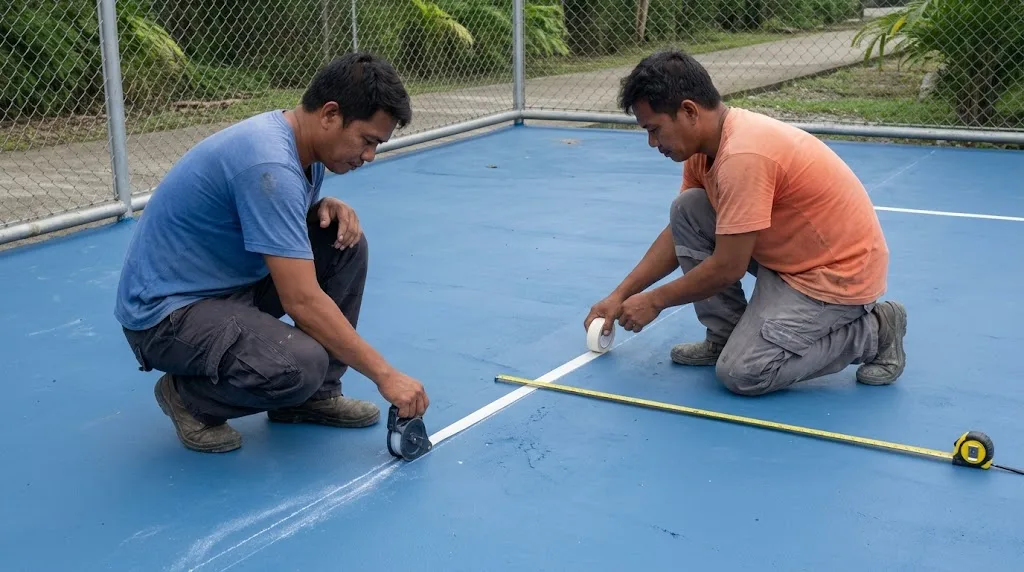
A chalk line, a tape and a roll of masking tape: the lines are the last thing to go on and the first thing a player sees. Illustrative photo.
Short answer: a pickleball court is a 20 ft by 44 ft (6.10 by 13.41 m) rectangle, and Rule 3.A.4.e of the 2026 USA Pickleball rulebook says every line should be 2 inches (5.08 cm) wide, one colour, clearly contrasting with the playing surface. The non-volley zone line is 7 ft (2.13 m) from the net, and the centreline runs from that line to the baseline only. The rulebook names no colour. The ASBA and USA Pickleball construction manual says white textured lines are best on a dedicated court, and that where other sports share the slab, tone-on-tone lines should be used and should stop 3 inches before the white playing lines. For two courts at the 30 by 60 ft minimum playing surface, the calculator below gets 119.7 m of line, about 6.1 sqm of painted line and about 6.5 litres of line paint at two coats and 10 percent waste, using one manufacturer data sheet's coverage that you can overwrite.
If you are an owner in Negros Oriental with a lot, a resort, a subdivision, a school or an old barangay slab, the lines are cheap and the mistakes are expensive: a court set out a few centimetres off square, a non-volley line measured from the wrong place, or lines painted before the colour coat has cured cannot be fixed with a roller. AEDO designs courts nationwide and builds them only in Negros Oriental, so this post covers the layout and the paint quantity, and shows the arithmetic so you can check a contractor's set-out yourself.
Pick how many courts and the playing-surface size. You get the total line length, the painted area, litres of line paint, tape length, the diagonals a crew can measure on site, and a dimensioned plan with every line labelled. A planning aid, not a design or a quotation.
Drawn from the number of courts, playing-surface size, strip and margin above. The numbered tags on the first court match the key below (on a large block the courts are too small to tag, so the tags move to a column at the right). Line widths are drawn thicker than true scale so they stay visible.
Planning sketch, not for construction, not to scale (NTS). Court size and line positions follow Section 3 and Figure 3-1 of the 2026 USA Pickleball rulebook. Pad edges, drainage, fall, net posts, fencing and line paint specification are per design.
We read Section 3, Court and Equipment, of the 2026 USA Pickleball Official Rulebook this month, including Figure 3-1. It is a US rulebook, and we found no Philippine code or standard that sets pickleball court dimensions or line markings, so it is the reference a designer or federation event would use. Here is what it says about lines, and what it does not.
| Item | What the 2026 rulebook says | Rule |
|---|---|---|
| Court size | The court must be a rectangle 20 ft (6.10 m) wide and 44 ft (13.41 m) long, singles and doubles alike. Figure 3-1 labels both dimensions "inclusive of lines". | 3.A.1, Fig. 3-1 |
| Where you measure to | Court measurements must be made to the outside edge of the perimeter and non-volley zone lines. | 3.A.2 |
| Playing surface | Minimum 30 ft (9.14 m) wide by 60 ft (18.29 m) long. Recommended for new construction and tournament play: 34 ft (10.36 m) by 64 ft (19.5 m). Stadium court: 50 by 80 ft. | 3.A.3 |
| Line width and colour | All lines should be 2 inches (5.08 cm) wide and the same colour, clearly contrasting with the colour of the playing surface and court. Figure 3-1 also says "Recommend Line Widths = 2 in." | 3.A.4.e, Fig. 3-1 |
| Baselines and sidelines | Baselines are the lines parallel to the net at each end; sidelines are the two lines bounding the court perpendicular to the net and baselines. | 3.A.4.a, 3.A.4.b |
| Non-volley zone (NVZ) | A 7 ft by 20 ft area beside the net on each side. Its lines run parallel to the net, 7 ft (2.13 m) from it, between the two sidelines. All lines that bound the zone are part of the zone. | 3.A.4.c |
| Centreline | The line down the middle of each end of the court, extending from the NVZ line to the baseline. It separates the right and left service courts. Figure 3-1 puts its middle 10 ft from the outside edge of the sideline. | 3.A.4.d, Fig. 3-1 |
| Service courts | The area on each end between the NVZ and the baseline either side of the centreline, bounded by and including their baseline, sideline and the centreline. Figure 3-1 shows 15 ft from the NVZ line to the baseline. | 3.A.4.f, Fig. 3-1 |
| Net and posts | Net top 36 in (91.44 cm) at the sidelines and 34 in (86.36 cm) at the centre, each within 0.25 in. Posts 22 ft (6.71 m) apart inside to inside, within 1 in. Figure 3-1 recommends posts extend 12 in outside the sideline. | 3.B.2, 3.B.5 to 3.B.7 |
| Why width matters in play | A served ball that lands on the NVZ line is "out". A player must not call a ball out unless they can clearly see a space between the line and the ball. | 8.C, 8.E |
What the Section 3 text we read does not set: any tolerance on court dimensions (it gives tolerances only for net height, plus or minus 0.25 in, and post spacing, plus or minus 1 in; the older ASBA manual does give line tolerances, quoted in section 5 below); the run-off distance around a court beyond the 30 by 60 ft playing surface; the surface type or its colour; the type of line paint; and the spacing between neighbouring courts. Those are the designer's and owner's decisions, which is why the calculator treats them as inputs.
Three reading notes. First, Rule 3.A.4.e says lines should be 2 inches and one colour; the verbs in 3.A.1 and 3.A.2 are must. For a court you are paying for, treat the 2 inch width as the requirement, because a federation event or a sanctioned club will. Second, the rulebook prints the NVZ as "7-foot by 20-foot (2.13 m by 6.08 m)", while 20 ft is 6.10 m everywhere else in the same section, including rule 3.A.1. The feet figures are the ones to build from; the 6.08 m looks like a rounding slip in the metric conversion. Third, the 2020 ASBA and USA Pickleball manual's set-out appendix says all lines shall be 2 inches wide except the baseline, which may be up to 4 inches. The 2026 rulebook we read has no such exception (3.A.4.e: all lines 2 inches), so for a new court mark every line at 2 inches and do not rely on the older manual's wider baseline.
Where we put the 7 ft: because Rule 3.A.2 measures to the outside edge of the NVZ line, we read the 7 ft as running from the net to the baseline-side edge of that line, so the line itself sits inside the zone. The calculator and the plan draw it that way. The 2020 manual's line tolerance guide (printed page 3 of chapter 1) supports this reading: it lists "net line to outside of NVZ line" as 7 ft 0 in, and says all its dimensions are to the outside edge of lines. Figure 3-1 is the tie-breaker if your designer reads it differently; at 2 inches the difference is 51 mm.
This is where owners ask "what colour?" and the honest answer is "one that stands out from the surface". What is sourced and what is not:
Practical rule we use: pick the surface colour first, then the line colour that contrasts with it under your actual lighting, and test a sample board in daylight and at night before the whole court is coated. We have no contrast ratio to give you and will not invent one.
The court is always 20 by 44 ft. What changes with the number of courts is the pad, and the line length scales in a straight line: each court needs the same 59.8 m of line at 2 inches. The table uses the 30 by 60 ft minimum playing surface for every court, each court keeping its own full area and no strip between them, as in our lot layout guide, whose 9.144 by 18.288 m module it reuses. That guide also adds a 2 m margin all round for its lot sizes; the table here has none, so its block is smaller than that guide's lots.
| Courts | Block of playing surfaces | Total line length | Painted line area | Line paint, 2 coats + 10% |
|---|---|---|---|---|
| 1 | 9.1 m by 18.3 m (167 sqm) | 59.8 m | 3.04 sqm | 3.3 L |
| 2 (2 by 1) | 18.3 m by 18.3 m (334 sqm) | 119.7 m | 6.08 sqm | 6.5 L |
| 4 (2 by 2) | 18.3 m by 36.6 m (669 sqm) | 239.4 m | 12.16 sqm | 13.0 L |
| 6 (3 by 2) | 27.4 m by 36.6 m (1,003 sqm) | 359.1 m | 18.24 sqm | 19.6 L |
The paint litres use the calculator's default 2.05 sqm per litre per coat (section 4), so they move with whatever coverage your supplier states. The line length does not depend on paint at all.
Run-offs. Inside a 30 by 60 ft playing surface the 20 by 44 ft court leaves 5 ft (1.52 m) beyond each sideline and 8 ft (2.44 m) beyond each baseline; at 34 by 64 ft it is 7 ft and 10 ft. No rule we read says whether neighbouring courts may share a run-off strip, or how wide a strip between courts should be. If a designer shares strips, the block shrinks and the lines stay the same; if they add a walkway or fence between courts, the block grows. Ask where any quoted spacing comes from; it is layout practice. The manual does say, for a tennis-court conversion, that four pickleball courts on a standard 60 by 120 ft tennis pad leave only 5 ft between the pickleball sidelines and the fences and 8 ft at the baselines, and that adding overall width gives players more room. For basketball slabs, see our conversion guide, which works the fit.
On the real job, AEDO's 2-court pad in Manjuyod was 352.63 sqm against 334.4 sqm of two minimum playing surfaces: the pad is about 5 percent larger than the playing surfaces. We have not itemised that difference, so treat the calculator's "margin" input as your own design choice, not as AEDO's Manjuyod allowance.
Lines are a separate step from the colour coat. The manual's sequence on a hard court is: clean, flood-test, patch, textured filler coats, two or three colour coats each dried completely, and then "one or two coats of textured line paint as recommended by the color-coating manufacturer", with at least 72 hours for an acrylic surface to cure before play. So the lines go on a dry colour coat, with a paint the colour-coat supplier approves.
| Method | What the sources say | Cost lines to ask for |
|---|---|---|
| Painted lines | Manual: 1 or 2 coats of textured line paint after the colour coat has dried. The line paint data sheet we read says to roll or brush it, to use high quality tape to mask the lines, to remove the tape as soon as the paint has dried, to allow adequate curing time on a new uncoated surface, and to apply only above 50 F (10 C) with 24 hours after, and not if rain is imminent or forecast. For outdoor concrete it adds sound perimeter drains and a vapour barrier under the slab. | Paint litres (editable coverage), masking tape metres, labour for set-out and painting |
| Taped lines | Manual: "Lines may be taped or painted on the court for pickleball", in its tennis-court conversion advice, and a note that temporarily taped or adhered lines may leave residue on the court or may damage the surface when pulled up. | Tape metres (about twice the line length if you mask both edges), re-laying cost |
| Stencils and templates | We read nothing on stencils for pickleball lines in the manual or the data sheet. A cut template for the NVZ or corners is a set-out convenience, not a sourced method. | Ask the painter what they use and who owns it |
Coverage, and what we could and could not confirm. We read one manufacturer data sheet: SportMaster Textured White Line Paint, a US acrylic line paint (ThorWorks Industries, revised 12/19). It states "500 to 600 lineal feet of 2-inch line per gallon". That is 152.4 to 182.9 m of 2 inch line per US gallon (3.785 L), or 40.3 to 48.3 m of line per litre, which is 2.05 to 2.45 sqm per litre. The sheet does not say whether that is one coat. The calculator defaults to the low end (2.05) and treats it as per coat, which is the conservative reading. It is not a Philippine product and not a Nippon product. Nippon Paint Malaysia's sports court flooring page, which we also read, lists a primer, FloorSports epoxy hybrid and mastic, a PU clear coat and Roadliner 268 (described there as a primer for asphalt courts) and no court line paint, so we have no Nippon line coverage. If your top coat is a Nippon system, as it was on AEDO's Manjuyod job, ask for the line paint data sheet for that system.
Default case, worked by hand. Two courts. Per court: sidelines 2 x 13.411 = 26.822 m; baselines 2 x (6.096 - 2 x 0.0508) = 11.989 m; NVZ lines the same 11.989 m; centrelines 2 x (4.572 - 0.0508) = 9.042 m. Per court 59.842 m; two courts 119.68 m. Area = 119.68 x 0.0508 = 6.08 sqm. Litres = 6.08 x 2 coats / 2.05 x 1.10 = 6.5 L, or 1.7 US gallons. Masking both edges: 239.4 m of tape.
What it costs. The only Philippine figure we have is from AEDO's own job: the Manjuyod job plan set aside a lump sum of PHP 4,500 for line-marking paint for the two courts, about PHP 2,250 a court. It was a materials allowance inside the painting line, not a price for a marking service, and we cannot turn it into pesos per litre because the plan does not state the litres. The contract painting line (PHP 221.64 per sqm on 352.63 sqm, covered in our surface guide) includes the game lines. AEDO has no separate line-marking price. In the calculator the paint price is a blank input you fill from your supplier's quote.
A rectangle with equal opposite sides and equal diagonals is square. That is geometry, not a rulebook clause, and the 2026 rulebook gives no tolerance for court dimensions. The 2020 ASBA and USA Pickleball manual does, in a "line tolerance guide" on its court drawing (all dimensions to the outside edge of the lines): net line to outside of NVZ line 7 ft 0 in, plus or minus 1/8 in (3.2 mm); net line to outside of baseline 22 ft 0 in, plus or minus 1/4 in (6.4 mm); outside sideline to outside sideline 20 ft 0 in, plus or minus 1/4 in (6.4 mm); outside sideline to centreline 10 ft 0 in, plus or minus 1/8 in (3.2 mm); diagonal 48 ft 4 in, plus or minus 3/4 in (19 mm). Those are the manual's figures, from an older edition than the rulebook, so use them as the working tolerance for a crew rather than as a 2026 rule. The numbers a crew can check with a tape:
| Rectangle | Sides | Diagonal (computed) |
|---|---|---|
| Court, outside edges of the lines | 20 ft by 44 ft (6.096 m by 13.411 m) | 48.33 ft = 14.73 m |
| Minimum playing surface | 30 ft by 60 ft (9.144 m by 18.288 m) | 67.08 ft = 20.45 m |
| Recommended playing surface | 34 ft by 64 ft (10.363 m by 19.507 m) | 72.47 ft = 22.09 m |
| One NVZ | 20 ft by 7 ft (6.096 m by 2.134 m) | 21.19 ft = 6.46 m |
| Single-corner check, 3-4-5 scaled | 4.5 m, 6.0 m | 7.5 m (4.5 squared plus 6.0 squared is 56.25, and 7.5 squared is 56.25) |
Diagonal = square root of (width squared plus length squared). For the court: 20 squared is 400, 44 squared is 1,936, the sum is 2,336 and its square root is 48.33 ft. The calculator prints these for your own selection.
The manual's own set-out method. The 2020 manual's appendix starts from the net rather than from four pegs: fix the centre point C between the net posts, mark points A and B 10 ft either side of C along the net line, then swing arcs of 22 ft and 29 ft 8 3/4 in from A and B; where the arcs cross are the four outside corners of the playing lines. Its accuracy check is that the end-to-end corner distance is exactly 20 ft and the diagonals are 48 ft 4 in. The arc length is the same geometry as above: from A to the far corner on the same end is a 20 ft by 22 ft diagonal, square root of (400 plus 484) = 29.73 ft, which is 29 ft 8.8 in, matching the manual's 29 ft 8 3/4 in within rounding. Either route gives the same corners, so use whichever your crew can measure more accurately, and finish with the two diagonals.
Our order on site, with the reason for each step. (1) Square the four outside corners from the diagonals before anything else, because every other line is measured from them. (2) Mark the baselines and sidelines between the pegs. (3) Find the net line at mid-length, 22 ft from each baseline, then set each NVZ line 7 ft from it. (4) Set each centreline with its middle 10 ft from the sideline edge, running from the NVZ line to the baseline and stopping there. (5) Check the net posts last: 22 ft apart inside to inside, which on a 20 ft court puts them about 12 in outside each sideline. Mark all of this in chalk on the cured colour coat, measure it again, and only then tape or paint. This order is AEDO practice, not a sourced procedure; the manual's version is the arc method above.
AEDO's own pickleball job is a 2-court open court in Manjuyod, Negros Oriental. The job plan lays it out to the standard court: 20 by 44 ft playing area per court, non-volley zone 7 ft each side of the net, and a line-marking paint item for the two courts; the proposal describes the game line markings as "per standard pickleball court layout". The paint system was one epoxy primer coat and two rubberized top coats, with silica sand in the second coat over the playing area only, and the lines were part of the painting scope. The plan does not spell out the order of the line step. The manual's order is the colour system first and the lines last, and that is the order to ask your painter for.
AEDO builds in Negros Oriental only. Our design-build service covers Dumaguete, Bais, Tanjay, Sibulan, Valencia and the rest of the province: see the local pages for Dumaguete, Bais, Sibulan and Tanjay. If you already have plans, the construction service builds from them; if you have a lot and an idea, the complete design priced at PHP 250 to 450 per sqm is the design route. We read no provincial or municipal ordinance on court markings for this post, and we found no Philippine rule on them, so the rulebook and the manual are the references; confirm any LGU requirement for a public or barangay court with the municipal building official.
Outside Negros Oriental we do not build. We design the court, draw the layout with dimensions you can hand to a local crew, review the contractor's marking plan and quote, and check milestones. A Single Milestone Check starts at PHP 7,500 per visit. Two companion posts cover what goes under the lines: paint types and quantities and the painting schedule in the rainy season.
What AEDO does. We design, check and review courts nationwide, and build only in Negros Oriental. For a court elsewhere we draw the dimensioned layout, review a contractor's marking plan and quote against Section 3 and the points above, and check milestones; in Negros Oriental we can price the whole court design-build. There is no separate AEDO price for line marking: it is quoted with the court after a slab visit or plan review. The structural side of covered courts is in our design package guide and structural checklist. We do not give legal opinions and we are not a paint supplier; Nippon is named only as the system used on one AEDO job.
Rules, read this month: Section 3 (rules 3.A.1 to 3.A.4.g, 3.B.2, 3.B.5 to 3.B.7, Figure 3-1) and rules 8.C and 8.E of the 2026 USA Pickleball Official Rulebook, as hosted by Pickleball Canada (the usapickleball.org copy is behind a human-verification page, which we did not bypass). Manual: Pickleball Courts: A Construction and Maintenance Manual, 2020 edition (ASBA and USA Pickleball): chapter 1 court dimensions and its line tolerance guide, chapter 2 tennis-court conversion (taped or painted lines), chapter 3 surfacing systems and Other Surfacing Tips (white textured lines, tone on tone), chapter 6 lighting (contrast, glare), chapter 7 windscreens and the appendix on establishing playing lines. The manual quotes the 2020 rulebook, so we used it for colour, method and the set-out tolerances only, not for the rules. Manufacturer: SportMaster Textured White Line Paint technical data sheet (ThorWorks, revised 12/19), one US product; Nippon Paint Malaysia's sports court page for what it does not list. AEDO records: the Manjuyod job plan (court standard, painting system, the PHP 4,500 line paint allowance), the Manjuyod proposal and our sibling guides. Our computations: every length, area, litre and diagonal in the post is arithmetic on the rulebook dimensions, shown above. AEDO assumptions with no source, edit them: 10 percent paint waste, two coats as the default, treating the data-sheet coverage as per coat, no strip and no margin around the courts, the set-out order, and the 3-4-5 scaling. What we could not confirm: any Philippine rule on court lines, any tolerance on court dimensions in the 2026 rulebook itself (the only tolerances we found are in the 2020 manual's drawing), whether the line paint sheet's coverage is per coat, a coverage figure for a Nippon or other Philippine-available line paint, any source ranking line colours for glare, and any source describing stencils.
How wide should pickleball court lines be, and what colour?
Rule 3.A.4.e of the 2026 USA Pickleball rulebook says all lines should be 2 inches (5.08 cm) wide and the same colour, clearly contrasting with the colour of the playing surface and court. Figure 3-1 gives the 20 ft by 44 ft court size as inclusive of the lines, and Rule 3.A.2 says court measurements are made to the outside edge of the perimeter and non-volley zone lines. The rulebook text we read does not name a colour. The ASBA and USA Pickleball manual says white textured lines are best on dedicated pickleball courts.
How deep is the non-volley zone and where does the centreline stop?
Rule 3.A.4.c makes the non-volley zone a 7 ft by 20 ft area beside the net, with its lines running parallel to the net 7 ft (2.13 m) from it, and says all the lines that bound the zone are part of the zone. Rule 3.A.4.d runs the centreline on each end of the court from the non-volley zone line to the baseline, so it does not cross the non-volley zone. Figure 3-1 puts the middle of the centreline 10 ft from the outside edge of the sideline.
Should pickleball lines be white on a basketball court?
On a dedicated court the ASBA and USA Pickleball manual says white textured lines are best. Where other sports share the surface, it says tone-on-tone or blended lines in the same colour family as the court should be used and should stop 3 inches before all white playing lines, and that other colours can be used on multi-use facilities. The sentence does not say which sport's lines are the tone-on-tone ones. The 2026 rulebook only requires that the pickleball lines be one colour and clearly contrast with the surface, so pickleball lines that match the basketball lines are the thing to avoid.
How do I mark pickleball lines on a basketball court?
The manual says lines may be taped or painted on the court for pickleball, and warns that temporarily taped or adhered lines may leave residue or damage the surface when pulled up. Painted lines go on a clean, cured surface with a line paint the colour-coat maker recommends. Pick a colour that stands out from both the surface and the existing basketball lines, and check the layout with a tape and the diagonals before any paint goes down. Our basketball to pickleball guide covers fit and cost.
How much paint do pickleball court lines need?
For two courts with 2 inch lines the line length is about 119.7 m and the painted area about 6.1 square metres. One SportMaster textured line paint data sheet, a US product we read, gives 500 to 600 lineal feet of 2 inch line per US gallon, which is about 2.05 to 2.45 square metres per litre. At the low end of that range, two coats and 10 percent waste, two courts need about 6.5 litres. That coverage is for one US product, not a Philippine one, so use your supplier's data sheet.
How do I check that pickleball court lines are square?
Measure both diagonals of the rectangle. For the 20 ft by 44 ft court they should be equal at 48.33 ft, which is 14.73 m, once opposite sides are also equal. The 30 ft by 60 ft minimum playing surface has diagonals of 67.08 ft, or 20.45 m. A 3-4-5 triangle scaled to 4.5 m, 6.0 m and 7.5 m checks a single corner. This is geometry, not a rule from the rulebook, which states no tolerance for court dimensions; the 2020 ASBA and USA Pickleball manual lists plus or minus 3/4 in (19 mm) on the 48 ft 4 in diagonal.
What does AEDO do about pickleball court line marking?
AEDO designs, checks and reviews courts nationwide and builds only in Negros Oriental, where line marking is part of the court painting scope, as in our 2-court job in Manjuyod. Elsewhere we draw the layout, review a contractor's marking plan and quote, and check milestones. A Single Milestone Check starts at 7,500 pesos per visit. There is no separate AEDO price for line marking: it is quoted with the court after a slab visit or plan review.
Rules, manuals, data sheets and project documents used. External links open in a new tab.
We found no Philippine code or standard setting pickleball line markings, no tolerance on court dimensions in Section 3 of the rulebook (the 2020 manual's drawing has them), no source ranking colours for glare, and no Nippon or other Philippine-available line paint data sheet, so those are stated as gaps. The line paint coverage is one US data sheet's figure. The unit price of line paint is left blank for your supplier's quote. This article is general information, not a specification for your court.
Send the court count, the playing-surface size, a photo of the slab and the quote or plan. A licensed engineer will check the layout against Section 3, the diagonals and the paint quantity, and tell you what to ask the painter.