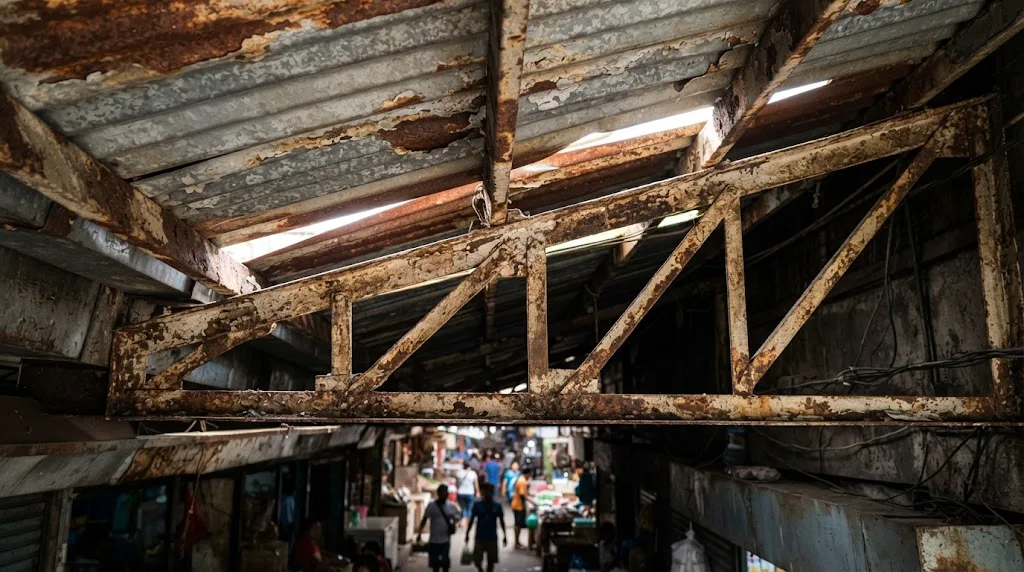
Rust streaks under the sheet laps are where it usually starts: water sits there longest, the zinc goes first, and the purlin lip thins before anything else. Illustrative photo.
Short answer: rust on a steel purlin or truss is only dangerous once it has eaten into the steel, so the decision rests on one number: how much thickness is left at the worst spot. Brush the rust off down to bright metal, measure it with a caliper or an ultrasonic gauge, and compare it with the original. No Philippine code gives a single cut-off, so as AEDO engineering judgement: under 10% loss, clean and repaint; 10% to under 25%, repair and reinforce after an engineer checks the capacity; 25% to under 40%, reinforce only if the loss is local, otherwise replace; 40% or more, or any hole, replace. The code basis sits in NSCP 2015 Chapter 5: where corrosion may impair strength or serviceability, steel must be designed to tolerate it or be protected from it (502.3.13), an existing structure is evaluated with thicknesses from a field survey (Appendix A-5), and new cold-formed steel may arrive no thinner than 95% of its design thickness (551.2.4). For the checker's default case, 1.2 mm C-purlins measured at 0.95 mm within a kilometre of the sea, that's a 21% loss, and cleaning, recoating and sistering the damaged runs on a 120 sqm roof comes to about ₱45,100–₱90,200 on AEDO 2026 planning ranges.
Near the sea the clock runs fast. The zinc on a common Z275 galvanized coating is only about 21 micrometres thick per side, and ISO 9223 puts the first-year corrosion of zinc in its very-high (C5) category, which includes coastal areas, at 4.2 to 8.4 micrometres a year. The checker below turns your measurement into a loss percentage, a verdict and a cost. After it: whether it's dangerous, where rust starts, how to measure, why the screw and cleat go first in a typhoon, the repair options, and an annual maintenance checklist.
Enter the original thickness of the member and the thickness you measured at its worst spot, after brushing it down to bright metal. You get the percentage of steel lost, AEDO's verdict band and the recommended repair priced for your roof. The verdict bands are AEDO engineering judgement, not a code limit; a licensed engineer's capacity check against NSCP 2015 decides the real repair. Costs are AEDO 2026 planning ranges, not quotations.
Not yet, if it's only surface rust: orange staining on steel that is still full thickness underneath. That tells you the zinc or paint is gone and the steel itself has started to corrode. Fix it now and it's a paint job.
It becomes dangerous when the rust has taken the steel with it. These are the signs we treat as "get it measured before the next typhoon":
If you see any of these, keep people off the roof until someone has checked it. A thinned purlin can still carry the sheets on a calm day and let go under a worker's weight or a gust. Our structural damage warning signs guide covers the rest of the building, and the leaking roof guide explains why a soft purlin overrides any leak diagnosis.
Negros, Cebu, Bohol, Siquijor and the rest of the Visayas put a lot of roofs within sight of the sea, and salt changes the arithmetic. ISO 9223:2012 classifies how corrosive the outdoor air is into six categories, and gives the first-year corrosion of standard metals for each (Tables 1 and 2):
| Category | Corrosivity | Carbon steel, first year (µm/a) | Zinc, first year (µm/a) |
|---|---|---|---|
| C1 | Very low | ≤ 1.3 | ≤ 0.1 |
| C2 | Low | 1.3 – 25 | 0.1 – 0.7 |
| C3 | Medium | 25 – 50 | 0.7 – 2.1 |
| C4 | High | 50 – 80 | 2.1 – 4.2 |
| C5 | Very high | 80 – 200 | 4.2 – 8.4 |
| CX | Extreme | 200 – 700 | 8.4 – 25 |
Its informative Table C.1 gives typical environments: coastal areas with low chloride deposition sit at C3, "coastal areas without spray of salt water" at C4 (ISO gives that one as a temperate-zone example), "coastal areas, sheltered positions on coastline" at C5, and coastal and offshore areas with occasional salt spray at CX. Its tropical examples matter here too: C3 includes a subtropical or tropical atmosphere with low pollution, and for indoor spaces C5 includes "unventilated sheds in subtropical and tropical zones". So a closed warehouse by the sea can be as hard on its roof steel as the open air.
Two cautions. ISO 9223 says the category comes from measuring (a year of exposed test coupons) or from estimation using environmental data, and its Note 1 to Table C.1 says chloride deposition depends on wind direction and speed, topography, sheltering islands and distance from the sea. A distance band like the one in our checker is an AEDO shortcut, not a classification. And ISO warns that first-year rates "cannot be simply extrapolated" to long-term behaviour; ISO 9224 covers that, and we haven't read it.
Now put that next to the coating. The GalvInfo Center's note on coating designations explains that a G90 galvanized sheet under ASTM A653, Z275 in metric, carries at least 275 g/m² of zinc total on both sides, about 42 micrometres, or about 21 micrometres per side if split evenly. At the C5 first-year zinc rate of 4.2 to 8.4 µm a year, that's the scale of a few years of exposure, not decades. Once the zinc is gone, bare steel at C5 first-year rates loses 80 to 200 µm a year, and a 1.2 mm purlin is only 1,200 µm thick. Steel under a roof is out of the rain, but that doesn't protect it by the sea: ISO 9223 (Note 4 to Table C.1) warns that sheltered surfaces that are never rain-washed collect salt, and the salt holds moisture, so they can fall into a higher corrosivity category than the open air. Roof steel near the coast can corrode as fast as these figures or faster, worst where laps, drips or an unventilated shed keep it wet. That's why a roof that looked fine five years ago can have holes in its purlin lips today, and why the coating is the thing to maintain.
Add the rest of the local weather: typhoons that drive rain and spray into laps and under flashings, and nights when the sheet drops below the dew point and drips on the purlins underneath (our metal roof condensation guide works that out from PAGASA station data). Water that stays on steel is what rusts it.
Rust is rarely even. On the roofs we inspect it starts where water sits longest or where the coating was broken:
These five words mean different things for the structure. The descriptions and actions below are how AEDO grades roof steel on site; no Philippine code defines them.
| Stage | What you see | What it means | Usual action (AEDO practice) |
|---|---|---|---|
| Surface rust | Orange staining, powdery; bright metal after a light brushing | Coating gone locally; little or no loss of thickness | Clean, prime with zinc-rich primer, topcoat |
| Scale | Dark flakes or layers that lift off; the surface under them is rough | Active corrosion; thickness lost under the scale, amount unknown until removed | Remove to firm metal, then measure |
| Pitting | Small craters after cleaning, often along laps and screw lines | Loss concentrated in spots; the thinnest point governs a lip or a screw hole | Measure at the deepest pits; decide by loss |
| Section loss | Flange or lip visibly thinner, edges ragged, a screwdriver dents it | Less steel carrying the load, and less for the screws to grip | Engineer's capacity check; reinforce or replace |
| Perforation | Holes, daylight, a lip that has broken off | The member at that spot is no longer the section it was designed as | Replace that length (or the member); prop if it sags |
A thickness number is the whole decision, so get a good one. First, safety: work from below or from a ladder at the eave. Never stand on sheets or purlins you suspect are thin, and in a ceiling space step only on joists or a board laid across them. If the worst spots can only be reached from on top, leave it to a crew with fall protection.
Why the code cares about the measured number. NSCP 2015 Appendix A-5, Evaluation of Existing Structures, says all dimensions used in an evaluation, explicitly including "thicknesses and connection details, shall be determined from a field survey" (A-5.3.1), with drawings allowed only "with field verification of critical values". The member's strength is then worked out with the code's normal design provisions using those measured dimensions (A-5.3.2 names Part 1, Sections 502 to 511; A-5 itself points only to Part 1; for cold-formed purlins we apply the Part 3 provisions the same way), and the engineer writes a report saying whether the structure, "including all members and connections", is adequate (A-5.5). For cold-formed purlins, Part 3 (Section 551.1.2) allows strength to be set by tests or by rational engineering analysis where the section no longer fits the standard formulas, which a pitted, ragged purlin often doesn't.
Two measurement bases in the code are worth knowing. Section 551.2.4: new cold-formed steel "as delivered to the job site shall not at any location be less than 95 percent of the thickness, t, used in its design". So a new purlin can legitimately read up to 5% under its design figure. And for structural tubes (HSS) designed under Part 1, Chapter 5 defines the design wall thickness of ERW HSS as 0.93 times the nominal; a new electric-resistance-welded HSS can read 7% under nominal and still be what the designer assumed. Light-gauge tubes of the kind used in house trusses, under about 3 mm, are usually designed as cold-formed members under Part 3, where the 95% delivery tolerance of 551.2.4 applies instead (the 3 mm split in the checker is an AEDO convention). The checker measures tube loss from 0.93 × nominal for walls of 3 mm and up, and from the nominal thickness below that.
We looked for a code percentage and didn't find one. NSCP 2015 gives the duty and the method, not a cut-off:
So the percentages below are AEDO engineering judgement, used to decide what to do while the engineer's calculation decides whether it's enough:
| Loss at the worst spot | AEDO verdict | Why |
|---|---|---|
| Under 10% | Monitor and repaint | Close to the 5% a new cold-formed member may already be under design thickness (551.2.4). Stop the corrosion and re-measure next year. |
| 10% to under 25% | Repair and reinforce | Screw pull-out drops by the same share as the thickness (Eq. 555.4-6). A thin purlin's bending capacity usually drops by more, because its flanges and lips lose effective width as they thin (Section 552). Check it with the measured thickness; usually a sister member or plate plus a full recoat. |
| 25% to under 40% | Reinforce if local, replace if along the length | A short patch can be plated or sistered past; a long thinned run costs almost as much to reinforce as to replace, and leaves old steel in place. |
| 40% or more, or any hole | Replace | Lips and flanges this thin buckle and tear; screws have little to grip. Prop or unload it until then. |
The same bands apply to every member in the checker, but a thin purlin loses capacity faster than a thick angle at the same percentage, so the engineer's check matters most on light-gauge steel. A 1.2 mm purlin with 20% loss has 0.96 mm left, and on the lip that can be the difference between a screw holding or pulling through. The engineer's check, not the band, has the final say.
A metal roof stays on because it's held down, not because it's heavy. Our truss guide works it through: sheet-metal roofing weighs about 0.05 kPa (NSCP Table 204-2, copper or tin sheet row), while the velocity pressure at roof height for a bungalow in open terrain at a basic wind speed of 250 kph is about 2.1 kPa (Eq. 207B.3-1), some forty times the sheet's weight before any pressure coefficient. The uplift goes sheet → screw → purlin → cleat → truss → anchor → column, and it fails at the weakest link.
NSCP 2015 designs purlins, sheets and their fasteners as components and cladding under Section 207E, and the explanatory text under its wind definitions (Section 207A.2, p. 2-29) adds that individual members of trusses "should also be designed for component and cladding loads". The C&C pressure coefficients for roofs (Figures 207E.4-2A to 2C for low-rise buildings) are zoned, with separate edge and corner zones around the roof perimeter, and are read against the effective wind area of each part. For fasteners the effective wind area definition is blunt: "For a cladding fastener, the effective wind area is the area of cladding secured by a single fastener." So each screw on an eave or corner purlin is designed for its own small patch of the most exposed part of the roof.
Now look at what that screw's strength depends on. NSCP 2015 Eq. 555.4-6 gives the nominal pull-out strength of a screw as Pnot = 0.85 tc d Fu2, where tc is the lesser of the depth of penetration and the thickness of the member the screw is driven into, here the purlin. Pull-out capacity is proportional to the purlin's thickness at the screw. A purlin that has lost 21% at the screw line has lost about 21% of its pull-out strength there, before counting the rust inside the screw hole itself. Pull-over through the sheet (Eq. 555.4-7, Pnov = 1.5 t1 d'w Fu1) is proportional to the sheet thickness in the same way, and a rusted-away steel washer shrinks d'w.
The same applies further down: a cleat or bolt that has rusted at the bearing, or a truss seat plate thinned where water sat, carries the whole truss's uplift. That's why after a storm we look at the connections before the members, and why the post-typhoon inspection checklist starts at the roof edge. For the full load path see our typhoon-resistant construction guide; for the wind numbers, the NSCP wind load guide.
Clean, prime and topcoat. Remove loose rust and scale to firm metal (wire brush, scraper or power tool), wipe off dust and salt with clean water, let it dry, then a zinc-rich primer followed by a compatible topcoat, applied on the day of cleaning so fresh steel doesn't flash-rust overnight in coastal air. The primer's zinc does the job the galvanizing used to do. Follow the paint maker's data sheet for film thickness and recoat times; that's the specification, not the painter's habit. Where hand tools can't get the steel back to bright metal, a zinc-rich primer is the wrong product; use a surface-tolerant primer made for hand-cleaned rusty steel, again per its data sheet. Don't paint over scale: it looks fine for a season and lifts off with the rust underneath. With the sheets on, the top face of the purlin under the sheet can't be cleaned or painted. If that's where the loss is, the sheets have to come up, or the purlin gets sistered or replaced.
Plate reinforcement. A steel plate or angle bolted or welded over a thinned spot, most often at truss joints, bearings and angle-bar members. Welding onto old steel isn't automatic: NSCP Appendix A-5.2.3 says where welding is anticipated for repair of existing structures, the steel's chemical composition shall be determined for the welding procedure. On a house roof, bolted plates avoid that question. If you do weld galvanized steel, grind the zinc off the weld zone and ventilate, and give every weld a zinc-rich touch-up afterwards.
Sistering new purlins. A new C-purlin fixed alongside the thinned one, spanning truss to truss, with its own cleats. It restores the load path without taking the sheets off, and the old purlin stays as a spacer. The new one must be designed to carry the load on its own, and the screws should go into the new steel.
Full replacement. Sheets lifted, old purlins or truss members cut out, new galvanized members fixed with new cleats and screws sized for your site's wind, sheets relaid with new screws and washers (old holes and short screws are where relaid roofs fail). If the sheets are rusted too, this is the time to replace them.
| Work (per sqm of roof area) | AEDO 2026 planning range | Built from |
|---|---|---|
| Clean, zinc-rich prime, topcoat, all roof steel in place | ₱200–450 (×1.2 within 1 km of the sea; ×1.1 at 1–5 km) | AEDO allowance, not built from a sibling rate: overhead prep and a two-coat system (zinc-rich or surface-tolerant primer plus topcoat) by a painter at ₱600–1,100 and a helper at ₱500–700 a day (labour rates guide), plus paint and access. The coastal factors are an AEDO allowance for a heavier system. Get a painter's quote on the actual steel |
| Sister C-purlins on the damaged runs | ₱340–530 per sqm affected | 2×4 1.5 mm GI C-purlin at ₱860 per 6 m (≈ ₱143/m, retail price read 18 Sep 2026, in our truss guide), 1.31 m per sqm at 0.8 m spacing with 5% waste ≈ ₱190, with the upper end at ₱230 allowing about 20% for supplier and price differences (AEDO), plus AEDO ₱150–300 for cleats, bolts, screws and labour |
| Plate or sister truss members (angle or tube) | ₱400–700 per sqm affected | AEDO planning allowance for plates, bolts, fabrication and touch-up |
| Replace C-purlins, sheets lifted and relaid | ₱710–1,190 per sqm affected | New purlins ₱190–230 (same basis as the row above) plus cleats and labour ₱150–250 (AEDO), lift-and-relay at the ₱250–450 installation labour band and ₱120–260 for flashing and fasteners from our roofing cost guide |
| Replace an angle-bar truss frame | ₱1,370–2,080 per sqm affected | Angle-bar frame with purlins ₱950–1,270 per sqm (truss guide), plus lift-and-relay ₱250–450, flashing and fasteners ₱120–260 and AEDO ₱50–100 demolition |
| Replace a light tube truss frame (house roofs) | ₱900–1,590 per sqm affected | "Light steel trusses + C-purlins" band ₱480–780 (roofing guide), plus the same lift-and-relay, flashing and demolition. Wide-span warehouse tube trusses fall in the guide's ₱850–1,450 fabricated-truss band and are priced on site |
| New 0.5 mm pre-painted sheets, where the old ones are rusted | ₱650–850 per sqm when members are being replaced (sheets already lifted); ₱1,020–1,560 per sqm otherwise | Roofing cost guide: sheet ₱650–850, plus installation labour ₱250–450 and flashing and fasteners ₱120–260 when the sheet job stands alone |
Access can change the picture: a two-storey eave, a roof over a running shop, or a warehouse needing a scissor lift. Those are priced on site.
Reading the checker's default case. A 120 sqm house roof within 1 km of the sea, with 1.2 mm C-purlins. After brushing, the worst reading is 0.95 mm, a 21% loss, along part of the purlins' length, with no holes. That lands in the repair and reinforce band. The recommended work is to clean and recoat all 120 sqm of roof steel with the coastal system at ₱240–540 per sqm, ₱28,800–64,800, and to sister new 1.5 mm C-purlins over the 40% of the roof where the damage runs, 48 sqm at ₱340–530, about ₱16,300–25,400. Total ₱45,100–₱90,200, or about ₱376–752 per sqm of roof. The screws on those purlins have lost about a fifth of their pull-out strength at the thinned spots, which is why the sisters take the new screws.
What moves it. Read 1.10 mm instead (8% loss) and it's a recoat only, ₱28,800–64,800. Read 0.70 mm along the length (42%) and it's replacement: 48 sqm of new purlins with sheets relaid at ₱710–1,190 plus recoating the other 72 sqm, about ₱51,400–96,000. Tick "holes" and it goes to replacement whatever the reading.
People ask this about steel warehouses, sheds and pre-engineered buildings. The honest answer: the steel frame itself doesn't mind rain or heat; what decides whether a metal building lasts is the coating, the details and the maintenance.
So near the sea, a metal building is as weather-proof as its owner's maintenance plan. NSCP 513.3.1 notes that shop paint isn't required unless the contract documents specify it, and 513.4.6 leaves touch-up and field painting responsibility to be set in the design documents. If you're building new by the coast, make the coating system and its touch-up part of the specification.
Once a year before the rainy season, again after every typhoon, and more often within a kilometre of the sea. Take a torch, a screwdriver, a wire brush, a caliper and your phone.
Costs. The walk-through is a few hours of a handyman's time. Spot touch-ups are cheap; a full recoat of the roof steel is the ₱200–450 per sqm allowance above. Gutter cleaning and screw replacement are small jobs. Our preventive maintenance guide covers the rest of a building's schedule and the Building Official's annual inspection regime.
Under Section 301.3 of the 2004 Revised IRR of PD 1096, a building permit isn't required for "repair works not affecting or involving any structural member, such as replacement of deteriorated roofing sheets or tiles, gutters, downspouts, fascias, ceilings and/or sidings", provided the work doesn't violate the Code. Replacing deteriorated sheets and gutters is on that list. Purlins and trusses are structural members, so reinforcing or replacing them isn't, and needs a permit with structural plans. Cleaning and repainting doesn't change any member, but the list doesn't name it either. Some Building Officials ask to be notified even for exempt work. Check with your OBO before starting; local practice varies. We found no later issuance changing Section 301.3.
Get an engineer's assessment when any reading is past 10% loss, there are holes, a purlin sags, the rust is at the connections, the roof is over people (a shop, a school, a church), or you want to add weight: solar panels, insulation or a ceiling. Our structural assessment report guide shows what the written report covers.
Where AEDO fits. Our structural assessment is ₱5,000 flat for the site visit and written report: we find the worst spots, measure, check the members and connections against NSCP 2015, and tell you whether it's a repaint, a reinforcement or a replacement. Outside Negros Oriental, send photos and readings first and we'll say whether a visit is needed; we prepare repair drawings nationwide, and our Single Milestone Check (from ₱7,500 per visit) can confirm your contractor's repair before the sheets go back on. In Negros Oriental, AEDO also designs and builds the repair or the new roof under one contract.
Code provisions were read this month from the NSCP 2015 Volume I scan: Chapter 5 Sections 502.3.13, 502.6, 513.3 and 513.4.6, Appendix A-5, the Part 1 symbol for HSS design wall thickness, and Part 3 Sections 551.1, 551.2.1, 551.2.4, 551.9 and 555.4.4 (Section 552 effective widths from its contents); Section 207A.2 definitions on p. 2-29 and Section 207E. Pages 2-27 and 2-28 are missing from our scan. Corrosivity categories and first-year rates are ISO 9223:2012 Tables 1, 2 and C.1. Coating masses are from GalvInfoNote 1.1. The permit exemption is Section 301.3 of the 2004 Revised IRR of PD 1096. The verdict bands, the rust-stage descriptions, the distance bands and the share of roof repaired are AEDO judgement and are labelled as such. Rates are AEDO 2026 planning ranges built from our roofing, truss and labour guides as listed in section 8.
My roof purlins are rusting. Is it dangerous?
Surface rust on a purlin is not a structural problem yet; it is a warning that the zinc coating is gone and the steel itself is now corroding. It becomes dangerous when the steel has lost thickness: flaking layers of scale, pits you can feel, a lip or flange you can dent with a screwdriver, holes, sagging between trusses, or rust around the screws and cleats that hold the roof down. Those are the places a typhoon pulls on first. If you see any of them, have a licensed engineer measure the remaining thickness before the next storm season, and keep people off the roof until then.
How much section loss is too much on a steel purlin or truss?
No Philippine code sets a single percentage. NSCP 2015 Section 502.3.13 requires that, where corrosion may impair strength or serviceability, steel be designed to tolerate it or be protected against it, and its Appendix A-5 evaluates an existing structure by analysis using thicknesses measured in a field survey. As AEDO's engineering judgement, not a code rule, we treat under 10% loss as clean-and-repaint, 10% to under 25% as repair and reinforce after a capacity check, 25% to under 40% as reinforce only if the loss is local and otherwise replace, and 40% or more, or any hole, as replace. For comparison, NSCP Section 551.2.4 lets new cold-formed steel arrive at the site no thinner than 95% of its design thickness.
How do I measure how thick a rusted purlin still is?
Find the worst spot first, usually the top flange and lip near a sheet lap, a screw line or a gutter, and the bottom flange under a condensation drip line. Wire-brush or scrape it down to firm, bright metal, then read the thickness with a vernier or digital caliper on an edge you can reach, or with an ultrasonic thickness gauge on a flat face you can only reach from one side. Take several readings and keep the lowest. Compare it with the original base-steel thickness from the plans, the tag or a clean offcut of the same stock, not with a painted or rusty reading.
How weather-proof are metal buildings really?
The steel frame itself doesn't mind rain; what decides how long a metal building lasts is the coating, the details and the maintenance. ISO 9223 puts the first-year corrosion of bare carbon steel at 80 to 200 micrometres a year in its C5 very-high category, which includes coastal areas, against 1.3 or less in C1. A Z275 galvanized coating carries only about 21 micrometres of zinc per side. So near the sea a metal roof stays sound if the coating is kept whole, laps and screws are sealed, gutters drain and condensation is controlled, and it fails early if those are neglected. In a typhoon the connections decide it, not the thickness of the sheets.
How much does it cost to fix rusted roof purlins?
For our checker's default case, a 120 sqm roof within 1 km of the sea with 1.2 mm C-purlins measured at 0.95 mm along part of their length, a 21% loss, the recommended repair is to clean and recoat all the roof steel and sister new 1.5 mm C-purlins onto the damaged runs, about 45,100 to 90,200 pesos on AEDO 2026 planning ranges. Clean-and-repaint alone is an AEDO allowance of about 200 to 450 pesos per sqm of roof before the coastal factor. Replacing C-purlins, with the sheets lifted and relaid, runs about 710 to 1,190 pesos per sqm of affected roof.
Do I need a building permit to repair rusted roof steel?
Section 301.3 of the 2004 Revised IRR of PD 1096 exempts repair works not affecting or involving any structural member, such as replacement of deteriorated roofing sheets or tiles, gutters, downspouts, fascias, ceilings and sidings, provided they don't violate the Code. Purlins and trusses are structural members, so replacing or reinforcing them is not on that list and needs a permit. Some Building Officials also ask to be notified of exempt work. Check with your OBO before starting; local practice varies.
What should an annual steel building maintenance check include?
Once a year, and after every typhoon, walk the roof space with a torch and a screwdriver: rust at sheet laps, screw lines and purlin lips, loose or missing screws and washers, cleats and bolts at the trusses, gutters and valleys that hold water, sagging purlins, and wet insulation. Clean out gutters before the rainy season, touch up any bare or rusting steel with a zinc-rich primer and topcoat, re-tighten or replace corroded screws, and write down the thickness at the worst spots so next year's reading can be compared. Near the sea, check more often.
Codes, standards and references read for this article. External links open in a new tab.
No Philippine code we found sets a section-loss percentage for repair or replacement of steel members; the bands here are AEDO engineering judgement. ISO 9223 categories should be measured or estimated for a real site; the distance bands in the checker are an AEDO shortcut. We did not read ISO 9224 (long-term corrosion) or the full ASTM A653 and A792 texts; coating figures come from GalvInfo's summary. Paint system details (film thickness, recoat times) belong to the paint maker's data sheet. All costs are AEDO 2026 planning ranges, not quotations. This article is general information, not a design for your building.
Find out whether it needs paint, reinforcement or replacement before the next typhoon, from a licensed civil engineer who measures it.