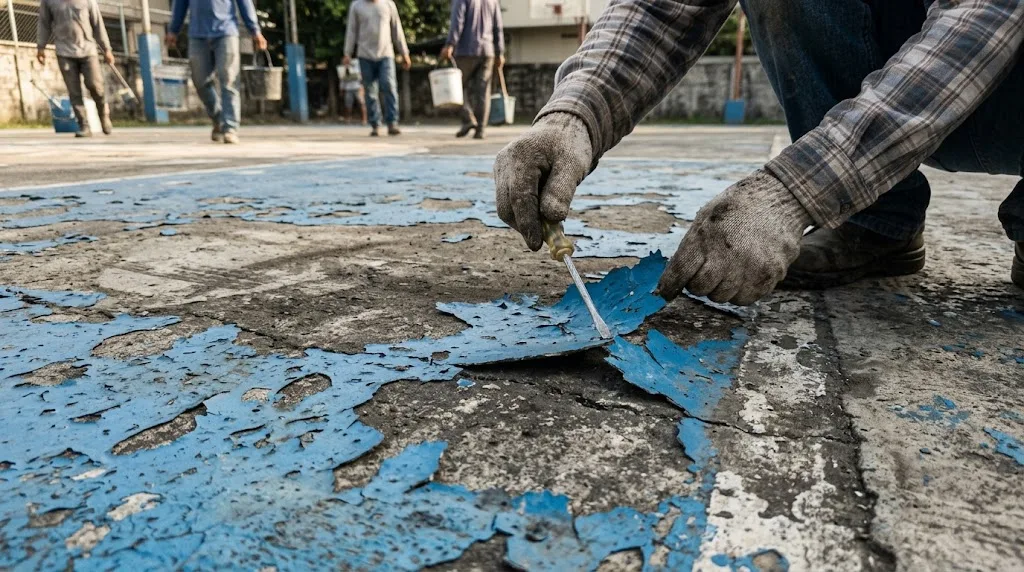
A flake lifted with a screwdriver tells you more than the colour does: look at the underside. Illustrative photo.
Short answer: in AEDO's experience, a failing court coating is usually a slab, preparation or weather problem more often than a bad-paint problem (that is our observation, not a survey). The data sheets we read put the same conditions on the slab and the day: moisture limit, cure time, surface finish, temperature and humidity. In our judgement, round blisters point first at moisture moving up through the slab. Peeling in strips points at a coat that never bonded: a smooth or sealed concrete face, laitance left on, or the wrong product. Chalky dust points at the texture coat. Puddles are a levels problem, and rust-coloured stains can mean corroding steel, which is structural. Before you pay for another coat, tick what you see in the checker below. It ranks the likely causes, names the test to run next, and gives one verdict: test before you recoat, repair then recoat, or slab problem: get it assessed.
This one is written for owners in Negros Oriental, from a barangay or LGU court in Bais or Tanjay to a resort, school or private club in Dumaguete, Sibulan or Manjuyod, who either have a court that is already failing or are about to paint a basketball slab or a new pad. One honest limit first: AEDO builds only in Negros Oriental. Everywhere else in the Philippines we design, seal, review remotely and check milestones of a contractor you hire. We name no climate figures here; the sequence and weather side is in our court painting schedule guide, and the layers and quantities in our court paint types guide.
Tick every symptom you can see, then answer what you know about the slab. It is a screening scorecard: the weights are AEDO judgement, not taken from a standard, and it cannot see inside your slab. Treat the top cause as the first thing to test, not as a diagnosis. There is no cost figure here by design.
Start with what the failure looks like, because each pattern has a short list of usual suspects and a test that separates them. The last column says where the statement comes from, so you can tell sourced facts from AEDO judgement.
| What you see | Usual causes, most likely first | First test or check | Basis |
|---|---|---|---|
| Round blisters | Moisture vapour from below; primer put on in rising temperature (pin holes); too early on new concrete | Plastic-sheet test on bare slab; pour date; the painter's temperature log | ACI 302.2 guide; Sika data sheet; Nippon data sheets |
| Peeling in strips, clean concrete underneath | No bond: smooth or sealed face, laitance, curing compound or hardener, wrong product, moisture | Ask what was sprayed on the slab and how it was prepared; pull-off strength | Nippon and Sika data sheets; Sherwin-Williams article |
| Chalky dust, sand rubbing off | Texture coat too thin or sand loaded only in the last coat; film weathering | Compare with the supplier's sample board; ask which coat carries the sand | AEDO job plan (practice, not a published finding) |
| Sticky, never fully cured | Rain, dew or high humidity during cure; wrong mix or dilution; too cool or shaded | Compare the painter's log with the data sheet limits; check the mix ratio on the data sheet | Nippon and Sika data sheets |
| Fading, patchy colour | Normal wear; stains that bleached the colour | Compare a worn lane with a corner that gets no play | ASBA and USA Pickleball manual |
| Cracks showing through | Slab shrinkage or movement; coating does not bridge cracks | Map and measure cracks; look for a level step or growth | Manual; Nippon sport finish data sheet |
| Puddles | Low spot or too little fall | Flood the clean court and string-line the birdbaths | Manual (birdbath, fall); Nippon data sheet |
| Rust-coloured stains | Net post or portable net hardware; or corroding rebar in the slab | Find the source; if it comes from the concrete, stop and have it assessed | Manual; AEDO structural guide |
| White powder or crust | Salts carried by water moving through the concrete | Dry-brush a marked patch and see if it returns after rain; plastic-sheet test | CMHA technical note; AEDO damp wall guide |
Concrete on the ground is never perfectly dry. Water from the subgrade, from a high water table or from a flooded pad moves up as vapour, and a coating film that does not let it out gets pushed off the slab. The American Concrete Institute's guide on slabs that receive moisture-sensitive coverings, ACI PRC-302.2-22 (first printed February 2023, replacing ACI 302.2R-06), says moisture-related problems with floor covering materials include blistering and delamination, and its scope names epoxy coatings and athletic flooring among the materials covered. It is written for floor coverings on slabs, mostly interior work, not for open-air court paint, so we use it for the mechanism and not as a court specification. We read the free preview of that guide (scope, contents and Chapter 1), not the paid body. What the preview does say is worth quoting in spirit: reaching a target moisture reading should not be the only test of a slab, because flatness, texture, cracking, curling, structural capacity, joints and whether the slab will stay dry matter too.
There is no single number. Each coating states its own limit, and the limits differ because the products differ. These are the ones we read:
| Document | Moisture limit it states | Air and slab conditions it states |
|---|---|---|
| Nippon Paint Floor-Pro 107 SF damp-proof epoxy primer, data sheet TDS 0174, Aug 2020 (Singapore site) | Concrete moisture content below 6%, or dried to 85% RH as per BS 8204; free from rising damp; waterproofed against negative ground-water pressure | Relative humidity below 85%; substrate at least 3 degrees C above dew point; 15 to 40 degrees C |
| Nippon Paint Floor-Pro 702 sport floor finish (acrylic), TDS 0195, Aug 2020 (Singapore site) | Below 4%, or dried to 85% RH as per BS 8204; free from rising damp; waterproofed against negative ground-water pressure | Relative humidity below 85%; substrate at least 3 degrees C above dew point; 10 to 35 degrees C on concrete |
| Sika Sikafloor-161 HC epoxy primer, Sept 2026 edition (Malaysia site) | Below 4% by weight (Tramex meter, CM or oven-dry method); no rising moisture on the polyethylene-sheet test | Relative humidity 80% maximum; substrate at least 3 degrees C above dew point; 10 to 30 degrees C |
| Tnemec, article on concrete moisture testing (a US coatings maker) | For most conventional floor primers, about 1.3 kg (3 lb) per 24 hours or 75 to 80% RH; specialty products tolerate up to about 9 kg (20 lb) per 24 hours and up to 99% RH | Not stated on the page |
Read the middle column twice. Two Nippon products from the same company differ (below 6% and below 4%), Sika asks below 4% by weight, and a damp-proof primer still insists on a slab free from rising damp. The takeaway is practical: ask the coating supplier for the moisture limit and the test method in writing before the slab is poured, because a barrier can only be laid before the pour. One more line from the Sika court sheet: its concrete-court preparation opens with "all concrete courts must have waterproof membrane" before the 28 days and the finish, and it adds an acrylic primer coat before the colour coats. It does not say what kind of membrane, so ask. Those four documents are all from outside the Philippines; we did not find a Philippine data sheet for a pickleball coating with these limits, and whether a given product is sold here is for the supplier to say.
We read the ASTM store pages (scope and summary only) and the three secondary descriptions; the standards themselves are paid, so the current edition's own wording on size and time is not confirmed. AEDO's "16 to 24 hours" sits inside that range (16 hours minimum per KTA-Tator and DeFelsko, 24 per Tnemec). Its 450 mm square is close to the 457 mm (18 in) sheet those pages give. We suggest the longer end, overnight, unless your coating maker names a time.
The ASBA and USA Pickleball manual describes the barrier for post-tensioned concrete courts: a vapour retarder generally of a minimum of two layers of 6 mil polyethylene, laid in opposite directions, lapped and taped, taking care not to puncture it. It points to ASTM E1745 (a standard on water vapour retarders under slabs) and ACI 302.2R for more. The manual does not give a barrier spec for a reinforced slab. AEDO's Manjuyod slab is reinforced, and the job plan uses one 6 mil sheet on the gravel with the steel on wide-base plastic chairs (never rebar offcuts, which puncture it), 150 mm laps taped, turned up at the wall, and every hole patched before the pour. That is a design choice for that slab. For yours it is the designer's call, and it is a call made before the pour, not after the first blister.
AEDO's plan also says to pour straight onto the barrier with no sand blotter layer over it, citing ACI 302.2R. We could not confirm that from what we read (the free abstract, the contents and Chapter 1 only), and 302.2R-06 has since been replaced by PRC-302.2-22. We report it as AEDO practice and name what we did not read.
On an existing slab you cannot add one. The options are to stop the water at its source (fix the levels, drainage and fill: see our lot filling guide), to let the slab dry and prove it by test, or to ask the coating maker what moisture-tolerant system it supports. Sika's primer data sheet says that if moisture is above 4 percent by weight a cementitious system can go on as a temporary moisture barrier; Nippon's damp-proof primer is described as moisture-tolerant during application but still wants a slab free from rising damp. Those are product decisions with their own limits, not a repair you can improvise. If the real problem is water entering the wall or the base, see our damp wall and peeling paint guide, which says the same thing about walls: repainting over an active moisture source often peels again within a rainy season, in our experience. Our waterproofing guide prices flat roofs and exposed roof slabs, decks, gutters, tanks and pools, not ground-bearing court slabs, so do not read its rates across.
The 28-day figure. Nippon's sport floor finish data sheet says new concrete must have cured at least 28 days, with a porous light-broom finish. Sika's Courtkote acrylic court coating data sheet says to allow new concrete to cure for 28 days. Those are the two sports-court documents we read, and AEDO's job plan uses the same figure, "28 days minimum". The manual gives a different shape for a post-tensioned slab: keep it moist for about seven days, then allow a further 21 to 38 days. Our concrete mix ratio guide asks for at least seven days of continuous curing, which agrees with the first part.
Time is not dryness. The manual's indoor chapter says concrete cures two ways, strength curing between 21 and 45 days and moisture curing that depends on conditions and is hard to gauge, so it is usually determined by testing. For indoor sports floors it asks for concrete in place at least 60 days and tested below the manufacturer's limit. That is an indoor-floor rule, not an outdoor acrylic one, but it shows why a calendar alone does not clear a slab. A slab on well-drained ground and a pad built up on fill over a wet site are not the same slab on day 28.
Alkalinity. Fresh cement is strongly alkaline. A resin supplier's leaflet (Synthomer) says Portland cement mixed with water reaches pH 13 to 14 and causes alkali burn and discolouration when painted. A Sherwin-Williams article on peeling concrete floors aims for a pH of 7.0 to 10.0 after cleaning and lists oil-based coats on bare, unetched, uncured concrete among seven causes of peeling. The manual's indoor chapter lists alkali among the bond-breakers a slab must be free of before a resilient athletic floor goes on, and the ACI preview lists a chapter on concrete pH testing, but we read no pH figure from either. AEDO's job plan says new concrete pH 12 to 13; we could not match that exact range to a source, so treat all of these as showing the direction, not as a limit. The limit that counts is the one on your coating's data sheet.
This is where most "peeling in strips" starts. The data sheets are specific:
What that means for a polished slab. Our surface guide prices the system AEDO used in Manjuyod: a machine-troweled and polished slab, then an epoxy primer and rubberized top coats. A troweled or polished face is the opposite of the broom finish the acrylic data sheets ask for, and the primer data sheets ask for mechanical preparation. AEDO's own job plan says so too: tell the polishing subcontractor not to apply a densifier or hardener, because a densified surface will not take the primer, and either leave a lightly abraded finish or budget a light diamond grind before priming. Whether a polished face is acceptable for a given product is the coating maker's decision, so get it in writing for your product before you polish.
Each data sheet sets a window. Outside it you can get a sticky film, a film that blisters, or a coat that never bonds.
| Source | What it says about conditions |
|---|---|
| Nippon sport floor finish (acrylic) | Relative humidity below 85%; at least 3 degrees C above dew point; do not apply below 10 degrees C ambient, above 35 degrees C on the concrete, or when rain is imminent; best in the cool morning or evening; second coat after a minimum of 4 hours depending on weather |
| Sika Sikafloor-2045 Courtkote (acrylic) | Minimum 4 hours between coats; court ready for use 24 hours after the final coat; protect the whole application and curing from rain |
| Sika Sikafloor-161 HC (epoxy primer) | Relative humidity 80% maximum; at least 3 degrees C above dew point; protect from damp, condensation and direct water for at least 24 hours; apply during falling temperatures, because on porous concrete during rising temperatures air rising from the pores can leave pin holes, and if pin holes remain the next layer can blister |
| ASBA and USA Pickleball manual | Patching at at least 55 degrees F (about 13 degrees C) with no precipitation in the immediate forecast; each coat dry before the next; at least 72 hours for an acrylic surface to cure before play |
Two points follow from those lines. First, a slab sitting in strong sun can be well over the air temperature, and Nippon sets a 35 degrees C limit on the concrete, not the air. Second, the pin-hole note explains a blister that is not moisture from below at all: a primer put on while the slab warms up can trap air and blister the coat above it. Both are things an applicator can plan around with a thermometer and a hygrometer, and both are things you can ask to see in a daily log.
For a court in Negros Oriental the practical consequence is simple: the painting date is a weather decision, and the right contractor can tell you the limits for their product and what they do when it rains mid-coat. We deliberately print no rainfall or climate figures here. How the cure and recoat holds fit into a real programme, with PAGASA data, is in our painting schedule guide.
Wrong product. Sherwin-Williams puts unsuitable coating selection for the floor's wear and exposure at the top of its seven causes of peeling concrete. A sports-court product is made and tested for it: Nippon's sport floor finish says it is designed for sport courts and claims resistance to ponding water for 48 hours; Sika's Courtkote is sold as a hardcourt sports surfacing system. AEDO's own list of failure causes includes a wall or roof elastomeric used on a trafficked court. No standard we read says that, so treat it as AEDO field judgement. The same logic shows up in walls: our painting cost guide notes Boysen publishes its masonry putty for interior use only, and that using it outside is a common reason exterior repaints peel in sheets. The test is simple: read the can, then the data sheet's application areas. If neither says sports court or trafficked floor, ask why that product is on your slab.
Dusting. AEDO's Manjuyod plan says silica sand only in the final coat, over a smooth substrate, is the usual cause of first-season dusting, and says to consider a lighter silica loading in the first top coat as well as the working loading in the second. That is AEDO practice, not a published finding. For comparison, Nippon's Malaysian professional page describes its anti-slip epoxy hybrid system as applied with non-skid sand in the intermediate coat. If your court sheds sand, ask the applicator which coat carries it and how much, and compare against the supplier's sample board.
The order that saves money. Repainting over an unfixed cause repeats the spend. For scale, AEDO's Manjuyod contract paint line was PHP 78,158 on a 352.63 sqm pad, PHP 221.64 per sqm (already public in our surface guide). That is a contract line, not a recoat price, and we do not publish a repair price for failed courts; it only shows the size of money that is thrown away each time a coat goes over a cause nobody fixed.
For a new court, close each cause before it happens. This list mixes sourced items with AEDO practice, marked as such:
Common mistakes. Repainting before testing. Treating the flake as the problem instead of the slab. Spraying a sealer or densifier on a slab that will be painted. Counting 28 days on the calendar and skipping the moisture test. Painting at the first dry afternoon after a wet week. Using a wall paint because it is cheaper per pail. Assuming a "waterproof" coat on top will hold water back from below.
AEDO's job plan for a 2-court open court in Manjuyod, Negros Oriental, has its own list of working rules for the coating. We are not asking you to take them on trust. Here is each one against what we could read this session:
| AEDO working rule | What we could confirm | What we could not |
|---|---|---|
| 28 days minimum before priming | Both sports-coating data sheets we read (Nippon and Sika) ask for 28 days; the manual has 7 days moist plus 21 to 38 days for post-tensioned slabs | That 28 days alone proves a slab dry. It does not: a moisture limit is tested |
| 6 mil polyethylene barrier on the gravel | The manual describes 6 mil polyethylene, generally two layers, under post-tensioned court slabs | A barrier spec for reinforced slabs in what we read. One sheet is AEDO's design choice |
| No sand blotter over the barrier (ACI 302.2R) | ACI PRC-302.2-22 replaced 302.2R-06; the free preview lists a chapter on vapour retarder location | The blotter statement itself: we read the abstract, contents and Chapter 1 only |
| ASTM D4263 sheet test, 450 x 450 mm, 16 to 24 hours | The test exists and ASTM lists D4263-24 as active; an 18 in (457 mm) sheet, at least 16 hours (KTA-Tator, DeFelsko) or at least 24 hours (Tnemec, 2005 edition). AEDO's 16 to 24 hours sits inside that range | The current edition's own text (paid); the exact 450 mm size (the pages we read say 457 mm) |
| No densifier or hardener before priming | Direction supported: Nippon (hardeners, curing membranes), Sika (curing membrane, additives, surface treatments), Sherwin-Williams (hardeners added to concrete) and the manual (liquid curing agents, sealers under indoor floors) all warn against such treatments | The word "densifier" in any page we read; that a lightly abraded finish is enough without grinding: depends on the product |
| New concrete pH 12 to 13 | Strong alkalinity of fresh cement is confirmed; Synthomer gives pH 13 to 14 for cement mixed with water | The 12 to 13 range. Sherwin-Williams aims for 7 to 10 after cleaning |
| Silica only in the last coat causes first-season dusting | Nothing; Nippon's anti-slip system uses sand in an intermediate coat | Any published finding. It is AEDO practice |
| Wall or roof elastomeric on a trafficked court fails | Sherwin-Williams lists unsuitable coating selection as the first cause of peeling | A standard naming elastomerics. It is AEDO field judgement |
| Vapour blistering is the most common court coating failure in this market | Nothing | Any survey. It is AEDO's observation, not a statistic |
That job's coating results are not part of this article. The finish lines (slab, polish and paint) and their rates are in the surface guide.
An open-air court takes sun and rain, so every point above is live: the barrier and the cure plan belong in the design, the weather limits belong in the contract, and the test belongs before the first coat. If you are in Dumaguete, Bais, Sibulan, Tanjay, Manjuyod or a neighbouring town and want one firm to take the court from slab to lines, that is what design-build is for, and construction from your plans covers a court you have already designed. Our Dumaguete and Bais pages describe the area. Our construction page lists a pickleball court in Manjuyod as work currently on site.
On the checking side, a Single Milestone Check from PHP 7,500 per visit is one site visit tied to a critical stage; for a court the stages that matter are before the pour (barrier laid and undamaged, chairs, levels) and before final payment (coating log, sample board). Our PHP 5,000 structural assessment lists foundation and settlement, columns, beams and slabs, and crack pattern and width in its scope, and the report is a structural finding. It does not list coating chemistry or moisture testing, so for a court slab we would confirm that a visit fits before you book. Outside Negros Oriental we design, seal and check remotely; we do not build there. See also what a structural assessment report contains and structural engineer fees.
Moisture, cure, preparation and weather limits are from the manufacturer data sheets named in the text (Nippon Paint Singapore and Sika Singapore and Malaysia sites) and from the ASBA and USA Pickleball manual, Pickleball Courts: A Construction and Maintenance Manual, 2020 edition. ASTM, ACI and ICRI documents are paid; we read only the free scope pages, abstract, preview and contents named in Sources. Tnemec, Sherwin-Williams, Synthomer, KTA-Tator, DeFelsko and the CMHA are secondary manufacturer or industry pages. AEDO's own rules come from the Manjuyod job plan and are labelled as AEDO practice. The checker's weights are AEDO judgement. No Philippine standard we found sets a limit for a pickleball court coating, and we found no Philippine data sheet for one. The only peso figure is the public Manjuyod contract line.
Why is the paint on my pickleball court blistering?
The first thing to rule out on concrete is moisture moving up through the slab and lifting a film that cannot let it out; AEDO's experience is that this is the usual culprit, though we have no survey to prove it. ACI's guide on slabs under moisture-sensitive coverings lists blistering and delamination among moisture problems, and its scope includes epoxy coatings and athletic flooring (it is written for floor coverings, not specifically for outdoor courts). Other causes are coating too soon on new concrete, putting a primer on during rising temperature so it pin-holes, and applying in humid or dewy weather. Test the slab for moisture before you repaint.
Why does paint peel off a concrete court in strips?
Strip peeling usually means the coat never bonded to the concrete. The manufacturer data sheets we read ask for laitance to be removed, a pull-off strength of at least 1.5 N/mm2, and no curing membranes, hardeners or surface treatments under the coating. A smooth troweled or polished face, a sealer or densifier, the wrong product, or moisture from below can each do it. Find out what was applied to the slab and how it was prepared.
How long must new concrete cure before painting a pickleball court?
The two sports-coating data sheets we read, Nippon Paint's sport floor finish and Sika's Courtkote, both ask for at least 28 days on new concrete. The ASBA and USA Pickleball manual describes about 7 days of moist curing then a further 21 to 38 days for a post-tensioned court slab. Days are not proof of dryness: the data sheet of your coating also sets a moisture limit that has to be tested.
How do I test a concrete slab for moisture before painting?
The simplest test is the plastic sheet method, ASTM D4263: a sheet is taped to the clean slab and checked for moisture afterwards; the pages we read give a minimum of 16 hours, 24 hours or 48 hours depending on the source, so use the time your coating maker names. It only shows whether moisture is present in the upper slab. Quantitative tests are an in-slab relative humidity probe (ASTM F2170) and calcium chloride (ASTM F1869). Use the method and limit your coating data sheet names.
Can I just repaint a peeling pickleball court?
Not until you know why it peeled. Paint laid over an active cause fails again, and the manual we read says repaired blemishes lead to a speckled look. If the cause is preparation or weather, fix that, remove the failed film back to sound edges and recoat inside the data sheet's weather window. If it is moisture or a moving slab, repainting only hides the problem for a while.
Does a vapour barrier under the slab stop court paint from blistering?
It lowers the risk but does not remove every cause. The manual describes a polyethylene vapour retarder under post-tensioned court slabs, generally two layers of 6 mil sheet, lapped and taped. A barrier can only go in before the slab is poured, and a punctured one defeats its purpose. Blisters can also come from weather, preparation and product problems that a barrier does not touch.
Manuals, data sheets and standards pages we read this session (all returned HTTP 200). External links open in a new tab.
All data sheets are from outside the Philippines; we found no Philippine data sheet for a pickleball court coating and no Philippine standard that sets a limit for one. We could not confirm from the standard itself AEDO's 16 to 24 hour sheet test (secondary sources agree with the range), and we could not confirm its no-sand-blotter citation, its pH 12 to 13 range, or its dusting and elastomeric rules from a source; they are labelled AEDO practice. This article is general information, not a diagnosis of your court.
Send photos of the failure, one close-up of a lifted flake, the slab size and age, and what the painter used. A licensed engineer will tell you which test to run first and whether the slab itself needs a look.