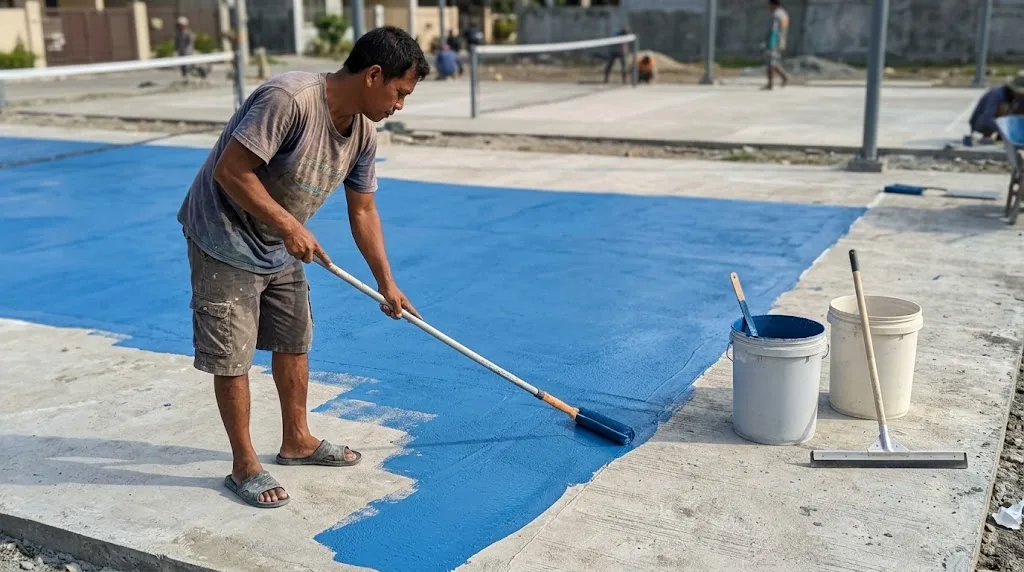
One roller, one wet edge, and a few pails: a court coating is thin, and every layer of it has its own job. Illustrative photo.
Short answer: a court is not painted with one paint. It is a stack: a primer that bonds to the slab (the epoxy primer sheet we read calls itself a barrier against moisture from the substrate and says it resists alkali), two or three colour coats that carry the texture and the colour, and line paint last. Which chemistry you pick (water-based acrylic, one-pack water-based epoxy hybrid, a two-pack epoxy primer under either) decides the number of coats, the spread rate and the waiting time between coats, and those facts are on the data sheet, not in the brochure. AEDO's own 2-court job in Manjuyod, Negros Oriental used one coat of Nippon epoxy primer and two coats of a Nippon rubberized top coat, with silica sand in the second coat over the playing area only. The calculator below rebuilds that job: for two courts it comes to about 9.0 US gallons of primer, 15.0 gallons of top coat and 12 kg of silica, about ₱67,400 of paint at the prices AEDO paid on that one job. Do not paste those prices into your own budget: they are one job's purchase prices, and the coverages are what that job's gallons implied, not a manufacturer rate. Also do not use wall paint, roof coating or a general floor paint just because the can says "concrete".
If you are an owner in Dumaguete, Bais, Sibulan, Tanjay, Canlaon, Manjuyod or anywhere else in Negros Oriental, with a barangay slab, a resort, a school or a lot you want turned into courts, the paint is the layer players and weather touch first, and the one you pay to redo if the system was wrong. AEDO designs courts nationwide and builds them only in Negros Oriental, so this post shows what each layer does, what the data sheets we read say, and how the litres are worked out so you can check a painter's quote. Companion posts cover when the court can be painted, why coatings fail and the lines.
Pick the number of courts, the playing-surface size and a paint system. You get litres and US gallons per layer, silica in kilograms, the material cost and a plan of the pad showing the outer run-off zone, the interior playing zone and the lines. The defaults rebuild AEDO's Manjuyod job; every coverage and price can be overwritten with your supplier's data sheet and quote. A planning aid, not a coating specification or a quotation.
Drawn from the number of courts, playing-surface size and margin above. The orange area is the outer run-off zone; the blue area is the interior zone (the 20 x 44 ft court); the lines are the 2 inch court lines. Line widths are drawn thicker than true scale so they stay visible.
Planning sketch, not for construction, not to scale (NTS). Court size and line positions follow Section 3 of the 2026 USA Pickleball rulebook. Which zones get silica, pad edges, fall, drainage, joints and fencing are per design and per the data sheet of the products used.
The coating is the top few millimetres of a court, and every layer in it exists for one reason. Reading the manual and the data sheets together, the order on a new concrete slab is:
What each type is, what its data sheet says, and where it shows up. All data sheets are from outside the Philippines (Singapore, Malaysia), so confirm availability and the Philippine version of the sheet with your supplier. We read every figure below on the sheet or page named in Sources.
| Type | What it is | Coats and spread (as read) | Recoat, cure, odour (as read) | In the Manjuyod job |
|---|---|---|---|---|
| Epoxy primer, two-pack | Nippon High Performance Primer: solvent-based, amine-adduct cured epoxy, a barrier against moisture from the substrate, alkali and efflorescence resistant (TDS updated Jan 2025, Malaysia). Pack 5 or 20 L. | 1 coat. 50 to 60 micron dry film. 8 to 10 sqm per litre theoretical; 5 to 6 sqm per litre practical on bare concrete wall by roller. | Recoat 8 hours minimum; pot life 4 to 6 hours; the sheet says avoid painting above 4% substrate moisture, when RH exceeds 85%, or when the surface is less than 3 C above the dew point. Solvent-based and highly flammable: ventilation, no ignition sources. | "1 coat Nippon epoxy primer". The job plan does not name the product. |
| Acrylic colour coats, water-based | Nippon Floor-Pro 702 Sport Floor Finish: one-component 100% acrylic, water-based, for sports courts (TDS 0195, Singapore, 2020). Sika Sikafloor-2045 Courtkote: pigmented acrylic used with a Neutral Filler (Singapore, May 2026). The manual's colour-coating sequence and its basic court-surface diagram are acrylic. | Floor-Pro 702: 1 to 2 coats, 250 micron dry film per coat, 3.0 sqm per kg per coat theoretical; system 1 or 2 base coats plus 2 finishing coats. Courtkote: per 100 sqm, 20 L primer, 60 L filler and 40 L Courtkote (two coats). | Floor-Pro 702: recoating time given as "within 14-18 hrs @ 28 C" (wording unclear, so we do not use it as a window), second coat after a minimum 4 hours, ponding resistance 48 hours. Courtkote: at least 4 hours between coats, ready for use 24 hours after the final coat. Both: 28 days on new concrete. Manual: at least 72 hours cure before play. | Not used. Shown here as the common alternative. |
| Epoxy hybrid, one-pack water-based | Nippon FloorSports 1K Epoxy Hybrid, water-based, about 40% volume solids, for multi-purpose sports floors (TDS updated Oct 2025, Malaysia). Nippon's Malaysian pickleball page recommends High Performance Primer plus two coats of it. | 2 to 3 coats. Unfilled 0.10 to 0.20 L per sqm per coat; filled, rolled 0.23 to 0.33 L per sqm per coat; filled, trowelled 0.50 to 1.00 L per sqm. Pack 5 or 15 L. | Touch dry 30 minutes, hard dry 2 hours, recoat 6 to 8 hours minimum. Water thinner and water clean-up; the sheet asks for good ventilation. The Nippon Malaysia page gives "low odour" only for the PU clear top coat. | Not used. Nippon's pickleball system on the Malaysian page. |
| Rubberized or elastomeric top coat | The job plan's own words for its top coat. We could not read a data sheet for it, so we cannot tell you its binder or coverage from a document. The manual's "rubber" appears only as granules in cushion layers (next row). | Job plan: 2 coats. Coverage as bought: 12.9 sqm per litre outer, 10.8 interior (section 5). | Not read. | "2 coats Nippon rubberized top coat", silica in coat 2 over the interior only. |
| Polyurethane (PU) and cushion layers | The manual describes liquid-applied cushion (4 to 8 coats of a latex-bound rubber-granule mix) and poured-in-place systems (a polyurethane binder with rubber granules, generally 4 to 12 mm), topped with acrylic colour coats. Nippon's FloorShield WB PU Clear Matt is a two-component water-based clear top coat that Nippon's Malaysian page marks compulsory for interior and semi-exposed areas; the exterior systems on the FloorSports sheet list no PU top coat. | Cushion and PU systems are thick; see our surface options guide for the cost side. | Not read beyond the above. | Not used. |
| Silica or sand aggregate | The manual says, in its cushioned-surface passage, that the colour coating may be mixed with sand to achieve a specific texture over the whole cushioning system (it gives no sand ratio). Its indoor chapter says in pickleball the rougher the texture the more the surface grips the ball and the slower it plays, and too smooth may be uncomfortably fast. Nippon's FloorSports sheet specifies 20% Non-skid Sand 103 Fine in its filled system. | Nippon: sand in the first finishing coat for the rolled filled system, in both finishing coats for the trowelled one; the 20% basis is not stated. | Mix mechanically for 2 to 3 minutes on the Nippon sheet. | About 12 kg (PHP 500) in the second coat, interior only. |
| Line paint | The manual says one or two coats of textured line paint as the colour-coat maker recommends, and that white textured lines are best on a dedicated court. The one line paint sheet we read is a US 100% acrylic emulsion with fine sand (SportMaster Textured White Line Paint), not a Nippon product. | 500 to 600 lineal feet of 2 inch line per US gallon on that sheet. Details in our line marking guide. | After the colour coat is dry. | Line paint allowance, PHP 4,500 for 2 courts. |
VOC and odour, only as read. The Nippon Malaysia sports court page gives "low odour" only for the FloorShield WB PU Clear Matt coat, not for the 1K Epoxy Hybrid itself, whose sheet asks for good ventilation; the High Performance Primer sheet is solvent-based and flammable. Boysen's product pages give VOC in grams per litre (for example 10.5 g/L for its water-based Acqua Epoxy), but we did not read a VOC figure for any sports-court coating. The manual's VOC passage is in its indoor chapter and is general: paint can emit VOCs during installation. We found no Philippine VOC limit for court coatings and did not look for one beyond that.
Acrylic or epoxy hybrid? We found no independent test comparing them for a Philippine climate. The manual describes acrylic systems; Nippon's pickleball page recommends the epoxy hybrid and says its 1K Epoxy Hybrid system is ITF-certified with a pace rating, which is Nippon's claim and we did not look up the ITF listing. Choose on a written recoat interval, a written warranty and a sample board on your own slab, as our surface options guide says.
One risk is buying a good paint for the wrong surface; AEDO's job plan lists a wall or roof elastomeric on a trafficked court as a common cause of coating failure. These are Philippine-market products whose pages we read, with what each is sold for. Nothing here says a named product failed on a court; the mechanisms are reasoning, and where AEDO has a working rule we say so.
| Product class | What the page says it is for | Why it is wrong on a trafficked court |
|---|---|---|
| Elastomeric wall covering (Boysen Elasti-kote) | A 100% acrylic water-based elastomeric wall paint formulated to bridge hairline cracks; "ideal for exterior concrete surfaces"; basecoat dry film 4.5 to 5.5 mils; recoat 2 to 4 hours; allow new concrete 14 to 28 days. The page says nothing about foot traffic or sport. | Reasoning, not a quoted failure: a thick film made to stretch over wall cracks is not specified for shoe scuffing, ponding or traction. AEDO's job plan lists "wall or roof elastomeric on a trafficked court" as a common cause of coating failure; no document we read states the mechanism. |
| Roof coating (Boysen Cool Shades) | A water-based acrylic roof coating with infrared-reflecting pigments for "properly primed roofing material", gloss finish. | A roof is not walked on. The page gives no abrasion or traction claim, and a gloss finish is the opposite of the "non-reflective and non-skid" claim on Nippon's Floor-Pro 702 sheet. The glare and grip points are reasoning. |
| General floor paint (Boysen Acqua Epoxy) | A two-component water-based acrylic epoxy for concrete floors, semi-gloss; "can withstand foot and light vehicular traffic"; recoat 4 hours; foot-traffic abrasion resistance fully develops after 3 days of curing (7 days for heavy duty); 25 to 30 sqm per 4 L at 1.7 to 2.0 mils. | It is a floor product, so it is not wrong in the way wall paint is. But the page makes no sports-court, traction or ball-bounce claim, and its finish is semi-gloss. Ask for evidence of texture and bounce, or use a system whose sheet names sports courts. |
| Wall and masonry primers and "paint" used as a floor primer | Nippon's High Performance Primer sheet lists masonry walls and concrete floors as substrates but gives separate preparation rules: a wall needs moisture below 30% by protimeter and alkalinity below pH 9; a floor must not exceed 4% moisture. | The data sheet has a floor rule and a wall rule. Using the wall rule on a slab skips the 4% floor limit. |
Two more points from the same pages. Boysen's wall page says that if concrete has cured more than 28 days no neutraliser is needed; the Nippon Floor-Pro 702 and Sika Courtkote court sheets set 28 days as a minimum for new concrete, which is longer than the wall paint's 14 to 28 day window. And a data sheet's list of substrates is not a promise of fitness: Nippon's sheet disclaimer says it remains the user's responsibility to determine suitability for the particular use. Our schedule guide covers the timing, and our court enclosure guide covers the products that do belong on walls, steel and roofs.
You can check every line by hand. For the default case, two courts at 30 x 60 ft each, side by side:
The coverage inputs were worked backwards from the gallons the job plan bought, which is why the calculator lands on whole gallons. That is a check that the arithmetic matches the job, not proof that the coverage is right for your product. How coverage relates to film thickness is on the data sheets: Nippon's formula is volume solids per cent times 10 divided by dry film thickness in microns, in square metres per litre per coat. For High Performance Primer that is 55 x 10 / 55 = 10, the theoretical top of its 8 to 10 range. The same sheets add that loss factors "can vary from 30% - 50% or even more", which is why practical figures run lower: a 40% loss turns 10 into 6, the neighbourhood of its 5 to 6 practical figure. Waste at 0% in the Manjuyod preset means no allowance for loss beyond what its coverages already contain.
The unit trap. The job plan's coverages only come out at 9.8, 12.9 and 10.8 sqm per litre if a "gal" is a US gallon of 3.785 L, and the plan does not name the pack. Boysen's product pages sell 4 litre cans; the Nippon sheets we read list 5, 15 and 20 litre packs. A 4 litre can holds 5.7% more than a US gallon (4 / 3.785 = 1.057). If the plan's "gal" had been 4 litre cans, the same area would imply coverages 5.7% lower (about 9.3, 12.2 and 10.2 sqm per litre). For your own quote, set "Prices below are per" to litre and divide a can price by its litres: pricing a 4 litre can per US gallon overstates the cost by 5.7%. Ask the pack size in litres on the quote.
The job plan says to verify its coverage "against Nippon's TDS for the specific products". We did that as far as the documents allow. Here is what lines up and what does not:
| Layer | Job plan as bought (sqm per litre per coat) | Data sheet we read | Reading |
|---|---|---|---|
| Epoxy primer | 9.8 | Nippon High Performance Primer: 8 to 10 theoretical, 5 to 6 practical on bare concrete wall by roller. | 9.8 is inside the theoretical range and above the practical one. The plan does not name which Nippon primer it bought, so this is the closest sheet, not a confirmed match. At 5 sqm per litre the same pad needs about 67 L (17.7 gal). |
| Top coat, outer | 12.9 | No sheet for the product. For comparison: FloorSports 1K unfilled 5 to 10; filled rolled 3.0 to 4.3; Floor-Pro 702 3.0 sqm per kg at 250 microns; the Courtkote system about 2.0 per litre of filler-colour mix. | Cannot be verified. It is thinner (more sqm per litre) than every filled system we read, and the plan's note says the figure is "in range once silica bulks the mix". |
| Top coat, interior | 10.8 | Same as above. | Cannot be verified, same caution. |
What to do with that. If a painter's quote gives a top coat coverage well above the data sheet's figure for that exact product, ask what film thickness it assumes and what warranty applies: coverage is thickness, and thin film is where early wear comes from (reasoning; we found no source tying the two for a court). Switch the calculator preset to your data sheet's number and see the litres. For the epoxy hybrid preset the calculator uses the TDS's 0.33 L per sqm (3.03 sqm per litre), the conservative end of the filled rolled range.
AEDO's own job is a 2-court open court in Manjuyod, Negros Oriental. From AEDO's Manjuyod job plan, the painting system and quantities as bought were:
| Item | Basis | Bought | Rate |
|---|---|---|---|
| Nippon epoxy primer | 1 coat over 334.34 sqm | 9 gal | ₱1,600 per gal |
| Nippon rubberized top coat, outer / run-off | 2 coats over 170.8 sqm | 7 gal | ₱3,200 per gal |
| Nippon rubberized top coat, interior | 2 coats over 163.5 sqm, second coat silica-loaded | 8 gal | ₱3,200 per gal |
| Silica sand | about 12 kg for the second interior coat | lump sum | ₱500 |
| Line marking paint | 2 courts | lump sum | ₱4,500 |
Those are AEDO's purchase prices on one job, not a price list and not a quotation. The job plan sets no third coat: the silica-loaded second coat is the finished playing surface. The outer run-off zone gets primer and two top coats and no silica. AEDO has no published painting price beyond that job; for your court the painting is quoted after a slab visit or plan review.
AEDO working rules behind the system, and what we could and could not confirm. These are AEDO practice for that job:
Every coat is a weather decision, and the data sheets give the limits. The Nippon sheets we read say not to apply when relative humidity exceeds 85% (Floor-Pro 702 asks for under 85%) or when the surface is less than 3 C above the dew point, and Floor-Pro 702 adds not to apply if rain is imminent. Sika's Courtkote sheet says to protect the whole application and curing from rain. PAGASA's climatological normals for Dumaguete City, 1991 to 2020 (a 30-year average, not a record), give 1,322.6 mm of rain and 124 rainy days a year (PAGASA counts a rainy day as 24 hours from 8 AM with at least 1 mm), with every month from January to December having at least 5. The same table lists a mean minimum temperature of 24.8 C, a mean dew point of 24.2 C and mean relative humidity of 81% for the year; these are averages of different observation times, so they do not tell you when a 3 C margin is met on a slab, but they show why the dew point limit is a real hold here. We do not claim dry months from that. The scheduling consequences are worked in our painting schedule guide.
AEDO designs and builds courts in Negros Oriental. Our design-build service covers the province; if you already have plans, the construction service builds from them, and if you have a lot and an idea, complete design at PHP 250 to 450 per sqm is the design route. The local pages for Dumaguete, Bais, Sibulan and Tanjay describe how we work in each; there are no AEDO location pages for Canlaon or Manjuyod, where we have worked, so we link none. We found no Philippine standard that sets a court coating system, and no provincial rule on one; for a public or barangay court, ask the municipal building official what the LGU requires.
Outside Negros Oriental we do not build. We design the court, write the paint system and cure holds into the drawings, review the contractor's data sheets and quote, and check milestones. A Single Milestone Check starts at PHP 7,500 per visit (read the project oversight page for what a visit covers, and ask us how a visit works for your site). For converting an existing slab, see our basketball conversion guide, and for the whole-court budget, the court construction cost guide.
What AEDO does. We design, check and review courts nationwide and build only in Negros Oriental. In Negros Oriental we price the whole court design-build, including the paint system, cure and tests, after a slab visit or plan review: there is no published AEDO painting price. Elsewhere we draw the court, write the coating holds into the drawings, review a contractor's paint specification and quote against the data sheets, and check milestones. AEDO is not a paint supplier and has no brand partnership: Nippon is named only as the system used on one AEDO job and as the source of data sheets. We do not give legal opinions.
Rules, read this month: 2026 USA Pickleball Official Rulebook Section 3 (rules 3.A.1, 3.A.3, 3.A.4.e), as hosted by Pickleball Canada. Manual: Pickleball Courts: A Construction and Maintenance Manual, 2020 edition (ASBA and USA Pickleball): colour coating (printed pages 41 to 42), cushioned surfaces (printed pages 42 and 45), Other Surfacing Tips (printed page 49), the post-tensioned slab passages (printed pages 30 and 36), and the indoor chapter's texture, VOC and leftover-material passages (printed pages 99, 102 and 103). Manufacturer data sheets and pages: Nippon Paint Singapore Floor-Pro 702 (TDS 0195, August 2020); Nippon Paint Malaysia High Performance Primer (Jan 2025) and FloorSports 1K Epoxy Hybrid (Oct 2025) data sheets and product pages and its sports court flooring page; Sika Singapore Sikafloor-2045 Courtkote (May 2026); SportMaster Textured White Line Paint (US); Boysen Philippines product pages for Elasti-kote, Cool Shades and Acqua Epoxy. Climate: PAGASA climatological normals, Dumaguete City, 1991 to 2020. AEDO records: the Manjuyod job plan (painting system, areas, gallons bought and rates, silica and line allowances, failure-mode rules). Our computations: every area, litre, gallon and kilogram in the post is arithmetic on those inputs, shown in section 4. AEDO assumptions with no source, edit them: 10% waste on the non-Manjuyod presets, treating the Courtkote consumption as two coats of the mix at 2.0 sqm per litre, the 0.22 kg per litre for Nippon's 20% sand (basis not stated), the 5 sqm per litre primer default for the hybrid preset (the low end of the sheet's practical range, which is for a wall), and the silica kg per litre derived from the plan's 12 kg. What we could not confirm: the product names and data sheets for the Manjuyod primer and top coat, what "rubberized" means in a Nippon data sheet, any Philippine price for Nippon, Sika or other court coatings (the prices here are AEDO's own on one job), the mechanism by which a wall or roof elastomeric fails on a court, and any recoat interval for a Philippine climate.
What type of paint is used on a pickleball court?
A hard court coating is a stack of layers, not one paint. The ASBA and USA Pickleball manual describes the common outdoor system as textured filler coats, then two or three colour coats, then one or two coats of textured line paint, with an acrylic surface as its basic system. Manufacturer data sheets we read describe a water-based acrylic sport floor finish, a one-pack water-based epoxy hybrid, and a two-pack epoxy primer under them. AEDO's own 2-court job in Manjuyod, Negros Oriental used one coat of Nippon epoxy primer and two coats of a Nippon rubberized top coat with silica sand in the second coat over the playing area.
How many coats of paint does a pickleball court need?
It depends on the system, so follow the data sheet for yours. Nippon's High Performance Primer sheet asks for 1 coat of primer, its FloorSports 1K Epoxy Hybrid sheet asks for 2 to 3 finishing coats, and its Floor-Pro 702 sheet describes 1 or 2 base coats plus 2 finishing coats. The manual says generally two or three colour coats and one or two line coats. AEDO's Manjuyod job used 1 primer coat and 2 top coats.
How much paint do I need for a pickleball court?
Litres equal area times coats divided by coverage in square metres per litre, plus waste. For two courts on a 334 square metre pad with 164 square metres of playing area, AEDO's Manjuyod job plan bought 9 gallons of primer, 15 gallons of top coat and about 12 kg of silica, which the calculator reproduces at about 9.0 gallons, 15.0 gallons and 12 kg. Those coverages are purchase-based figures from one job, not a manufacturer rate, and a data sheet may give a lower coverage per litre, which means more paint. Replace them with the data sheet of your product.
Can I use house wall paint or roof paint on a pickleball court?
We do not recommend it. The Philippine wall and roof products whose pages we read are sold for walls and roofs: an elastomeric wall covering made to bridge hairline cracks, and a gloss heat-reflective roof coating. Neither page mentions foot traffic or sport. AEDO's job plan lists a wall or roof elastomeric on a trafficked court as a common cause of coating failure, and the failure mechanism is AEDO practice, not something a data sheet states. Use a product whose data sheet names sports courts or concrete floors, and ask the supplier for the data sheet.
How long should paint dry between coats on a pickleball court?
Each product sets its own minimum. Nippon's High Performance Primer sheet gives a minimum recoat time of 8 hours, its FloorSports 1K Epoxy Hybrid sheet 6 to 8 hours, and its Floor-Pro 702 sheet a second coat after at least 4 hours, depending on weather. Sika's Courtkote sheet says at least 4 hours between coats and 24 hours before use. The manual says each coat must dry completely before the next and that an acrylic surface generally needs at least 72 hours to cure before play.
Why is sand mixed into pickleball court paint?
For texture and grip. The manual says, in its cushioned-surface passage, that the colour coating may be mixed with sand to achieve a specific texture, and its indoor chapter says that in pickleball the rougher the texture the more the surface grips the ball and the slower it plays, while too smooth a surface may be uncomfortably fast. Nippon's FloorSports sheet specifies 20 percent non-skid sand in its filled system without saying whether that is by weight or by volume. AEDO's Manjuyod job put about 12 kg of silica in the second top coat over the playing area only.
Does AEDO paint pickleball courts in Negros Oriental?
AEDO designs and builds pickleball courts in Negros Oriental, with the painting scope, cure and tests written into the programme, and quotes after a slab visit or plan review. There is no published AEDO painting price, AEDO is not a paint supplier and has no brand partnership. Elsewhere in the Philippines AEDO designs and seals the drawings, reviews a contractor's paint specification and quote remotely, and checks milestones, with a Single Milestone Check from 7,500 pesos per visit.
Rules, manuals, data sheets and pages read for this article in October 2026 (all returned HTTP 200). External links open in a new tab.
All data sheets are from outside the Philippines, and the Boysen figures are from product pages. We found no Philippine price list for court coatings (the prices here are AEDO's own on one job), no Philippine standard for a court coating system, no data sheet for the Manjuyod top coat, and no source for AEDO's silica-dusting rule or the failure mechanism of wall and roof elastomerics on a court. This article is general information, not a coating specification for your court.
Send the court count, the slab age and size, the paint system on the quote and its data sheets. A licensed engineer will check the layers, coats, quantities and holds, and tell you what to ask the painter.