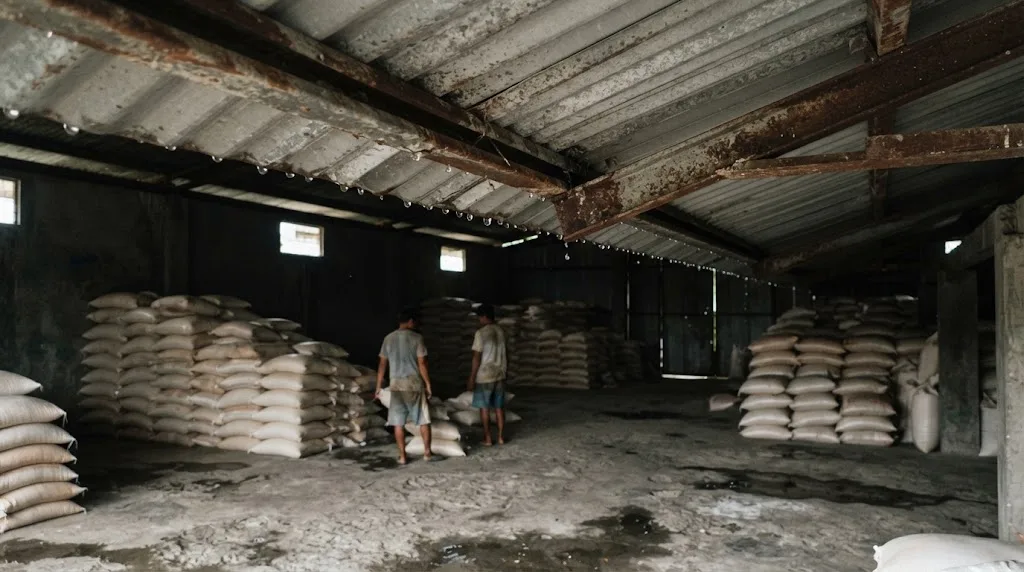
No rain last night, and the floor is still wet by morning. Droplets on the sheet and along the purlins are the tell. Illustrative photo.
Short answer: if your metal roof drips on dry, clear nights and early mornings but not while it rains, that's condensation, not a leak. At night the sheet loses heat to the sky and runs a few degrees colder than the air under it. Once it drops below the air's dew point, water forms on the underside, runs to the purlins and drips. Philippine air makes this easy: PAGASA's normals for Dumaguete put the average daily low within 0.1 to 1.1°C of the average dew point, month by month. Ventilation alone rarely fixes a bare sheet, because the outdoor air it brings in is nearly saturated too. The fixes that stop the drip change what the moist air touches: a fleece that holds the water, or insulation under the sheet with taped laps. For a 300 sqm bare-sheet warehouse roof, foil-faced insulation fitted under the existing sheets plus ridge and eave vents comes to about ₱168,000–₱360,000 on AEDO 2026 planning ranges.
The checker below works out the dew point from your air temperature and humidity (or a PAGASA station and month), tells you whether the sheet goes below it, how much insulation would keep the underside dry, and what the right fix costs for your roof area. After it: how to tell condensation from a leak, the physics, where the moisture comes from, the fixes ranked by cost, and when rusting purlins need an engineer.
Station presets are PAGASA 1991–2020 normals: the month's average daily low as the night air temperature, and the humidity that gives PAGASA's average dew point at that temperature. The dew point uses the US National Weather Service formula. How far the sheet cools below the air is your input; the default is an AEDO assumption inside a measured range. Fix costs are AEDO 2026 planning ranges, not quotations.
The owner's first guess is almost always a leak, and the first contractor usually agrees and starts sealing laps. Before anyone climbs up, spend one dry night and one rainy day watching. The pattern tells you most of what you need.
| What you see | Points to condensation | Points to a leak |
|---|---|---|
| When it drips | Dry, clear nights and early morning; stops once the sun is on the roof | During rain or soon after; also on cloudy, windy nights if it's raining |
| Where it drips | Spread across the whole underside, often worst at purlins, bolts and the low end of the sheet | Same few spots every time: laps, fastener holes, ridge and flashings, gutters, around vents and pipes |
| What the underside looks like | Fine droplets or a wet film over large areas, even in the middle of sheets | Dry sheet with a wet trail from one point; rust streaks from one hole |
| Weather that makes it worse | Clear sky, still air, after a humid day; the dry-season nights | Heavy, wind-driven rain; typhoon rain |
| Hose test on the roof | Nothing appears | Water appears inside, sometimes a few metres downslope of the hole |
The weather row has measurement behind it. In a field study under Thailand's hot, humid climate, Khedari and co-workers built test roof panels from common roofing materials and found their surfaces 1–6°C below the air under clear and cloudy skies, while under rainy skies the surfaces and the air were "fairly close". A roof that drips only when it rains isn't cold enough then to condense, so the water is coming through. Many roofs have both problems, and our leaking roof repair guide explains why a leak's stain is rarely right under the hole.
Air holds water vapour, and the warmer it is, the more it can hold. The dew point is the temperature at which the vapour already in the air would saturate it. PAGASA defines it as the temperature "when atmospheric moisture begins to condense to liquid forming dew upon objects." Any surface colder than the dew point of the air touching it gets wet.
A metal sheet at night is such a surface. It faces a clear sky that is far colder than anything on the ground, so it radiates heat away faster than the air around it can replace. The US Department of Energy's NightCool report from Florida, citing Clark (1981), puts the cooling rate of a sky-facing surface at about 60 W/m² on a clear night in a humid climate, about 40 W/m² with half the sky clouded and about 7 W/m² under full overcast. Wind cuts it too. The sheet ends up colder than the air, by the 1–6°C the Thai study measured on its test roof panels.
Thin steel has almost no thermal resistance of its own (BR 443 lists galvanised steel at 50 W/m·K), so the underside is as cold as the top. Warm, moist air rising inside the building meets that underside, cools below its dew point, and leaves water behind. On a bare sheet the droplets collect, run down the corrugations or along the purlins, and fall wherever the path ends.
The dew point needs only the air temperature and relative humidity. The US National Weather Service publishes this form of the Magnus-Tetens formula, which the checker uses:
with temperatures in °C and vapour pressure in millibars. Lawrence (2005) gives a handy rule of thumb for humid air: the dew point falls by about 1°C for every 5% drop in relative humidity below 100%. So at 95% humidity the dew point is only about 1°C under the air temperature, and a sheet 3°C below the air is well into the wet zone.
PAGASA's climate page puts the country's average monthly relative humidity at 71% in March to 85% in September. That's the day-and-night average. The more useful numbers are in PAGASA's station climatological normals, which list both the average daily minimum temperature (usually reached "during early hours of the morning (before sunrise)", in PAGASA's words) and the average dew point. Put them side by side and you see how little cooling a roof needs.
| PAGASA station (1991–2020) | Annual RH | Avg. daily low | Avg. dew point | Gap, annual | Gap, month by month |
|---|---|---|---|---|---|
| Dumaguete, Negros Oriental | 81% | 24.8 °C | 24.2 °C | 0.6 °C | 0.1–1.1 °C |
| Mactan, Cebu | 82% | 24.9 °C | 24.4 °C | 0.5 °C | 0.1–1.1 °C |
| Tacloban, Leyte | 84% | 24.8 °C | 24.6 °C | 0.2 °C | 0.0–0.4 °C |
| Davao City | 81% | 24.4 °C | 24.1 °C | 0.3 °C | 0.1–0.8 °C |
| Science Garden, Quezon City | 78% | 23.6 °C | 23.1 °C | 0.5 °C | 0.0–1.6 °C |
| Port Area, Manila | 74% | 25.6 °C | 23.4 °C | 2.2 °C | 0.9–3.7 °C |
The gap is how far the air can cool before it's saturated. Take it as approximate: PAGASA's dew point is an average of the station's routine observations, not the value at dawn, while the low is a daily extreme, and single nights vary. The pattern is still plain. At most stations, in most months, air at its daily low is within about a degree of its dew point, so a sheet only one or two degrees colder than the air gets wet. Manila's Port Area in the dry months (gaps of 3.1–3.7°C from February to April) is the one place in the table where a mildly cooled sheet can stay dry. Our best time to build guide uses the same station sheets for rainy days by month.
PAGASA also notes that March to May, the hot dry months, are when "temperature and humidity attain their maximum levels". Dry season doesn't mean dry air. It means clearer skies, and clear skies are what make the sheet cold.
The station numbers describe outdoor air. The air under your roof is often wetter, because the building adds water to it. BlueScope's technical bulletin on roof condensation lists showering, cooking, washing and even people as moisture sources in a house. In the buildings where we see roof drips most, the sources are bigger:
Cutting the source is the cheapest fix there is. It's also the only one that works on every roof type, because none of the others can keep up with a building that keeps making water.
Two things stop condensation: keep the surface that moist air touches above the dew point, or keep moist air away from the cold surface. Everything below is one or both. The costs are AEDO 2026 planning ranges per square metre of roof area, built from our sibling cost guides where they have the figure and labelled as AEDO planning where they don't.
| Fix | AEDO 2026 planning range | What it does | Where it falls short |
|---|---|---|---|
| Cut moisture sources | Little or nothing | Lowers the dew point inside | Can't bring it below the outdoor dew point |
| Ridge vent or turbines, with eave or low-wall intake | ₱8,000–35,000 for a house-size roof; about ₱60–150 per sqm on larger roofs | Flushes out the moisture the building adds; dries the roof space in the morning | Doesn't warm a bare sheet; brings in outdoor air that is nearly saturated at night |
| Foil-faced insulation fixed under the existing sheets, laps taped (sheets lifted and re-laid) | ₱500–1,050 per sqm | Keeps moist air off the cold sheet and keeps the exposed face warm; also cuts daytime heat | Needs a proper vapour-tight face and sealed laps; wicks water if it hangs into the gutter |
| Fleece-backed (anti-condensation) sheets, at re-roofing | ₱970–1,580 per sqm | Holds the condensate in the fleece until it dries by day | Condensation still forms; no heat benefit; needs ventilation and a drying cycle |
| New sheets with foil-faced insulation, at re-roofing | ₱1,100–1,930 per sqm | Same as the retrofit, done while the roof is off anyway | Only makes sense when the sheets are due for replacement |
| Ceiling with a ventilated roof space above | ₱484–1,127 per sqm of ceiling, plus vents | Protects the room and goods; adds a place for ceiling insulation | Alone, it moves the drip onto the ceiling board; the sheet still needs a membrane or insulation |
| Insulated sandwich-panel roof (cold or air-conditioned storage) | ₱1,650–2,650 per sqm installed | Continuous insulation with sealed metal faces | Refrigeration, dehumidification and joint detailing are a separate design |
Where the numbers come from. Ventilation for a house-size roof and "radiant barrier or ceiling insulation" at ₱250–600 per sqm are from our house heat guide. Pre-painted 0.4 mm rib-type sheets at ₱480–620 per sqm, installation labour at ₱250–450 per sqm and insulated sandwich panels at ₱1,400–2,200 per sqm are from our roofing cost guide. Ceilings at ₱484–793 per sqm in PVC and ₱681–1,127 per sqm in painted fibre cement are from our ceiling cost guide. So the insulation retrofit is insulation plus lift-and-relay labour; the re-roof is sheet plus insulation plus labour plus the roofing guide's ₱120–260 per sqm for flashing, ridge, gutters and fasteners; the fleece re-roof is built the same way; the panel roof is panel plus labour. One caution: the ₱250–600 insulation figure in our house heat guide was written for a radiant barrier or ceiling insulation, and we haven't confirmed it covers a foil-faced blanket of the resistance the checker now recommends. Treat the insulation lines as an AEDO 2026 planning range and get a supplier quote for the specific blanket. The ₱60–150 per sqm ventilation band for bigger roofs and the ₱120–250 per sqm premium for a fleece backing are AEDO planning ranges, not published figures.
Ventilation first, almost always. It's cheap, it takes the building's own moisture out, and both the fleece and the insulation work better with it. BlueScope says plainly that ventilation assists in allowing moisture to escape. What the PAGASA table says just as plainly is that in most of the country ventilation can't stop a bare sheet from condensing on a clear night, because the air it brings in is already at or near saturation at dawn.
Fleece-backed sheets hold water instead of stopping it. The maker of one widely used fleece says it absorbs up to 1,000 g of water per square metre, must be allowed to dry during the day, needs good ventilation at the ridge and gutter, and is made for uninsulated metal roofs. That suits an open farm shed or a dry-goods warehouse being re-roofed. It won't cut the afternoon heat, and it can be laminated to the sheet at the roll-former, so in practice it comes with new sheets.
Foil-faced insulation under the sheet is the fix we reach for most on warehouses, workshops and houses without ceilings, because it deals with condensation and heat at once. Two details decide whether it works. The foil (the vapour-resisting face) has to be continuous, with the laps taped, so moist air can't get behind it to the cold sheet; BlueScope says sealing the overlaps with appropriate tape may increase the membrane's effectiveness and calls it important where the temperature and humidity difference across it is large, which a dripping roof on a clear night is; for air-conditioned buildings in the tropics it notes the reflective face may go towards the sheet, with a second membrane on the other side of any blanket. And the insulation has to stop short of the gutter, or it wicks water and holds it against the underside of the sheet, which BlueScope warns can corrode the sheet from below with nothing visible until it perforates. The checker gives the minimum core thermal resistance for your conditions and a recommended figure three times higher; on the default case that's 0.39 and about 1.2 m²K/W, which is blanket territory (foil-faced glasswool or fibre), not a single thin bubble-foil layer. Compare it with the product's declared core resistance, not a figure that includes air spaces on both sides; BR 443 draws exactly that distinction for bubble-foil and multi-foil products. At stations and months where PAGASA's average gap is only a few tenths of a degree, the minimum climbs past anything practical; the checker says so and asks for an on-site humidity reading rather than sizing an absurd blanket, and the order of work becomes moisture control and ventilation first, then a practical blanket with taped laps. When the sheets go back, use new screws long enough for the insulation thickness; old holes and short screws are where re-laid roofs fail in a typhoon.
A ceiling protects what's under it, and in a house it's where ceiling insulation goes. On its own it doesn't stop the sheet sweating; the water just lands on top of the ceiling boards. If the roof above drips, put a membrane or insulation under the sheet and ventilate the space between.
Reading the checker's default case. Dumaguete, January: air under the roof 24.6°C (PAGASA's average daily low) at 94.7% humidity, which gives a dew point of 23.7°C. With the sheet 3°C below the air it sits at 21.6°C, 2.1°C under the dew point, so a bare sheet drips. To keep an insulated foil face dry the insulation needs a core resistance of at least 0.39 m²K/W; because the minimum is optimistic, we'd specify at least three times that, about 1.2 m²K/W, which means a foil-faced glasswool or fibre blanket, not a single bubble-foil layer. For a 300 sqm warehouse roof in sound condition the recommended package is foil-faced insulation under the existing sheets at ₱150,000–315,000 plus ridge and eave ventilation at ₱18,000–45,000, ₱168,000–₱360,000 in all. Fleece-backed sheets at re-roofing, with flashing, ridge and fasteners, would be ₱291,000–474,000 plus the same vents.
What moves it. Set the sheet cooling to 0.5°C (a cloudy, breezy night) and a bare sheet stays just dry, 0.4°C above the dew point, which the checker flags as borderline. Pick Manila's Port Area in March and the gap is 3.5°C, so the default 3°C of cooling doesn't reach the dew point, though at 0.5°C above it the checker still flags it as borderline and suggests ventilation. Push the humidity up for a shed full of birds and the dew point climbs toward the air temperature, and once the gap is down to a few tenths of a degree the checker stops sizing insulation and tells you to cut the moisture and ventilate first.
Ventilation won't hold a bare sheet above the dew point on its own, but a warehouse without it is worse on every count. It takes out the moisture from goods, floors and people, it lets fleece and insulation dry out after a wet night, and it takes heat out of the roof space in the afternoon. A vent with no intake moves almost nothing: air has to come in low, at the eaves or through low wall louvres, and leave high, at the ridge.
No Philippine code we could find sizes roof-space ventilation. The IRR requires it only for enclosed attics: Section 1206.3(d) of the 2004 Revised IRR of PD 1096 says enclosed attics, including rafter spaces with ceilings fixed to the rafters, "shall be provided with adequate ventilation protected against the entrance of rain", but it gives no size, and an open warehouse or shed roof with no ceiling has no attic, so nothing in the IRR sizes its ventilation. Its other ventilation rules (Rule VIII, Section 808) cover windows and air for rooms, and the one mention of condensation is about draining aircon condensate. For a figure to work from, the nearest published one we've read is Australia's: the National Construction Code 2022, as summarised in Lysaght's bulletin PAB14, asks roofs pitched 15° or more to have 7,000 mm² of opening per metre at the eaves plus 5,000 mm² per metre at high level, measured per metre of the roof's longest horizontal dimension, and more on flatter roofs. That rule was written for Australia's cooler climate zones 6 to 8, not the tropics, so treat it as a practice starting point, not a Philippine requirement. For a 30 m long shed that reads as about 0.21 m² of opening at the eaves and 0.15 m² at high level. Open corrugation ends, continuous ridge vents and turbines all count toward it; the turbine or ridge-vent maker's rated free area tells you how many you need.
For a new warehouse, it's cheaper to decide this at design stage than to cut openings later. Our warehouse construction cost guide and pre-engineered steel building guide cover where the roof sits in the budget.
Cooling the inside turns the problem around. In an air-conditioned space the cold surfaces are on the inside, and the humid air is outdoors and in the roof space. BlueScope's bulletin makes the point for tropical countries: the air outside is warm and moist compared with cooler air-conditioned interiors, so the membrane arrangement changes. Condensation then forms wherever warm outdoor air reaches something the aircon has cooled, which is usually behind a lining, at an unsealed penetration or where a door frame breaks the insulation. Our container van house guide covers the same trap in a steel box.
For storage that is cooled or chilled, the roof and walls become part of the refrigeration design: insulated panels with sealed joints, a continuous vapour-control face on the warm side, and dehumidification sized by a mechanical engineer. Our cold storage design brief covers what has to be decided before anything is built. The checker prices only the panel roof.
A roof that's wet every clear night for years pays for it. Lysaght's PAB14 lists what prolonged moisture does to a building: moulds and bacteria on building materials, fasteners, wiring and metal roofing corroding, gypsum softening, timber warping or rotting, and insulation losing part of its R-value. Under the roof, the damage usually shows in this order:
Surface rust on a purlin isn't a structural problem yet. Get it looked at by an engineer when you see any of these: rust that flakes off in layers, holes or a thinned flange you can dent with a screwdriver, sagging between trusses, bolts or cleats that have lost section, or a roof you want to re-sheet or load with insulation, solar panels or a ceiling. Replacing a purlin is structural work, and the steel sizes and connections should be checked against the wind uplift your site sees (our steel vs wood truss guide covers the frame side). Our structural assessment report guide shows what the written report covers, and our preventive maintenance guide puts roof checks on a schedule.
Under Section 301.3 of the 2004 Revised IRR of PD 1096, repair works "not affecting or involving any structural member, such as replacement of deteriorated roofing sheets or tiles, gutters, downspouts, fascias, ceilings" don't need a building permit, provided they don't violate the Code. Replacing deteriorated sheets (including with fleece-backed ones) and repairing ceilings are on that list. Adding insulation, or a ceiling where there was none, isn't named, so ask your OBO before starting. Replacing rusted purlins or trusses touches structural members, so it doesn't. Some Building Officials ask to be notified even for exempt work, so check with your OBO.
Condensation fixes are usually carpentry and roofing work, done by a roofing contractor. Where an engineer earns the fee is in the diagnosis, whether it's condensation, a leak or both, and in any roof where the purlins, the uplift connections or the added weight of insulation or a ceiling need checking.
Where AEDO fits. Nationwide, send us photos and your roof details and we'll tell you what's dripping and which fix fits, and prepare the roof details your contractor builds from. Where the purlins or trusses look doubtful, our structural assessment is ₱5,000 flat for the site visit and written report; outside Negros Oriental, send photos first and we'll say whether a visit is needed. In Negros Oriental, AEDO also designs and builds, including re-roofing and insulation work, under one contract.
Daily minimum temperatures, dew points and humidity are PAGASA's 1991–2020 climatological normals for Dumaguete, Mactan, Tacloban, Davao City, Science Garden and Port Area; the national 71–85% humidity range is from PAGASA's climate page. The dew-point formula is the one the US National Weather Service publishes; the 1°C per 5% rule of thumb is from Lawrence (2005). The 1–6°C night cooling of roof surfaces is from Khedari et al. (2000), measured on test roof panels in Thailand; the 60, 40 and 7 W/m² cooling rates are from the US DOE/FSEC NightCool report, citing Clark (1981). The surface resistances of 0.10 and 0.17 m²K/W (plain and low-emissivity faces), the 50 W/m·K for steel and the core-resistance rule for foil products are from BRE's BR 443. Condensation, membrane and ventilation guidance is from BlueScope CTB-11 and Lysaght PAB14; the fleece capacity is from its maker. Rates are from AEDO's house heat, roofing and ceiling cost guides as listed in section 5. The 3°C default cooling, the 2°C borderline band, the 3× insulation margin, the ₱60–150/sqm ventilation band for large roofs and the ₱120–250/sqm fleece premium are AEDO planning figures.
Why does my metal roof drip inside when it isn't raining?
Because the underside of the sheet has gone colder than the dew point of the air under it. On clear nights a metal sheet loses heat to the sky and ends up colder than the air; a field study in Thailand measured test roof panels 1 to 6°C below the air under clear and cloudy skies. Philippine night air is already close to saturated: PAGASA's 1991-2020 normals for Dumaguete put the average daily minimum within about 0.1 to 1.1°C of the average dew point, month by month. So even a small drop in sheet temperature wets the underside, and the droplets run to the purlins and drip, usually late at night and early in the morning.
How can I tell condensation from a roof leak?
Watch when and where it drips. Condensation drips on dry, clear nights and early mornings, stops once the sun warms the sheet, and shows as droplets spread across the whole underside and along the purlins. A leak drips during or just after rain, comes back in the same spots, usually at laps, fasteners, flashings, gutters or penetrations, and a hose test on the roof can reproduce it. Many roofs have both, so check on a dry night and again in the rain.
Will ventilation alone stop condensation under a metal roof?
Usually not in the Philippines, if the sheet is bare. Ventilation replaces the air under the roof with outdoor air, and PAGASA's normals show outdoor air at its daily low sitting within about a degree of its dew point at most stations. A bare sheet a few degrees colder than that air will still get wet. What ventilation does do is remove the extra moisture from wet floors, animals, cooking or drying palay, and dry the roof space in the morning. It is the cheapest first step and it makes the other fixes work, but a sheet that drips on clear nights normally needs an anti-condensation fleece or insulation under it.
Does anti-condensation (fleece-backed) roofing work in the Philippines?
It works for what it is designed to do: hold the condensate so it doesn't drip. One manufacturer says its fleece absorbs up to 1,000 g of water per square metre, must be allowed to dry during the day with good ventilation at the ridge and gutter, and is made for uninsulated metal roofs. It does not stop condensation forming, it doesn't cut heat, and it can be laminated to the sheet at the roll-former, so in practice it comes with new sheets and makes most sense when you are re-roofing an open shed or warehouse anyway.
How much does it cost to fix metal roof condensation?
It depends on the roof and what is under it. For our calculator's default case, a 300 sqm bare-sheet warehouse roof in Dumaguete in January with the sheet 3°C below the air, the recommended fix of foil-faced insulation fitted under the existing sheets with taped laps, plus ridge and eave ventilation, comes to about ₱168,000 to ₱360,000 on AEDO 2026 planning ranges. Ventilation alone for a house-size roof is about ₱8,000 to ₱35,000. An insulated sandwich-panel roof for cold or air-conditioned storage runs about ₱1,650 to ₱2,650 per sqm of roof, installed.
Climate data, formulas, studies and technical bulletins read for this article. External links open in a new tab.
PAGASA's station normals are long-term averages, not a forecast for any night, and the dew point column is an average of the station's routine observations, not the value at dawn, while the minimum temperature is a daily extreme. The Thai study measured specific test roof panels and the Florida figures are cited rates; your roof's night cooling depends on sky, wind, colour and slope. The Australian ventilation table is quoted as a practice reference, not a Philippine requirement. The only Philippine provision we found on roof-space ventilation is IRR §1206.3(d), which requires "adequate" ventilation without a size; we found none on roof condensation. All cost figures are AEDO 2026 planning ranges, not quotations.
Find out whether it's condensation, a leak or both before paying anyone to seal laps or re-roof.