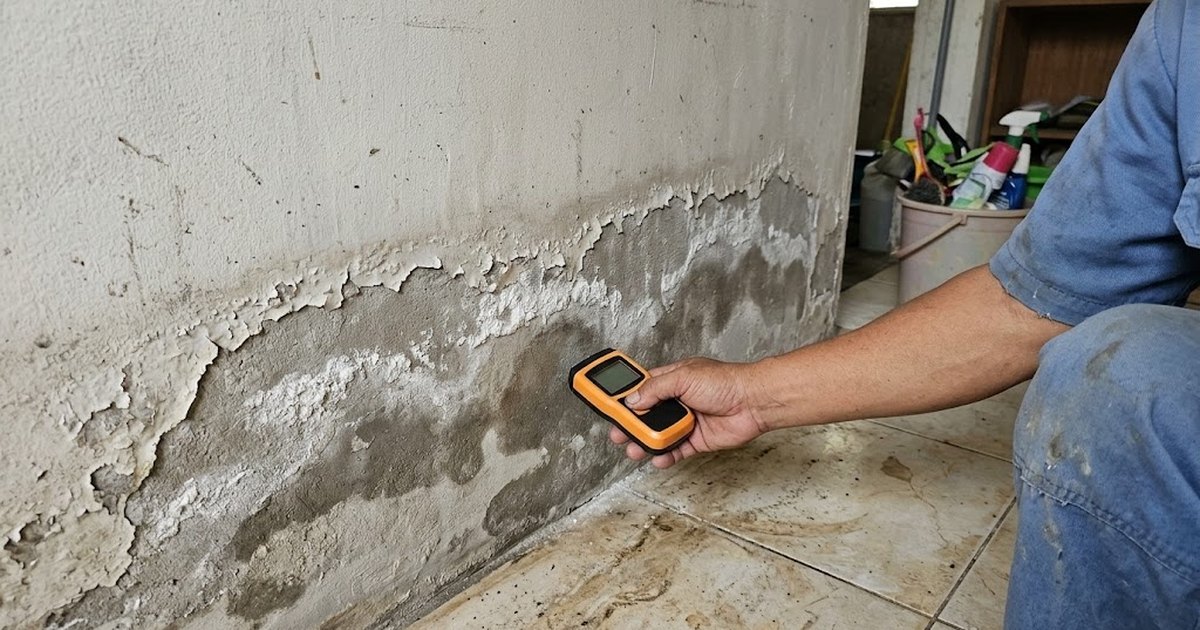
White powder on a damp wall is salt carried up by moisture. Repainting over it won't last. Illustrative photo.
Short answer: a damp wall with bubbling paint and a white powdery crust is water moving through your plaster and blocks. The white stuff is salt the water left behind when it dried out. Find where the water comes from before you spend anything, because repainting over an active moisture source often peels again within a rainy season, in our experience. In a CHB-and-plaster house the usual culprits are ground moisture wicking up from the footing, a leaking roof slab or window, typhoon rain driven through hairline cracks, condensation in closed-up corners, or a pipe leaking inside the wall.
Good news first: most of these are water-management jobs, not structural ones. Tick what you see below and the checker ranks the likely causes and tells you what to check next. Then the calculator prices the fix that actually stops the water.
Tick every pattern you can actually see on the wall. It's a screening tool that points you at the likely source. It can't see inside your wall, so treat the top result as the first thing to check, not a diagnosis.
CHB, mortar and cement plaster are all porous. Put them in contact with wet soil and water climbs up through the tiny pores by capillary action, the same way a tissue soaks up a spill. It keeps climbing until evaporation from the wall face balances the supply, and that's where you get the tide mark. The Building Conservation article on soluble salts shows exactly this: a salt tide line in masonry caused by rising damp, with crystals forming wherever drying happens at the surface.
The white crust is efflorescence. The Concrete Masonry & Hardscapes Association (CMHA) puts it simply: you need soluble salts in the masonry, moisture to carry them, and evaporation or pressure to move the solution to the surface. Remove any one of the three and efflorescence doesn't happen. You can't take the salts out of cement, so the only lasting fix is controlling the water.
Now picture a house with no damp-proofing layer between footing and wall, where the yard has been filled or paved higher over the years. That's the classic setup: soil above the floor slab, soaked every rainy season, wicking straight into the blocks.
The common reflex is a thick waterproof cement plaster band along the bottom of the wall. It doesn't stop rising damp. The same Building Conservation article notes that salts find the path of least resistance and bypass dense impermeable materials, and it shows a dense cement repair to sandstone in Toronto where de-icing salts and moisture rose past the cement band and started a new zone of decay just above it. That article is about historic masonry, but the physics carries over to CHB: a dense band doesn't stop the water, it can push the tide mark and salt crust higher, above the band. Fix the ground and drainage first.
| What you see | Likely cause | Fix that stops the water |
|---|---|---|
| Level tide mark along the bottom of the wall, salt crust just above it | Rising damp from wet soil, no damp-proofing at the footing, yard higher than the floor | Lower and drain the ground outside first. A dense waterproof plaster band alone won't stop it. Chemical damp-proof injection only in stubborn cases, after an engineer confirms it suits the wall |
| Patch under a roof deck, slab or gutter | Roof or slab leak | Waterproof the deck or gutter first. See our waterproofing cost guide |
| Stains spreading from window corners | Failed sealant or cracked plaster at the frame | Re-seal the frame perimeter, fix the sill slope, patch cracks |
| Worse after typhoons, on weather-facing walls | Wind-driven rain through cracks and porous plaster | Rout and seal cracks, exterior waterproof coating |
| Black spots in corners, behind furniture, aircon rooms | Condensation | Keep doors and windows shut while the aircon runs, in our experience don't set it very cold, pull furniture off outside walls, air the room out when the aircon is off, check the aircon drain line, then anti-fungal repaint |
| Damp next to a CR or sink, even in dry weather | Plumbing leak | Plumber first: pressure-test the line, fix the pipe, then re-plaster |
Paint doesn't stop water, it just hides it for a while. Water trying to get out of the wall lifts the film, and salts crystallising behind it push it off. That's why a fresh coat over an active source often bubbles again within a rainy season, in our experience. Our painting cost guide covers the other common exterior failure: interior masonry putty used outside, which holds moisture and peels in sheets. Fix the water, let the wall dry out, then paint.
Black spots that come back after wiping are usually mould growing on a surface that stays damp. The World Health Organization's guidelines on dampness and mould found sufficient evidence that people in damp or mouldy buildings are at higher risk of respiratory symptoms, respiratory infections and worsening asthma, and their main recommendation is to prevent or minimise persistent dampness in the first place. Same conclusion as for the paint: in our experience bleach only cleans the surface, and mould comes back while the wall stays damp. If someone in the house has asthma, move this up your list.
In an aircon room, the usual advice to "improve ventilation" backfires here. The same WHO summary notes that, apart from leaks and heavy rain, most moisture enters a building in incoming air, and that cool parts of air-conditioning units can bring surface temperatures below the dew point. Our outside air is humid, so opening windows while the aircon runs brings in more moisture to condense on the cold wall. Keep doors and windows shut while the aircon runs, and in our experience don't set it very cold, pull beds and cabinets off outside walls, and air the room out when the aircon is off. Also check the aircon drain line isn't dripping into the wall.
Enter the affected area and tick the fixes your wall needs. Each row is a separate line item and the total is the exact sum of the rows shown.
The stain is never the expensive part. The source is. A condensation problem in a bedroom corner might end at a scrape-and-repaint. Rising damp along a 6-meter wall with the yard sitting above the floor is drainage work first, then re-plastering the damaged band, then paint, and skipping the drainage just means paying for the plaster twice.
When a damp wall is a structural problem. Most aren't. But if you see rust-coloured stains bleeding out of a beam, column or slab, cracks running along the line of the steel, or chunks of concrete breaking off, that's corroding rebar. As an engineering rule, rust takes up more room than the steel it came from and cracks the concrete from inside. Don't plaster over it. Read structural damage warning signs and get it assessed first. If your house also floods, our flood-resistant house design guide covers raising floors and site grading.
What is the white powder on my wall?
It's almost always efflorescence: soluble salts that water dissolved out of the cement, blocks, sand or soil, carried to the surface and left behind when the water evaporated. It isn't mould and it isn't the problem itself. It's a sign that water is moving through that part of the wall. Dry-brush it off, but expect it back until the moisture source is stopped.
Why does my paint keep peeling even after I repaint?
Because the wall behind it is still wet. Water pushing out through plaster lifts the paint film, and salts crystallising under the paint push it off from behind. A fresh coat over an active moisture source often bubbles and peels again within a rainy season, in our experience. Find and stop the water first, let the wall dry, then repaint.
How do I know if it's rising damp or a leak?
Look at where the damp sits. Rising damp shows as a band along the bottom of the wall with a fairly level tide mark, and it's usually worst where the outside ground or garden is at or above your floor level. A leak shows as a patch that starts at a source, under a roof slab, around a window, or on the wall shared with a CR, and it often gets worse right after heavy rain or water use.
Should I open the windows to dry out a damp aircon room?
Not while the aircon is running. Our outside air is humid, so opening up brings in more moisture to condense on the cold wall. Keep doors and windows shut while the aircon runs, in our experience don't set it very cold, pull beds and cabinets off outside walls, and air the room out when the aircon is off. Also check that the aircon drain line isn't dripping into the wall.
How much does it cost to fix a damp wall in the Philippines?
It depends on the cause, not the stain. A scraped or re-plastered wall needs the full paint system of primer, putty and two topcoats, about ₱270–₱440/sqm, the guide's full-system rate on new plaster; we price scraped walls at the same rate because they need the same primer-putty-topcoat build-up. A plain repaint of a sound wall is about ₱180–₱330, and exterior paint systems run about ₱290–₱480. Re-plastering adds about ₱150–₱300 per sqm per side before paint, and an exterior wall waterproofing coating runs about ₱530–₱720 per sqm, all from AEDO's published cost guides. Re-plastering also needs about ₱105–₱210 per sqm for hacking off old plaster and admixture (AEDO market estimates). Drainage work, crack routing and sealing, and chemical damp-proof injection are priced per linear meter and vary a lot by site, so treat those as estimates until someone has looked at the wall.
When is a damp wall a structural problem?
Most damp walls are a water-management problem, not a structural one. It becomes structural when you see rust-coloured stains bleeding from concrete, cracks running along a beam, column or slab, or pieces of concrete breaking off and exposing steel. That pattern points to corroding rebar, and it needs an engineer's assessment before any cosmetic repair.
Technical and health references used in this article. External links open in a new tab.
Painting, plastering and external-wall waterproofing rates are taken from AEDO's own published cost guides linked in the calculator notes. Hacking off plaster (₱80–₱150/sqm), waterproofing admixture (₱25–₱60/sqm), crack routing and sealing (₱300–₱700 per linear meter; epoxy injection costs considerably more, AEDO market estimate), drainage and regrading (₱1,500–₱3,500 per linear meter) and chemical DPC injection (₱2,000–₱4,000 per linear meter; few PH installers, quotes vary widely) are AEDO market estimates, not figures from a published price list.
A licensed engineer finds the source before you pay for a repaint that won't hold, and tells you whether any of it is structural.