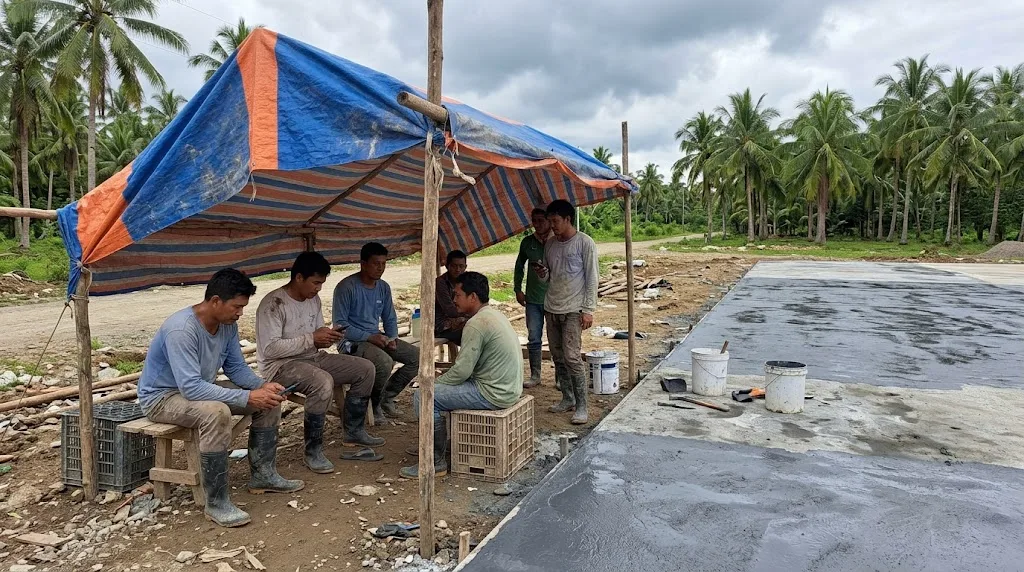
The crew can wait under a tarp. The paint cannot be hurried, and neither can the slab. Illustrative photo.
Short answer: on a new slab, the date you can first play is set by three waits that no crew can shorten: the slab's cure before priming, the minimum hours between coats, and the manual's 72 hours before play. The painters' own days are the small part. With this page's default settings, a slab poured on Monday 2 November 2026 reaches its earliest play date on Sunday 20 December 2026, 48 days after the pour, and about 34 of those days are the slab and the paint waiting. Rain adds 6 days to that, because Dumaguete's PAGASA normals have 11 rainy days in November and 12 in December, and the calculator treats each rainy day as a no-paint day. Take the rain out and the same six-day crew plays on Monday 14 December 2026. The calculator has no “number of painters” box on purpose: more painters would move none of the waiting.
If you are building or recoating a court in Dumaguete, Bais, Tanjay, Manjuyod or anywhere else in Negros Oriental, put your own pour or start date in the calculator. It builds a day-by-day schedule with a live Gantt chart. Below it: the order of work and each hold, what the manual and the data sheets say (and do not say), Dumaguete's weather from PAGASA, what rain, dew and humidity do to each step, and how AEDO sequenced its own Manjuyod job. There is no plan or section drawing on this page, because a schedule is not geometry.
Enter the pour date of a new slab, or the date a painter can start on an existing one. The tool lays out cure, prep, tests, primer, coats, lines and the wait before play, day by day, and gives the earliest play date. The waits come from the manual and the data sheets in sections 1 and 2; the rain days come from PAGASA's Dumaguete normals (section 3), spread evenly through each month. A planning aid, not a forecast.
A court is painted in a fixed order, and between most of the steps something has to happen that nobody can speed up. The table lists each step, what decides its length, and the number we could read. Where we could not find a number, the table says so, because an invented hold is the easiest way to ruin a court.
| Step | Work or wait | What decides it | What we read |
|---|---|---|---|
| 1. Pour and moist cure | Wait | The concrete | The manual says to keep a new slab moist for about seven days with burlap, polyethylene sheet or curing paper. That sentence sits in its post-tensioned slab section. |
| 2. Cure before priming | Wait | The concrete and the coating maker | The same manual passage then says to allow an additional 21 to 38 days (as printed). Nippon's Floor-Pro 702 sheet (Singapore, 2020) says new concrete must have cured at least 28 days. AEDO's job plan says 28 days minimum. We found no cure figure in the manual's outdoor reinforced-slab section; its indoor chapter has different figures (section 2). |
| 3. Prep | Work | The crew and the surface | Clean, remove laitance and contaminants; Nippon's sheet describes pressure-washing and an acid etch for new concrete. AEDO's plan tells a polishing sub not to apply a densifier. No source gives a number of days. |
| 4. Moisture check | Wait | The test method | AEDO practice is a taped plastic sheet left 16 to 24 hours. ASTM's scope page says the plastic-sheet method is used to indicate the presence of capillary moisture in concrete; we did not read the standard's test duration. Nippon's sheets say avoid coating a substrate over 4% moisture content. |
| 5. Flood test, patch, dry-back | Work, then wait | Weather, then the patch compound | The manual floods the court to find low spots where water stands at least 1/16 inch deep, and patches at 55°F (about 13°C) or above with no precipitation in the immediate forecast. It says each coat must dry thoroughly and gives no hours. |
| 6. Prime | Work, then wait | The primer | Nippon's High Performance Primer sheet (Malaysia, Jan 2025): recoat after at least 8 hours, pot life 4 to 6 hours after mixing at 25 to 30°C. |
| 7. Top coats | Work, then wait | The top coat | Nippon's FloorSports 1K Epoxy Hybrid sheet (Malaysia, Oct 2025): 2 to 3 coats, recoat after at least 6 to 8 hours. Floor-Pro 702: second coat after at least 4 hours, depending on weather. The manual: each coat must dry completely before the next. |
| 8. Lines | Work | The colour coat being dry | The manual says line the court when the colour coating is dry, with one or two coats of textured line paint as the coating maker recommends. No hours given. |
| 9. Cure before play | Wait | The coating | The manual says generally at least 72 hours for an acrylic surface to cure completely before playing. The Nippon sheets we read give no time to light traffic or full cure. |
The pattern is what matters. Four of the nine steps are pure waits and three more end in one, and the long wait comes first. The painters do their part in a handful of working days, spread across weeks in which the slab and the paint are doing the work. That is why a court that was poured in the wrong month can sit finished-looking and unplayable for weeks, and why the date to argue about is the pour date, not the painter's start date. Our surface options guide covers the systems and their costs, and our paint types guide goes into each coat.
Every number in the calculator comes from one of four places, and it helps to know which.
What we did not find. A maximum overcoat time on any sheet we read; a time to light traffic or full cure on any of them; any statement of what rain during the 72 hours does to the cure; and a cure figure in the manual's outdoor chapter for an ordinary reinforced slab. The manual does say, in its post-tensioned passage (printed page 41), that the slab must be dry so vapour emissions do not affect adhesion and that the surfacing maker has the test methods; its indoor chapter (printed pages 99 and 101) says strength curing occurs between 21 and 45 days and that a slab under indoor sports flooring should have been in place at least 60 days and tested for moisture. Those are indoor-installation figures, not an outdoor court rule, so the calculator does not use them. The 72 hours is the manual's “generally,” so ask the supplier for the figure for your product, written, before you open the court. One non-Nippon sheet reads differently: Sika's Sikafloor-2045 Courtkote sheet (Singapore, May 2026), which we also read for our paint types guide, allows a minimum of 4 hours between coats, says the court is ready for use 24 hours after the final coat, and says application and curing must be protected from rain. That is a different product, so the calculator keeps the manual's more cautious 72 hours as its default; if your supplier's written figure is shorter, enter it. The Floor-Pro 702 sheet's “recoating time: within 14–18 hrs @ 28°C” sits beside its separate “second coat after a minimum 4 hours” and is worded loosely enough that we do not use it as either a minimum or a maximum; ask Nippon or your supplier which it is.
The climate source is PAGASA's Climatological Normals sheet for Dumaguete City, Negros Oriental (09°19'59.43"N, 123°17'57.53"E, elevation 7.048 m), period 1991–2020. These are 30-year averages, not a forecast and not records. PAGASA defines a rainy day as a 24-hour period from 8 AM to 8 AM with at least 1 mm of rain, and relative humidity as the ratio of the water vapour actually in the air to the most it could hold at that temperature.
| Month | Rainfall (mm) | Rainy days | Relative humidity (%) | Normal max (°C) | Normal min (°C) | Air minus dew point (°C), computed |
|---|---|---|---|---|---|---|
| Jan | 96.7 | 11 | 84 | 29.2 | 24.6 | 3.0 |
| Feb | 73.7 | 8 | 83 | 29.4 | 24.5 | 3.3 |
| Mar | 68.2 | 7 | 81 | 30.2 | 24.7 | 3.6 |
| Apr | 49.1 | 5 | 79 | 31.2 | 25.4 | 4.1 |
| May | 84.5 | 8 | 79 | 31.9 | 25.5 | 3.9 |
| Jun | 144.0 | 12 | 81 | 31.7 | 25.0 | 3.7 |
| Jul | 146.0 | 14 | 82 | 31.5 | 24.5 | 3.5 |
| Aug | 104.6 | 11 | 80 | 31.9 | 24.4 | 3.7 |
| Sep | 116.8 | 12 | 81 | 31.7 | 24.4 | 3.5 |
| Oct | 158.6 | 13 | 82 | 31.2 | 24.6 | 3.4 |
| Nov | 146.4 | 11 | 82 | 30.7 | 25.1 | 3.3 |
| Dec | 134.0 | 12 | 83 | 30.1 | 25.0 | 3.1 |
| Year | 1,322.6 | 124 | 81 | 30.9 | 24.8 | 3.5 |
Source: PAGASA Climatological Normals, Dumaguete City, 1991–2020. The last column is ours: PAGASA's dry bulb temperature (air temperature at the time of observation) minus its dew point temperature, both from the same sheet. The sheet does not say which hours the dry bulb, dew point and humidity columns average over.
What this shows, and what it does not:
This is one coastal station. Bais, Tanjay, Manjuyod, Canlaon and the other towns have their own weather, and an inland or upland site can differ from a station 7 metres above sea level. We read only the Dumaguete sheet, and the calculator's rain mode is only as good as that one sheet is for your site; use the “own number” setting if you have a better local record. Our best time to build guide shows the same normals beside other stations and explains how a rain allowance works in a contract. Two differences from that guide are deliberate: its house planner counts a rainy day as 30% of a day lost to painting under a roof, while this tool defaults to a whole day because a court coat has no roof over it (both are AEDO assumptions), and the guide labels a month “dry” at 6 or fewer rainy days (April here, with 5), which is its own threshold and not a PAGASA label.
Not every step cares. Some of what follows is read from a sheet, and some is our reasoning; each row says which.
| Step | Rain | Dew and humidity | Source or reasoning |
|---|---|---|---|
| Cure | Does not delay it. The slab keeps curing, and the wet helps in the first week. | Not a concern. | Reasoning from the manual's moist-cure sentence. Heavy rain on a fresh surface is a pour-day problem, covered in our best time guide. |
| Prep | Pressure-washing and an acid etch wet the slab. Rain on a prepped slab restarts the drying. | Needs the slab dry before the next step. | The washing and etch are in Nippon's Floor-Pro 702 sheet. The dry-back is our reasoning. |
| Moisture test | A wet slab or a wet week makes the result meaningless. | The test reads moisture rising from below; humid air is a side issue. | Reasoning. The test method is AEDO practice; the ASTM page gives only the scope. |
| Flood test and patch | The flood test wets the slab on purpose. The manual wants no precipitation in the immediate forecast when patching. | The patch must dry before priming. | Manual (flood test, 55°F, no precipitation forecast). Dry-back hours are an AEDO assumption. |
| Prime | The primer is a two-pack, pot life 4 to 6 hours at 25 to 30°C. A rain delay after mixing wastes what is in the pail. | Do not apply above 85% relative humidity or when the surface is under 3°C above the dew point. | Nippon High Performance Primer sheet, Jan 2025. Mix only what the crew can roll in the dry window (our practice note). |
| Top coats | Do not apply when rain is imminent. Best applied in the cool morning or evening. | Same 85% and 3°C limits on the epoxy hybrid sheet; Floor-Pro 702 says relative humidity under 85% and 3°C or more above the dew point. | Floor-Pro 702 sheet (rain, morning or evening, 35°C concrete) and FloorSports sheet (limits). What happens to a coat rained on before it dries is not in any sheet we read. |
| Lines | Same as the top coats. | Same. | The manual says line when the colour coat is dry. Line paint sheets were not read. |
| Cure before play | We found no source that says whether rain during the 72 hours restarts the clock. | No Nippon sheet we read gives a cure time. The FloorSports sheet says only that its drying and recoat times depend on temperature, humidity and thickness. | Manual (72 hours, “generally”). Ask the applicator and write the answer into the quote. |
This is the point that surprises owners, and it is why the calculator has no crew-size input. Doubling the painters shortens the orange blocks in the figure and leaves every blue block exactly where it was. The slab does not cure faster for a bigger crew, a coat does not dry sooner because three people rolled it, and the 72 hours after the lines runs on the clock whoever is standing on the court.
Rain and rest days work the other way round: they add no-paint days in front of the work blocks, and sometimes push a coat to the next morning, but they do not make any wait shorter. The calculator reports the three effects separately so you can see them: the waits, the days added by the crew's calendar, and the days added by rain. Try the crew set to 7 days a week and then 5: only the middle number moves. Our how long to build a house guide makes the same point about the slab and formwork holds in a house, and our formwork removal guide covers the concrete side.
AEDO's 2-court job in Manjuyod, Negros Oriental, has a written painting plan, and we quote it here only as far as it goes. It is AEDO working practice on one job, not a code, and not a recommendation for your paint system.
That is the whole of what we publish of the programme. We do not publish the job's pricing breakdown, and the plan is for one site and one owner. The point for your court is the order: pour, cure, polish or prep, test, patch, prime, coat, coat, lines, wait, play, and a name against each hold. Our surface options guide shows the Manjuyod floor lines as built, and our paint peeling and blistering guide explains why the 28 days and the moisture test exist.
Because the painting comes at least 28 days after the pour, the month you pour is the month, four weeks later, in which you want the fewest rain days. The table is the calculator's own result at its default settings (six-day crew, PAGASA Dumaguete normals, every rainy day stopping work, no extra dry-back day) for a pour on the first working day of each month (Monday to Saturday, skipping 1 January and 1 May as holidays; the pour dates are illustrative, and the 1 October row is already past). It is a model of averages, not a forecast, and one real year can look nothing like it.
| Pour date | Prime coat on | Earliest play | Days from pour | Added by rain (days) |
|---|---|---|---|---|
| Thu 1 Oct 2026 | Sat 7 Nov 2026 | Tue 17 Nov 2026 | 47 | 4 |
| Mon 2 Nov 2026 | Thu 10 Dec 2026 | Sun 20 Dec 2026 | 48 | 6 |
| Tue 1 Dec 2026 | Thu 7 Jan 2027 | Sun 17 Jan 2027 | 47 | 6 |
| Sat 2 Jan 2027 | Wed 10 Feb 2027 | Fri 19 Feb 2027 | 48 | 5 |
| Mon 1 Feb 2027 | Mon 8 Mar 2027 | Tue 16 Mar 2027 | 43 | 1 |
| Mon 1 Mar 2027 | Mon 5 Apr 2027 | Tue 13 Apr 2027 | 43 | 1 |
| Thu 1 Apr 2027 | Fri 7 May 2027 | Mon 17 May 2027 | 46 | 3 |
| Mon 3 May 2027 | Tue 8 Jun 2027 | Sat 19 Jun 2027 | 47 | 5 |
| Tue 1 Jun 2027 | Sat 10 Jul 2027 | Wed 21 Jul 2027 | 50 | 9 |
| Thu 1 Jul 2027 | Sat 7 Aug 2027 | Tue 17 Aug 2027 | 47 | 4 |
| Mon 2 Aug 2027 | Fri 10 Sep 2027 | Tue 21 Sep 2027 | 50 | 8 |
| Wed 1 Sep 2027 | Sat 9 Oct 2027 | Mon 18 Oct 2027 | 47 | 5 |
Two readings, both from the model, and neither a promise. First, the rain allowance runs from 1 day (pours in February and March, so the painting lands in March and April, the months with the fewest rainy days in the normals) to 9 days (a June pour, painting in July, the month with the most). Second, the long cure dominates every row: the best row is still 43 days from pour to play. The practical lever is not to hunt for a dry month. It is to pour early enough that the cure ends before your deadline with room for the rain days, and to put the cure and paint dates into the programme and the contract on day one. Our best time to build guide explains how to write a rain-delay allowance into the contract, and the court construction cost guide covers the rest of the build. If you are converting an existing slab, set the slab to “existing” and the cure drops out; the moisture test and the flood test do not. See also our basketball to pickleball conversion guide and our line marking and colours guide for the lines step.
Ask the applicator for the answers to these in writing, and put the answers in the contract or the quotation. None of them needs a price from us, and several of them are what separates a clean job from an argument in January.
Negros Oriental: AEDO designs and builds pickleball courts here, the same design-build and construction service as our other work, with the cure, the tests and the painting window written into the programme from the start. See our Dumaguete and Bais pages for where we work. There is no published painting price: we quote after a slab visit or a plan review, and the only painting figure we publish is the Manjuyod contract line in our surface options guide. AEDO is not a paint supplier and has no brand partnership.
Everywhere else in the Philippines: we do not build. We design the court (complete design), seal the drawings, review a contractor's programme and paint specification remotely, and check milestones on site: the Single Milestone Check is from ₱7,500 per visit (project oversight), and a coating start is a good milestone, since the checks are the slab's age, the moisture test and the weather record before the primer goes on. For an existing slab with cracks or settlement, the structural assessment is ₱5,000 flat, a licensed-engineer visit and written report in 5 business days; it is a structural survey of the slab, not a coating inspection.
Weather, read this week: PAGASA Climatological Normals, Dumaguete City, 1991–2020 (monthly rainfall, rainy days, humidity, temperatures, dry bulb and dew point), PAGASA's Climate of the Philippines page (seasons) and tropical cyclone page (average 20 a year, 8 or 9 crossing, peak July to October). The air-minus-dew-point column is our arithmetic on the sheet's two columns. Coating steps and waits: ASBA and USA Pickleball Pickleball Courts Construction & Maintenance Manual (2020), printed pages 36, 41–42 and, for the indoor figures we did not use, 99 and 101, as hosted by the City of Salem, NH; Nippon Paint technical data sheets for Floor-Pro 702 (Singapore, Aug 2020), High Performance Primer (Malaysia, Jan 2025) and FloorSports 1K Epoxy Hybrid (Malaysia, Oct 2025); the ASTM D4263 scope page. AEDO practice, from the Manjuyod job plan: the 28-day minimum, the 16 to 24 hour plastic-sheet test, the no-densifier instruction and the polishing sequence. AEDO assumptions with no source, edit them: days for prep, flood test and patching; the patch dry-back and the wait before the lines; the 0 dry-back days after rain (a PAGASA rainy day is simply a lost day); the 100% share of rainy days that stop work; the six-day crew week; the Monday 2 November 2026 pour date in the default case. Not found: a maximum overcoat time, a time to light traffic or full cure, a cure figure in the manual's outdoor chapter for an ordinary reinforced slab, and any source on what rain does to the cure during the 72 hours (a Sika court sheet says to protect curing from rain and gives 24 hours before use; it is shown for comparison and not used in the defaults). Careful with: the data sheets are Nippon's Singapore and Malaysia sheets, not Philippine sheets, and may not be the products on your quote; the manual is a US document and the 21 to 38 days is printed in its post-tensioned slab passage.
When is the earliest I can play on a newly painted pickleball court?
The ASBA and USA Pickleball manual says to generally allow at least 72 hours for an acrylic surface to cure completely before playing, a cure the manual places after the lines. On a new slab that comes at the end of a longer sequence. In AEDO's calculator at its defaults, a slab poured on Monday 2 November 2026 with a 28-day cure, a six-day crew and PAGASA's Dumaguete rainy-day normals reaches its earliest play date on Sunday 20 December 2026, 48 days after the pour, and about 34 of those days are the slab and the paint waiting. The 72 hours is the manual's general figure, and the Nippon data sheets we read give no time to light traffic or full cure, so ask your supplier for the figure for your product in writing.
How long should a new concrete slab cure before painting a pickleball court?
AEDO's Manjuyod job plan sets 28 days as the minimum before priming, and Nippon's Floor-Pro 702 data sheet (Singapore, 2020) says new concrete must have cured at least 28 days. The ASBA and USA Pickleball manual says to keep a new slab moist for about seven days and, in its post-tensioned slab passage, to allow an additional 21 to 38 days as printed. We found no cure figure for an outdoor ordinary reinforced slab in the manual (its indoor chapter gives 21 to 45 days for strength curing, which we do not apply to a court). Your coating supplier's written number governs, and the slab should also pass a moisture check before priming.
Can you paint a pickleball court in the rainy season in Negros Oriental?
In principle yes, but every coat needs a dry working window and rain days add to the schedule. PAGASA's Dumaguete normals for 1991 to 2020 show 124 rainy days a year and no month with fewer than five. April (5 rainy days) and March (7) have the fewest, July (14) and October (13) the most. The Nippon sheets we read say not to apply when relative humidity is above 85% (Floor-Pro 702 asks for under 85%) or when the surface is under 3 degrees C above the dew point, and the Floor-Pro 702 sheet adds not to apply when rain is imminent. In the calculator at its defaults, rain adds 6 days to a November pour and 1 day to a February pour. We do not claim dry months, because the normals do not show any.
How long do you wait between coats of court paint?
It depends on the product, so read the data sheet for yours. Nippon's High Performance Primer sheet gives a minimum recoat time of 8 hours, its FloorSports 1K Epoxy Hybrid sheet 6 to 8 hours, and its Floor-Pro 702 sheet a second coat after at least 4 hours, all depending on weather. The manual says each coat must dry completely before the next and to follow the manufacturer. The calculator defaults to 8 hours, and in practice that usually means the next morning.
What happens if it rains while the paint is curing?
No source we read says what it does. Nippon's Floor-Pro 702 sheet says not to apply when rain is imminent, Sika's Courtkote sheet says to protect application and curing from rain, and the manual wants no precipitation in the immediate forecast when patching, but none says what rain does to a coat that is wet or whether the 72-hour cure restarts. Ask the applicator in writing who redoes a coat that is rained on, whether the wait restarts, and who pays for mixed material that cannot be used.
Will hiring more painters get the court finished sooner?
Only the working days get shorter. In the calculator's default case, 8 working days sit inside 48 days from pour to play, and 34 days are waiting on the slab cure and the paint, which no crew size changes. Moving the crew from a five-day to a seven-day week moves the play date from Friday 25 December 2026 to Thursday 17 December 2026, and the waiting stays at 34 days.
Is there a Philippine standard for pickleball court painting and cure times?
We found none. The cure, coating and play times on this page come from a US industry manual (ASBA and USA Pickleball, 2020), from Nippon Paint data sheets issued in Singapore and Malaysia, and from AEDO's own job plan. Ask your supplier for a written specification for the exact products on your quote, and have it name the cure before priming, the weather limits and the time before play.
Does AEDO paint and build pickleball courts in Negros Oriental?
AEDO designs and builds courts in Negros Oriental, with the cure, tests and painting window written into the programme, and quotes after a slab visit or plan review; there is no published painting price, and AEDO is not a paint supplier and has no brand partnership. Everywhere else in the Philippines AEDO designs and seals the drawings, reviews a contractor's programme and paint specification remotely, and checks milestones on site, with a Single Milestone Check from 7,500 pesos per visit.
Documents read for this article in October 2026. External links open in a new tab.
We found no Philippine standard that sets cure, overcoat or play times for a pickleball court. The manual is a US document, and its 21 to 38 additional days appears in its post-tensioned slab passage; we found no cure number for outdoor ordinary reinforced slabs in it (its indoor chapter, printed pages 99 and 101, has 21 to 45 days of strength curing and a 60-day minimum before indoor sports flooring, which we did not apply). The three Nippon sheets are from Singapore and Malaysia, and AEDO's job plan does not name the product codes it used, so they may not match the products on your quote. We found no maximum overcoat time, no time to light traffic or full cure on the Nippon sheets, and no statement of what rain does to the cure before play (the Sika sheet says only to protect curing from rain and gives 24 hours before use). We read only the scope page of ASTM D4263, not the standard, so its test duration and sheet size are not quoted. We read only PAGASA's Dumaguete sheet; the climate-type definitions are on PAGASA's map image, which we could not load, so we do not restate them. The 2026 USA Pickleball rulebook was not needed and not used. This article is general information, not a design, a coating specification or a quotation.
Send the court plan, your target opening date and the paint system on the quote. Our team will lay out the cure, test and paint dates against the weather and tell you what to put in writing.