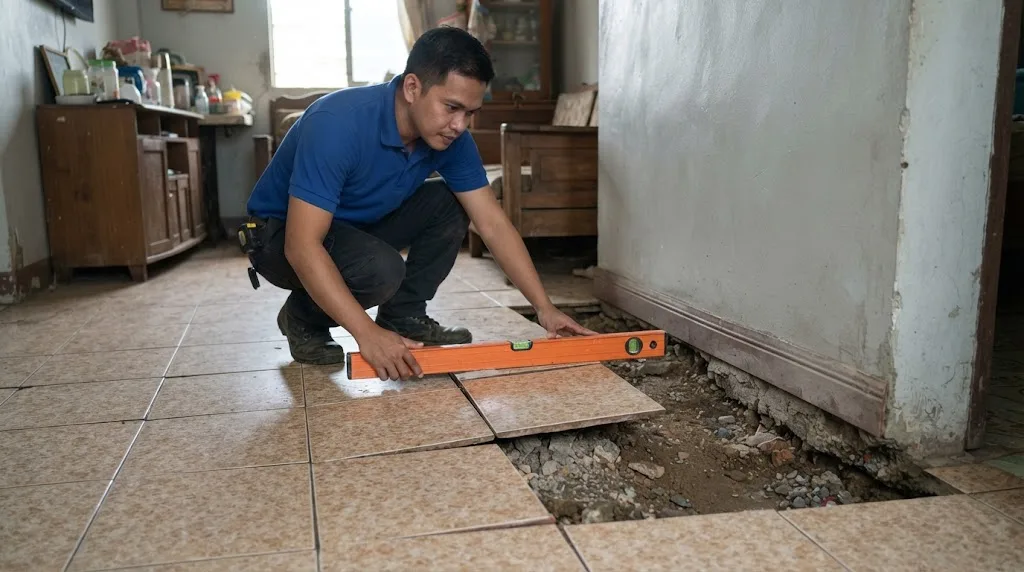
Checking the level of a floor where the tiles have lifted and sunk beside the wall, leaving the soil and gravel fill exposed. The question is whether only the slab moved, or the wall moved with it. Illustrative photo.
Short answer: when a floor sinks, one of two things has happened. Either the floor slab has dropped because the fill under it settled, washed out or rotted away, or the footings under the columns and walls have settled into the ground. The first is annoying and usually fixable room by room. The second is a structural problem, and the house itself is moving.
The quickest way to tell them apart is to look at the walls. If the floor has pulled away from walls that are still straight and uncracked, the slab is the likely culprit. If the walls have diagonal cracks at the doors and windows and the doors have started to stick, the footings are. The checker below sorts your symptoms, the slope tool turns string-line readings into a number, and the cost calculator prices the repair.
Most Philippine houses have a slab-on-grade ground floor: a thin concrete slab, often 100 mm, poured on compacted fill between the foundation walls. It carries people and furniture, not the roof. The roof, the walls and any second floor come down through the columns onto the footings, which sit deeper in natural ground. Those two parts can move independently, which is why the same "sinking floor" has two very different repairs.
Our foundation types guide explains why footings on soft ground sometimes need a different foundation altogether.
Tick everything you can see. Each sign points toward the floor slab, the footings, or both, and the checker shows which way your house leans. It is a screening aid built on AEDO engineering judgement, not a diagnosis, and it can't replace an engineer looking at the house.
You don't need a laser level. A tight string and a tape measure, or a clear hose filled with water, gives readings good enough to decide whether to call an engineer.
Enter the distance between your two end points and how far the floor is below the level line at each. A bigger reading means a lower floor. The middle reading is optional and shows whether the floor dishes or humps between the ends.
Worked example: a string line across a 4.0 m room reads 10 mm down to the floor at one wall and 28 mm at the other, and 24 mm at the middle. The floor drops 18 mm over 4.0 m, a slope of about 1 in 222 or 4.5 mm per metre, which is steeper than the 1/300 comparison. The middle sits 5 mm below the straight line between the ends, so there is some dishing on top of the tilt. That pattern, tilting toward one wall with a sag in between, is worth an engineer's visit before anyone lifts a tile.
Recasting a slab over the same soft ground, or underpinning a footing down to another layer of soft clay, pays twice for the same failure. For footing settlement, the repair depends on what is under the house, and that means a soil investigation. NSCP 2015 Section 303.7 lists what a foundation investigation report may be required to contain, including recommendations to mitigate the effects of differential settlements and the expected total and differential settlement.
Our soil boring test cost guide puts a borehole at about ₱25,000 to ₱35,000 for a typical 10-metre hole on published Metro Manila pricing, and a minimum two-borehole residential investigation at roughly ₱50,000 to ₱80,000 including mobilisation. Provincial sites cost more because the rig has to travel. For a slab that dropped over a single leak with sound walls around it, an engineer may decide test pits and a look at the fill are enough. That is a judgement call for the engineer on site, not a code exemption.
| Repair | When it fits | Relative cost |
|---|---|---|
| Fix the water source and monitor | Small, old dip that has stopped moving; hairline cracks only | Lowest |
| Void filling / slab jacking with grout | Slab still in one piece, hollow underneath, walls sound | Low to moderate per sqm |
| Break out, recompact and recast the slab | Slab cracked into pieces, fill poor or organic, walls sound | Moderate per sqm, plus new tiles |
| Underpin footings with mass concrete | Footings settled; firmer soil reachable at a workable depth | High, priced per footing |
| Micropiles | Firm layer too deep for hand-dug underpinning; rare for houses | Highest; priced only from a geotechnical design |
Cracks in the walls get repaired last, after the movement is stopped. Patching them first only hides the evidence the engineer needs. Our structural damage warning signs guide explains which crack patterns deserve urgent attention.
Section 301 of PD 1096 says no one shall "erect, construct, alter, repair, move, convert or demolish any building or structure" without first getting a building permit from the Building Official. Underpinning footings is work on the structure itself, so plan on a permit with repair plans signed and sealed by a licensed civil engineer. Whether replacing a ground-floor slab-on-grade needs its own permit is worth asking your LGU's Office of the Building Official before work starts, because practice varies. If the work involves excavating next to a neighbour's wall, NSCP 2015 Section 302.3.2 requires written notice to the adjoining owner at least 10 days before the excavation, with the condition of their building documented in photographs.
Pick the floor repair, the area affected and any footing work. Each row is a separate line item and the total is the exact sum of the rows. The number of footings to underpin should come from an engineer's assessment, not a guess. It's a planning range, not a quote.
The floor repair is priced per square metre. The footing repair is priced per footing, and it changes the total far more than the floor does.
Worked example 1, a slab that dropped over a leaking pipe (the calculator's default): 20 sqm of tiled floor, 0.30 m of fill replaced, leak fixed, no footing work. That comes to ₱63,136 to ₱123,070, or about ₱3,157 to ₱6,154 per sqm. Breaking out is ₱8,000-16,000, fill ₱6,750-10,500 for 7.5 m³ bought, compaction ₱1,080-1,920, the new slab ₱17,000-24,000, tiles ₱16,000-28,000, the leak ₱5,000-25,000, repair plans ₱4,306-12,650 and the assessment ₱5,000.
Worked example 2, the same floor with void filling instead: 20 sqm grouted, tiles patched at the holes and the leak fixed comes to ₱46,040 to ₱106,920, about ₱2,302 to ₱5,346 per sqm. It is cheaper only if the slab is still whole and the fill underneath is sound apart from the hollow.
Worked example 3, footing settlement at one corner: 10 sqm of floor recast over 0.20 m of new fill with tiles, two footings underpinned, 12 m of wall cracks repaired and a two-borehole soil investigation comes to ₱179,135 to ₱386,877. The two footings alone are ₱80,000-200,000 of that, which is why a per-sqm figure means little once footings are involved.
So for planning, a slab-only repair on a tiled floor runs roughly ₱2,300 to ₱6,200 per sqm in these examples, and each footing underpinned adds ₱40,000 to ₱100,000 before plans and permits. None of this includes moving out while the floor is open, or repairs to damage that the movement already caused elsewhere. If the house is badly out of level and the floor is also below flood level, compare against raising the floor level, since both jobs break out the same slab.
Low-lying lots are often filled before building, in Negros Oriental as anywhere else. Where a former rice paddy, fishpond or riverside lot was filled to build on, the soft soil under that fill doesn't show until something moves. If your floor is dropping and you know the lot was filled, get the walls, footings and soil checked before paying for new tiles. Tiling over a moving floor buys a second repair.
Why is my floor sinking when the walls look fine?
Usually because the fill under the ground-floor slab has settled, washed out or rotted, while the walls stand on footings in firmer ground below. Signs are a gap between the floor and the skirting, hollow or cracked tiles in the middle of the room, and a dip near a CR, kitchen, septic tank or downspout. NSCP 2015 Section 302.4 sets out that fills be free of organic material and compacted in lifts of 20 cm or less, and fill placed without that keeps settling.
How can I tell if it is the floor slab or the foundation settling?
Look at the walls and openings. If only the floor has dropped and the walls are straight and uncracked, it is most likely the slab. If there are diagonal cracks from the corners of doors and windows, doors that stick, stepped cracks in the CHB, or a floor that tilts right up to one wall, the footings are probably settling. Measuring the floor with a string line or water level along the walls and across the middle helps confirm which.
How much does it cost to repair a sinking floor in the Philippines?
In our calculator, breaking out and recasting 20 sqm of tiled floor over 0.30 m of new compacted fill, with the leak fixed, comes to ₱63,136 to ₱123,070, or about ₱3,157 to ₱6,154 per sqm. Void filling the same 20 sqm with grout instead comes to ₱46,040 to ₱106,920, about ₱2,302 to ₱5,346 per sqm, if the slab is still whole. The break-out, grout, leak repair and patching rates are AEDO market estimates for 2026.
What does underpinning a foundation cost?
Underpinning one footing with mass concrete is an AEDO market estimate of ₱40,000 to ₱100,000 per footing for 2026. In our calculator, a corner of a house with 10 sqm of floor recast, two footings underpinned, 12 m of wall cracks repaired and a two-borehole soil investigation comes to ₱179,135 to ₱386,877. Micropiles cost more and are only priced from a geotechnical design.
Do I need a soil test before repairing foundation settlement?
For footing settlement, usually yes, because the repair has to reach soil that will not keep settling. NSCP 2015 Section 303.6 recommends consolidation tests where structures sit above compressible fine-grained soils with N under 6. A minimum two-borehole residential investigation runs roughly ₱50,000 to ₱80,000 including mobilisation, based on published Metro Manila pricing. For a slab that dropped over a single leak with sound walls, the engineer may judge that test pits are enough.
Do I need a building permit to repair a sinking foundation?
Section 301 of PD 1096 requires a building permit to erect, construct, alter, repair, move, convert or demolish any building or structure. Underpinning footings is structural work, so plan on a permit with repair plans signed and sealed by a licensed civil engineer. Ask your LGU's Office of the Building Official whether replacing a ground-floor slab needs its own permit. If you excavate beside a neighbour's building, NSCP 2015 Section 302.3.2 requires written notice at least 10 days before.
Primary code and legal texts first, then a published geotechnical paper, then AEDO's own cost guides. External links open in a new tab.
The break-out and hauling rate (₱400-800/sqm), void filling or slab-jacking grout (₱1,500-3,000/sqm), tile patching at injection holes (₱150-300/sqm), leak repair (₱5,000-25,000), underpinning per footing (₱40,000-100,000), wall crack repair (₱600-1,500/m) and permit allowance (₱5,000-15,000) are AEDO market estimates for 2026, not figures from a published price list. They move with access, depth to firm soil, the condition of the house and your LGU, so treat the calculator output as a planning range. The symptom weights and the 5 mm measurement threshold are AEDO judgement, not code requirements, and the 1/300 figure is a published research finding on frame buildings, not an NSCP limit.
A licensed engineer checks the floor levels, the crack pattern, the footings where they can be exposed and the drainage around the house, and tells you in writing whether it's the slab or the foundation and what the repair should be, before anyone breaks a tile.