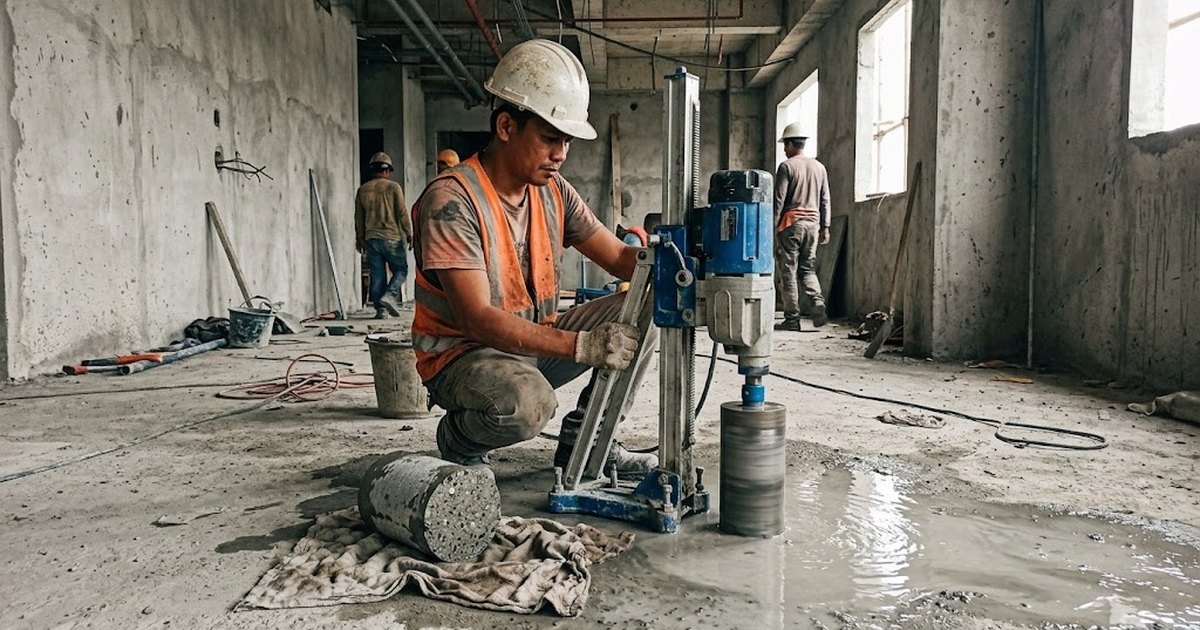
A drilled core shows the strength the concrete actually has, not what the delivery ticket claimed. Illustrative photo.
Short answer: a rebound hammer cannot pass or fail your concrete. Its own standard says so. Only drilled cores decide, and the code gives two numbers: the average of three cores must reach 85% of the specified strength, and no single core may fall below 75%.
A cylinder breaks low. That does not by itself condemn anything. The code asks, in order: was the acceptance limit really breached, then do the calculations show adequacy is significantly reduced, then and only then take three cores. Skipping to coring is expensive; skipping past it and hoping is worse.
Enter the specified strength and what came back. This applies the NSCP Section 426.12 acceptance rules to your numbers, tells you whether coring is even triggered, and how many cores the code requires. Every limit used here is quoted from the code; the cost band is AEDO practice.
Before anything else, get the unit of measurement right. Under Section 426.12.1.1 a strength test is the average of the strengths of at least two 150 × 300 mm cylinders, or at least three of the smaller size. One cylinder is not a strength test. A single low break on its own proves nothing and should not start a panic or a stop-work order.
The chain of standards behind it: sampling to ASTM C172M, cylinders made and standard-cured to ASTM C31M, tested to ASTM C39M. If any of those were not followed, the argument to have is about the testing, not the concrete.
Section 426.12.3.1 makes the strength level of a concrete mixture acceptable when both of the following hold.
| Condition | The rule |
|---|---|
| Running average | Every arithmetic average of any three consecutive strength tests equals or exceeds f′c |
| Individual test floor | No strength test falls below f′c by more than 3.5 MPa where f′c ≤ 35 MPa, or by more than 0.10 f′c where f′c > 35 MPa |
Both must be satisfied. If the running average fails but no individual test breached the floor, the code's response is to take steps to raise subsequent results, not to core. Coring is triggered by the individual floor being breached.
Where the total quantity of a given concrete mixture is less than 38 m³, strength tests are not required if evidence of satisfactory strength is submitted to and approved by the building official. That is a discretionary approval on a specific mixture, not a blanket waiver for a small project, and the approval has to actually be obtained.
This is the most commonly misused instrument on a Philippine assessment, usually with good intentions. ASTM C805, the standard for the rebound number of hardened concrete, states plainly that rebound values cannot be used as the basis to accept or reject concrete.
What it is genuinely good for is real and valuable: assessing in-place uniformity, delineating variation in quality across a structure, and estimating in-place strength only where a correlation has been developed for that concrete. On a silo, a warehouse slab or a condominium column grid, that is exactly how you decide where the three cores should come from instead of drilling at random.
| Method | Standard | What it decides |
|---|---|---|
| Drilled cores | ASTM C42M | Acceptance. The only method the code's 85/75 criteria attach to |
| Rebound number | ASTM C805 | Uniformity and where to core. Not acceptance or rejection |
| Ultrasonic pulse velocity | ASTM C597 | Relative density and internal flaws; a diagnostic, not a strength verdict |
| Strength evaluation | NSCP Section 427 | The fallback when cores do not settle it and doubt remains |
Coring itself is modest. The expensive parts are the delay, the reinstatement, and the decision that follows. A core through a structural member must avoid cutting reinforcement, which means locating bars before drilling, and the hole has to be properly reinstated afterwards.
Our practice bands for Philippine work in 2026, excluding access equipment and out-of-town mobilisation:
| Item | Band |
|---|---|
| Core extraction and compression test, per core | ₱3,500 – ₱8,000 |
| Rebound hammer survey, per visit | ₱8,000 – ₱20,000 |
| Rebar locating before drilling, per visit | ₱6,000 – ₱15,000 |
| Hole reinstatement, per core | ₱1,500 – ₱4,000 |
| Written engineering evaluation of the results | ₱25,000 – ₱90,000 |
If the cores do not clear the criteria, the next step is a strength evaluation under Section 427, which is a different order of cost and time. That is the real reason to get the sampling and curing right on the way up. Our guides on concrete mix ratios and ready-mix pricing cover the supply side, the structural audit guide covers what a full assessment involves, and the report guide covers how the results should be written up.
Every acceptance figure is read from NSCP Volume I, 7th Edition 2015, Chapter 4, Section 426.12 at pages 4-185 to 4-186: 426.12.1.1 for the definition of a strength test, 426.12.3.1 for the two acceptance conditions, the 3.5 MPa and 0.10 f′c limits, 426.12.2.1(c) for the 38 m³ exemption, and 426.12.4.1 for the coring trigger, the three-core rule, the ASTM C42M reference, the 48-hour to 7-day testing window, the 85% average and 75% single-core criteria, and the referral to Section 427. The statement that rebound values cannot be used to accept or reject concrete is from ASTM C805/C805M itself. All peso figures are AEDO practice bands, not code.
Can a rebound hammer be used to accept or reject concrete?
No, and the test standard says so itself. ASTM C805, the standard for the rebound number of hardened concrete, states that rebound values cannot be used as the basis to accept or reject concrete. What the rebound hammer is genuinely good at is assessing in-place uniformity, mapping variation across a structure, and estimating strength only where a correlation has been developed for that specific concrete. In a real assessment its job is to tell you where to core, not whether the concrete passes. The decision belongs to drilled cores tested under ASTM C42M.
What counts as a strength test under the NSCP?
Section 426.12.1.1 of the National Structural Code of the Philippines defines a strength test as the average of the strengths of at least two 150 by 300 millimetre cylinders, or at least three of the smaller size. One broken cylinder is not a strength test and no conclusion should be drawn from it on its own. Sampling follows ASTM C172M, the cylinders are made and standard-cured to ASTM C31M, and they are tested to ASTM C39M.
When is concrete strength acceptable without coring?
Section 426.12.3.1 sets two conditions that must both be satisfied. Every arithmetic average of any three consecutive strength tests must equal or exceed the specified compressive strength, and no individual strength test may fall below the specified strength by more than 3.5 megapascals where the specified strength is 35 megapascals or less, or by more than ten percent of the specified strength where it exceeds 35 megapascals. If both hold, the concrete is acceptable and there is nothing to investigate.
How many cores are required when a cylinder result is low?
Three, for each strength test that falls below the specified strength by more than the limit allowed for acceptance. Section 426.12.4.1 permits cores drilled in accordance with ASTM C42M once the likelihood of low-strength concrete is confirmed and calculations indicate that structural adequacy is significantly reduced. The cores must be moisture-conditioned in watertight bags or containers, transported to the testing agency, and tested between 48 hours and 7 days after coring unless the licensed design professional approves otherwise.
What core strength is acceptable?
Two conditions, and both must be met. Under Section 426.12.4.1, concrete in an area represented by core tests is considered structurally adequate if the average of three cores is equal to at least 85 percent of the specified compressive strength, and no single core is less than 75 percent of it. Miss either one and the area is not accepted on the cores alone. The code then allows additional testing of cores from locations represented by erratic results, and if structural adequacy remains in doubt the responsible authority may order a strength evaluation under Section 427.
Is a small concrete pour exempt from strength testing?
There is a narrow exemption. Section 426.12.2.1(c) provides that if the total quantity of a given concrete mixture is less than 38 cubic metres, strength tests are not required if evidence of satisfactory strength is submitted to and approved by the building official. That is a discretionary approval, not an automatic waiver, and it applies to the quantity of a given mixture rather than to the project as a whole. On anything structural it is usually cheaper to test than to argue about it later.
Every standard and code provision used or referred to in this guide. Links open in a new tab.
ASTM C42M, C172M, C31M, C39M and C597 are cited by designation as referenced within NSCP Section 426.12 and are purchased standards without free full text. All peso figures are AEDO Construction practice bands for Philippine work in 2026, not code or published rates.
A low break is a question, not a verdict. The answer comes from the right test, in the right place, evaluated against the right clause.