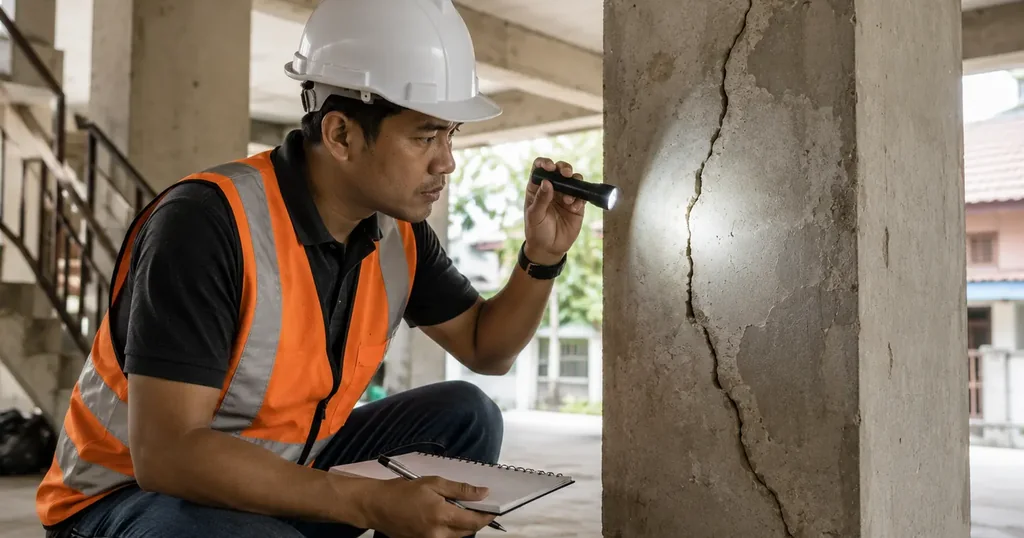
The site visit is the cheap part. The report is what you are actually paying for. Illustrative photo.
Short answer: a structural assessment report is only useful if it ends in a decision. It should tell you what was inspected and when, what was observed, what that means against a stated basis of evaluation, a specific finding, a recommendation with a priority, what the report does not cover, and whose seal stands behind it. If the document you received stops at photographs and the phrase "generally in fair condition," you have paid for a walkthrough, not an assessment.
This matters because the report outlives the visit. It is what you hand to a contractor to price a repair, to a buyer during negotiation, to a condominium board, or to the next engineer who picks up the problem two years from now. A vague report cannot do any of those jobs.
People expect a government form for this. There isn't one we can point you to. The National Structural Code of the Philippines (NSCP 2015) is a design code: it tells an engineer how to design and evaluate structures, not how to lay out a private report. The National Building Code (PD 1096) governs permits, occupancy, and what happens when a building is declared dangerous, not the format of an engineer's opinion.
So the format is a matter of professional practice, and practice varies widely. Two reports on the same building, at the same price, can differ from twelve substantive pages to a one-page letter. Knowing the difference before you commission one is the entire point of this guide.
If you would rather see one than read about one, we published a complete specimen structural assessment report — all ten sections filled in, free to read or download as a PDF.
This is the structure AEDO issues. Use it as a specification when you commission an assessment, or as a checklist against a report already in your hands.
Open the report you were given and tick what is actually in it. You'll get a completeness score, the gaps that matter most, and what to ask the engineer for.
A conclusion that cannot be acted on is not a conclusion. In our reports the finding lands on one of five verdicts, each with a reason and a timeframe attached.
| Verdict | What it means | What you do with it |
|---|---|---|
| No action needed | What you were worried about is not structural | Repair the finish if you want to; nothing else is owed |
| Monitor | Real but not yet conclusive — movement may or may not be ongoing | Fixed measuring points, a stated interval, and a re-check date |
| Restrict use | The structure is not safe for its current loading or occupancy | Reduce load or close the area now, then design the fix |
| Repair or retrofit | Intervention is required and can be designed | Get the repair designed and priced; the report is the brief |
| Evacuate | Rare. Risk of collapse or of harm is immediate | Vacate first, notify the building official, engineer follows |
Two of these, restrict use and evacuate, have consequences beyond your building. Under PD 1096 Section 214 a building that is structurally unsafe or a hazard to life, health or property is a dangerous building, and Section 215 directs the building official to order it repaired, vacated or demolished according to the degree of danger. Our structural audit guide covers what happens when that process starts from the government's side rather than yours.
Most assessments are resolved visually. Testing enters when the report needs proof of what is inside the concrete — typically when the structure will carry new load, when a member is visibly distressed, or when the concrete's history is unknown.
Where concrete strength is in question, the code is specific. Under NSCP 2015 Section 426.12, the average of three cores must reach 85% of the specified strength, and no single core may fall below 75%. That is the test that decides, not a surface reading.
| Item | AEDO 2026 band |
|---|---|
| Structural assessment: site visit, NSCP 2015 evaluation, written report in 5 business days | ₱5,000 flat |
| Concrete core extraction and compression test, per core | ₱3,500 – ₱8,000 |
| Rebound hammer survey, per visit | ₱8,000 – ₱20,000 |
| Rebar locating before drilling, per visit | ₱6,000 – ₱15,000 |
| Written engineering evaluation of test results | ₱25,000 – ₱90,000 |
Testing figures exclude access equipment and out-of-town mobilisation. If a report recommends testing, it should say what question the test is meant to answer — a test without a question attached is a line item, not an investigation.
Section 14 of Republic Act 544, the Civil Engineering Law, requires a registered civil engineer to obtain a seal, and requires plans and specifications prepared by or under the direct supervision of a registered civil engineer to be stamped with it. On an assessment report, the seal identifies who is professionally accountable for the opinion.
It does not certify that the building is safe, and no honest report claims that it does. An assessment is a professional opinion on observed condition, on a stated date, within stated limits. Where a construction defect is involved, Article 1723 of the Civil Code holds the engineer or architect who drew the plans, and the contractor, liable for fifteen years from completion for collapse traced to plans, ground, construction or materials — which is a different question from the condition report you are holding, and one our liability guide covers.
The seal requirement is RA 544 Section 14. Dangerous-building consequences are PD 1096 Sections 214 and 215. The fifteen-year liability rule is Civil Code Article 1723. Core acceptance at 85% average and 75% minimum is NSCP 2015 Section 426.12. The limit on rebound hammer readings is ASTM C805. The ₱5,000 flat fee is AEDO's published price; the testing bands and the nine-part report structure are AEDO practice, not a statutory format.
What should a structural assessment report contain?
At minimum: the scope and date of the inspection, a description of the building and its apparent structural system, the observations with located and dated photographs, any measurements or tests actually performed, the basis of evaluation the engineer used, a specific finding for the structure or the element in question, a recommendation with priority, a statement of the report's limitations, and the signature and seal of the civil engineer who inspected it. A report missing the finding, the recommendation or the limitations is a letter with photographs attached, not an assessment.
Is there a prescribed format for a structural assessment report in the Philippines?
There is no single statutory template we can point you to. The National Structural Code of the Philippines is a design code, and the National Building Code governs permits, occupancy and dangerous buildings rather than the layout of a private engineer's report. That absence is exactly why quality varies so much between firms, and why it is worth knowing what a complete report looks like before you pay for one.
Who can sign and seal a structural assessment report?
A civil engineer registered with the Professional Regulation Commission. Section 14 of Republic Act 544, the Civil Engineering Law, requires a registered civil engineer to obtain a seal and requires plans and specifications prepared by or under that engineer's direct supervision to be stamped with it. The seal identifies who is professionally accountable for the opinion. It does not, by itself, certify that the building is safe.
What verdicts can a structural assessment report give?
In AEDO's practice the finding lands on one of five: no action needed, monitor, restrict use, repair or retrofit, or evacuate, which is rare. Each one should carry a reason and a timeframe. A report whose conclusion is only that the structure appears generally in fair condition has not given you anything you can act on, budget for, or hand to a third party.
Does a structural assessment need concrete testing?
Usually not. Most assessments are resolved by a visual condition survey and an engineering evaluation. Testing enters when the report needs proof of what is inside the concrete, and then the code is specific: under NSCP 2015 Section 426.12 the average of three cores must reach 85 percent of the specified strength with no single core below 75 percent. A rebound hammer cannot pass or fail concrete; ASTM C805 says its values cannot be used as the basis to accept or reject concrete.
How much does a structural assessment report cost in the Philippines?
AEDO charges ₱5,000 flat for a single-building site visit and a written report within 5 business days. Where the report calls for testing, that is scoped and quoted separately: our 2026 practice bands are ₱3,500 to ₱8,000 per concrete core, ₱8,000 to ₱20,000 for a rebound hammer survey per visit, ₱6,000 to ₱15,000 for rebar locating per visit, and ₱25,000 to ₱90,000 for the written engineering evaluation of test results, excluding access equipment and out-of-town mobilisation.
Every code and statute provision used in this guide, linked to its primary source where publicly available. Links open in a new tab.
The nine-part report structure, the five-verdict ladder and every peso figure here are AEDO Construction's own practice for Philippine work in 2026, not a statutory format or a published rate. This guide is engineering practice information, not legal advice.
A licensed engineer inspects the building and issues the report structure set out above — findings, recommendations, limitations, signed and sealed.