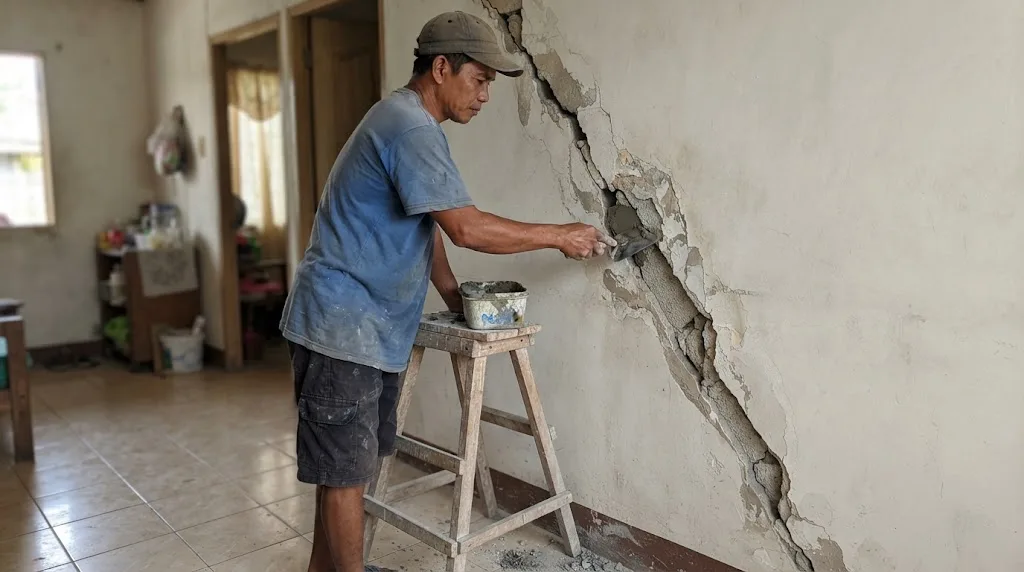
Packing mortar into a wide diagonal crack like this one only hides it. A crack this size needs a diagnosis first, because if the wall is still moving, the patch cracks again. Illustrative photo.
Short answer: the right crack repair depends on two things, where the crack is and whether it's still moving. A stable hairline crack in the plaster needs filler and paint, about ₱150 to ₱300 per metre before painting. A crack along the line where the CHB meets a column needs mesh and a strip of new plaster. A crack that's growing, wide, diagonal, horizontal or in a beam or column needs a diagnosis first, and the repair after that (grout injection, crack stitching or epoxy injection) runs into thousands of pesos per metre.
This post is about choosing and pricing the repair. If you're still working out whether your crack is serious at all, start with our structural damage warning signs guide, which covers crack patterns, widths and the 2-minute check. Then come back here with what you found.
A crack is the wall relieving movement. If whatever caused it has stopped, such as early plaster shrinkage or a one-off earthquake, the crack is dormant and you can fill it. If the cause is still there, such as a footing still settling, soil pushing on a wall or steel rusting inside concrete, the crack is active, and it keeps opening.
Put a rigid repair into an active crack and the movement just finds the next weakest line, usually right beside your patch. The published repair guidance is clear about this:
That's why the very first question isn't "which product?" but "has it stopped?"
You need a record over time, not a guess from one look.
Two practical points. Don't plaster or paint over a crack you're monitoring, because a covered crack can't tell you anything. And in the rainy season, check whether the crack changes with the weather. In our engineering judgement, a crack that opens and closes a little with heat and rain but doesn't grow overall is a movement joint problem, not a settlement problem, and the repair has to stay flexible.
Tell it where the crack is, how wide it is and whether it's moving. It suggests the type of repair and what to avoid. It's a screening guide based on the published repair guidance and our warning signs thresholds. It can't see your wall, and it isn't an engineering assessment.
Here's the menu, from cheapest to most involved. The rates are per linear metre of crack, before repainting.
| Crack | Repair | ₱ per metre | Who decides |
|---|---|---|---|
| Hairline plaster or shrinkage crack, stable | Open up, fill with acrylic or elastomeric filler, repaint | 150-300 | Owner or painter |
| Wider plaster crack, stable, or exterior crack that lets rain in | Rout to a V, seal with flexible sealant, repaint | 300-700 | Owner or contractor |
| Crack along a CHB-to-column or CHB-to-beam line | Hack a strip, embed fibreglass mesh, re-plaster, repaint | 250-500 | Contractor; engineer if it widens |
| Structural crack in CHB, confirmed dormant | Cement grout injection | 1,500-3,500 | Engineer |
| Structural crack in CHB, needs tension across it | Crack stitching with bars bonded into the bed joints | 2,000-4,500 | Engineer |
| Crack in an RC beam, column, slab or wall, confirmed dormant | Low-pressure epoxy injection | 2,500-5,000 | Engineer |
| Crack from rusting rebar | Break out, treat or replace steel, rebuild cover | Priced after assessment | Engineer |
All rates in the table are AEDO market estimates for 2026, not figures from a published price list. The ₱300-700 routing and sealing rate is the same estimate used in our damp wall and efflorescence guide.
Fine, random or map-like cracks in the plaster that haven't changed are almost always the plaster shrinking as it dried. They don't go into the block. The repair is simple: scrape the crack open a little so the filler has something to grip, brush out the dust, fill with an acrylic or elastomeric crack filler, sand it flat, then prime and repaint the whole wall panel, not just a stripe over the crack. A patch of fresh paint on an old wall always shows.
FEMA 308 notes that paint can bridge small cracks and that some paints can bridge cracks up to 0.06 inch (about 1.5 mm), and it tells you to check the paint maker's data for what a specific product can do. It also warns that coatings only work over a dormant crack, and won't bridge cracks that keep moving from shrinkage or temperature changes. So paint over a plaster crack only after your marks show it has stopped. On outside walls, use a filler and paint rated for exterior use, because ordinary putty cracks again with sun and rain.
This straight vertical crack beside a column, or horizontal one under a beam, is one of the most common cracks in a Philippine house. The concrete frame and the CHB infill are different materials, they shrink and move differently with heat and moisture, and the plaster over the line between them is where that difference shows.
Plastering over it again usually cracks on the same line. In our engineering judgement, the durable fix is to bridge the joint:
On an exterior face that takes driving rain, the other option is to rake the joint out and fill it with a paintable flexible sealant, accepting a visible line. If the crack keeps widening, runs diagonally away from the column, or the column itself is cracked, stop treating it as a finishing problem and get it assessed.
Diagonal and stepped cracks, horizontal cracks, anything over about 5 mm, cracks that go through the wall and cracks in beams and columns all start the same way: someone finds out why the wall cracked and whether it has stopped. A repair chosen before that is a guess. Once the cause is known, these are the usual options.
Epoxy is usually the wrong tool for CHB. FEMA 308's summary table notes that epoxy injection is not recommended for partially grouted reinforced masonry, and its grout injection guide says epoxy resins are not recommended for injection into masonry because their properties won't be compatible with the masonry. In our engineering judgement, most Philippine house walls fit that description, with grout only in the cores that hold vertical bars, so that caution applies. A contractor offering epoxy injection on a hollow CHB wall should be able to explain why.
After any structural repair, the wall is re-plastered over the repaired zone, ideally with mesh, and repainted. If the assessment finds a weak wall rather than a damaged one, the fix moves from repair to strengthening, which our seismic retrofit cost guide covers.
Pick the repair, enter the total length of crack and the wall area to repaint. Each row is a separate line item and the total is the exact sum of the rows. Structural methods automatically include the assessment, because they shouldn't start without one. It's a planning range, not a quote.
The crack itself is often the smaller part of the bill. Repainting the whole panel so the repair doesn't show, and the minimum cost of getting a crew to site, add up quickly on a small job.
Worked example 1, cracks along the column lines (the calculator's default): 10 m of CHB-to-column cracks repaired with mesh and a re-plastered strip, plus 12 sqm of full paint system over the new plaster. Mesh and re-plaster is ₱2,500 to ₱5,000, painting ₱3,240 to ₱5,280, and mobilisation ₱2,000 to ₱5,000. Total: ₱7,740 to ₱15,280.
Worked example 2, a dormant crack in a concrete beam: 4 m of epoxy injection, 6 sqm of full paint system, with the structural assessment included. Epoxy injection is ₱10,000 to ₱20,000, painting ₱1,620 to ₱2,640, mobilisation ₱2,000 to ₱5,000 and the assessment ₱5,000. Total: ₱18,620 to ₱32,640, before any engineer's repair design or supervision.
For labour-only quotes, our construction labor rates guide puts a mason at ₱650 to ₱900 a day in the provinces and ₱800 to ₱1,200 in Metro Manila, and plastering labour at ₱90 to ₱300 per sqm per side. If a larger area of plaster has gone hollow and has to come off, re-plastering runs ₱150 to ₱300 per sqm per side from our CHB and plastering cost guide, plus about ₱80 to ₱150 per sqm to hack off the old plaster (AEDO market estimate, from the damp wall guide).
When it's an engineer's job, not a painter's. Get the wall assessed before any repair if the crack is wider than about 5 mm, still growing, horizontal, diagonal from a door or window corner, visible on both faces, in a beam, column or slab, or showing rust. Also if doors have started sticking, or a crack came back wider or longer after it was patched. (A fine line that returns along a column after plain plastering is the usual joint crack covered above.) Our warning signs guide explains what each of those patterns usually means, and after a big storm, the post-typhoon inspection checklist covers the rest of the house.
How much does wall crack repair cost in the Philippines?
It depends on the repair, not the crack length alone. As AEDO market estimates for 2026, filling hairline plaster cracks runs about ₱150 to ₱300 per metre, routing and sealing with a flexible sealant ₱300 to ₱700 per metre, and hacking a strip, embedding mesh and re-plastering ₱250 to ₱500 per metre. Structural repairs cost more: cement grout injection of CHB ₱1,500 to ₱3,500, crack stitching ₱2,000 to ₱4,500 and epoxy injection of a concrete member ₱2,500 to ₱5,000 per metre. In our calculator, 10 m of CHB-to-column cracks with mesh and re-plaster plus 12 sqm of full paint system comes to ₱7,740 to ₱15,280.
Can I just fill a wall crack and repaint it?
Only if the crack has stopped moving. FEMA 308 describes routing, sealing and painting as cosmetic repairs with negligible structural benefit, and says surface coatings are only appropriate if the crack is dormant. A crack that is still opening will split a rigid filler or plaster again. Mark it, wait 2 to 4 weeks, and fill it only if it has not changed.
Is epoxy injection good for cracked CHB walls?
Usually not. FEMA 308 notes that epoxy injection is not recommended for partially grouted reinforced masonry, and its grout injection guide says epoxy resins are not recommended for injection into masonry because their properties are not compatible with the masonry. In our engineering judgement, most Philippine CHB walls are only partly grouted, so structural cracks in them are normally repaired with cement grout injection or crack stitching, as an engineer specifies. Epoxy injection suits dormant cracks in concrete beams, columns, slabs and walls.
Why does the crack between my CHB wall and column keep coming back?
The concrete column and the CHB wall are different materials that shrink and move differently, so the plaster over the line between them is where that movement shows. Plastering straight over it again tends to crack on the same line. Good practice is to bridge the joint with fibreglass mesh embedded in new plaster, or on an exterior face to rake it out and seal it with a flexible sealant. If the crack keeps widening or runs diagonally away from the column, have it assessed.
How do I check if a wall crack is still moving?
Draw a short pencil line across each end and across the widest point, write the date, and photograph it with a ruler beside it. Check again after 2 to 4 weeks. If the crack has run past the end marks or the gap is wider, it is still moving. For a more exact record, a plastic tell-tale crack monitor is fixed across the crack; Avongard says its tell-tales are calibrated to 1.00 mm and can be read by interpolation to 0.5 mm.
When is a wall crack a job for an engineer instead of a painter?
Call an engineer if the crack is wider than about 5 mm, still growing, horizontal, diagonal from a door or window corner, visible on both faces of the wall, in a concrete beam, column or slab, or showing rust. Those need a diagnosis before any repair is chosen. AEDO's structural assessment is ₱5,000 flat with a written report within 5 business days.
Published repair guidance first, then manufacturer guidance, then AEDO's own cost guides. External links open in a new tab.
The per-metre rates for filling hairline cracks (₱150-300), mesh and re-plaster strips (₱250-500), cement grout injection (₱1,500-3,500), crack stitching (₱2,000-4,500) and epoxy injection (₱2,500-5,000), and the ₱2,000-5,000 mobilisation allowance, are AEDO market estimates for 2026, not figures from a published price list. They move with access, crack depth, wall thickness and location, so treat the calculator output as a planning range. The mesh detail for CHB-to-column joints is good practice in our engineering judgement, not a code requirement. ACI RAP Bulletin 1 and FEMA 308 are US guidance documents, not Philippine codes; they are cited for repair method, not as legal requirements.
A licensed engineer inspects the cracks, finds out whether they're still moving and why, and tells you in writing which repair fits, before you pay anyone to fill or inject them.