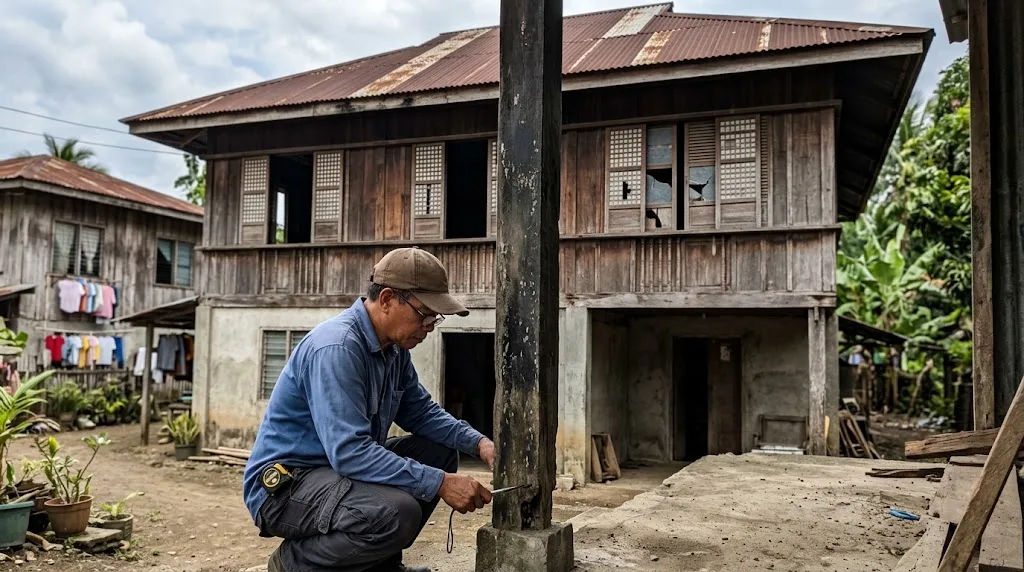
Capiz windows, hardwood posts, a GI roof: the parts of an old house that decide both the repair bill and the paperwork. An assessment starts at the ground-floor posts. Illustrative photo.
Short answer: before you price a single post or sheet, find out whether the house is 50 years old or more. Under RA 10066, the National Cultural Heritage Act, Sec. 5(f), a structure dating at least 50 years old is presumed an important cultural property for the purpose of protecting it against modification or demolition, unless the cultural agency declares otherwise. The 2024 IRR gives a presumed property the same level of protection as a Grade II property, and says intervention works, including modification or demolition, need the cultural agency's prior approval. NHCP's own plan-review page says any proposal to modify a structure that old needs an NHCP clearance. As of 2026 that means a house finished in 1976 or earlier (one finished in 1976 reaches 50 during the year). What no text we read settles is where routine like-for-like repair stops and "modification" starts, so we say so plainly below.
The cost side is more ordinary. For a 120 sqm timber house with 4 rotten posts, a worn roof, old wiring and a cosmetic finish, the calculator gives a restoration scope of ₱906,074 to ₱1,821,488, against ₱3,300,000 to ₱4,704,000 to demolish and rebuild at standard finish. In that case restoring is far cheaper on paper. The real questions are the legal gate, what the frame needs, and what the calculator cannot price. This guide covers the legal frame, where old houses actually fail, what each repair costs, and how to choose between restoring, repairing in stages and rebuilding.
Tell it the age, the material, what you can see, and the repairs you expect. You get a heritage-status check, a condition score, an itemised restoration range built only from AEDO's other guides, a comparison with demolishing and rebuilding, and a restore, repair-in-stages or rebuild lean. A planning range, not a quotation.
RA 10066, the National Cultural Heritage Act (approved March 26, 2010; its short title says "of 2009"), was amended by RA 11961 on August 24, 2023, and the NCCA issued a 2024 IRR for the amended Act. All three, plus NHCP's published guidelines and checklists, say something about old houses. This is a reading of public documents, not legal advice. AEDO doesn't give legal opinions and doesn't process clearances for you; confirm with NHCP and a lawyer.
The 50-year presumption. Sec. 5 says that "for purposes of protecting a cultural property against exportation, modification or demolition", certain works are considered important cultural property "unless declared otherwise by the pertinent cultural agency." Item (f) is structures dating at least fifty (50) years old, with the National Historical Institute (now NHCP, renamed by RA 10086) as the agency that can declare otherwise. The owner "may petition the appropriate cultural agency to remove the presumption," which "shall not be unreasonably withheld."
| Status of the house | How it arises | What it means for repairs | Where it is written |
|---|---|---|---|
| Presumed important cultural property | By operation of law, with no declaration: a structure at least 50 years old, until declared otherwise or the presumption is removed | Same level of protection as Grade II. Intervention works, "including modification or demolition," need prior approval of the Commission and/or the cultural agency. NHCP's page asks for a clearance before modifying a structure that old. | RA 10066 Sec. 5(f); 2024 IRR Secs. 10, 12.4, 35; NHCP plan-review page |
| Declared Heritage House | The owner applies to NHCP; the NHCP Board decides by resolution | NHCP's guidelines require its written permission for any repair, addition, alteration, renovation, restoration or reconstruction of the exterior. To qualify in the first place, the house should have at least 70% of its original structure and materials | NHCP Guidelines on Heritage Houses (2020), Secs. II.F, IV, VI.A |
| Marked or declared property (NHCP marker, National Cultural Treasure, declared Important Cultural Property) | Declared or marked by the agency | Grade I or II. Under the DPWH circular, a clearance from the agency is a prerequisite to a building-permit application | 2024 IRR Sec. 36.2.1; NBCDO MC No. 03, s. 2018 |
| Locally declared | An LGU ordinance | Grade III in the registry. If the house is also presumed, the highest applicable grade and its protections apply. We did not read any local ordinance; ask the LGU for its text | 2024 IRR Sec. 21.8.1 |
What "at least 50 years" means in practice. Counting from the year of completion, the house has to date from 1976 or earlier to be 50 in 2026. That sweeps in a 1900s bahay na bato and a 1970s concrete bungalow alike. The Act's list item doesn't ask whether the structure is important; the 2024 IRR does narrow it to structures at least 50 years old "that possess potential historical, cultural, architectural, artistic, and/or scientific value of national significance" (Sec. 12.4.3). Who decides that, and how, is left to the petition procedure. NHCP's own checklist is broader: it applies its requirements to "all structures fifty (50) years and above."
What the penalties say. "To the extent that the offense is not punishable by a higher punishment under another provision of law," the Act prohibits intentionally destroying, demolishing, mutilating or damaging "important cultural property" (Sec. 48(a) as enacted; Sec. 91 of the 2024 IRR). On conviction the penalty is a fine of not less than ₱200,000 or imprisonment for a term of not less than 10 years, or both, at the court's discretion (Sec. 49 as enacted; Sec. 92 of the IRR). The cultural agency can also issue an ex parte cease and desist order when the physical integrity of a property is in danger of destruction or significant alteration; the IRR says this covers presumed properties (Sec. 55). And for a privately-owned cultural property that "has fallen into disrepair through neglect to such an extent that it will lose its potential for conservation," the agency may order repair within 30 to 45 days and do it for the owner's account (Sec. 56). Whether an undeclared, presumed house counts as "important cultural property" for criminal liability is a lawyer's question, taken up in section 3. We found no court decision on it.
What a declaration can give back. Cultural properties declared Grade I or II are entitled to priority government funding, a heritage marker, and an incentive for private support of conservation through the NCCA's Conservation Incentive Program (Sec. 7 as amended). The IRR encourages LGUs to enact real-estate-tax incentives down to a zero assessment level for declared properties (Sec. 82) and says NHCP's Heritage House privileges "could" take the form of reduced realty tax or deductions for repairs (Sec. 83.1.1). Nothing in what we read makes a tax break automatic; it depends on a local ordinance and a declaration.
How to find out where you stand. Ask your LGU's cultural or tourism office whether the house is in its local inventory, check NHCP's registry of declared and marked sites and structures, and write NHCP before any work beyond routine upkeep. The DPWH circular tells Building Officials to look at the local registry of cultural property or the national registry when they decide whether a building is heritage. The signed-off answer you want is either a clearance for your scope or a decision removing the presumption.
For a modification. NHCP's checklist for proposed development work, dated 23 August 2022, covers declared and marked sites, Heritage Houses and "all structures fifty (50) years and above." You submit the scope of work and the reasons for it; an as-built plan with photo documentation of existing conditions, a building condition survey and a location map showing the impact on historic sites within one kilometre; and the proposed plan. Both plans carry architectural drawings (perspectives, floor plans, elevations, sections) and engineering plans "if available": structural, electrical, mechanical and plumbing. NHCP's page says the request is facilitated by its documentation center and "raised to the NHCP Board Meeting for review and approval/disapproval." Neither page states a processing time. The agency may also require a Conservation Management Plan or a Heritage Impact Assessment before approving work on Grade I or II properties, "as deemed necessary" (IRR Sec. 35.3).
For lifting the presumption. NHCP's separate checklist asks for a written petition by the owner with proof that all owners authorise it, a survey form, photo documentation of the building including the interior and the setting, and a notarised sworn statement of the date of construction and every alteration and renovation. It also asks for a clearance from the municipal or city government, signed by the cultural-tourism officer, administrator or mayor, that the building holds no local historical, socio-cultural or architectural significance, and a clearance from the NCCA that it holds no exceptional national significance. The petition then runs through the procedure in Sec. 8 of the Act as amended and Sec. 30 of the IRR: position papers within 15 days of the notice (extensions of at most 30 days), and a decision within 90 days of the deadline for the last position papers. The Commission charges a fee for petitions to remove a presumption (IRR Sec. 34); the amount is not stated in what we read.
At the building permit. PD 1096's IRR makes a building permit mandatory for any construction, alteration, repair, conversion, demolition or addition, and DPWH's NBCDO Memorandum Circular No. 03, s. 2018 adds a written clearance for built heritage to the documents for a permit application. It names three: the National Museum, for a structure declared a National Cultural Treasure or Important Cultural Property; NHCP, for a structure declared a National Historical Landmark, National Shrine, National Monument or Heritage House, "dating at least fifty (50) years; and bearing a marker" installed by NHCP or its predecessor; and the NCCA, for structures designed by a National Artist for Architecture or created by one for Sculpture, and inscribed in the World Heritage List. The 2024 IRR restates it: clearance is a prerequisite for building permits involving Grade I or II properties (Sec. 36.2.1), and Building Officials must consult the cultural agencies before issuing permits for construction, renovation or demolition that may affect them (Sec. 36.2). Two more details matter to heirs. Building Officials who start condemnation proceedings on an old building must get a certification that it isn't Grade I or II (Sec. 36.2.2), so a "dangerous building" route doesn't bypass the agencies. And the general permit rules still apply: our building permit guide and who can sign plans cover the ordinary side.
Routine repair versus "modification." The Act protects against "modification or demolition." The IRR talks about "intervention works, including modification or demolition." We found no text that defines a minor repair, and none that exempts routine upkeep like repainting or replacing a broken sheet. We also found none that says such work needs clearance. Anything beyond that, such as replacing structural posts, changing the roof frame or removing walls, should be put to NHCP in writing first.
Did RA 11961 narrow the presumption? The amended definition of "important cultural property" (Sec. 3(bb)) reads as property "officially declared" by law or the cultural agency. The amended Act leaves Sec. 5, the presumption, as it was (it is printed in RA 11961 as unchanged), and the 2024 IRR keeps the presumption and treats presumed properties as Grade II. We found no court ruling on how those two fit. Treat the presumption as live: that is how NHCP and the IRR are written.
How the DPWH circular applies to an unmarked 50-year house. MC No. 03, s. 2018 lists NHCP's trigger with semicolons: "declared as ... Heritage House; dating at least fifty (50) years; and bearing a marker." It can be read as three alternatives or as one combined test. The circular doesn't say which, and we couldn't confirm how your Building Official reads it. The 2024 IRR (Sec. 36.2.1) speaks of Grade I or II properties, which include presumed ones.
Houses of mixed age. The petition checklist asks for the construction date and every alteration. No rule we read says which date counts when a 1930s core carries a 1990s wing.
Timing, fees and the IRR's own status. Neither NHCP page states how long a clearance takes or what it costs. We also couldn't confirm from the text when the 2024 IRR was published or took effect.
Local rules. We read no LGU ordinance. Heritage zones (Sec. 12 of the Act; IRR Secs. 27 and 28) and local declarations can add requirements, so ask the LGU.
A house of this age is usually a wood frame, a stone-and-wood mix, or early concrete. NHCP's heritage-house guidelines describe the Spanish colonial form as typically "stone for the ground floor and wood for the second floor," and the American-period forms as bungalows and "bahay-na-kongkreto," reinforced concrete houses. The loads go down the same way in all of them: roof to rafters and purlins, to the top plate and posts, to the second-floor girder and joists, down the ground-floor posts or walls to a pedestal or footing. What fails first is whatever has been wet or eaten the longest.
Termites and rot in the posts and joists. Posts take the whole load, and the base of a post is the part that touches damp ground. Our termite damage guide keeps treatment and repair as two separate bills: a licensed pest-control provider treats the colony, then the damaged members are replaced. Replacing a post before the colony is treated wastes the repair.
Sagging floors. A bouncy timber floor is usually joists or a girder that has lost section at the bearing end. A ground slab that has sunk is a settlement question; our sinking floor guide separates a hollow slab from a footing that is moving.
Rusted roof and trusses. Old GI sheets and the steel or wood under them fail together at the nail holes, valleys and ridge. Our rusty roof guide says when members can be recoated and when they need replacing, and the leaking roof guide covers finding the leak. The steel versus wood truss guide is the place to start if you are replacing a timber frame.
Cracked masonry. Cracks at the corners of door and window openings are the usual first sign, and the wall crack guide prices the repair once the cause is known. Old unreinforced stone walls have no steel tying them together. Our seismic retrofit guide says plainly that no Philippine source gives a retrofit cost per square metre, so the calculator doesn't invent one. For early reinforced concrete, the question is what the steel inside has done; core testing answers it.
Wiring and plumbing. A house of this age may have cloth-covered or aluminium wire and a fuse box. Our rewiring guide scores those among its highest-risk answers and prices a full rewire, with a permit allowance. It also explains that electrical plans need a Professional Electrical Engineer under RA 7920. We have no AEDO rate for re-piping, which is why that line in the calculator is yours to fill.
Our structural warning signs guide sorts which combinations mean "book an assessment now," and the assessment report guide shows what a written report contains.
Every rate in the calculator comes from another AEDO guide. We built none of them for heritage work, so they are the ordinary-contractor price of the same operation. Heritage-grade materials, hand-finished joinery and a conservation specialist cost more, and none of them is in the numbers.
| Item | Range used | Basis and source guide |
|---|---|---|
| Termite soil or chemical barrier | ₱650 to ₱900 per linear m of ground perimeter | Calculator range in the termite damage guide: ₱650 is a published Philippine pest-control starting price; the ₱900 upper end is that guide's AEDO allowance for a worse infestation. Treatment is billed by a pest-control provider, not AEDO |
| Replace a load-bearing wood post | ₱9,000 to ₱15,000 each | AEDO market estimate in the same guide. The guide won't quote a post without seeing it, so treat this as indicative only |
| Replace a joist, truss or purlin | ₱5,500 to ₱9,500 each | AEDO market estimate, same guide |
| Clean and recoat the roof steel in place | ₱200 to ₱450 per sqm | Rusty roof guide, AEDO planning allowance (before the guide's coastal factors of ×1.1 and ×1.2, which the calculator does not apply) |
| New sheets, steel members sound | ₱1,020 to ₱1,560 per sqm | Same guide: sheet ₱650 to ₱850, plus installation labour and flashing and fasteners |
| New sheets and new C-purlins | ₱1,360 to ₱2,040 per sqm | Our sum: replace C-purlins with sheets lifted and relaid ₱710 to ₱1,190, plus new sheets ₱650 to ₱850, both from the rusty roof guide |
| Rout and seal / grout injection / crack stitching | ₱300 to ₱700 / ₱1,500 to ₱3,500 / ₱2,000 to ₱4,500 per linear m | Wall crack guide, AEDO market estimates: rout and seal for wider plaster cracks, grout injection and stitching for structural cracks in CHB. The guide's per-job mobilisation allowance is not added here. No AEDO rate exists for old stone or adobe; treat these as a floor |
| Ground slab recast and re-tiled | ₱2,050 to ₱3,400 per sqm | Our sum from the sinking floor guide: break-out ₱400 to ₱800, new 100 mm slab ₱850 to ₱1,200, ceramic tile ₱800 to ₱1,400. New fill, if needed, is extra |
| Full rewire | ₱144,216 to ₱223,325 (new conduit) or ₱110,973 to ₱169,050 (sound conduit) for 80 sqm, scaled by area ÷ 80 | Rewiring guide worked example: 2 lighting circuits, 2 outlet circuits, 10 switches, 14 outlets, 2 aircon circuits, 1 other dedicated circuit, a new panel board, and (for the higher pair) new conduit chased into CHB walls. Scaling by floor area is our simplification |
| Cosmetic finishes | ₱3,000 to ₱8,000 per sqm | "Finishes only" band in the renovate or rebuild guide |
| Demolition | ₱500 to ₱1,200 (light frame), ₱900 to ₱1,800 (CHB load-bearing, 1 storey), ₱1,500 to ₱3,000 (RC frame, 1 to 2 storeys) per sqm | Same guide. The calculator uses the light-frame row for wood, the CHB load-bearing row for old stone (the nearest match; none is built for stone) and the RC-frame row for early concrete. See also the demolition cost guide |
| New house | ₱20,000 to ₱26,000 / ₱27,000 to ₱38,000 / ₱38,000 to ₱55,000 per sqm | House construction cost guide: economy, standard, mid-high |
| Structural assessment | ₱5,000 flat | AEDO's structural assessment page: site visit and written report in 5 business days |
Not priced, on purpose: re-piping and a seismic strengthening scheme (no AEDO or Philippine per-sqm figure we can cite), timber flooring, windows, doors and capiz, joinery, anything that must match original details, and the fees for design, permits and clearance. If NHCP or the National Museum requires a Conservation Management Plan or Heritage Impact Assessment, that is a specialist's fee on top. A restoration usually runs over what its first list shows, because walls opened up show more. The 8% and 15% strengthening allowances in the renovate-or-rebuild guide are the nearest thing we have to an allowance for that, and its authors call them placeholders.
On cost alone, restoring wins in the default case by a wide margin, because a new house means new foundations, frame, roof and finishes while restoration pays only for what is broken. Our renovate or rebuild guide puts the rule this way: if the two numbers are within about 10 to 12% of each other, cost should not be the tiebreaker. The calculator reads that band as its thresholds (our reading of "about 10 to 12%"), comparing the midpoints of the two ranges: a restoration midpoint below 88% of the rebuild midpoint leans "Restore"; above 112% it reads "Rebuild leans ahead on cost"; in between is a close call to settle on other grounds.
Three things override the arithmetic:
What nobody should do is pay for a finished-looking repair before the frame has been looked at. A coat of paint over a termite-hollowed post is the most expensive repair on this list.
What we do. AEDO is a structural and construction engineering firm, not a heritage-conservation consultancy. We don't declare significance, issue NHCP clearances, give legal opinions or prepare Conservation Management Plans, and we don't claim any heritage accreditation. The cultural agencies decide what is allowed. What we do is the structural side: a site visit by our team and a written report, signed by a licensed civil engineer, on the posts, floors, roof frame, walls and foundation, repair or strengthening design from that report, and, in Negros Oriental only, carrying out the repair. Elsewhere in the Philippines, AEDO designs, seals and reviews remotely and can check milestones of a contractor you hire.
The price. The structural assessment is ₱5,000 flat: a site visit and written report within 5 business days, with testing such as concrete cores quoted separately if the report calls for it. Site visits cover Negros Oriental, Cebu, Luzon and NCR. A condition survey and as-found drawings are the kind of documents NHCP's checklist asks for, but whether NHCP accepts ours for a given clearance is NHCP's call. For repair design, we quote after the assessment.
Legal points were read from RA 10066 (LawPhil text), RA 11961 (LawPhil), the 2024 IRR of RA 10066 as amended (LawPhil PDF), DPWH NBCDO Memorandum Circular No. 03, s. 2018, and NHCP's Guidelines on Heritage Houses (2020), its plan-review page and its checklists NHCP-ODEPP-HPD-LSR-004 and LSR-005, all in October 2026. We did not read a court decision, any local ordinance or any NHCP ruling on a particular house, and no text we read gives a clearance fee or a clearance processing time. Every cost rate is taken from the AEDO guide named in section 5. Four things are AEDO's own: the condition-scorecard weights, scaling the rewiring example by floor area, using the CHB load-bearing demolition row for stone, and reading the 10 to 12% tie band from the renovate-or-rebuild guide as the lean's thresholds. Edit any count to match your house.
Is a 50-year-old house automatically protected under RA 10066?
It is presumed to be. Section 5(f) of RA 10066 treats a structure dating at least 50 years old as an important cultural property for the purpose of protecting it against modification or demolition, unless the cultural agency declares otherwise, and the owner may petition to remove the presumption. The 2024 IRR gives presumed properties the same level of protection as Grade II properties. RA 11961 (2023) changed the definition of important cultural property to one that has been officially declared, but it left Section 5 as it was, and we found no court ruling on how the two fit. Treat the presumption as live and ask NHCP in writing about your scope.
Do I need NHCP clearance to repair or renovate an old family house?
For a house at least 50 years old, NHCP's plan-review page says any proposal to modify it shall receive an NHCP clearance, and its checklist asks for the scope of work, an as-built plan with photos and a building condition survey, and the proposed plan. The 2024 IRR requires prior approval for intervention works, including modification or demolition, on Grade I and II properties, which it extends to presumed ones, and DPWH's NBCDO Memorandum Circular No. 03, s. 2018 makes a clearance a prerequisite to a building permit for the built heritage it lists. No text we read defines a minor repair or exempts routine upkeep, so put anything beyond repainting or like-for-like patching to NHCP in writing first. We found no published processing time or fee for a clearance.
Can I demolish an old ancestral house that I own?
Not freely if it is 50 years old or more. The protection covers modification and demolition, and the Act's penalty for intentionally destroying, demolishing or damaging important cultural property is a fine of not less than ₱200,000 or imprisonment of not less than 10 years, or both. Whether an undeclared, presumed house counts for that penalty is a question for a lawyer. NHCP's clearance page sends demolition plans to its procedure for lifting the presumption, which asks for a notarised statement of the construction date and alterations, a clearance from the LGU and one from the NCCA. The 2024 IRR also requires the agency's prior approval for demolition of a presumed property. A demolition also needs a building permit under the PD 1096 IRR.
How much does it cost to restore an ancestral house?
It depends on the frame, not the age. For a 120 sqm timber house with 4 rotten posts, 6 joist or truss pieces, 150 sqm of new roof sheets, 8 linear metres of crack grouting, 30 sqm of floor re-laid, a full rewire, termite treatment and cosmetic finishes, our calculator gives ₱906,074 to ₱1,821,488, built only from rates in other AEDO guides. Demolishing and rebuilding the same area at standard finish comes to ₱3,300,000 to ₱4,704,000. The restoration figure leaves out windows, doors, joinery, re-piping, seismic strengthening, heritage-grade materials, design, permits and clearance fees.
What goes wrong first in an old wood or stone house?
Post bases in contact with damp ground and termites, girder and joist ends sitting on posts and walls, the roof ridge, valleys and nail holes, the eaves, and cracks at the corners of openings in old masonry. Termites hollow wood from the inside while the surface stays largely intact, so a post that looks sound can still be the problem. Wiring is the other age issue: cloth-covered or aluminium wire and a fuse box are what to look for.
Should I restore, repair in stages or rebuild an old house?
In the calculator's default case restoring wins on cost, and AEDO's renovate-or-rebuild guide treats two costs within about 10 to 12% of each other as a tie. Three things override the arithmetic: a frame with leaning walls, settlement or many rotten primary members, which points to repairing in stages after an assessment; the legal gate, because a house of 50 years or more needs the presumption lifted or the agency's prior approval before it can be demolished; and what you want from the house. NHCP's criteria also say a Heritage House should have at least 70% of its original structure and materials, so heavy replacement can rule a house out of that status.
What does AEDO do for an ancestral house?
AEDO's structural assessment is ₱5,000 flat for a site visit by our team and a written report within 5 business days, with testing such as concrete cores quoted separately if the report calls for it. Site visits cover Negros Oriental, Cebu, Luzon and NCR. AEDO designs repairs nationwide and carries out repairs in Negros Oriental only. AEDO is not a heritage-conservation consultancy: it does not give legal opinions, issue NHCP clearances or prepare conservation management plans.
Texts and pages read for this article. External links open in a new tab.
NHCP, NCCA and the National Museum decide what applies to a particular house; this article summarises public texts and is neither legal advice nor an NHCP determination. The condition-scorecard weights and the restore, repair-in-stages and rebuild thresholds are AEDO conventions, not code or legal rules. The calculator prices ordinary repairs, not heritage-grade work. It is a planning range, not a quotation.
Before you set a budget or write to NHCP, get our team's read on the posts, floor, roof frame and walls, so the scope you cost is the one the house needs.