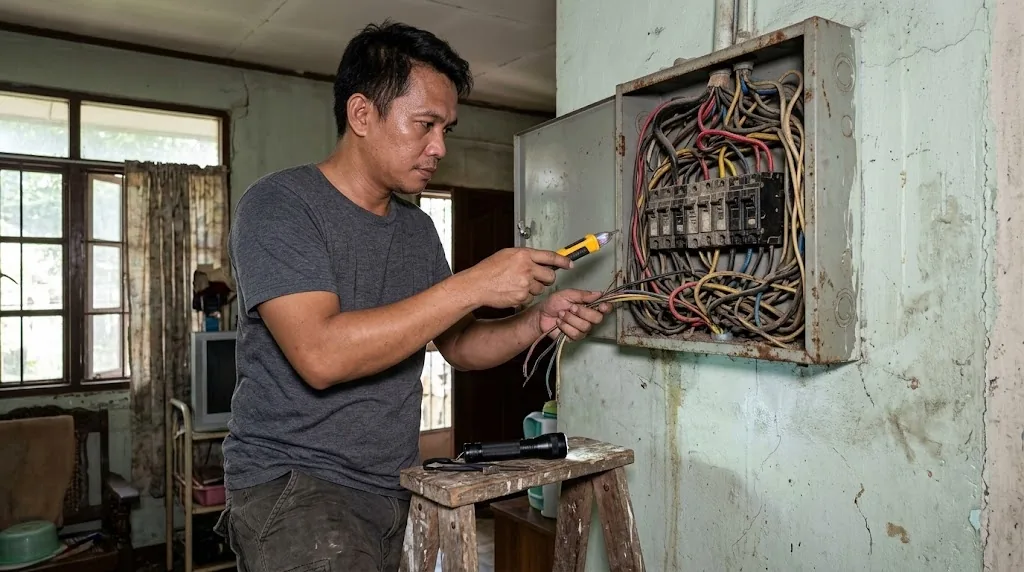
Tangled, discoloured wiring in an old panel is one of the clearest signs a house is due for an inspection. Illustrative photo.
Short answer: a 20 to 30 year old house doesn't automatically need rewiring. It needs rewiring when the wiring shows you it's failing, or when you're about to load it with more than it was built for, like a second or third aircon. For a typical 80 sqm two-bedroom house, a full rewire with a new panel and new conduit chased into CHB walls comes to about ₱144,000 to ₱223,000 in our calculator below. If the old concealed conduit is still sound and the electrician can pull new wire through it, the same house drops to about ₱111,000 to ₱169,000.
On the legal side, RA 7920 gives a Professional Electrical Engineer the sole authority to seal electrical plans, and the actual wiring work has to be done under a licensed PEE, REE or Registered Master Electrician. Start with the checker. It tells you whether this is a "watch it" situation or a "switch it off today" one.
Tick what you've actually noticed, then pick the house age and wire type. It's a screening tool, not an inspection. It can't see inside your walls, so a "monitor" result doesn't mean the wiring is safe.
Most of these signs point to heat at a connection. A loose or corroded joint at an outlet, switch or breaker resists current, and resistance turns into heat. The U.S. Consumer Product Safety Commission lists hot outlet and switch plates, flickering lights, dead circuits and a burning-plastic smell as signs of electrical system problems, and says to have a qualified electrician find the cause rather than trying it yourself.
| What you notice | What it usually points to | What to do |
|---|---|---|
| Burning smell, sparks, hot or melted outlet | Overheating connection or damaged insulation | Switch off that circuit now and call an electrician |
| Shock from an appliance or tap | Live part touching metal, often with no working ground | Don't touch it again, switch off the main, call an electrician |
| Breaker trips often when big loads run | Circuit carrying more than it was set up for | Don't upsize the breaker. Have the circuit checked, and plan a dedicated circuit |
| Old fuse box | Original service equipment, easy to defeat with the wrong fuse | Budget for a panel board with breakers as part of any rewire |
| Two-slot outlets, adapters on three-prong plugs | No equipment grounding at those outlets | Have grounding checked. The U.S. Fire Administration says never force a three-prong cord into a two-slot outlet |
| Extension cords as permanent wiring | Not enough outlets or circuits for how the house is used now | Add outlets and circuits. Extension cords are for temporary use only |
| Silver-coloured aluminium branch wiring | Connection-failure risk documented by the U.S. CPSC | Have a licensed electrician assess it. CPSC names full replacement with copper as the fix that removes the cause |
A note on the aluminium row: CPSC warns that failing aluminium-wired connections seldom give easy-to-spot warning signs and have been reported to overheat with no prior problems, so with aluminium wiring the absence of symptoms doesn't mean much. That research is from U.S. homes, mostly wired between 1965 and the mid-1970s. We haven't found equivalent Philippine data, so treat it as a reason to have it looked at, not a local statistic.
It helps to know what a "rewire" actually touches. Power comes in from the utility's service drop, through your meter, into a main breaker and a panel board. From the panel, separate branch circuits run out to the lights, the general outlets, and dedicated circuits for heavy loads. A grounding electrode ties the system to earth.
A partial rewire fixes one part of the house: a new aircon circuit, a kitchen that trips every time the rice cooker and kettle run together, or one room whose wiring got damaged in a leak or by rats. It's cheaper and faster, but the new work still ends at your old panel and your old grounding. If those are the problem, a partial job just moves it.
A full rewire makes sense when the warning signs are spread across the house, when there's a fuse box or no grounding, when the house has been extended piecemeal with cords and add-ons, or when you're already opening walls and ceilings for a renovation. Doing it during a renovation saves most of the chasing and patching cost, because the walls are getting redone anyway.
The cheapest full rewire is the one where the existing concealed conduit is still intact. The electrician pulls out the old wire and pulls new wire through the same pipes, so there's little chasing. Whether that's possible is something only an electrician on site can tell you, after checking the conduit for breaks and blockages.
What the law says about who does the work. These points are read from the text of RA 7920 (the New Electrical Engineering Law) and PD 1096 (the National Building Code), linked under Sources.
Who seals the plans. RA 7920 Section 31(a) gives a Professional Electrical Engineer (PEE) "the sole authority to seal electrical plans." Section 34 says no electrical installation shall be undertaken unless the plans are prepared by or under the responsible charge of, and signed and sealed by, a PEE, and a construction permit is first secured.
Who does the wiring. Section 31(c) puts installation, wiring, maintenance and repair in residential buildings within a Registered Master Electrician's (RME) field of practice, with work above 500 kVA or 600 V supervised by a PEE or a Registered Electrical Engineer (REE). Section 34 requires the work to follow the Philippine Electrical Code and be done under the responsible charge of a PEE, REE or RME.
Licenses belong to people, not companies. Section 35 says no firm or corporation may be registered or licensed to practice electrical engineering. When a contractor says their company is licensed, ask for the name and PRC license number of the PEE and the electrician who will actually handle your job. Section 27 requires practitioners to put their license number on documents they sign.
The permit. PD 1096 Section 301 says no person shall "erect, construct, alter, repair, move, convert or demolish any building or structure" without first obtaining a building permit from the Building Official. Section 1301 requires electrical installations to conform to the Philippine Electrical Code. Section 302 asks for electrical plans signed and sealed by "a registered electrical engineer", older wording that RA 7920 Section 34 later tightened to a PEE seal. The only exemption Section 302 mentions is for submitting plans in cases the Building Official exempts or doesn't require. It isn't an exemption from the permit. Which permit a rewire needs, and what papers go with it, is set by your local Office of the Building Official, so check with them before the walls are opened. Our service sizing guide covers how electrical permit fees are computed.
A note on the Code itself. The Philippine Electrical Code Part 1, 2017 Edition, is published by the Institute of Integrated Electrical Engineers of the Philippines (IIEE) as a printed book. We don't reproduce its tables here. Wire sizes, breaker ratings and grounding details for your house come from the plans your PEE prepares under it.
Defaults are a typical 80 sqm two-bedroom house. Count your current breakers for the circuit numbers, and walk the house to count switches and outlets. Every line item is shown, and the total is the exact sum of the rows.
Commercial establishments have a separate yearly obligation to have the installation inspected and certified. That's a different requirement from rewiring a house, covered in our annual electrical safety inspection guide.
How do I know if my house needs rewiring?
Age alone doesn't decide it. What decides it is what the wiring is doing. Outlet or switch plates that are hot to the touch, a burning-plastic smell, flickering lights and circuits that stop working are the warning signs the U.S. Consumer Product Safety Commission lists for failing connections. Add breakers that trip often, an old fuse box, two-slot outlets with no ground pin, and a house that runs on extension cords. One or two of those in a 20 to 30 year old house is a reason to have a licensed electrician inspect it. A burning smell, sparks, a hot or melted outlet, or a shock from an appliance or tap is not a wait-and-see sign: switch off that circuit and call an electrician now.
How much does it cost to rewire a house in the Philippines?
For a typical 80 sqm two-bedroom house with 2 lighting circuits, 2 outlet circuits, 10 switches, 14 outlets, 2 aircon circuits, 1 other dedicated circuit, a new panel board and new conduit chased into CHB walls, our calculator gives ₱144,216 to ₱223,325 for a full rewire. If the existing concealed conduit is still sound and new wire can be pulled through it, the same house comes to ₱110,973 to ₱169,050. Wire is priced in whole ~150 m rolls, and wire, conduit, boxes, wiring devices, panels and breakers come from CW Home Depot and Wilcon product pages checked on 2026-09-16. Labour uses AEDO's published electrician and helper day rates. Productivity, chasing and patching, grounding, consumables, overhead and the permit allowance are AEDO market estimates.
Do I need a permit to rewire my house?
Plan on it. PD 1096, the National Building Code, Section 301 says no person shall alter or repair a building without first obtaining a building permit from the Building Official, and Section 1301 requires electrical installations to follow the Philippine Electrical Code. RA 7920, the New Electrical Engineering Law, Section 34 says no electrical installation shall be undertaken unless the plans are signed and sealed by a Professional Electrical Engineer and a construction permit is first secured. Which permit a rewire needs, and what documents go with it, is set by your local Office of the Building Official, so check with them before work starts rather than after.
Who is allowed to do the rewiring and sign the electrical plans?
Under RA 7920 Section 31, a Professional Electrical Engineer (PEE) has the sole authority to seal electrical plans. A Registered Master Electrician (RME) may do installation, wiring, maintenance and repair work in residential buildings, with work above 500 kVA or 600 V supervised by a PEE or a Registered Electrical Engineer. Section 34 requires the installation itself to be done under the responsible charge of a PEE, REE or RME. Section 35 adds that the practice is personal, so no firm or corporation can be licensed to practice electrical engineering. A civil engineer's license does not cover signing electrical plans.
Can I rewire only part of the house?
Yes, and it often makes sense. Common partial jobs are adding a dedicated circuit for a new aircon, redoing a kitchen circuit, or replacing one room's wiring that has been damaged. In our calculator, with floor area 80 sqm, scope set to partial, no panel replacement and every other count at zero, one aircon circuit in exposed conduit comes to ₱20,059 to ₱36,457, and one outlet circuit with 4 outlets chased into CHB comes to ₱23,792 to ₱34,784. Both include a full roll of wire and a permit allowance, which is why small jobs cost more per circuit. The catch is that new wire still connects to your old panel and grounding. If the panel is an old fuse box, or the house has no grounding at all, the electrician may tell you the partial job isn't safe on its own.
My breaker keeps tripping. Should I replace it with a bigger one?
No. A breaker that keeps tripping is doing its job: something on that circuit is drawing more than the circuit is set up for, or there's a fault. The correct breaker size depends on the wire it protects, so fitting a bigger breaker on the same old wire takes away the protection instead of fixing the problem. Unplug what you added recently, and have a licensed electrician find out whether the circuit is overloaded, faulty, or simply needs a new dedicated circuit for the appliance.
Laws first, then safety references, then the retailer pages behind every price. Retailer pages were checked on 2026-09-16 and prices change. External links open in a new tab.
AEDO market estimates, not published figures: wire run per circuit and per device, conductors per run and waste, which wire size each circuit type uses for pricing, rounding wire up to whole ~150 m rolls per size (colours not split), conduit fittings allowance, crew productivity, grounding set, consumables, chasing and patching per metre, overhead and profit, and the plans, permit and inspection allowance. Actual LGU permit fees depend on your local Building Official and the load on the plans. We did not find a Philippine source on aluminium branch wiring, so the aluminium guidance relies on the U.S. CPSC publication above.
Before you pay for a full rewire, or a patch that misses the real problem, get the circuits, panel and grounding checked and a written scope you can price.