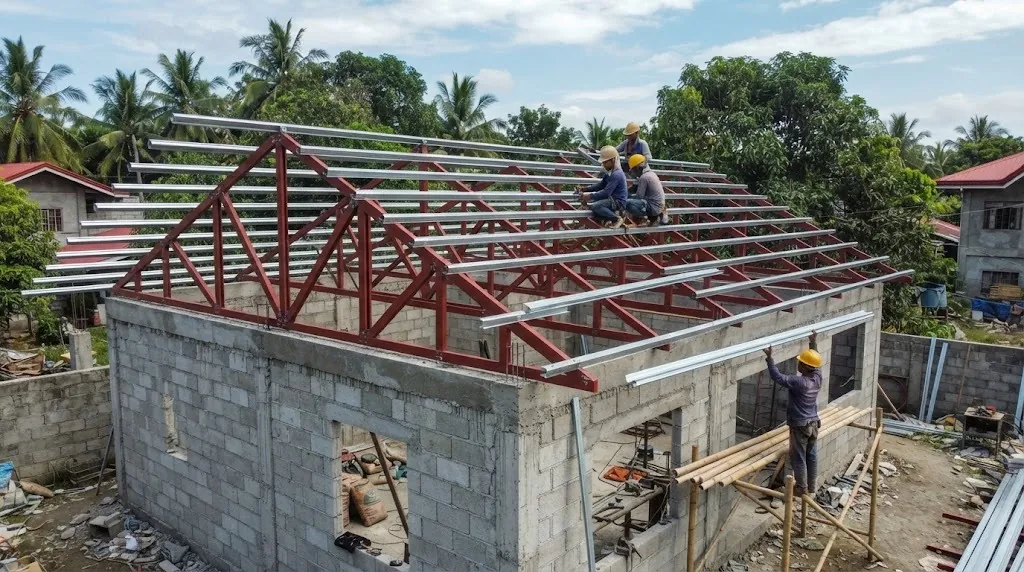
The truss is the part you can see from the street during construction. The straps and bolts at each end are the part that keeps it there. Illustrative photo.
Short answer: per square metre of roof, coco lumber is the cheapest truss, a cold-formed C-section steel truss comes next, and a hot-rolled angle-bar truss costs the most. For a typical 10 × 8 m bungalow at a 25° pitch, the frame with C-purlins works out to roughly ₱550–740/m² in coco lumber, ₱680–910/m² as a C-section truss and ₱950–1,270/m² in angle bar, on AEDO's 2026 planning estimate built from retail prices. Good lumber bought S4S at retail is dearer than all three. The cheaper choice isn't always the cheaper roof, though. Termites, rust and, above all, how the truss is tied down in a typhoon decide what you actually pay over 20 years.
The calculator turns your house footprint into true roof area, a truss count, purlin length and a side-by-side cost for each system.
Material prices are retail figures read on 18 September 2026. Labour and connection allowances are AEDO estimates. Roof sheets, flashing, gutters and ceiling are not included.
Most Philippine houses end up with one of three frames under the roof sheets:
Here's what the raw material cost on 18 September 2026 on two Philippine online hardware retailers. Provincial prices, including Negros Oriental, differ with freight, so treat these as a reference point rather than your quote.
| Item (retail) | Price read 18 Sep 2026 | Works out to |
|---|---|---|
| Coco lumber 2×4×12 | ₱250 (both retailers) | ≈ ₱31 per board foot |
| Coco lumber 2×3×12 | ₱187 (Topmost) / ₱200 (HardwareZonePH) | ≈ ₱31–33 per board foot |
| Good lumber S4S 2×4×12 | ₱918 (Topmost) | ≈ ₱115 per board foot |
| C-purlin 2×3, 1.2 mm GI, 6 m | ₱600 (Topmost) | ₱100 per metre |
| C-purlin 2×4, 1.2 mm GI, 6 m | ₱690 (Topmost) / ₱572 for 100×50×1.2 (HardwareZonePH) | ₱95–115 per metre |
| C-purlin 2×4, 1.5 mm GI, 6 m | ₱860 (Topmost) | ≈ ₱143 per metre |
| Angle bar 2″ × 5 mm, 6 m | ₱1,314 (Topmost) | ₱219 per metre |
| Angle bar 1½″ × 4.5 mm, 6 m | ₱887 (Topmost) | ≈ ₱148 per metre |
Two things stand out. Coco lumber costs about a quarter of good lumber per board foot, which is why it dominates cheap roofs. And a metre of 2″ angle bar costs about twice a metre of 2×4 C-purlin, which is most of why angle-bar trusses are the priciest frame. One retailer's angle-bar list didn't hang together (its 50×50×5 mm bar was listed cheaper than its 50×50×3 mm bar), so we priced angle bar from the other one.
The calculator's default house, a 10 × 8 m footprint, 25° gable, 750 mm overhang, has about 120 m² of sloping roof over an 80 m² footprint. That jump is the first thing to understand: every roof price is per square metre of roof, and a pitched roof with eaves is always bigger than the floor. Our roofing cost guide walks through the geometry.
| System (10 × 8 m house, C-purlin 2×4 1.2 mm at 0.8 m) | Trusses | Frame cost, AEDO estimate | Per m² of roof |
|---|---|---|---|
| Coco lumber truss at 0.8 m | 13 | ₱66,500–88,700 | ≈ ₱550–740 |
| Cold-formed C-section truss at 1.0 m | 11 | ₱81,900–109,200 | ≈ ₱680–910 |
| Hot-rolled angle-bar truss at 1.2 m | 9 | ₱114,500–152,600 | ≈ ₱950–1,270 |
| Good lumber (S4S, retail) truss at 0.8 m | 13 | ₱141,500–188,600 | ≈ ₱1,170–1,570 |
These sit close to the structure bands in our roofing guide (timber trusses with steel purlins ₱380–620/m², light steel trusses with C-purlins ₱480–780/m², fabricated steel trusses ₱850–1,450/m²), a little above the timber and light-steel bands because the guide's bands are for typical spans and this estimate includes purlins, connections and labour in one figure. Wider spans cost more per square metre with every system, because the truss gets deeper and the webs get longer faster than the roof area grows.
At roughly ₱115 per board foot S4S at retail, a hardwood truss costs more than an angle-bar one. Rough-sawn hardwood from a local lumberyard is cheaper than S4S, and prices vary a lot by province, so get a lumberyard quote before ruling it out. But if someone tells you wood is "always cheaper than steel", ask which wood.
A roof in the Philippines is designed for gravity and then checked, often more critically, for the wind trying to lift it off. The numbers make the point on their own.
So the roof stays on because it's tied down, not because it's heavy, whatever the truss is made of. A steel truss tack-welded to a steel plate on the tie beam is not stronger in a typhoon than a timber truss with a proper hold-down strap. It's the chain of connections that fails: sheet to purlin, purlin to truss, truss to beam, beam to column. Our typhoon-resistant construction guide covers the full load path.
Coco lumber's price is honest. What it doesn't include is the termite and moisture risk. NSCP 2015 Section 605 (Decay and Termite Protection) sets out where untreated wood isn't allowed, and a few provisions land directly on house roofs:
There's also a design problem. NSCP Tables 615.2-1 and 615.2-2 list reference design values for visually stress-graded Philippine woods: apitong is in the Medium Strength Group (bending 16.5 MPa at the 80% stress grade), yakal in the High Strength Group (24.5 MPa). We couldn't find coconut in either table. That doesn't make coco lumber illegal, but an engineer can't read its allowable stresses off the code the way they can for apitong, and has to justify the values used.
Termites hollow a truss from the inside while the surface still looks fine, and a truss replacement runs roughly ₱5,500–9,500 per piece on our termite damage repair guide. Two or three bad trusses erase most of what coco lumber saved over C-section steel.
Steel's weak point is the opposite one: it doesn't get eaten, it corrodes. The C-purlins priced above are sold galvanized (GI), with a zinc coating. Angle bars are sold both as black iron (BI) and galvanized. In practice:
Gravity load is modest on a metal roof, which is why truss spacing is usually driven by the purlin span and the roofing sheet rather than by the truss itself. The code numbers:
| Load | NSCP 2015 value | Source |
|---|---|---|
| Copper or tin sheet roofing | 0.05 kPa | Table 204-2 |
| Metal deck, 20 gage / 18 gage | 0.12 / 0.14 kPa | Table 204-2 |
| Clay tile: Ludowici / Roman / Spanish | 0.48 / 0.57 / 0.91 kPa | Table 204-2 |
| Cement tile | 0.77 kPa | Table 204-2 |
| Ceiling: suspended steel channel system | 0.10 kPa | Table 204-2 |
| Roof live load, slope under 33.3% (under about 18.4°) | 1.00 / 0.75 / 0.60 kPa for 0–20 / 20–60 / over 60 m² tributary | Table 205-3, Method 1 |
| Roof live load, slope 33.3% to under 100% | 0.75 / 0.70 / 0.60 kPa | Table 205-3, Method 1 |
A tile roof is ten to fifteen times heavier than a metal one, which is why switching from long span to tile is a structural decision, not a finishes choice. See our dead and live loads reference.
Spacing and span, as practice rather than code. NSCP 2015 doesn't fix a truss or purlin spacing for houses; it comes out of the design. What we typically see on Philippine houses: purlins for long span sheets at about 600–1,000 mm, timber trusses closer together than steel ones, and angle-bar trusses spaced widest because C-purlins can span further between them. On span, there's no code limit per material either. As an AEDO rule of thumb, we keep coco lumber trusses to ordinary bungalow spans and move to steel once the clear span gets long or the site is exposed, because timber connections at long spans get big and hard to do well.
Which one we'd usually pick. For a typical house, a galvanized C-section truss with properly detailed tie-downs is usually the best value: no termites, light, straight, and cheaper than angle bar. Angle bar earns its price on longer spans, heavy tile roofs and exposed sites. Coco lumber is fine for a sheltered, short-span, budget roof if it's treated, kept dry and properly strapped, and if you accept that you'll inspect it for termites.
Nationwide, AEDO designs the roof framing and the connections as part of a complete design package. In Negros Oriental, we build it.
Material prices were read from the product pages of Topmost Hardware and HardwareZonePH on 18 September 2026 and move with the market; our material price tracker follows the PSA indices. Roof covering and ceiling weights are NSCP 2015 Table 204-2; roof live loads Table 205-3; the velocity-pressure formula Eq. 207B.3-1 with Kz from Table 207B.3-1 and Kd from Table 207A.6-1; wood decay provisions Section 605; wood reference values Tables 615.2-1 and 615.2-2. Member sizes, labour, connection allowances, the hip-roof uplift and spacing defaults are AEDO planning estimates. None of this is a design.
An engineer models and designs the steel roof trusses of a 2-storey house. From the AEDO YouTube channel, uploaded 2021-01-16.

Which is cheaper in the Philippines, a steel or a wood roof truss?
Coco lumber is cheapest per square metre of roof, then a cold-formed C-section steel truss, then hot-rolled angle bar. For a 10 × 8 m gable house at 25° with a 750 mm overhang, the frame with C-purlins works out to roughly ₱550–740/m² in coco lumber, ₱680–910/m² as a C-section truss and ₱950–1,270/m² in angle bar, from retail prices read on 18 September 2026. Good lumber bought S4S at retail is the most expensive, about ₱1,170–1,570/m², because it runs about ₱115 per board foot against about ₱31 for coco lumber. These are AEDO planning estimates, not quotations, and exclude the roofing sheets.
Is coco lumber good enough for roof trusses?
It's cheap and widely used, but price in two risks. Coconut doesn't appear among the Philippine species in NSCP 2015 Tables 615.2-1 and 615.2-2, so an engineer can't read its allowable stresses from the code as they can for apitong or yakal. And it's exposed to termites and rot: NSCP Section 605 requires treated or naturally decay-resistant wood in several conditions, including wood nearer than 150 mm to earth, and a 15 mm air space on the tops, sides and ends of wood girders entering masonry or concrete walls.
How far apart should roof trusses and purlins be?
NSCP 2015 doesn't set one spacing for house trusses or purlins; the design sets it, because spacing decides the load each member carries. As common Philippine practice, purlins for long span roofing are typically about 600–1,000 mm apart, timber trusses sit closer together than steel ones, and angle-bar trusses are often spaced widest because C-purlins can span further between them. The calculator uses 0.8 m for timber, 1.0 m for C-section and 1.2 m for angle bar as planning defaults only. The roofing sheet maker's span table and your engineer's calculation decide the real figures.
Which roof truss holds up better in a typhoon?
The connections decide it more than the material. A metal sheet weighs about 0.05 kPa (NSCP Table 204-2), while velocity pressure at roof height for a bungalow in open terrain at V = 250 kph is about 2.1 kPa (Eq. 207B.3-1, Kz 0.85, Kd 0.85), roughly forty times the sheet's weight before any pressure coefficient. Any of the three systems can be designed for that, and any of them fails if the purlin-to-truss and truss-to-beam connections are tack welds, single nails or gravity bearing. NSCP 2015 has no wind zones; for an ordinary house, V is read from Figure 207A.5-1A at your site.
How much does the roof frame cost for an 80 sqm house?
A 10 × 8 m footprint with a 25° gable and 750 mm overhang has about 120 m² of sloping roof, half again the footprint. On AEDO's 2026 planning estimate from retail prices read on 18 September 2026, the frame with C-purlins, connections and labour comes to roughly ₱66,500–88,700 in coco lumber, ₱81,900–109,200 as a C-section truss and ₱114,500–152,600 in angle bar. Roofing sheets, flashing, gutters and ceiling are extra.
Code provisions, retailer price pages and AEDO references used in this guide. External links open in a new tab.
Truss member sizes, the Howe-pattern geometry, waste factors, labour and connection allowances, the 15% hip-roof uplift, the typical spacing defaults and the span rule of thumb are AEDO's own planning estimates and practice, not code values. Retail prices are Metro Manila online listings and differ in the provinces.
A truss profile copied from another house is sized for someone else's span and wind speed. We size yours.