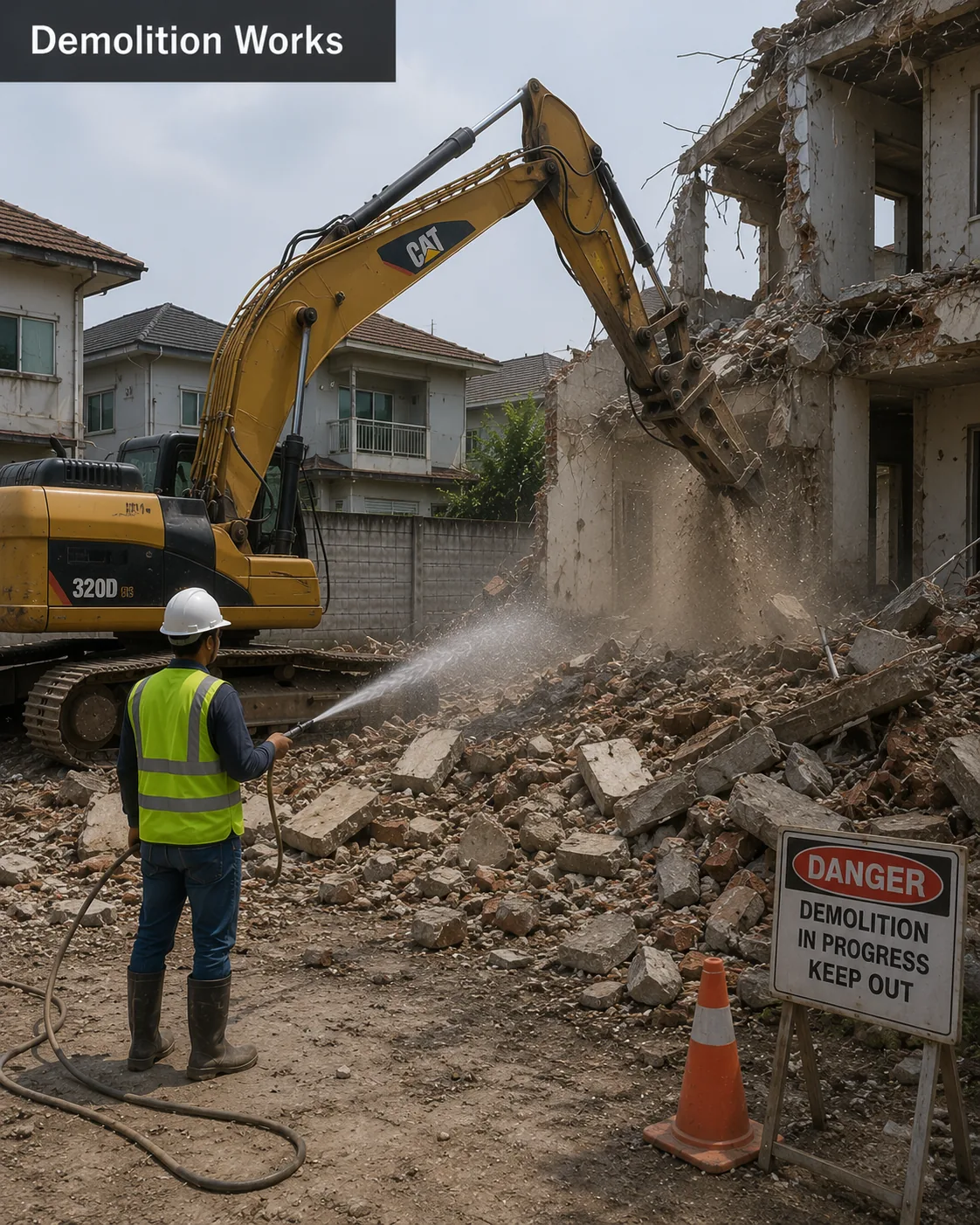
The machine is the cheap part. Everything on the ground has to be lifted, loaded and carried away by weight — which is what the bill is really made of.
Short answer: demolition is not priced by floor area. It is priced by the weight you have to carry off the site, and the permit — the part everyone worries about — costs ₱3.00 per square metre. On a 160 m² two-storey concrete house that is about ₱480. The hauling on the same house is closer to ₱66,000, and the usual way of estimating it understates the truck count by around forty per cent.
A two-storey reinforced concrete house of 160 m² produces roughly 107 tonnes of debris. A timber-and-GI house of the same floor area, on the same concrete slab, produces about 26 tonnes. Same plan, same area, four times the material — and about four times the cost per square metre. This is why "cost per square metre to demolish" is a nearly useless figure until you say what the building is made of — and why the tool below asks about structure before anything else.
A demolition bill has five lines, and they are nothing like the proportions people expect.
| Line | Share of a typical concrete-house job | What moves it |
|---|---|---|
| Hauling and disposal | Largest single line | Debris weight, truck payload, haul distance, tipping fee |
| Labour | Large | Structure type, whether machines can reach the site |
| Equipment | Varies wildly | Excavator and breaker rental, or nothing at all if it is done by hand |
| Salvage recovery | Negative — a credit | Reinforcing steel, roof sheets, timber, fittings |
| Demolition permit | Rounding error | ₱3.00/m² of floor area, fixed by the PD 1096 IRR |
Two of those deserve the rest of this page: the truck count, which is almost always understated, and the permit, which is almost always overestimated.
Turns your building into tonnes of debris, loose cubic metres, truck trips and a peso band — and tells you whether the trips are limited by the body size or by the payload. Densities come from NSCP 2015 Table 204-1; the permit fee comes from the PD 1096 IRR. Quantity and productivity coefficients are planning assumptions and are printed with the result.
This is the single most useful thing on the page, so it is worth stating slowly.
Broken reinforced concrete has a loose bulk density of roughly 1,600 kg per cubic metre. A six-wheeler dump truck with a six-cubic-metre body, filled level with concrete rubble, would therefore be carrying about 9.6 tonnes. A typical six-wheeler payload is around five tonnes.
So the truck is full at about 3.1 m³ — roughly half its body. Anyone who estimated trips by dividing total debris volume by body volume has just understated the hauling line by a factor of two, and hauling is usually the largest line in the bill.
The Check to Run on Any Demolition Quote
Ask the contractor two questions: how many truck trips, and what is in each trip. If the answer to the first is a round number with no working behind it, the quote was priced on floor area and will be revised upward once the slab comes down.
The second question matters because mixed debris hauls differently from clean concrete. A load of roofing sheets and timber fills the body long before it troubles the axle. A load of slab does the opposite. A crew that segregates will move the same building in fewer, better-loaded trips — and segregated concrete is also the fraction a crushing operation will actually take.
Under Presidential Decree 1096, demolition requires a permit from the Office of the Building Official. It is applied for on NBC Form B-08, one of the accessory permit forms listed in the Revised IRR alongside fencing, scaffolding and sidewalk construction.
The fees are set out in the New Schedule of Fees of the 2004 Revised IRR, under Demolition/Moving of Buildings/Structures Fees:
| Item | Fee |
|---|---|
| Buildings in all Groups, per m² of floor area | ₱3.00 |
| Building systems, frames or portions, per vertical or horizontal dimension, including fences | ₱4.00/m² |
| Structures up to 10.00 m in height | ₱800.00 |
| Every metre or portion above 10.00 m | ₱50.00 |
| Appendage up to 3.00 m³ per unit | ₱50.00 |
| Every m³ or portion above 3.00 m³ | ₱50.00 |
| Moving a building, per m² of area moved | ₱3.00 |
So the permit on a 160 m² house is ₱480, and on a 1,000 m² warehouse it is ₱3,000. These are the national schedule figures; local ordinances add their own clearances and charges on top, and a barangay clearance, a zoning clearance and an environmental or excavation clearance are commonly required alongside.
The Revised IRR gives the Secretary or an authorised representative the power to impose administrative fines not exceeding ₱10,000 for, among other things, "erecting, constructing, altering, repairing, moving, converting or demolishing a private or public building/structure if without building/demolition permit." The fine is not the real exposure. The real exposure is a stop-work order in the middle of a partial demolition, with the structure already compromised and the site unsafe to leave.
Owners tend to treat demolition as a large, frightening number. On a rebuild it usually is not. Run the calculator on a 160 m² concrete house and the band lands somewhere near ₱97,000 to ₱228,000. Rebuilding the same house at the rates in our 2026 house construction cost guide is a multi-million-peso exercise, so demolition is commonly two to five per cent of the replacement cost.
That is rarely what decides between renovating and rebuilding. What decides it is whether the existing frame and foundations can carry the new use at all, which is a structural question with a structural answer — the subject of our renovate or rebuild guide and, where the building is already showing distress, our warning signs checklist.
One exception is worth naming. Partial demolition is disproportionately expensive per square metre, because the part left standing has to be supported while the part coming down is removed, and because machines usually cannot be used. If you are taking off a storey, removing a wing, or opening up a frame for a second-floor addition, price it as engineering work and not as clearance work.
That last item feeds straight into what comes next. Once the building is gone you are looking at a bare lot, and the cost of getting it ready to build on again is a separate exercise — covered in our site development cost guide.
Permit fees are quoted from the New Schedule of Fees and Other Charges of the 2004 Revised IRR of PD 1096, section on Demolition/Moving of Buildings/Structures Fees; the ₱10,000 administrative fine is from the IRR's provisions on administrative fines. Form B-08 is the Demolition Permit in the IRR's schedule of forms. Unit weights are from NSCP 2015 Table 204-1, Minimum Densities for Design Loads from Materials — reinforced concrete with stone including gravel at 23.6 kN/m³, cement or lime mortar at 20.4 kN/m³; hollow concrete masonry walls from Table 204-2 at 1.05 / 1.15 / 1.48 kPa for 100 / 150 / 200 mm (16.5 kN/m³ unit density, no grout) plus 0.24 kPa per plastered face. Labour rates are AEDO's published 2026 construction labour rates. Loose bulk densities, productivity per crew-day, reinforcement content and scrap prices are planning assumptions from ordinary practice and are printed inside the tool so you can argue with them.
How much does it cost to demolish a house in the Philippines?
For a typical two-storey reinforced concrete house of around 160 square metres of total floor area, a realistic planning band in 2026 is roughly six hundred to fifteen hundred pesos per square metre of floor area, before salvage credit. A light timber and galvanised iron structure sits far below that, nearer two to four hundred pesos per square metre, because there is far less weight to carry away. The figure is driven almost entirely by the mass of debris and the number of truck trips it takes to remove it, not by the plan area, so two houses of the same floor area can differ by a factor of four.
Do I need a permit to demolish a building in the Philippines?
Yes. A Demolition Permit is issued by the Office of the Building Official on NBC Form B-08 under Presidential Decree 1096. The fee itself is small. The 2004 Revised Implementing Rules and Regulations set it at three pesos per square metre of floor area for buildings in all Groups, four pesos per square metre for building systems, frames or portions including fences, and eight hundred pesos for structures up to ten metres in height plus fifty pesos for every metre above that. The Revised IRR also allows an administrative fine of up to ten thousand pesos for demolishing a building without a permit.
Why are demolition quotes priced by truck trips?
Because hauling is usually the largest single line in the bill and it is limited by weight, not by volume. Broken reinforced concrete has a loose bulk density near sixteen hundred kilogrammes per cubic metre, so a six-wheeler dump truck with a six cubic metre body would be carrying close to ten tonnes if it were filled level with concrete rubble. That is roughly double a typical six-wheeler payload, so the truck leaves half empty and the trip count doubles. A quote that divided the debris volume by the body volume will always be too low.
Is it cheaper to demolish and rebuild or to renovate?
It depends on what is wrong with the existing structure, not on its age. Demolition and disposal typically adds only a few per cent to the cost of the replacement building, which is rarely the deciding number on its own. The deciding factors are whether the existing foundations and frame can carry the new use, whether the layout can be made to work, and whether the building complies with current code. A structural assessment answers all three before any money is committed, and it costs a small fraction of either option.
What is the salvage value of a demolished house?
The recoverable value is mostly in reinforcing steel, roofing sheets, structural timber, doors, windows and fittings. Reinforcement in a residential concrete member commonly runs somewhere near ninety kilogrammes per cubic metre of concrete, and scrap steel trades well below new bar price. On a two-storey concrete house this can offset a meaningful share of the demolition bill. In Philippine practice the credit is often not paid in cash at all. The demolition crew keeps the scrap and the roofing and quotes a lower price in exchange, which is why a quote that includes salvage rights and one that does not are not comparable.
What happens to demolition debris?
Republic Act 9003, the Ecological Solid Waste Management Act of 2000, names construction debris expressly in its definition of solid waste, so it is regulated waste rather than rubble you may leave anywhere. It is not classified as special waste under that Act, which covers household hazardous items, bulky waste, electronics, batteries, oil and tyres. What it does mean in practice is that the debris has to reach a facility authorised to receive it, since the Act prohibits open dumps. Clean concrete rubble is often crushed and reused as fill or sub-base, which can reduce both the tipping fee and the number of trips if there is a nearby taker. Confirm the receiving site and its charge before signing a demolition contract, because tipping fees and haul distance are the two variables that move the hauling line the most.
Statutes, codes, official tools and references used or referred to in this article, linked to their source. Links open in a new tab.
Prices, cost bands and rate figures in this article are AEDO Construction's own market and practice figures for Philippine work unless a source is named beside them. Code and statute references above link to the primary text.
A written structural assessment tells you whether the existing frame and foundations can carry what you actually want to do — before you spend a peso on demolition.