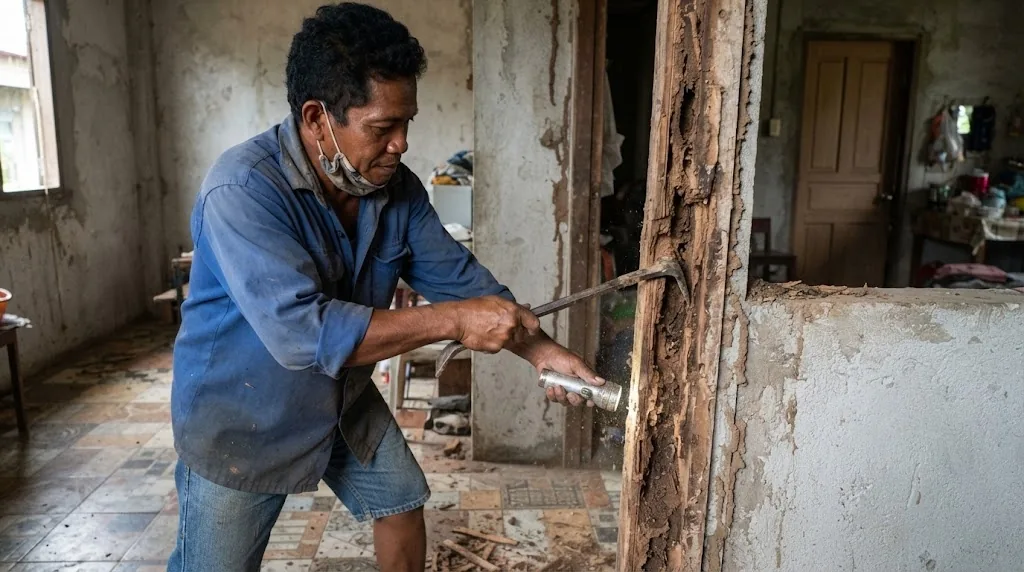
Wood that looks solid from outside can be hollow inside. Probe and pry before pricing the repair. Illustrative photo.
Short answer: most of what homeowners spot first — a mud tube on a foundation wall, a few discarded wings near a window — is early-stage and treatable for a few thousand pesos. The damage that actually costs money is what you can't see from the surface: termites hollow wood from the inside while leaving the outer shell mostly intact, so a truss or door frame can look fine and still have lost most of its strength. The checklist below turns what you've actually observed into a severity read so you know which situation you're in, and the calculator gives you separate, real cost ranges for termite treatment and for wood repair — because they're two different jobs, done by two different kinds of contractor.
That last point matters enough to say up front: AEDO doesn't do pest control. We're a structural and construction engineering firm. Killing the colony is a licensed pest-control provider's job. Deciding whether a damaged truss is still safe to carry your roof, and repairing or reinforcing it if it isn't, is ours. Most termite situations need both, in that order — treat first, then assess and repair what's structural.
Check every sign you've actually observed. This is a screening tool to decide whether a professional inspection is worth booking now — it cannot diagnose structural failure, and it isn't a substitute for someone physically looking at the wood.
The termite species doing this damage in most Philippine homes are subterranean termites — colonies that live in the soil and build mud tubes to reach wood above ground while staying protected from open air and sunlight. That's why the tube is often the first visible sign: it's not damage itself, it's the termite's travel route to the wood they're about to damage or are already inside. Once they reach a timber member — a door jamb, a roof truss, a floor joist, an old wood post — they eat along the grain from the inside, which is why tapping for a hollow sound catches damage that a visual check from the outside misses entirely.
Philippine construction mixes concrete/CHB structure with timber roof framing, door and window jambs, and — in older or provincial houses — full wood-frame construction, so the exposure is wide: a purely concrete house can still lose its entire roof truss system to termites even though the walls are untouched.
Two treatment approaches cover most residential termite jobs in the Philippines, and pest-control companies quote them differently:
| Method | How it works | Typical starting price |
|---|---|---|
| Soil / chemical barrier treatment | A termiticide solution is injected or trenched into the soil around and under the structure, creating a treated zone termites can't cross undetected | ~₱650 per linear meter of perimeter (post-construction); pre-construction on bare ground before a slab is poured runs from ~₱180 per sqm |
| Baiting system | In-ground stations (Sentricon and Xterm are the two brand-name systems sold in the Philippines) are placed around the structure; termites feed on bait and carry a slow-acting agent back to the colony, working toward eliminating it rather than just repelling foragers | ~₱900 per linear meter of perimeter |
Both are real, established methods — soil/chemical barrier treatment is the faster, more common choice for an active visible infestation, while baiting is often preferred where drilling or trenching around the foundation is impractical (tiled floors, tight setbacks) or where the goal is longer-term colony elimination rather than just a barrier. A licensed pest-control provider should recommend which fits your property; the figures above are starting rates from published Philippine pest-control pricing, not a ceiling — get a firm quote for your actual perimeter and infestation severity.
Treatment and structural repair are billed by different contractors and should never be blended into one number — this tool keeps them separate on purpose.
Repair cost is driven by which members are damaged and how many, not by floor area — a 200-sqm house with one bad door jamb is a small job, and an 80-sqm house with three eaten roof trusses is not. As an AEDO market estimate for materials and labor:
Replacing a damaged member before the colony is treated is a wasted repair — new wood without a barrier or bait program in place is just the next meal. The order that actually protects the repair spend: pest-control provider treats the colony, then a structural check confirms what needs replacing versus what can be reinforced in place, then repair happens once.
AEDO's role here, stated plainly. AEDO is a structural and construction engineering firm — we do not perform termite extermination, apply termiticide, or install bait stations. For treatment, hire a licensed pest-control provider. Where AEDO fits in is the structural side: assessing whether a termite-damaged member is still safe to carry load, and designing and carrying out the repair or reinforcement once the colony has been treated. Nationwide, that's the complete design package plus remote oversight of a contractor you hire locally; in Negros Oriental, AEDO can design and carry out the repair directly.
How do I know if termite damage is serious or just cosmetic?
Use the visible signs as a screen, not a verdict. Mud tubes, discarded wings, or light surface tunneling on non-structural trim usually mean early or cosmetic damage that treatment can stop before it spreads. Hollow-sounding wood, sagging door/window frames, or any visible damage to a roof truss, purlin, or floor joist is a different tier — those touch load-carrying members and warrant a professional look before you assume it's just cosmetic. Only a physical inspection confirms how much section has actually been lost.
How much does termite treatment cost in the Philippines?
Based on published Philippine pest-control pricing, post-construction soil/chemical barrier treatment typically starts around ₱650 per linear meter of perimeter, and a baiting system (Sentricon, Xterm) typically starts around ₱900 per linear meter. Pre-construction soil poisoning on bare ground runs from about ₱180 per sqm. Get a firm quote from a licensed provider for your property — these are starting rates, not a ceiling.
How much does it cost to repair termite-damaged wood?
A separate cost from treatment, driven by which members are damaged. As an AEDO market estimate: a damaged door or window frame runs roughly ₱4,000–₱7,500 per piece; a truss, purlin, or joist runs roughly ₱5,500–₱9,500 per piece; a load-bearing wood post runs roughly ₱9,000–₱15,000 per piece and needs an engineer's assessment before removal.
Does AEDO do termite extermination or pest control?
No. AEDO is a structural and construction engineering firm and does not apply termiticide, install bait stations, or exterminate termites. Hire a licensed pest-control provider for treatment. AEDO's role is assessing whether a damaged member is still safe to carry load, and designing/carrying out the repair once the colony has been treated.
Can termite damage make a house structurally unsafe?
It can, if damage has progressed into load-bearing members like trusses, joists, or wood posts — termites hollow wood from the inside while the surface stays largely intact, hiding how much strength is actually lost. Damage confined to non-structural trim is a lower-stakes repair. Only a physical inspection tells you which situation you're in; the checklist on this page is a screening tool to decide whether that inspection is worth booking now.
Pricing and technical references used in this article. External links open in a new tab.
Repair cost figures (door/window frames, trusses/joists, wood posts) are stated as AEDO market estimates for materials and labor, not sourced to a published price list — actual cost depends on wood species, member size, and site access.
A licensed-engineer assessment of the damaged member — whether it's still safe to carry load, and what repair or reinforcement it actually needs.