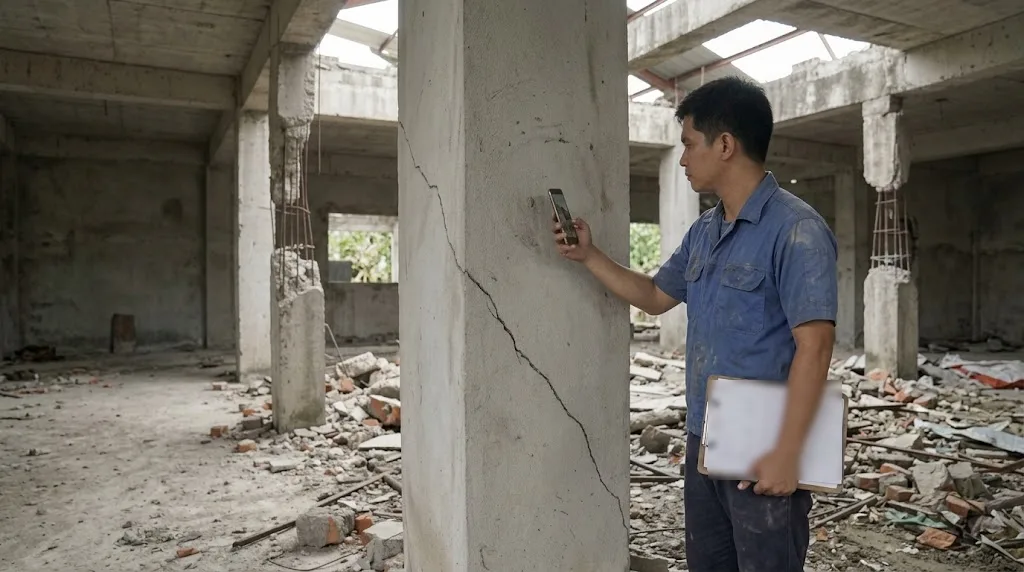
Put a scale next to the crack, write down which column it is on, and do it before anyone patches or repaints. Illustrative photo.
Short answer: a structural damage report is the document that lets someone else act on your building: an insurer to evaluate a claim, a lender to hold or release money, the building official to decide a tag, a contractor to price repairs. To do that it has to say when and in what weather the building was inspected, exactly where each defect is, how wide each crack is, what probably caused it, how serious it is, what to do about safety now, what the repair scheme is, and who signed it. On the insurance side, here is what we could verify from the text of RA 10607. For fire insurance, written notice to the insurer is due "without unnecessary delay" (Section 90), and the Code defines fire insurance to include windstorm and earthquake when covered by extension or separate policy (Section 169). The insurer pays within 30 days after proof of loss is received and the loss is ascertained, or within 90 days of receipt if ascertainment is not done within 60 (Section 249). What we could not verify is any number of days for notice or proof of loss for typhoon, earthquake or flood claims, so we give you none: check your policy and your insurer's claim form. Take the photographs and measurements before cleanup, because they are the evidence everyone else will ask for.
The checker below triages the damage you can see into one of three actions and gives you a before-cleanup evidence list for your hazard. After it: what the report is for, what goes in it, the triage schemes that exist (and which are official here), what the Insurance Code says, the evidence checklist, and what AEDO does and does not do.
Tell us the event, who is in the building and what damage you can see. You get one of three actions, the reasons, and a list of what to photograph and measure before cleanup. This is AEDO's own screening logic, not an official tool and not a substitute for an engineer or for a tag from your building official.
The same building can have four readers after a typhoon, an earthquake, a fire or a flood, and each wants something different from the engineer's document.
| Reader | What they need to decide | What in the report answers it |
|---|---|---|
| Insurer or its adjuster | What was damaged, by what, and how the loss is valued under the policy | Dated, located observations; probable cause; extent. Not the valuation, which is the insurer's and adjuster's job |
| Lender | Whether the collateral is sound, and whether to hold or release a loan or a repair draw | Severity classification, the repair scheme, and a statement of limits |
| Building official (LGU) | Whether to tag the building, order vacation, or issue a repair permit | Safety findings, immediate actions taken, the repair scheme to be permitted |
| Contractor | What to repair and in what order | Member-by-member findings with locations, and the repair scheme |
One document can serve all four only if it separates three things clearly: what was observed, what the engineer concludes, and what is still not known. A report that blends them leaves each reader guessing which part applies to them.
It is also worth being plain about what the report cannot do. It does not decide whether the policy covers the loss, does not value the claim, and does not guarantee a payout. Those are for the insurer under the policy and the law, and, if there is a dispute, for the Insurance Commission or the courts (section 4).
There is no official Philippine template for a private engineer's damage report. Our guide to the structural assessment report covers the general structure, and AEDO publishes a 10-page specimen report. For a damage report meant for an insurer, lender or LGU, these are the parts we look for:
For test results, such as concrete cores after a fire, see our concrete core testing guide. For what a crack means at the level of a single wall, see structural damage warning signs and the post-typhoon inspection checklist. For repair costs for cracks after the report, see wall crack repair cost.
Severity is the part of the report the other readers act on first, so it helps to know the schemes in use. The honest summary is that the best-known scheme is American, the Philippine practice we could find is local, and there is no single national form that we could locate.
| Scheme | What it is | What we read |
|---|---|---|
| ATC-20 and ATC-20-2 (Applied Technology Council, USA) | Postearthquake safety evaluation of buildings; the origin of green, yellow and red placards | The ATC's placard page: the placards are Inspected (green, apparently safe), Restricted Use (yellow) and Unsafe (red). The original 1989 ATC-20 called the yellow one Limited Entry; the Restricted Use wording is in the later addendum, ATC-20-2. |
| ATC-45 (Applied Technology Council) | Field manual for safety evaluation of buildings after windstorms and floods | The ATC's page describes procedures for deciding whether damaged buildings are safe for use or whether entry should be restricted or prohibited, with the same three placards. It is aimed at building officials, inspectors and engineers. |
| Local red and yellow tags (Philippines, October 2025) | Davao City's building official, working with the Philippine Institute of Civil Engineers, tagged buildings after the quakes | Red: severe damage, considered dangerous for occupancy. Yellow: moderate structural or non-structural damage needing repair. Red-tagged owners were told to get a comprehensive structural assessment and clearance from the building official, and yellow-tagged owners to submit an assessment report and repair methodology and get a repair permit. |
| DILG advisory (posted 13 October 2025) | Told LGUs in the affected regions to run rapid structural assessments led by Building Officials and City or Municipal Engineers, with DPWH, local DRRM offices and barangays | Structures declared unsafe get evacuation and relocation. The advisory refers to "existing government issuances and protocols" but, as reported, does not name them. |
| PD 1096 (National Building Code), Sections 214 and 215 | The legal hook | Section 214 describes dangerous buildings, including those structurally unsafe or a hazard through dilapidation, inadequate maintenance or abandonment. Section 215 says that when a building is found or declared dangerous or ruinous, the Building Official shall order its repair, vacation or demolition depending on the degree of danger. |
What we could not find. We looked for a single national Philippine issuance prescribing post-disaster building placards and found none by number. The DILG advisory, as reported, does not name one. Practice therefore varies by building official: ask yours which tag and which documents it uses. The three-level idea (safe, restricted, unsafe) is common to all of them, which is why the checker uses three outcomes. But the checker is AEDO's screening aid, not an official tool, and a tag from your building official overrides it.
For the report, severity words should be the same ones the building official is likely to use: say plainly which elements are unsafe, which are restricted, and which are repairable in the ordinary course. Our structural audit guide covers the government side of dangerous-building processes, and our condominium assessment guide covers the same questions for a condominium corporation.
The Insurance Code is PD 612, as amended by RA 10607, approved on 15 August 2013. We read the text of RA 10607 on LawPhil for this article. The sections below are the ones that bear on a property damage claim. We searched for a later law amending them and did not find one, but that is not a guarantee, and your policy can add its own conditions. Section numbers are those of RA 10607.
| Section | What it says | What it means for you |
|---|---|---|
| 169 | "Fire insurance" includes insurance against loss by fire, lightning, windstorm, tornado or earthquake and other allied risks, when covered by extension to fire policies or under separate policies. | A typhoon or earthquake claim under a fire policy extension is within the Code's definition of fire insurance. How the provisions apply to your wording is for the insurer or a lawyer to say. |
| 86 | Unless the policy provides otherwise, the insurer is liable for a loss of which a peril insured against was the proximate cause, but not for a loss of which the peril was only a remote cause. | Why a report should separate event damage from older defects. |
| 90 | For fire insurance, the insurer is exonerated if written notice is not given to it, by the insured or someone entitled to the benefit of the insurance, without unnecessary delay. For other non-life insurance, the Commissioner may specify the notice period. | Notify in writing, promptly. We did not find a period set by the Commissioner for other perils, so we do not quote one. Check your policy. |
| 91 | When a policy requires preliminary proof of loss, the insured is not bound to give proof as would be necessary in a court of justice; it is sufficient to give the best evidence in their power at the time. | Give what you have, with dates. You do not need a perfect file on day one. |
| 92 and 93 | Defects in a notice or preliminary proof that the insured might remedy, and that the insurer omits to specify without unnecessary delay as grounds of objection, are waived. Delay in presenting notice or proof is waived if caused by the insurer's act or if it omits to object promptly and specifically on that ground. | If the insurer says your paperwork is incomplete, it is meant to say specifically what is missing, promptly. |
| 249 | For a policy other than life, the insurer shall pay within 30 days after proof of loss is received and the loss is ascertained by agreement or arbitration; if ascertainment is not made within 60 days after receipt of proof of loss, payment is due within 90 days after that receipt. Failure or refusal to pay in time entitles the insured to interest at twice the ceiling prescribed by the Monetary Board, unless the ground is that the claim is fraudulent. | The clock runs from receipt of proof of loss, so keep the date you submitted a complete set. |
| 250 | In litigation to enforce a policy, the Commissioner or court must find whether payment was unreasonably denied or withheld; if so the insurer pays attorney's fees and expenses plus interest at twice the Monetary Board ceiling. Failure to pay within the Section 248 or 249 time is prima facie evidence of unreasonable delay. | The consequence of the Section 249 clock. |
| 63 | A policy condition limiting the time to commence an action to less than one year from when the cause of action accrues is void. | A very short suit period in a policy is not enforceable. Ask a lawyer how long you actually have. |
| 333 and 334 | An independent adjuster acts for the insurer; a public adjuster acts for the insured. Each must be licensed as the matching type, and a firm licensed as one cannot hold the other license. A salaried company adjuster employed by the insurer needs no license. | Know which side an adjuster is on. An engineer is neither. |
| 439 | The Insurance Commissioner may adjudicate claims and complaints against an insurer where the amount claimed, excluding interest, costs and attorney's fees, does not exceed 5 million pesos in a single claim. | A route for a denied or delayed claim below that amount. Ask the Insurance Commission or a lawyer about your case. |
What we could not verify, and so dropped. We did not find a statutory number of days to notify an insurer of typhoon, earthquake or flood loss, or a statutory deadline for submitting the proof of loss. Policies often set their own periods in the conditions, and we did not read yours. We also did not read any Insurance Commission circular on claim documentation. If anyone, including an agent or an adjuster, quotes you a deadline, ask where in the policy or the law it is written.
What an engineer's report does not do. It does not make the insurer pay, does not change what the policy covers, and does not bind the insurer's own adjuster to the same conclusions. It is evidence. AEDO does not guarantee any claim outcome and does not act for you against your insurer.
The Insurance Code lets you give the best evidence you have at the time (Section 91). The best evidence is the one that cleanup destroys, so the order matters: make it safe, record it, only then clean it.
Fire. One local government's service page (Angono) lists a Certification of Fire Incident for fire insurance claims issued by the Bureau of Fire Protection, with requirements that include photographs of the burned property, an itemized inventory and a floor plan or sketch of the burned area. Requirements are set by the issuing office, so ask the BFP station that handled the incident. Flood. Mark and photograph the high-water line on the walls, with a tape in frame, before it is cleaned off. Earthquake. Re-photograph cracks after each aftershock with the date. Typhoon. Note where water got in and photograph roof sheets and truss connections from below, and from above if it is safe.
A damage report is easy to commission and hard to read well. These are the questions we would put to any engineer's report before relying on it:
For a lender or an owner buying a damaged property, our commercial building due diligence guide shows how an assessment feeds a purchase or loan decision. For property managers, regular inspection before a storm is cheaper than documentation after it: see building preventive maintenance. If the damage is seismic and the building is going to be repaired rather than rebuilt, seismic retrofit cost shows what strengthening can involve. And for who is liable when a structure fails, see our engineer and architect liability guide.
What AEDO does and does not do. AEDO's published structural assessment is ₱5,000 flat: a licensed-engineer site visit and a written report within 5 business days, a visual condition survey plus an engineering evaluation against NSCP 2015, with severity-graded findings and recommendations. Concrete cores, a rebound hammer survey and rebar locating are scoped and quoted separately (AEDO practice bands are on the structural assessment page), and repair design or repair work is quoted separately after the findings. Site visits are in Negros Oriental, Cebu, Luzon and NCR; elsewhere, ask first. AEDO designs, checks and reviews nationwide, and builds only in Negros Oriental; away from Negros Oriental, repairs go to a contractor you hire, and we review the repair scheme and check milestones. We are not claims adjusters. We do not value or negotiate your claim, do not give legal opinions, do not act for you against your insurer and cannot promise any claim outcome. The report says what the structure shows; the policy and the insurer decide the rest.
Insurance Code provisions (Sections 63, 86, 90 to 94, 169, 249, 250, 333, 334 and 439) and the approval date are from the text of RA 10607 on LawPhil. PD 1096 Sections 214 and 215 are from the Supreme Court E-Library text. The placard names and meanings are from the Applied Technology Council's placard and ATC-45 pages. The October 2025 tagging practice is from Davao City's building official and the DILG advisory as published by DILG Calabarzon. The BFP fire certification requirements are from a local government's service page, and may differ by station. The ₱5,000 fee, 5-business-day turnaround and scope are AEDO's published services page. The 10-part report structure, the evidence sequence and the checker's screening rules are AEDO practice, not a code or an official method. The checker has no peso figures, no crack-width thresholds and no day counts for notice or proof, because we could not verify any.
Do I need an engineer's report to claim insurance for typhoon or earthquake damage?
Not as a general rule that we could find. Section 91 of the Insurance Code (RA 10607) says that when a policy requires preliminary proof of loss, it is enough for the insured to give the best evidence in their power at the time. What proof your insurer asks for is set by the policy and the insurer's claim form. An engineer's report is useful because it records the cause, extent and severity of structural damage in a form the insurer, a lender or the building official can act on, but it does not replace the insurer's own inspection or adjuster, and it does not decide the claim.
How soon must I notify my insurer after a typhoon, earthquake or fire?
For fire insurance, Section 90 of the Insurance Code says the insurer is exonerated if written notice is not given to it, by the insured or someone entitled to the benefit of the insurance, without unnecessary delay. Section 169 defines fire insurance to include loss by lightning, windstorm, tornado or earthquake when covered by extension to a fire policy or under a separate policy. For other non-life insurance, Section 90 says the Insurance Commissioner may specify the notice period, and we did not find one. So we cannot give you a number of days. Read your policy, notify the insurer in writing as soon as it is safe to do so, and keep proof that you sent it.
How long does the insurer have to pay a property claim?
Under Section 249 of the Insurance Code, for a policy other than life insurance the insurer must pay within 30 days after it receives proof of loss and the loss is ascertained by agreement or arbitration. If the loss is not ascertained within 60 days after the insurer receives the proof of loss, it must pay within 90 days after that receipt. Failing to pay in time entitles the insured to interest at twice the ceiling prescribed by the Monetary Board, unless the refusal is based on the claim being fraudulent. The clock starts when proof of loss is received, so the date you submit complete documents matters.
What is the difference between an engineer's damage report and an adjuster's report?
An adjuster values and negotiates the loss under the policy. The Insurance Code (Sections 333 and 334) distinguishes independent adjusters, who act for the insurer, from public adjusters, who act for the insured, and each must hold the matching license. An engineer's damage report describes the structure: what is damaged, where, how badly, the probable cause, what is unsafe and how it could be repaired. AEDO's assessment is an engineering report. We are not adjusters, we do not value or negotiate claims, and we do not act for the insured against the insurer.
Are the green, yellow and red placards official in the Philippines?
The three-level scheme of Inspected, Restricted Use and Unsafe placards comes from the Applied Technology Council in the United States (ATC-20 for earthquakes, ATC-45 for windstorms and floods). In the Philippines we found Davao City's building official, working with the Philippine Institute of Civil Engineers, issuing red and yellow tags after the October 2025 earthquakes. A DILG advisory told LGUs to follow existing issuances without naming them, and we found no single national placard form or issuance number. AEDO's checker on this page is a screening aid, not an official tool, and a tag from your building official is what counts for occupancy.
What if my insurer delays or denies the claim?
Section 250 of the Insurance Code says that in litigation to enforce a policy the Commissioner or the court must find whether payment was unreasonably denied or withheld, and that failure to pay within the Section 248 or 249 period is prima facie evidence of unreasonable delay. Section 439 gives the Insurance Commissioner power to adjudicate claims where the amount, excluding interest, costs and attorney's fees, does not exceed 5 million pesos in a single claim. Section 63 makes void a policy condition that limits the time to sue to less than one year from when the cause of action accrues. Those are the provisions we read. This is general information, not legal advice, so speak to a lawyer or the Insurance Commission about a specific denial.
Can I start repairs before the insurer or an engineer has seen the damage?
Make the building safe first: people come before paperwork. Beyond that, nothing we read in the Insurance Code answers the question, so it depends on your policy. A sensible order is to photograph and measure everything before cleanup, tell the insurer in writing what emergency work you plan, keep removed material if the insurer may want to see it, and get the engineer to record the damage before it is covered up. Repairs to a building may need a permit from the building official, so ask your Office of the Building Official before you start permanent work.
What does AEDO's ₱5,000 structural assessment cover, and what does it not?
AEDO's published structural assessment is a licensed-engineer site visit and a written report within 5 business days, a visual condition survey plus an engineering evaluation against NSCP 2015, for ₱5,000 flat. Concrete cores, rebound hammer surveys and rebar locating are scoped and quoted separately. The report states what was seen, the finding and the recommendations with priorities. It does not value your loss, does not decide coverage and does not promise any claim outcome. Site visits are in Negros Oriental, Cebu, Luzon and NCR; for other places, ask first.
Laws, standards pages and local-government pages read for this article in October 2026. External links open in a new tab.
We did not find a Philippine national issuance prescribing post-disaster building placards, any Insurance Commissioner circular setting a notice period for non-fire perils, or a statutory proof-of-loss deadline, so none is cited. We did not read your policy, any insurer's claim form or any Insurance Commission claims circular. This article is general information, not legal advice or insurance advice, and not an engineering assessment of your building.
Send us your photos with locations, the building's age and use, and what your insurer, lender or building official has asked for. Our team will tell you whether a visit is needed first and what the written report would cover.