Short answer: triage first, then commission an assessment sized to what you found. Most condominium concerns start with a visual survey and crack mapping. Cores and analysis come in only where the survey says strength or load is actually in doubt. What a board can't do is sit on the photos, because the Civil Code ties liability to repairs that weren't made.
Picture how it starts. A resident posts a photo in the group chat of a crack running across a beam in the parking level. Someone else says theirs is worse. By evening the property manager is fielding questions about whether the building is safe, and nobody on the board has a structural engineer's number.
Answer from what the property team can see and what's on file. You get a priority level and the scope layers to put in the request for quotation.
Section 9 of RA 4726 requires the owner of a project to register a declaration of restrictions before selling any unit. That declaration has to provide for a management body, which can be a condominium corporation, an association of owners, a board of governors or a management agent.
Among other things, Section 9 says the declaration may give that body power to enforce the restrictions, and provide for maintenance of insurance, and for maintenance and other services benefiting the common areas. The Act doesn't list structural inspections by name. Your declaration, master deed and insurance policy are where the actual obligation is written, so pull those out before the first board meeting on this.
Civil Code Article 2190 makes the proprietor of a building responsible for damages from its total or partial collapse if it's due to the lack of necessary repairs. Article 2192 sends the injured party to the engineer, architect or contractor only where the damage comes from a construction defect under Article 1723. So the defence against the first article is a record: the concern was reported, an engineer assessed it, and the recommended repairs were programmed. Who counts as the proprietor in your building is a question for counsel reading the master deed.
An assessment isn't one test. It's a sequence, and each step decides whether the next one is needed. Paying for cores before anyone has mapped the cracks is an easy way to waste the budget.
| Layer | Triggered by | What it answers |
|---|---|---|
| Visual survey and crack mapping | Every assessment | Where the problems are and how widespread |
| Non-destructive testing | Cracks, spalling or suspect areas from the survey | Cover, bar position, relative concrete quality |
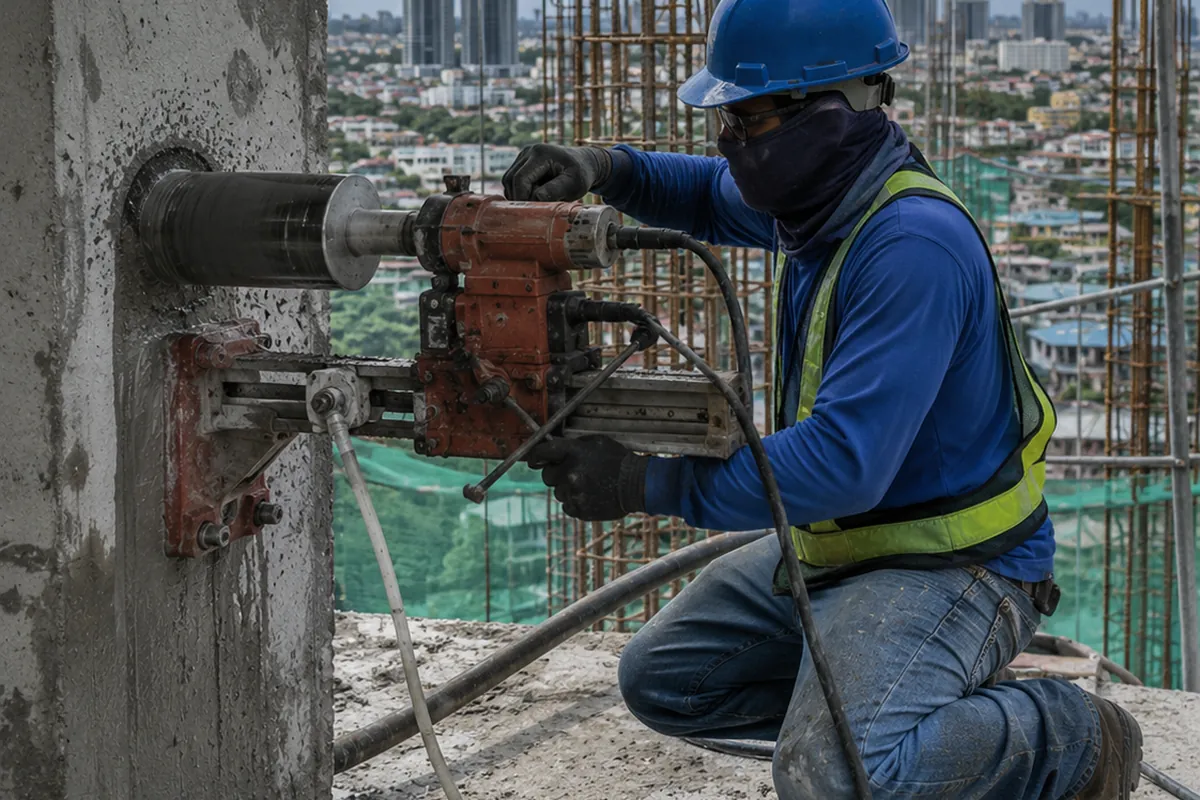
| Concrete cores | Strength in doubt | In-place strength against NSCP 426.12.4.1 |
| As-built documentation | No usable structural drawings | What the structure actually is |
| Structural analysis | Alterations, added load, event damage | Whether members still carry what they now must |
PD 1096 Section 214 treats a building as dangerous where it's structurally unsafe, or a hazard because of inadequate maintenance, dilapidation, obsolescence or abandonment. Section 215 directs the building official to order repair, vacation or demolition depending on the degree of danger. A board that already has an engineer's report and a programme of repairs goes into that conversation very differently from one that has only resident complaints.
Management body provisions are RA 4726 Section 9. Liability is Civil Code Articles 2190 and 2192. Dangerous buildings are PD 1096 Sections 214 and 215. Core acceptance is NSCP 2015 Section 426.12.4.1, and the limit on rebound hammer results is stated in ASTM C805 itself. The triage weighting is AEDO's own practice, not a code method.
Who is responsible for structural maintenance in a condominium?
Section 9 of the Condominium Act (RA 4726) requires the project owner to register a declaration of restrictions that provides for a management body, which may be a condominium corporation, an association of owners, a board of governors or a management agent. The declaration may give that body power to enforce the restrictions and provide for maintenance and other services benefiting the common areas. Read your own master deed and declaration to see exactly how responsibility was allocated in your building.
How often should a condominium building be structurally assessed?
We have not found a national statute that fixes a structural assessment interval for private condominiums. That makes the building's own declaration of restrictions, its insurance terms and its maintenance programme the real drivers. In practice, assess after any strong earthquake, typhoon or fire affecting the building, whenever cracking or corrosion appears in columns, beams or slabs, and before any change that adds load, such as rooftop tanks or new amenities.
Is a rebound hammer test enough to judge the concrete?
No. ASTM C805, the rebound hammer standard, states that its results cannot be used to accept or reject concrete. The rebound survey tells the engineer where to take cores. Under NSCP 2015 Section 426.12.4.1, an area is considered structurally adequate if the average of three cores is at least 85 percent of the specified strength and no single core is below 75 percent.
What happens if the building official finds the building dangerous?
PD 1096 Section 214 treats buildings as dangerous where they are structurally unsafe or a hazard because of inadequate maintenance, dilapidation, obsolescence or abandonment. Section 215 directs the building official to order repair, vacation or demolition depending on the degree of danger. A documented assessment and repair programme is the best position to be in if that conversation ever happens.
Who pays if part of the building collapses from neglect?
Article 2190 of the Civil Code makes the proprietor of a building responsible for damages from its total or partial collapse if it is due to the lack of necessary repairs. Where the damage comes from a construction defect covered by Article 1723, Article 2192 directs the injured party to the engineer, architect or contractor instead. Who counts as the proprietor in a condominium depends on how the project and its common areas are held, so have counsel read the master deed.
Can a unit owner remove a wall inside their unit?
Not safely without an engineer confirming the wall is non-structural, and not without following the declaration of restrictions, which Section 9 of RA 4726 allows to empower the management body to enforce its rules. Unit alterations can turn an otherwise sound building into one that needs assessing.
Statutes, code provisions and standards used in this guide. Links open in a new tab.
The triage check reflects AEDO's engineering practice. It is not a regulated method, it cannot certify a building as safe, and it is not legal advice on who bears liability in a particular condominium.
Start with a survey that tells the board where it stands, then test only what the survey flags.