Has your building ever been formally assessed against current seismic standards?
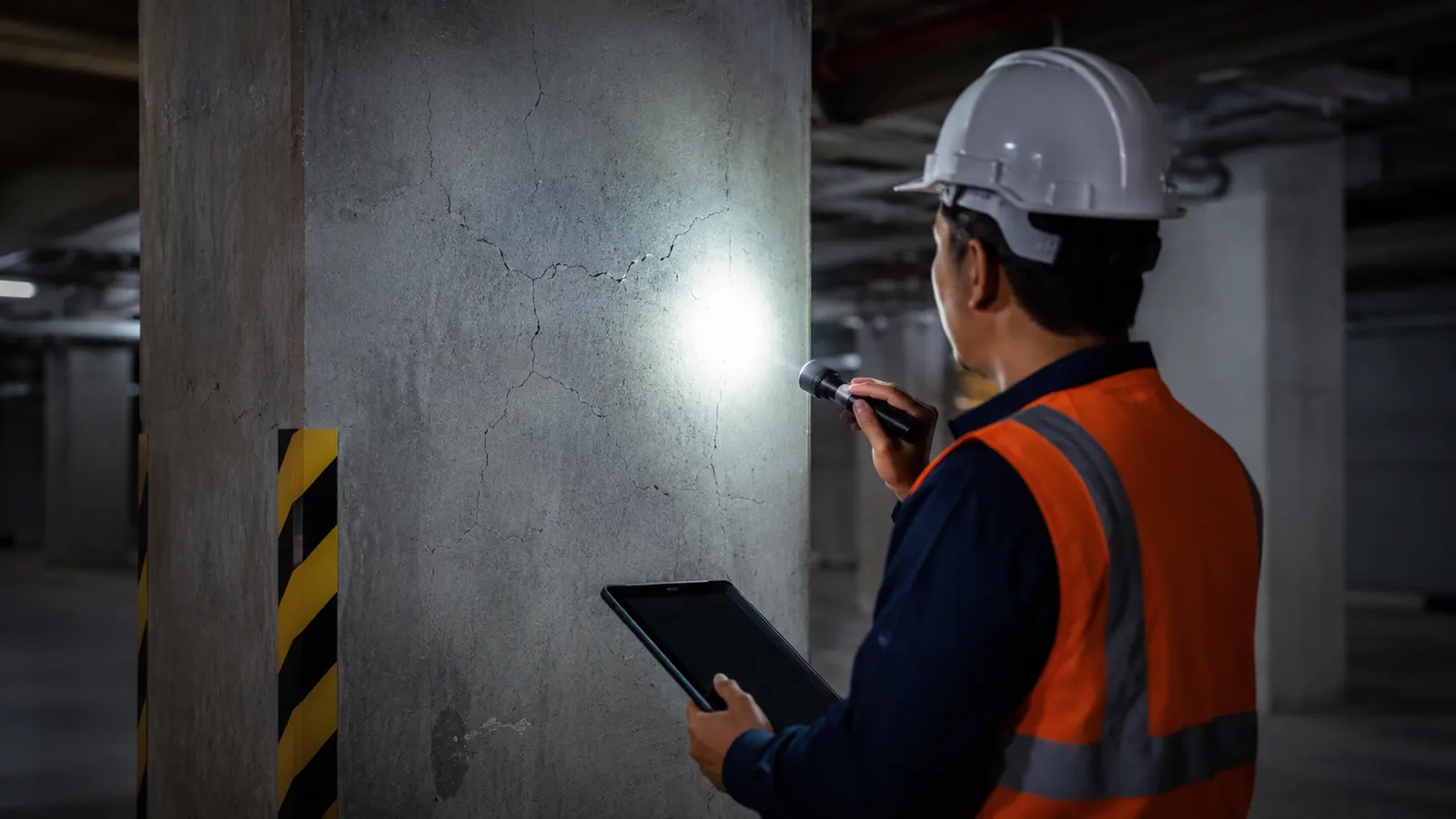
The visual condition survey — checking for cracking, spalling, and other visible distress with a flashlight and a documented checklist — is step one of every structural audit, LGU-run or privately commissioned.
If you run a hospital, school, or other essential-service building in the Philippines, there's a real chance a government audit program already applies to you — and if you own an ordinary home, there's a good chance it explicitly doesn't, despite what the headlines imply. A regional news item out of Davao this month is a useful reminder to check which is actually true for your property, and what a real structural audit involves either way.
On July 13, 2026, at a session held at SM City Davao, DILG-Davao Region engineers laid out plans to strengthen the agency's infrastructure audit program in the wake of the June 8 magnitude-7.8 earthquake that struck off Mindanao's coast and heavily damaged parts of Davao Occidental. It's a small, regional story — but the national program behind it isn't small or regional at all, even though its scope is narrower than most coverage implies.
Engr. Henry Villanueva of DILG-Davao's Project Development Management Unit explained the approach plainly: the audit will determine how many buildings in the region would likely collapse in an earthquake of similar magnitude to June 8's, with retrofitting recommended for essential public facilities — hospitals, evacuation centers, government offices — found structurally inadequate.
The program isn't a one-off inspection sweep. It's building institutional capacity: an initial training round for LGU engineers wrapped up in June 2026, with a second round scheduled for August 25-26, 2026. DILG-Davao is coordinating with DPWH, the Association of Structural Engineers of the Philippines (ASEP), and academic partners — the University of Mindanao and Ateneo de Davao University — to train civil engineers and auditors and to feed findings into updates for both local ordinances and the National Building Code itself, alongside the NBCRC review already underway at DPWH.
This isn't a Davao-only initiative — it's the regional continuation of DILG's national Infrastructure Audit (IA) Program, which was already running before the June 8 quake. By June 11, 2026, DILG had directed LGUs in Regions IX, XI, and XII to conduct rapid structural assessments before residents could return to affected buildings, and reported — through its own release via the Philippine Information Agency — that 854 LGUs nationwide had by then been trained on the program's Harmonized IA Tool, 208 of them in Mindanao, with 3,302 LGU-owned buildings across Mindanao already under screening as of May 15, 2026.
DILG-Davao's July 13 session is a regional continuation of a program that's been building since 2024-2025 — not an isolated local idea. DILG developed the Harmonized Infrastructure Audit Tool (HIAT) in 2024 with the Association of Structural Engineers of the Philippines (ASEP) and the Philippine Institute of Civil Engineers (PICE), publicly announced it in April 2025 through Undersecretary Marlo Iringan at the 2nd Earthquake Preparedness Summit, then formally launched the national Infrastructure Audit (IA) Program under Memorandum Circular No. 2025-071 on July 21, 2025. By October 2025, DILG had already trained dozens of high-risk LGUs along the West Valley Fault and said it intended to extend the audit toward privately-owned essential-service buildings. The June 8, 2026 Mindanao earthquake didn't start this program — it accelerated it: three days later, DILG issued a formal advisory directing LGUs across Regions IX, XI, and XII to conduct rapid structural assessments before displaced residents could return home.
There's also an older, broader-worded mandate in the background that's easy to confuse with the active program: Joint Memorandum Circular 2019-01, issued October 24, 2019 by DILG, DPWH, and DTI, which directs LGUs to assess "all public and private buildings, facilities, and infrastructure" — with a 90-day reporting clock that then-DILG Secretary Eduardo Año activated at a February 26, 2020 press conference. That circular hasn't been repealed, but it isn't the document driving the audits actually being carried out today. As the next section covers, the currently active program has a narrower, explicitly-written scope — which changes who's actually affected right now.
A structural assessment you commission yourself produces the exact same kind of report an LGU audit would — except you control the timing, and you get it before there's an enforcement deadline attached.
Book My Assessment (from ₱10,000)This is where most coverage gets vague, and the honest answer is: it depends which mandate you're looking at — and the program actually being executed is narrower than the older language suggests.
DILG's own published program guidelines (Memorandum Circular No. 2025-071) are explicit: priority goes to LGU-owned and "lifeline" infrastructure delivering essential services — hospitals, schools, government offices, emergency response facilities. Even privately-owned hospitals and schools are covered under this essential-services scope. The program explicitly excludes privately-owned buildings not providing essential services, ordinary residential properties, and nationally-owned facilities. An ordinary private home, by the program's own wording, is not covered.
The older Joint Memorandum Circular 2019-01 (2019) directs LGUs to assess "all public and private buildings" without the essential-services carve-out the current program uses. It hasn't been repealed, and a Local Building Official could in principle still invoke it — but the funded, systematized program actually being rolled out on the ground (the IA Program, with trained auditors and a national tracking database) is the narrower one.
Separately from either DILG-run audit program, the National Building Code's own Implementing Rules already give Local Building Officials standing authority to require any existing building's owner — public or private — to submit a licensed professional's certification on structural stability and fire safety, with a recommendation on retrofit need, when circumstances warrant it. That authority isn't tied to DILG's LGU audit programs and can apply regardless of building type; it's simply exercised case by case rather than through a nationwide sweep.
"Structural audit" sounds bureaucratic, but the actual engineering work behind it is straightforward and follows a consistent sequence regardless of who's commissioning it — an LGU, a bank, or you:
A licensed engineer inspects the building for visible distress: cracking patterns, wall or column leaning, concrete spalling, rebar corrosion, foundation settlement, and any unauthorized modifications since original construction.
The building's age, structural system, and original design (if drawings exist) are checked against current NSCP 2015 seismic (§208) and wind (§207) provisions. Buildings designed under older code editions are common — that alone isn't disqualifying, but it changes what the engineer is checking for.
If visual findings suggest deeper issues, engineers use non-invasive methods — rebar scanning, concrete strength (rebound hammer or core sampling), and in some cases ground-penetrating radar on foundations — to evaluate what can't be seen from the surface.
Findings are compiled into a signed report with a specific recommendation — the same document format an LGU audit produces, a bank requires for a loan release, or an insurer requires for a claim.
Every structural audit — DILG's, DPWH's, or a private engineer's — lands on a finding somewhere on the same scale:
| Finding | What It Means |
|---|---|
| No Action Needed | Structure performs adequately against current standards. No intervention required. |
| Monitor | Minor findings noted but not urgent — re-inspect on a defined schedule, typically annually. |
| Restrict Use | Structure is safe for reduced occupancy or specific use only — e.g., no upper-floor access — until repairs are made. |
| Repair / Retrofit | Structural deficiencies identified that require intervention — see our full breakdown of retrofit methods and real cost ranges. |
| Evacuate / Demolish | Structure poses immediate life-safety risk. Occupancy should stop until the building is either retrofitted to a safe standard or demolished. |
An audit that comes back "no action needed" isn't wasted money — it's the documented proof you didn't have before, and it's the same proof a bank, an insurer, or a future buyer will eventually ask for anyway. Most buildings that get assessed don't land in the "demolish" tier; they land somewhere in the middle, which is exactly the range where knowing early is cheapest.
Send us photos and basic building info — age, structural system, any visible cracking or damage — and we'll tell you honestly whether you need a full paid structural assessment or not, before you spend anything.
No spam. We'll email you directly to ask a few quick questions about your building.
For LGU officials, the accountability is explicit under both the current IA Program's own guidance and the older JMC 2019-01: missing an audit deadline doesn't itself trigger sanctions, but if an unassessed building later collapses and causes injury or death, administrative and criminal cases can follow — including dismissal and disqualification from future public office for negligent officials.
For private owners whose building sits outside the IA Program's scope — which, as covered above, is most ordinary homes — there's no criminal exposure just for not commissioning an audit. But skipping one has quieter costs, unrelated to DILG's program entirely: no documented basis for an insurance claim if the building is damaged, no report to hand a bank for a loan release or refinance, and no defense if a tenant or occupant is hurt and the building's condition is questioned afterward. The National Building Code's own dangerous-and-ruinous-building provisions can still reach any structure regardless of DILG program scope, and enforcement generally — DOLE, DPWH, and local Offices of the Building Official — has intensified since the Angeles City collapse, and that climate isn't specific to construction-phase buildings.
DILG, DPWH, and DTI jointly issue Joint Memorandum Circular 2019-01, broadly directing LGUs to assess "all public and private buildings." Then-Secretary Eduardo Año activates a 90-day reporting clock in February 2020. Background context — not the document driving today's active audits.
DILG Undersecretary Marlo Iringan announces the Harmonized Infrastructure Audit Tool (HIAT) at the 2nd Earthquake Preparedness Summit, with pilot-testing planned for NCR, Region III, and CALABARZON.
DILG issues Memorandum Circular No. 2025-071, formally launching the Infrastructure Audit (IA) Program nationwide — prioritizing LGU-owned and "lifeline" essential-service buildings (including privately-owned hospitals and schools) and excluding ordinary private residences from scope. DILG publicizes the launch through its own release on August 7.
DILG reports dozens of high-risk LGUs trained along the West Valley Fault and a 74-LGU nationwide coach corps, and signals intent to extend the audit toward privately-owned essential-service buildings.
A 9-storey building under construction collapses, killing dozens of workers and sharply raising national scrutiny of structural compliance and enforcement.
A magnitude-7.8 earthquake strikes off Mindanao's coast, heavily damaging parts of Davao Occidental and causing deaths directly attributed to inadequate structural integrity.
Three days after the quake, DILG directs LGUs in Regions IX, XI, and XII to inspect and clear buildings before residents return. DILG reports 854 LGUs trained nationwide on HIAT (208 in Mindanao) and 3,302 Mindanao buildings already under screening as of May 15.
At a session in SM City Davao, DILG-Davao lays out plans to prioritize essential-facility retrofitting and coordinate with DPWH, ASEP, and academic partners. A second engineer-training round was scheduled for August 25-26, 2026 (per SunStar's July 13 report; we have not confirmed it took place).
Whether or not your LGU has an active audit program yet, the same engineering questions apply: is your building structurally adequate under current standards, and if not, what does it need? Find out on your own timeline, not the enforcement calendar's.
Statutes, codes, official tools and references used or referred to in this article, linked to their source. Links open in a new tab.
Prices, cost bands and rate figures in this article are AEDO Construction's own market and practice figures for Philippine work unless a source is named beside them. Code and statute references above link to the primary text.
AEDO Construction provides structural assessment and retrofit design nationwide, plus full design-build execution in Negros Oriental. One licensed engineer follows your building from first inspection through completed work — no handoff between separate firms.
Essential-service building owners — private hospitals, schools, and similar facilities — should expect DILG's Infrastructure Audit Program to reach them as the rollout expands past its current LGU-owned priority list. Ordinary homeowners fall outside that program's scope, but the same engineering report still answers the question that actually matters: is this building structurally sound. A structural assessment you commission on your own schedule costs the same engineering work either way, minus the deadline pressure.
In the wake of the June 8, 2026 M7.8 Mindanao earthquake, DILG-Davao Region is scaling up its local rollout of DILG's national Infrastructure Audit (IA) Program using the Harmonized IA Tool (HIAT). Engr. Henry Villanueva of DILG-Davao's Project Development Management Unit says the audit will determine how many buildings would likely collapse in an earthquake of similar magnitude, with retrofitting recommended for essential facilities found structurally inadequate. LGU engineer training was scheduled for August 25-26, 2026, in coordination with DPWH, ASEP, the University of Mindanao, and Ateneo de Davao University. Nationally, DILG had already trained 854 LGUs on HIAT by June 11, 2026 (208 in Mindanao), with 3,302 Mindanao buildings under screening as of May 15, 2026.
Mostly no. DILG's currently active Infrastructure Audit (IA) Program, formally launched under Memorandum Circular No. 2025-071 (issued July 21, 2025), prioritizes LGU-owned and "lifeline" essential-service public buildings — hospitals, schools, government offices, emergency facilities. Even privately-owned hospitals and schools are covered under this scope. The program explicitly excludes privately-owned buildings not providing essential services, ordinary residential properties, and nationally-owned facilities, per DILG's own guidelines — an ordinary home is not covered. A separate, older circular (JMC 2019-01, 2019) speaks more broadly of "all public and private buildings," but it isn't the document driving today's active audits.
A visual inspection for cracking, leaning, spalling, corrosion, and foundation settlement; a review of the building's design against current NSCP seismic and wind provisions; and, where warranted, non-destructive testing like rebar scanning or concrete strength testing. The output is a written report with a finding: no action, monitor, restrict use, repair, retrofit, or demolish. See what that report should contain, section by section.
For LGU officials, non-compliance with either the IA Program or the older JMC 2019-01 can lead to administrative and criminal liability if an unassessed building later collapses and causes injury or death. For private owners outside the IA Program's scope — most ordinary homes — there's no criminal exposure just for not auditing, but skipping it removes your documented basis for an insurance claim, a bank loan release, or a liability defense, separate from DILG's program entirely.
AEDO Construction offers a licensed-engineer structural assessment from ₱10,000, by floor area, with a written report delivered within 5 days — covering a site visit, visual condition survey, and engineering evaluation against current NSCP 2015 provisions.