If a building you designed collapses fourteen years after you handed over the keys, you can still be sued for it. That isn't a fringe reading of the law — it's the plain text of Article 1723 of the Civil Code, and it's the reason "the project is closed" is not the same thing as "the liability is closed."

Article 1723 exists precisely for defects that don't show up until years after occupancy — a defect in the plans, in the ground, or in the workmanship.
The engineer or architect who prepared a building's plans is liable for damages if the building collapses within 15 years of completion, due to a defect in the plans or the ground. The contractor is liable for the same 15 years for collapse caused by construction defects, inferior materials, or breach of contract. If the engineer or architect supervises the construction, they're solidarily liable with the contractor — full exposure, not a partial share. Accepting the finished building does not waive the owner's right to sue. And once collapse happens, there's a separate 10-year deadline from the collapse itself to actually file the case.
Enter the building's completion date to see when its 15-year design/construction liability window closes. If it has already collapsed, add the collapse date to check the separate 10-year filing deadline.
This is the provision, in full — Book IV, Title VIII, Chapter 3 ("Contract for a Piece of Work") of the Civil Code of the Philippines, Republic Act No. 386:
"The engineer or architect who drew up the plans and specifications for a building is liable for damages if within fifteen years from the completion of the structure, the same should collapse by reason of a defect in those plans and specifications, or due to the defects in the ground. The contractor is likewise responsible for the damages if the edifice falls, within the same period, on account of defects in the construction or the use of materials of inferior quality furnished by him, or due to any violation of the terms of the contract. If the engineer or architect supervises the construction, he shall be solidarily liable with the contractor.
Acceptance of the building, after completion, does not imply waiver of any of the cause of action by reason of any defect mentioned in the preceding paragraph.
The action must be brought within ten years following the collapse of the building."
Three paragraphs, several distinct rules packed into the first one alone. It's worth reading slowly, because most of the confusion around this law comes from people quoting only the opening sentence and missing what follows it in the same paragraph.
The single most common misreading of Article 1723 is treating "15 years" as one deadline. It's actually the trigger for the collapse; the deadline to sue is a separate clock that only starts once the collapse happens.
The 15-year clock starts here — the date of substantial completion or turnover, not the permit date or the groundbreaking date.
If the building collapses on year 14, Article 1723 liability is triggered. If it collapses on year 16, this specific article no longer applies — the 15-year window has closed.
Once a covered collapse happens, the injured party has 10 years from that collapse date — not from the original completion date — to actually file suit.
Worked example: a building is completed in 2015. It collapses in 2028 — 13 years later, inside the 15-year window, so Article 1723 liability attaches. The owner or an injured third party then has until 2038 — 10 years from the 2028 collapse — to bring the case. Filing in 2039 would be too late, even though the collapse itself happened well within the original 15 years.
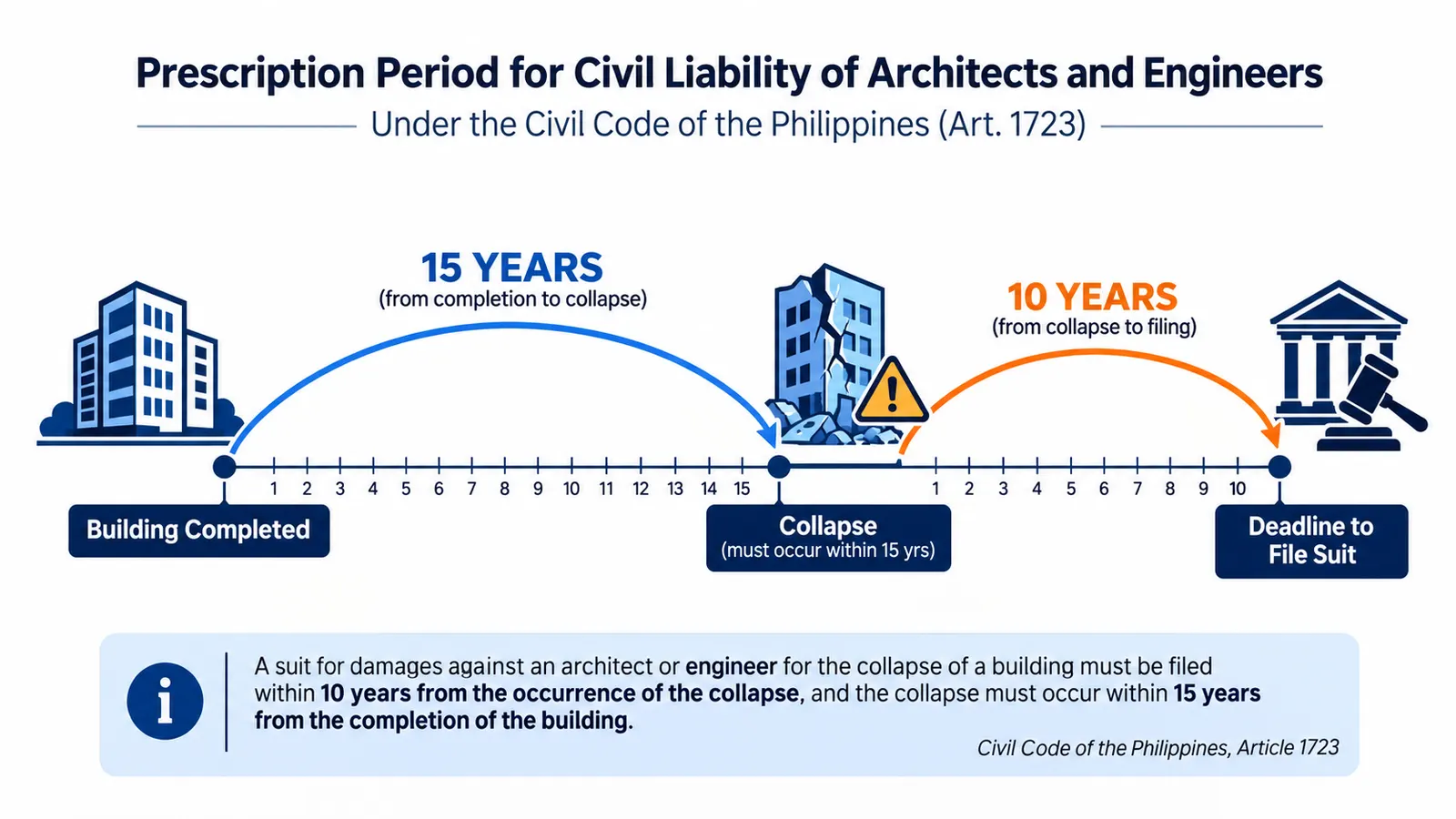
The two clocks in one diagram — the 15-year window for the collapse to occur, then the separate 10-year window to file suit once it does.
Article 1723 Liability by Role
| Role | What triggers their liability | Period |
|---|---|---|
| Engineer / architect (design only) | Defect in the plans and specifications, or defect in the ground | 15 years from completion |
| Contractor | Defects in construction, inferior materials furnished by the contractor, or any violation of the contract terms | 15 years from completion |
| Engineer / architect who also supervised construction | Any of the above — solidarily liable with the contractor | 15 years from completion |
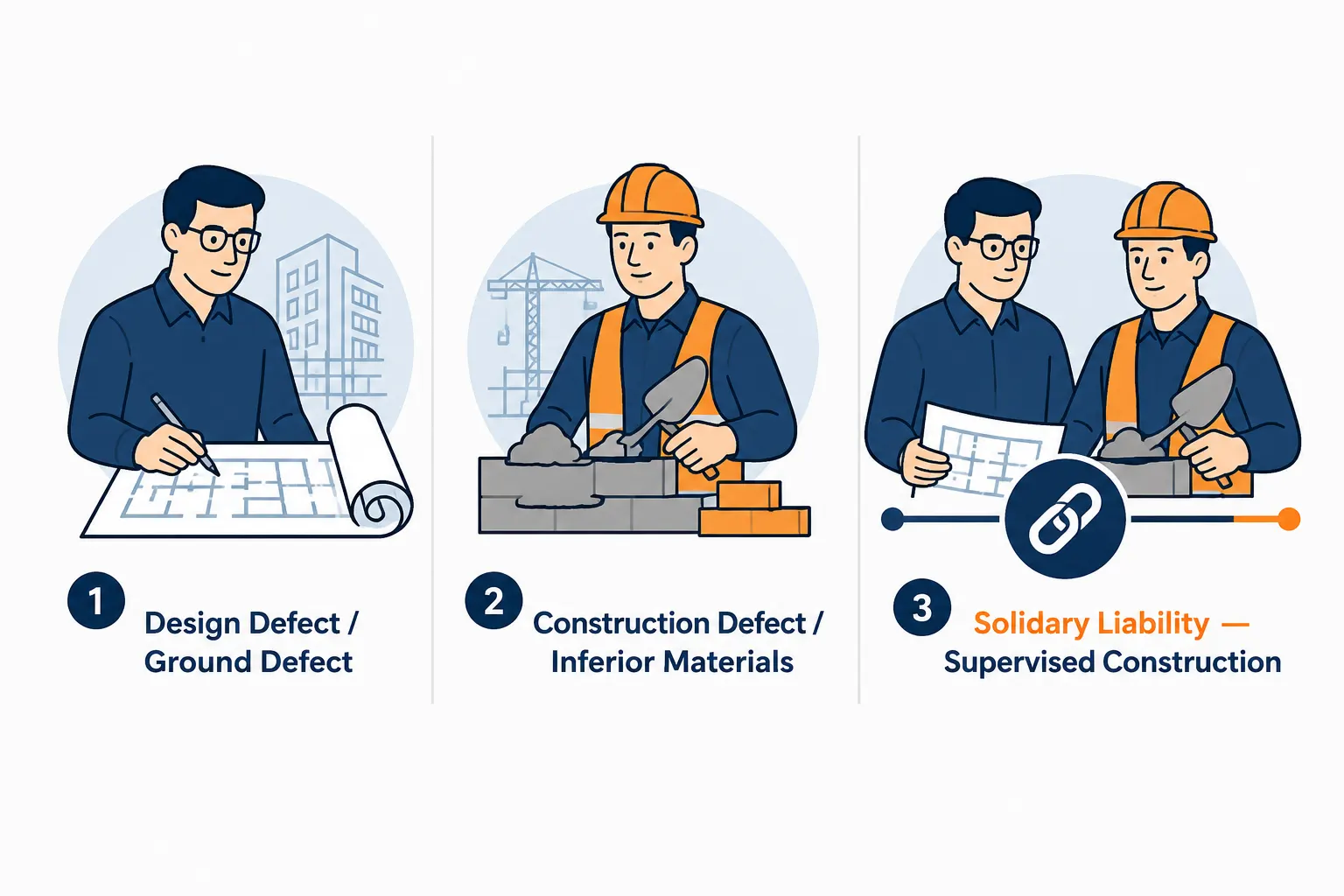
Each role answers for a different kind of defect — until the designer also supervises construction, at which point the two liabilities fold into one.
"Solidarily liable" is the detail that changes the practical exposure. It does not mean the designer only answers for their design-related share while the contractor answers separately for theirs. It means an injured party can recover the full amount of damages from either party — or both — leaving them to sort out contribution between themselves afterward. A supervising architect doesn't get to point at the contractor's workmanship and limit their own exposure to the plans; supervision folds the two liabilities into one.
Article 1723 civil liability doesn't replace professional licensing law — the two run on separate tracks, and a single collapse can trigger both at once:
| Track | What it governs | Who enforces it |
|---|---|---|
| Civil Code Art. 1723 | Money damages for the collapse itself | Regular courts, via a civil suit |
| RA 9266 (Architecture Act of 2004) | Licensing, scope of practice, and professional discipline for architects | Professional Regulation Commission (PRC) |
| RA 544, as amended by RA 1582 (Civil Engineering Law) | Licensing and scope of practice for civil engineers | Professional Regulation Commission (PRC) |
| PD 1096 (National Building Code), Sec. 308 | Requires the owner to engage a licensed architect or civil engineer for full-time inspection and supervision of construction | Local building officials / DPWH |
A PRC case can suspend or revoke a license without an owner ever collecting a peso in damages, and an Article 1723 damages suit can succeed without the PRC taking any disciplinary action at all. If the collapse causes injury or death, criminal liability for reckless imprudence can also apply on top of both — three separate legal tracks a single structural failure can open, each with its own process and its own standard of proof.
On case law: Article 1723 is rarely the subject of a fully litigated, reported Supreme Court decision — most building-failure disputes in the Philippines are resolved through settlement, insurance, or PRC administrative proceedings rather than a published appellate ruling squarely interpreting this article. Treat the statute's plain text, above, as the primary authority, and verify any case citation independently before relying on it.
A 15-year tail means the geotechnical report, the sealed and dated drawings, and the site supervision logs from a project you finished a decade ago can matter again. Documentation discipline is the only real defense once a dispute surfaces years later.
Signing a turnover or certificate of acceptance does not close off recourse under Article 1723. If a structural issue surfaces years after occupancy, the completion date and the original design/build team's identity are the first two facts worth confirming.
Does Article 1723 apply to any collapse, or only total collapse?
The statute's text simply says the structure "should collapse" — it does not itself distinguish total from partial collapse. Whether a given partial failure counts is a fact-specific legal question; don't assume either way without counsel.
What if the contractor supplied materials the owner separately approved?
Article 1723 places the burden on the contractor for "materials of inferior quality furnished by him" — the specific facts of approval, specification, and who sourced the materials would need to be weighed against the contract terms, which is a case-specific determination outside the scope of a general guide.
Does this law cover renovations, or only new construction?
Article 1723 sits within the Civil Code provisions on a "contract for a piece of work" for a building. Whether it extends to a major renovation or structural retrofit depends on the specific contract and scope — a question best confirmed with a lawyer for the facts at hand.
Can a contract shorten or waive the 15-year period?
Article 1723 is a statutory liability, not merely a contractual default term, and the article explicitly closes off one common workaround — acceptance of the building does not waive it. Attempting to contractually shorten a statutory liability period raises its own legal questions that a general guide like this one shouldn't answer for a specific contract.
Is AEDO Construction a law firm?
No. AEDO Construction is a Filipino design-build engineering firm. This article explains the engineering and construction-industry context of Article 1723; for an actual legal opinion, dispute, or filing, consult a licensed Philippine lawyer.
Statutes, codes, official tools and references used or referred to in this article, linked to their source. Links open in a new tab.
Prices, cost bands and rate figures in this article are AEDO Construction's own market and practice figures for Philippine work unless a source is named beside them. Code and statute references above link to the primary text.
A 15-year liability tail is only manageable if the records exist to show what was actually designed, specified, and supervised. In Negros Oriental, AEDO's design-build process keeps sealed design documentation and full-time construction supervision records on every project; elsewhere in the Philippines, AEDO provides the complete design and remote oversight of the contractor you hire, with the same documentation discipline — the same paper trail that determines whether a defect traces back to the plans, the ground, or the construction, years down the line.
This article is general information about Philippine construction law, not legal advice for a specific dispute. Consult a licensed Philippine lawyer for any actual claim or defense under Article 1723.