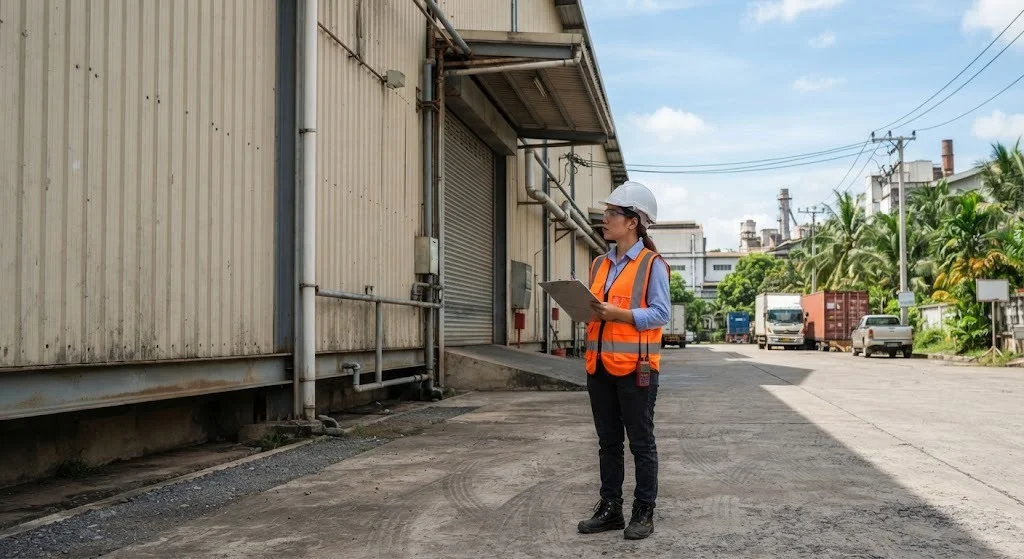
The building you're about to sign for is a bundle of deferred decisions someone else made. Illustrative photo.
Short answer: a commercial lease or purchase transfers you more than floor area. It transfers whatever the current owner or tenant has been deferring — cracked members, an unpermitted mezzanine, a lapsed fire safety certificate, an electrical system quietly running past its rated life. None of that shows up in a listing photo or a broker's walkthrough. A structural and MEPFS due-diligence assessment, done before the offer deadline rather than after the keys change hands, is what turns "the building looked fine" into a number you can act on.
This matters more, not less, the larger the deal. A residential buyer who misses a hairline crack loses a repair bill. A company that leases a warehouse with an undocumented racking system, or buys a plant with a fire protection system that never passed its annual inspection, is exposed to business interruption, regulatory shutdown risk, and a liability position it did not know it was accepting. The assessment costs a fraction of any one of those outcomes.
Three things separate a commercial acquisition or lease from a residential one, and each one raises the stakes.
Article 1561 of the Civil Code makes a seller answerable for hidden defects that render a thing unfit for its use, but excludes patent or visible defects in the same sentence. Article 1567 gives the buyer the choice between rescinding the sale or demanding a proportionate price reduction, with damages either way. Article 1571 bars any action on that warranty six months after delivery. None of these three articles are about leasing. A tenant's protection comes from the representations, warranties and maintenance obligations written into the lease itself — which is exactly why those clauses deserve a lawyer's attention before signing, informed by an engineer's findings rather than the broker's assurances.
Four layers, in the order that makes sense to spend money on.
Not every deal needs the full four-layer engagement. A short-term lease of a small retail unit might only warrant the survey and a fire-safety check. A purchase of an industrial plant with process equipment almost always warrants all four, plus a closer look at whatever systems the equipment depends on.
Walk the building with this open, or fill it in from the broker's disclosures and your own site visit. Check anything that applies. You'll get a risk tier and a recommendation to take into the negotiation — not a substitute for the assessment itself.
Ask for these in writing, early, from the seller or landlord's side. A response within a day or two is a good sign; a runaround is information in itself.
| Document | What it establishes |
|---|---|
| Certificate of title or lease contract on file | Who can actually convey or lease the property, and what's annotated against it |
| Building permit and certificate of occupancy | Whether the structure was approved, and for what use |
| As-built structural and MEPFS drawings | What the building was designed to carry and how its systems are laid out |
| Fire Safety Inspection Certificate, current year | Whether the Fire Code (RA 9514) compliance chain is intact |
| Zoning certificate / locational clearance | Whether your intended use is actually permitted on the site |
| Maintenance and service logs for MEPFS systems | How the building has actually been run, not how it looks on a walkthrough |
| Records of any additions, mezzanines or fit-outs | Whether load added after original construction was ever engineered |
Where several of these come back missing rather than merely delayed, that's the signal to commission the assessment before negotiating further, not after. Our as-built documentation guide covers what it costs to reconstruct drawings that don't exist, and the commercial building annual compliance guide walks through the PD 1096 and RA 9514 obligations that come with the building once you're the one holding them.
| Finding | What it really is | Effect on the deal |
|---|---|---|
| No occupancy permit for current use | Unregularized construction or an unreported change of use | Regularize before closing, or price the risk into the offer |
| Undocumented mezzanine or racking | Unverified load path on structure not designed for it | Structural analysis is mandatory before relying on it for storage |
| Cracking at beam-column joints | Frame distress, not a finish issue | Engineer's opinion required before any offer stands |
| Lapsed Fire Safety Inspection Certificate | The Fire Code compliance chain is broken | Business permit renewal risk transfers to the next occupant |
| Corroding reinforcement | Section loss in members you'll rely on | Repair scope grows with every area opened up |
| Aged MEPFS with no records | A replacement bill with no data to size it | Budget conservatively, or get the review done first |
The habit that matters most is the same one that matters in a residential purchase, at a much larger scale: get the written assessment before the offer, not after. A report your engineer can point to is the only thing that turns a soft "this needs work" into a specific number a seller or landlord has to respond to.
Hidden-defect warranty in a sale is Civil Code Articles 1561, 1566, 1567 and 1571. Collapse liability once you control the property is Articles 2190 and 2192, tied to the fifteen-year construction-defect rule in Article 1723. Dangerous-building findings and their consequences are PD 1096 Sections 214 and 215. Fire Safety Inspection Certificate requirements reference RA 9514 and its 2019 Revised IRR. Accessibility figures reference BP 344's 2024 Revised IRR. Structural adequacy references the NSCP 2015. The ₱5,000 flat entry fee is AEDO's published price for a single-building structural assessment; the risk scorer's weighting and every cost/timeline range beyond that flat fee are AEDO practice estimates, not statutory or code figures.
Does the seller's hidden-defect warranty protect a company buying a commercial building?
Only within narrow limits, and only in an outright purchase, not a lease. Article 1561 of the Civil Code makes a seller answerable for hidden defects that render a thing unfit for its use, but the same article excludes patent or visible defects in the same sentence, and Article 1571 bars any action on that warranty six months after delivery. Article 1567 gives the buyer the choice between withdrawing from the sale or demanding a proportionate price reduction, with damages in either case. None of this extends automatically to a lease, where the tenant's protection depends on the representations and warranties written into the lease contract itself. Have counsel confirm which provisions actually apply to your transaction before you rely on any of them.
Who is liable if the building partially collapses after we take it over?
Article 2190 of the Civil Code makes the proprietor of a building responsible for damages from its total or partial collapse if that collapse is due to the lack of necessary repairs. Article 2192 sends the claim to the engineer, architect or contractor instead only where the damage traces to a construction defect covered by Article 1723 — plans, ground conditions, construction quality or materials, within fifteen years of completion. Once your company controls the property as owner or as the party responsible for its upkeep under the lease, Article 2190's proprietor exposure is a live question, which is exactly why the condition of the structure needs to be documented before you take that position, not after.
What happens if the local building official later finds the building dangerous?
PD 1096 Section 214 defines a dangerous building as one that is structurally unsafe, or a hazard to life, health or property because of inadequate maintenance, dilapidation, obsolescence or abandonment. Section 215 directs the building official to order it repaired, vacated or demolished depending on the degree of danger, and any of those outcomes can happen after you have already signed. A pre-transaction assessment and a documented repair programme are the record that shows you inherited a known, budgeted condition rather than an undisclosed one.
What should a commercial due-diligence assessment actually cover?
Four layers. A visual structural survey of the frame, roof, floor slabs and any mezzanine or racking. A comparison of the building as it stands against its as-built structural drawings, or measured documentation where those drawings don't exist. A code-compliance check — structural adequacy referenced against NSCP 2015, fire-safety compliance referenced against RA 9514, and accessibility referenced against BP 344's 2024 Revised IRR if the building is open to the public. And an MEPFS condition review covering electrical, plumbing, fire protection and mechanical systems, since a failed rooftop unit or an undersized panel is as much a budget item as a cracked column.
How much does a due-diligence assessment cost and how long does it take?
AEDO's published entry point is five thousand pesos flat for a single-building structural site visit and written report within five business days, the same rate quoted for a residential assessment. A commercial due-diligence engagement covering structural, MEPFS and code-compliance review across a larger floor area is scoped to the building and typically runs from that entry point up to a proposal sized for the site, with a full multi-discipline report generally taking two to three weeks. Either way, get the quote before the offer deadline, not after.
Which findings should actually change the offer price?
Findings that convert into cash the current owner has been deferring: cracking at beam-column joints or evidence of settlement, corroding reinforcement, a missing or unamended certificate of occupancy against the building's current use, unpermitted mezzanines or racking not covered by the structural design, an expired or absent Fire Safety Inspection Certificate, and MEPFS systems near or past their service life. Each of these has a repair, regularization or replacement cost attached to it, and that number belongs in the negotiation, not in a punch list after you move in.
Every statute and code provision used in this guide, linked to its primary source where publicly available. Links open in a new tab.
The ₱5,000 entry-point fee is AEDO's published price for a single-building structural assessment. All cost and timeline ranges beyond that flat fee, and the red-flag scorer's weighting, are AEDO practice estimates, not statutory or code figures. This guide is not legal advice on how these provisions apply to your specific lease or purchase.
Structural, MEPFS and code-compliance review, scoped to the deal size and sequenced to your closing date.