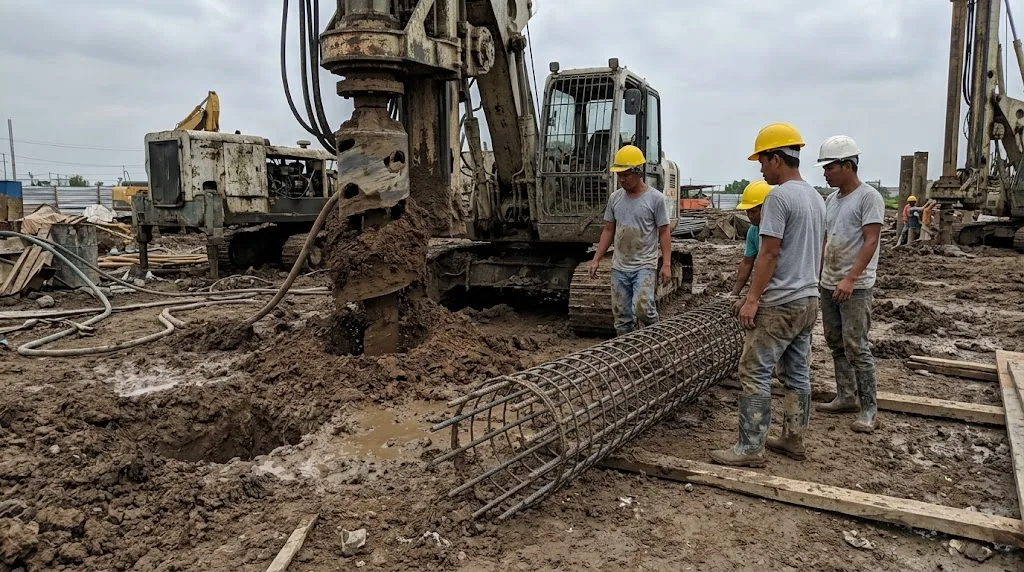
The cage waiting beside the hole is a big part of the material bill; the rig time is the rest. Neither can be priced properly until the soil boring says how deep the pile must go. Illustrative photo.
Short answer: there is no published national price list for piles in the Philippines, so any per-pile number is a planning range until a piling contractor prices your site. Our 2026 planning range for a 600 mm bored pile is about ₱6,500 to ₱9,000 per metre installed (roughly ₱100,000 to ₱135,000 for a 15 m pile), before pile caps, rig mobilisation and load tests. For the calculator's default case, 20 bored piles, 600 mm by 15 m, five four-pile caps, one static load test and rig mobilisation, the budget comes to about ₱3.12 million, or about ₱156,000 per pile all in. Piles are used when firm soil is too deep for footings to reach, and the soil boring log decides that and the pile length. The number that matters when comparing bored and driven piles is cost per kilonewton of allowable capacity, not cost per metre.
Below the calculator: when piles are actually needed, bored vs driven vs micropiles, how N-values become a pile length, what NSCP 2015 Chapter 3 says about design and load tests, a real generic example from a cement-plant silo, and what moves the price.
Enter the pile type, count, diameter and length from your designer's schedule. For bored piles the tool prices concrete and steel from AEDO's published material prices and adds an installation rate. For driven and micropiles the rate is supply and installation together. Installation rates are AEDO 2026 planning assumptions, not quotes: replace them with your piling contractor's figure. You also get the pile cap concrete, the rig mobilisation and any load tests.
Piles carry load down through weak soil to something that can hold it. They cost more per column than a footing, so nobody uses them out of preference. The usual triggers are the ones in our foundation types guide: soft or loose soil near the surface, reclaimed land or a high water table, liquefiable sand, expansive clay, and heavy structures such as silos, tanks and warehouses with tall racking. What the code says about it:
So the sequence is boring first, foundation type second. Our soil boring cost guide covers what the investigation costs (about ₱25,000 to ₱35,000 per 10 m borehole in our planning range) and how many boreholes NSCP Table 303-1 requires. On a pile job that's a small share of the foundation budget, and the pile length and count depend on it. See also soil profile types and the settlement cases in our foundation settlement repair guide.
| Type | How it's built | Where it fits | Watch for |
|---|---|---|---|
| Bored (cast-in-place) | A hole is drilled, often with casing or slurry to keep it open, a rebar cage is lowered in and concrete is placed from the bottom up | Tight sites, larger single-pile loads, deep bearing layers, places where hammer vibration is a problem | Clean hole bottom, cage centring and cover, concrete placement method, no soil caving into the shaft. NSCP 307.2.1 says concrete placement must exclude foreign matter and secure a full-sized shaft |
| Driven precast concrete | Factory or yard-cast piles hammered into the ground, spliced if needed | Soft ground with open access and enough headroom, repeat layouts with many similar piles | Hammer noise and vibration near neighbours, damage to piles while driving, splices (NSCP 307.5.4 sets splice rules), piles that hit an obstruction short of the design length |
| Micropile | Small-diameter drilled and grouted pile with a steel bar or pipe | Low headroom, tight access, underpinning existing buildings | Not named in the pile sections of NSCP Chapter 3 we read, so it goes through building official approval with test data (Section 306.1); needs a designer who will own the design |
Steel pipe, H-piles and timber piles also appear in NSCP Chapter 3 (Sections 307.1, 307.6, 307.7) but are less common on ordinary Philippine building work.
Which is cheaper? It depends on the site, and you can't tell from the type alone. Driven precast is often cheaper per metre in soft ground with a clear site. Bored piles cost more per metre but one large pile can replace several small ones, and bored piles can be the only workable choice next to existing buildings. Ask for both prices against the same design load, and compare ₱ per kilonewton of allowable capacity.
The Standard Penetration Test counts hammer blows to drive a sampler 300 mm; the count is the N-value. Low N is soft or loose ground, high N is stiff or dense. Together with the samples, the borehole log shows the soil layers, the groundwater level and where the firm layer starts. What the NSCP requires of the report (Section 303.7) includes a plot of borings, descriptions and classifications of the materials found, the water table elevation, recommendations for foundation type and design bearing capacity, expected total and differential settlement, laboratory test results and a field borehole log. For piles, Section 306.1 adds: recommended pile types and installed allowable axial capacities, estimated settlement, driving criteria, installation procedures, field inspection and reporting procedures, and pile load test requirements.
How this becomes a length: the geotechnical engineer picks the bearing layer and estimates the capacity two ways. Skin friction is the grip along the shaft; end bearing is what the toe rests on. Their sum, with the safety factors the designer uses, must exceed the design load. If the boring stops in a soft layer, nobody knows how deep the good soil really is. Section 303.1 says, unless the geotechnical engineer specifies otherwise, boreholes should reach at least five metres into hard strata or until a suitable bearing layer is reached. For a pile job, ask that the borehole go past the expected pile toe.
Two practical points. First, the pile length in the plans is a design length. On site the crew keeps drilling or driving until the criteria in the report are met, so the bill can move if the bearing layer is deeper or shallower than the borehole predicted. Second, a boring done 40 m from the building tells you about the ground at that borehole. Section 303.1 wants all boreholes inside the footprint and generally uniformly distributed. See NSCP seismic design for how soil class ties into the earthquake design of the whole structure.
Read from the NSCP 2015 Volume I scan. If your plans cite a newer edition, it governs.
| Item | What the code says | Section |
|---|---|---|
| Basis of design | Pile foundations are designed and installed on the basis of a foundation investigation where required by the building official. Piles not specifically mentioned in the chapter may be permitted with building official approval on submission of test data, calculations or other information | 306.1 |
| Interconnection | Pile caps of every structure subject to seismic forces are interconnected by ties capable of resisting in tension or compression a minimum horizontal force equal to 10 percent of the largest column vertical load, unless other approved methods are shown | 306.2 |
| Allowable loads | Axial and lateral pile loads are determined by an approved formula, a foundation investigation or load tests | 306.3 |
| Group action | Consider the reduction of allowable pile load when piles are in groups | 306.7 |
| Uncased cast-in-place piles: length | Bored or drilled piles cast against earth are limited to 30 times the average diameter, and f'c not less than 17.5 MPa; the length may exceed 30 diameters if design and installation follow an approved foundation investigation report | 307.2.1 |
| Uncased cast-in-place: stress | Allowable compressive stress in the concrete not more than 0.33f'c | 307.2.2 |
| Uncased cast-in-place: skin friction without a study | Frictional resistance may be assumed as one-sixth of the Table 305-1 bearing value at minimum depth, not more than 25 kPa, unless a greater value is allowed after a Section 303 investigation. Friction and bearing shall not be assumed to act simultaneously unless recommended by that investigation | 306.12 |
| Precast concrete piles | f'c at least 20 MPa, and 20 MPa reached before driving; ties or spirals at most 75 mm apart for 600 mm from the ends and 200 mm elsewhere; prestressed piles f'c at least 35 MPa | 307.4, 307.5 |
| Metal-cased concrete piles: driving order | No pile is driven within 4.5 average pile diameters of a pile filled with concrete less than 24 hours old, unless the geotechnical engineer approves | 307.3.2 |
| Water jetting | Not used to install piles except where the building official specifically permits it | 306.10 |
| Seismic Zone 4: piles and caps | Pile caps, piers or piles are interconnected by ties; concrete f'c at least 20.68 MPa (3,000 psi) at 28 days | 308.4 |
| Seismic Zone 4: cast-in-place piles | Minimum longitudinal reinforcement ratio of 0.005 for uncased cast-in-place piles in the top half of the pile length, at least 3,048 mm below ground or the whole length if greater; at least four bars; special transverse confinement near the top; ties not more than 12 bar diameters, half the least dimension or 305 mm apart | 308.6 |
| Seismic Zone 4: precast piles | Minimum longitudinal ratio 0.01, with closed ties of at least 10 mm and confinement within three pile diameters of the pile cap bottom | 308.5.1 |
Most of the Philippines is Seismic Zone 4; NSCP Section 208.4.4.1 puts only Palawan except Busuanga, Sulu and Tawi-Tawi in Zone 2, so Section 308 applies to nearly all pile jobs. We did not use pile capacity formulas here: this article isn't a design method, and the designer's calculations and the geotechnical report govern. The scan prints Section 306.10 twice (Water Jetting, and Protection of Pile Materials); we cite the water jetting text as printed.
A pile's capacity on paper is an estimate from soil data. A test converts it to a measurement. What the NSCP names:
The ASTM standards themselves are sold by ASTM; we cite them as the NSCP does, and we did not read their full text. Chapter 3 doesn't set what percentage of piles must be tested, so the count comes from the project specification and the building official. A static test on a large pile needs a reaction system (anchor piles or a loaded frame) and days of a crew, which is why one test can cost as much as several piles. Where a project uses a cheaper dynamic test, ask your designer whether the correlation with a static test is accepted for your soil.
Inspection during installation matters as much: drilling logs, concrete volume against theoretical volume for bored piles, driving records for driven ones, and the checks on the cage that we describe in our rebar inspection guide.
We found no published Philippine price schedule for piling we could cite, and we won't quote one we can't source. What we can do is show the material part from AEDO's own price guides and give the installation part as a labelled planning assumption. Bored pile materials at the default prices (concrete ₱5,100/m³ with 10% allowance, steel at 0.5% of section plus 30%, ₱40/kg):
| Bored pile diameter | Materials per metre (computed) | Installation per metre (AEDO planning) | Installed, per metre (planning range) | Per 15 m pile (planning range) |
|---|---|---|---|---|
| 400 mm | ₱961 | ₱3,000 | ₱3,400 to ₱4,700 | ₱51,000 to ₱70,000 |
| 600 mm | ₱2,163 | ₱5,500 | ₱6,500 to ₱9,000 | ₱97,000 to ₱135,000 |
| 800 mm | ₱3,846 | ₱8,000 | ₱10,000 to ₱14,000 | ₱150,000 to ₱210,000 |
| 1,000 mm | ₱6,009 | ₱11,000 | ₱14,500 to ₱20,000 | ₱218,000 to ₱300,000 |
Driven precast (supply and drive), AEDO 2026 planning range: about ₱3,000 to ₱4,200 per metre for a 300 mm square pile and ₱4,600 to ₱6,500 for 400 mm. Micropiles, all in: about ₱5,000 to ₱8,000 per metre. All three exclude mobilisation, pile caps, load tests and site works. A piling contractor's quote will differ with soil, rig availability in your province, casing or slurry, groundwater and the number of piles: 8 piles cost more per metre than 80. Treat the ranges as a way to tell whether a quote is in the right area, not as a price.
How it fits into a whole building: the foundation is only part of the bill. See our warehouse cost guide and cost per square metre guide for the wider picture, and labour rates for the crew side of pile caps and cage tying.
We reviewed the foundation drawings for a cement-plant storage silo (no client details here). The drawings show 102 bored piles, 1,000 mm diameter, 37 m long, each with 12 bars of 20 mm and a 10 mm spiral, and an allowable pile capacity of 4,400 kN. That reinforcement is 12 × 314 = 3,770 mm² in a 785,000 mm² section, about 0.48%, close to the 0.005 minimum in NSCP 308.6.
When we rechecked the loads with NSCP 2015 seismic forces, including the silo's stored mass at full, the worst pile came out at 1.95 times its allowable capacity (about 8,590 kN against 4,400 kN), with some inputs still open (soil report, fault type, fill level). A layout that meets the NSCP basis needed roughly 180 piles with a larger raft. The lesson for owners is generic: on heavy structures the count is often set by earthquake and overturning, not by dead load alone, so a pile design borrowed from another code or another site can be short under NSCP. Note also that 37 m on a 1.0 m pile is 37 diameters, beyond the 30 diameters of NSCP 307.2.1, so that clause's exception, which needs an approved foundation investigation report, is the route a pile like this must take. See our tank and silo assessment guide and structural assessment report for how we scope this kind of review.
Foundations are also a permit topic. If your plans get returned, see why plans come back. The structural fee for the design is a separate line; see structural engineer fees and, for steel-framed buildings on piles, pre-engineered steel buildings and concrete vs steel frame.
How AEDO works on piles. AEDO's licensed civil engineers design and check pile foundations from your soil report: pile type and count, pile caps and ties, and a review of the load test plan. We build only in Negros Oriental; everywhere else in the Philippines we design, seal, review remotely and check milestones, and your local piling contractor installs. Our published 3-working-day structural design express (₱7,500 up to 150 sqm, ₱50/sqm above that, up to 500 sqm) is for the superstructure design, and a pile foundation on heavy structures is quoted separately once we've read the soil report. The Single Milestone Check (₱7,500 per visit) can cover a pile installation or a load test.
Code clauses were read from the NSCP 2015 Volume I Chapter 3 scan (Sections 303 to 309), with Section 208.4.4.1 as read for our rebar guide. Material prices are from AEDO's ready-mix and rebar price guides. Installation rates, mobilisation and load test costs are AEDO 2026 planning assumptions, not sourced market prices. The silo figures are from AEDO's own review.
How much does a pile foundation cost in the Philippines?
There is no published national price list for piles, so treat any figure as a planning range until a piling contractor quotes your site. AEDO's 2026 planning range for a 600 mm bored pile is roughly 6,500 to 9,000 pesos per metre installed, which is about 100,000 to 135,000 pesos for a 15 metre pile, before pile caps, mobilisation and load tests. For our default case of 20 bored piles, 600 mm by 15 m, with five pile caps, one static load test and rig mobilisation, the calculator gives about 3.12 million pesos, or about 156,000 pesos per pile all in.
When do you need piles instead of footings?
When firm soil is too deep for footings to reach economically: soft or loose soil, reclaimed or high water table sites, liquefiable sand, and heavy structures such as silos, tanks and warehouses. NSCP 2015 Section 303.1 lists anticipated pile use as a case for an exhaustive geotechnical investigation, and Section 303.4 calls for a liquefaction assessment where groundwater is 2 m or shallower and there is unconsolidated saturated sandy alluvium with N below 15. The boring log decides it, not a rule of thumb.
Bored piles or driven precast piles: which is cheaper?
It depends on site, not on the pile type. Driven precast piles are often quicker and cheaper per metre in soft ground with open access, but they need a piling hammer, headroom and space, and the vibration can affect neighbouring structures. Bored piles suit tight sites, larger single-pile loads and deep bearing layers. Ask for both prices with the same design load. Compare cost per kilonewton of allowable capacity, not cost per metre.
How is the pile length decided?
By the soil boring log. The geotechnical engineer reads the SPT N-values layer by layer, finds the bearing layer, and estimates skin friction along the shaft and end bearing at the toe. NSCP 2015 Section 303.1 says boreholes should go at least five metres into hard strata or until a suitable bearing layer is reached, unless the geotechnical engineer specifies otherwise. The final length is confirmed on site by driving criteria or drilling records and, for important piles, by a load test.
Is a pile load test required in the Philippines?
NSCP 2015 Section 306.1 requires the foundation investigation report for piles to include pile load test requirements where the building official requires the investigation, and Section 306.3 allows allowable pile loads to be set by an approved formula, a foundation investigation or load tests. Static axial compression tests follow ASTM D1143 (Section 306.4) and high-strain dynamic tests follow ASTM D4945 (Section 306.5). We did not find a fixed percentage of piles to test in Chapter 3, so the number of tests comes from the project specification and the building official.
Does NSCP 2015 allow micropiles?
We did not find micropiles named in the pile sections of NSCP 2015 Chapter 3 that we read. Section 306.1 permits piles not specifically mentioned in the chapter subject to building official approval, on submission of acceptable test data, calculations or other information on their properties and load capacity. Section 309 allows special foundation systems approved by the engineer of record with calculations and a track record. In practice a micropile job needs a designer who will stand behind it and test data.
Codes and AEDO references used for this article.
We found no published Philippine price schedule for piling we could cite, so installation, mobilisation and load test costs are AEDO 2026 planning assumptions. We did not read ASTM D1143 or the other ASTM test standards in full, and no source we read sets a Philippine rule for how many piles to test. This article is general information, not a design for your building.
Send us the soil boring report, the column loads and the layout. A licensed civil engineer will check the pile type, count and length and tell you what to ask your piling contractor to quote.