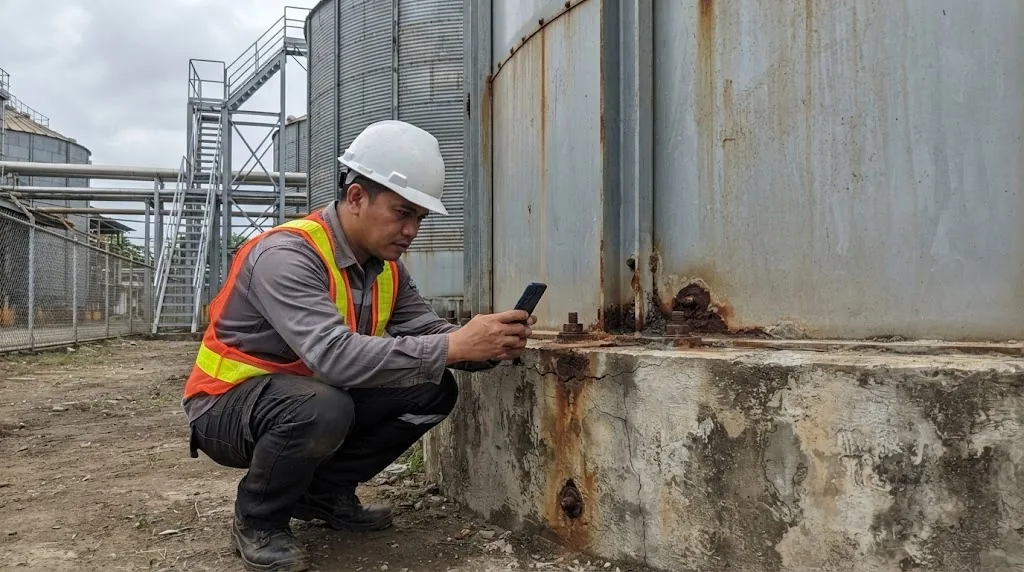
Corrosion at the base ring and anchor bolts is where silo assessments usually start. Illustrative photo.
Short answer: a silo, tank, or elevated process structure that is showing visible distress, is old enough that nobody on-site has ever seen its original design calculations, is about to carry more load than it was built for, or was designed before current wind and seismic provisions existed, needs a structural assessment before that condition becomes a shutdown. Unlike a house or office building, a silo or tank holding live process material doesn't fail politely — it fails as a spill, a collapse, or a production stoppage that costs far more than the assessment would have.
This is a different animal from a building structural audit. A cement silo, a water or chemical storage tank, or a steel process tower carries loads a typical building code was never written around first — internal material pressure, thermal cycling from stored contents, corrosion from what's inside or the plant atmosphere around it, and support conditions (legs, skirts, rings) that behave nothing like a column grid. The assessment has to speak that language.
In practice, these are the situations that should trigger an assessment rather than a "we'll get to it" note on a maintenance log:
Any one of these is a reason to schedule an assessment. More than one at the same time — say, an old silo with visible cracking that's also slated for a capacity increase — is a reason to move it up the queue.
Answer for one structure at a time. This gives an illustrative urgency band and likely assessment scope — it is not a substitute for an actual site visit, and it does not replace an engineer's judgment on a structure showing signs of imminent failure.
A proper industrial structure assessment moves through the same four stages regardless of whether it's one tank or a battery of fifteen silos — the scope decision is how deep it goes at each stage, not whether a stage gets skipped.
An engineer walks the structure — inside and out where access allows — and documents every crack, spall, corrosion patch, weld defect, coating failure, and any measurable tilt or out-of-plumb condition, tied to a location on the structure so the same spots can be re-checked later. For a battery of similar silos or tanks, this stage also establishes which units are outliers and deserve priority over the rest.
What gets tested depends on the material. On a concrete silo, that typically means core sampling for compressive strength, carbonation depth testing near reinforcement, and a rebound-hammer survey to map surface condition across the wall. On a steel tank or tower, it means ultrasonic thickness gauging at the shell, roof, legs, and welds to measure actual remaining section against the original design thickness — the same measurement approach used under API 653 for steel storage tank inspection.
This is the step that gets skipped most often, and it's the one that matters most for older structures. A silo or tank built in the 1980s or 1990s was very likely never checked against NSCP 2015's non-building structure provisions, because those provisions didn't exist yet or the structure predates any formal seismic design requirement on-site. The assessment recalculates the current governing lateral force — wind per NSCP Chapter 2 Section 207, seismic per Section 208.8 — using the structure's real, tested condition (not its as-built condition) and compares that against what the structure can actually resist today.
The output is a sealed report: findings, the governing code check, a clear pass/fail or restricted-use rating, and — where something doesn't pass — a remediation approach (strengthening, load restriction, monitoring interval, or in the worst case, decommissioning). A report with no clear urgency rating and no next action is not a finished assessment.
This is where a lot of confusion comes from, because building-code habits don't transfer cleanly to process structures. Here's what actually governs, verified against the primary sources rather than assumed:
| Structure type | Governing reference | What it covers |
|---|---|---|
| Vessels, tanks, and pressurized spheres on braced or unbraced legs | NSCP 2015 Vol. I, Table 208-12, Item 1 (R = 2.2, Ω₀ = 2.0) | Seismic force-reduction factors for the elevated, legged configuration |
| Cast-in-place concrete silos with walls continuous to the foundation | NSCP 2015 Vol. I, Table 208-12, Item 2 (R = 3.6, Ω₀ = 2.0) | Seismic force-reduction factors for a rigid, foundation-continuous silo |
| Distributed-mass cantilever structures — stacks, chimneys, skirt-supported vertical vessels | NSCP 2015 Vol. I, Table 208-12, Item 3 (R = 2.9, Ω₀ = 2.0) | Seismic force-reduction factors for cantilever-type process structures |
| Flat-bottom, ground-supported tanks | NSCP 2015 Vol. I, Sec. 208.8.4 | Separate seismic procedure for tanks with supported bottoms, rather than Table 208-12 |
| Welded steel aboveground storage tanks (built to API 650/12C) | API 653 | In-service inspection, repair, alteration and reconstruction — not a design or seismic-force standard |
| Concrete silos and stacking tubes (design/assessment basis) | ACI 313 (supplemental to ACI 318) | Design specification for concrete silos storing granular materials — does not cover steel tanks |
The distinction between API 653 and ACI 313 trips people up constantly: API 653 is an inspection standard for welded steel tanks; it has nothing to say about a concrete silo. ACI 313 is a concrete silo design standard; it has nothing to say about a steel tank's shell thickness. An assessment scope that cites the wrong one for the structure in front of it is a sign the scope wasn't written by someone who checked.
A structure that was never checked against Section 208.8's seismic provisions isn't automatically unsafe — plenty of older structures have enough reserve capacity to pass once actually calculated. The risk is not knowing either way. An assessment converts "we assume it's fine because it's still standing" into an actual number, which is the only basis for deciding whether to keep operating, restrict load, retrofit, or replace.
There is no honest flat rate to quote here, and AEDO isn't going to invent one. What actually moves the price and timeline:
Every one of AEDO's industrial assessment quotes is built from the actual site and structure count — not a per-tank rate pulled from a table, because that number would be dishonest for anything other than the specific structure it was built around.
Who can seal an industrial structural assessment. Under the Civil Engineering Law (RA 544), the practice of civil engineering covers consultation, design, and the engineering supervision of structures — a structural assessment and its sealed report fall within that scope, and must be signed and sealed by a PRC-licensed civil engineer, not an unlicensed inspector or a maintenance contractor.
AEDO's role outside Negros Oriental. A structural assessment is a design and engineering service, so AEDO's PRC-licensed engineers can inspect, test, and issue a sealed assessment report for a plant anywhere in the Philippines — this doesn't require AEDO to be the builder on-site. If the assessment leads to a retrofit or repair, AEDO builds directly only in Negros Oriental. Elsewhere, AEDO provides the remediation design and remote engineering oversight of a contractor the client engages locally.
When does an existing silo or tank need a structural assessment?
The common triggers are visible distress (cracking, corrosion, tilt or settlement), an aging structure with no assessment on file, a planned increase in stored load or added equipment, an insurance or corporate-audit requirement, or a check after a typhoon or earthquake. A structure showing more than one of these at once should move from routine to urgent.
What code governs the seismic design check for an existing tank or silo in the Philippines?
NSCP 2015 Volume I, Section 208.8, Non-Building Structures, applies. Table 208-12 sets the R and Ω₀ factors by structure type — for example R=2.2 for vessels and tanks on braced or unbraced legs, and R=3.6 for cast-in-place concrete silos with walls continuous to the foundation. Flat-bottom, ground-supported tanks are instead checked under Section 208.8.4. Many older industrial structures were never checked against these provisions at all, since they predate the 2015 edition or were built without a seismic design basis.
Does API 653 apply to concrete silos?
No. API 653 governs the in-service inspection, repair, alteration and reconstruction of welded steel aboveground storage tanks built to API 650 or API 12C — it does not cover concrete silos. Concrete silo design and assessment instead references ACI 313, which is supplemental to ACI 318 and covers concrete silos and stacking tubes for granular materials.
Can AEDO assess an industrial structure outside Negros Oriental?
Yes. A structural assessment is a design and engineering service, not a construction service, so AEDO's PRC-licensed engineers can inspect, test, and issue a sealed assessment report for a plant anywhere in the Philippines. If the assessment recommends retrofit or repair construction, AEDO builds directly only in Negros Oriental; elsewhere, AEDO provides the remediation design and remote engineering oversight of a contractor the client engages locally.
Every code section, table, and standard cited above, checked against the primary source before publishing.
Cost and scope drivers described above are AEDO's own professional judgment based on how industrial assessment scopes are actually built, not figures from a published rate schedule — no industry-standard per-tank or per-silo rate exists to cite, and none is implied here.
Tell us the structure type, count, and what's prompting the check — you'll get a real scope and timeline, not a guess.