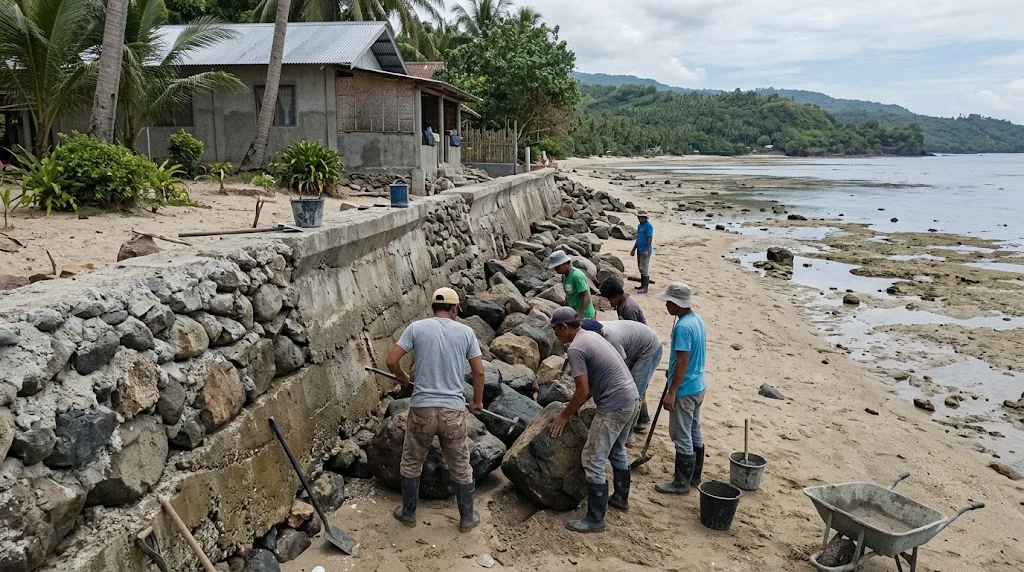
Boulders going in at the toe of a beachfront wall at low tide. The toe is the part the sea attacks first, and the part that never shows once it works. Illustrative photo.
Short answer: for a wall that stands 2 m above the beach with a 1 m deep toe, our planning math comes to roughly ₱14,100–₱27,200 per metre as a rock revetment, ₱15,700–₱22,000 as a reinforced concrete cantilever wall on a spread footing, ₱33,700–₱48,600 as a mass concrete gravity wall, and about ₱32,000–₱48,300 if the RC wall has to sit on piles. For a 30 m frontage that is ₱472,000–₱660,000 for the RC wall. Read those numbers carefully, though. They are quantities times the planning rates in AEDO's cost guides, with the concrete walls drawn to the proportions in our retaining wall guide. They are not a seawall design, because what decides a seawall is the wave, the tide, the scour at the toe and the ground under it, and none of those can be read from a lot title. Two things come before the budget: the Water Code easement strip, and, if you are building seaward of the shoreline, the foreshore lease.
The calculator gives you the quantities and cost range for your own height and length and draws the section from your inputs. Below it are the rules to clear first, what each type is good and bad at, what moves the price, and what the wall can do to the beach next door.
Pick the type, the length and the height. You get the concrete, rock, steel and pile quantities per metre, a low-to-high cost range from the planning rates in AEDO's cost guides, and a section drawing from your inputs. A planning range, not a quotation, and not a design: wave, tide and ground data are not in it.
Drawn from the type, height, toe depth and the geometry assumptions above. The numbered tags match the key below.
Concept only: design needs wave, tide and geotechnical data. Planning sketch, not for construction, and not to scale in the vertical direction relative to the sea level shown. The water line is a placeholder, not a design level. Section proportions, toe and base thicknesses, stone grading, reinforcement, drainage, return walls and the depth of the toe are per design.
A seawall is not just a construction item. It is a structure on, or right next to, public land, so three questions come first. We read the texts below this month; where we could not confirm something, we say so.
Article 51 of Presidential Decree No. 1067 (the Water Code, December 31, 1976) reads, in substance: the banks of rivers and streams and the shores of the seas and lakes, throughout their entire length and within a zone of three (3) meters in urban areas, twenty (20) meters in agricultural areas and forty (40) meters in forest areas, along their margins, are subject to the easement of public use in the interest of recreation, navigation, floatage, fishing and salvage. No person is allowed to stay in the zone longer than necessary for those purposes, or to build structures of any kind.
Three things follow, and they are worth reading slowly:
Land below the shoreline is a different matter. DENR Administrative Order No. 2004-24 (August 24, 2004), the revised rules on foreshore lands, defines foreshore land in Section 2 as "the part of the shore which is alternately covered and uncovered by the ebb and flow of the tide." Reading its sections:
What we did not find: a sentence in DAO 2004-24 that says a private seawall may, or may not, be built on foreshore. Rock placed seaward of the shoreline to hold a beach is exactly the case to ask the CENRO about in writing before any stone goes in, because "reclamation" is expressly outside the lease.
For the siting rules for the house itself, see our easement guide and the lot hazard check. If any of this is unclear, spending a few hundred pesos on a written query to the CENRO, the Building Official and the EMB office before paying a contractor is the best money in the whole project.
| Type | What it is | What to know | Planning cost at 2 m high, 1 m toe (calculator default) |
|---|---|---|---|
| Rubble-mound rock revetment | Sloping layers of stone: large armour stone on top, smaller stone beneath, over a geotextile on the graded bank, with extra stone at the toe. | FHWA's coastal revetment guidance (HEC-25, 2nd ed., Chapter 6) does not recommend slopes steeper than 1.5 horizontal to 1 vertical, bases its armour-size coefficient on a layer at least two stones thick, wants an underlayer no lighter than one-tenth of the armour stone weight, and a large volume of toe stone designed to fall into any scour hole. It takes a lot of stone and a lot of footprint. | ₱14,100–₱27,200 per m |
| RC cantilever wall | A reinforced concrete stem on a base slab, on the ground or on piles. | Uses the least concrete of the two vertical types, but it is a vertical face. A Woods Hole Sea Grant sheet says hard structures (it names seawalls, bulkheads and revetments together) reflect waves sharply, with more turbulence and suspended sediment. The toe depth and the base are where the design effort goes. | ₱15,700–₱22,000 per m on spread footing; ₱32,000–₱48,300 on piles |
| Mass concrete gravity wall | A thick tapered concrete block that stays up by its own weight. | Simple to detail, but it uses a lot of concrete (3.3 m³ per metre in the default case against 1.1 for the RC wall) and the same vertical-face behaviour. | ₱33,700–₱48,600 per m |
| Sheet piling | Steel or other sheets driven into the ground. | Dropped from the calculator: we found no Philippine rate for it we can cite. | not priced |
The rock revetment has the lowest low end in the table and by far the widest range (its midpoint is above the RC wall's), because stone prices, haul distance and the machine to place it swing so much. A vertical concrete wall tends to look cheaper per metre until you add the toe protection, the return walls, the drainage and the piles. A real quote should show each. Our retaining wall cost guide covers the same walls on land; a seawall is a retaining wall with the sea on one side, and that is the whole difficulty.
You can check every line by hand. For the default case (RC cantilever wall on a spread footing, 2 m crest height, 1 m toe depth, 30 m long), total height Ht = 2 + 1 = 3 m:
For the rock revetment, the slope length is H × √(1 + n²) (4.47 m for H = 2 m and n = 2). Armour is two stones thick (2 × 0.6 m), the underlayer is two stones of a size one-tenth the weight (a diameter of 0.11/3 = 0.46 times the armour stone, an AEDO reading of FHWA's one-tenth rule), and the toe is the toe width times the toe depth. That gives 12.0 m³ of stone per metre in the default case, counting the armour and underlayer over the crest width as well as the slope. The gravity wall is (B + top width) ÷ 2 × Ht. Piles are pile length ÷ spacing times the installed rate per metre of pile.
The calculator's numbers are the easy part. A seawall is designed from information the page cannot know:
NSCP 2015 gives no seawall table. A text search of the Chapters 1 to 5 scans turned up no seawall, revetment or breakwater provisions. What it does say is in Chapter 3, Section 305.1: the footing provisions of that section do not apply to building and foundation systems in areas subject to scour and water pressure by wind and wave action, and buildings and foundations subject to such loads shall be designed in accordance with an approved national standard. For a wall that is the sea's side of the story, the code hands the design back to the engineer.
The durability side is in NSCP Chapter 4. Table 419.3.1.1 puts concrete exposed to moisture and an external source of chlorides, including salt, brackish water, seawater or spray from these sources, in Exposure Class C2. Table 419.3.2.1 asks C2 concrete for a maximum water-cementitious ratio of 0.40 and a minimum 35 MPa, with a chloride limit of 0.15% by weight of cement for non-prestressed concrete. Section 420.6.1.4.1 says cover is to be increased as deemed necessary in corrosive environments. That is why the calculator's concrete price is the ready-mix guide's 5,000 PSI row (34.5 MPa, about ₱5,400 per m³), the nearest listed grade: ask the plant for a 35 MPa, 0.40 w/cm mix and expect to pay a little more. We read these clauses from the OCR text of the NSCP 2015 chapters; the cover table's numbers are not quoted because the scan text is not clean enough to be sure of them.
A seawall protects one lot. The beach does not stop at the lot line. A Woods Hole Sea Grant and Cape Cod Cooperative Extension sheet on armouring a sandy shoreline lists what a hard structure built in front of one house can do:
That is a US sheet about sandy shores, so it describes the mechanism, not a Philippine rule or measured result for your coast. On our side of the world, the practical consequences are a dispute with a neighbour and, where the Water Code applies, public-use questions. The FHWA revetment guidance (HEC-25, Chapter 6, Section 6.4) says flanks should be protected by tying the structure into an existing revetment or wall or by using a return wall, with the return wall longer than the expected long-term and storm-induced recession. Those flank walls cost money, and the calculator does not include them. Ask for them in the design.
If your wall faces a stretch of coast with a shared beach, such as a resort row, consider designing it together with the neighbours. Our beach cottage and small resort guide covers the siting side.
What AEDO does. We design, check and review structures nationwide and build only in Negros Oriental. A seawall should be designed on wave, water-level and soil data for the site. If you have a contractor's quote or a drawing, we review it against that data and against the unknowns in this article; if the wall is already built and cracked, tilting or undercut, the structural assessment is ₱5,000 flat for a site visit by our team and a written report within 5 business days, with testing quoted separately. Site visits cover Negros Oriental, Cebu, Luzon and NCR; elsewhere, send photos and plans for a remote review. Design and construction are quoted per project once the site data is in. We do not give legal opinions or process permits, foreshore leases or ECCs for you: those go through the CENRO, the EMB regional office and the Building Official.
The checklist we would work through before paying a contractor:
Law and rules, read this month: PD 1067 Articles 5, 51 and 52 (LawPhil, December 31, 1976; no amendment found); DENR Administrative Order 2004-24 (Supreme Court E-Library) and DAO 2006-01; PD 1096 Sections 103 and 301 and the Annex "A" definition of a structure. Engineering sources: NSCP 2015 Chapter 3 Section 305.1 and Chapter 4 Sections 419.3.1.1, 419.3.2.1 and 420.6.1.4.1, from the local scans; FHWA HEC-25 (2nd ed.) Chapter 6 as reproduced by Pile Buck Magazine (we read the reproduction, not the FHWA PDF); the Environment Agency toe structures guide; the Woods Hole Sea Grant sheet. Rates, all AEDO guides: rock ₱800–₱1,300/m³ (sand and gravel guide); placing ₱180–₱320/m³ (lot filling guide, a fill rate); 5,000 PSI concrete about ₱5,400/m³ (ready-mix guide); rebar ₱37–₱41/kg (rebar guide); pouring labour ₱1,500–₱2,500/m³ (labour rates guide); piles ₱3,400–₱4,700 per metre for 400 mm bored (pile guide); 20–40% difficult-site add-on and the wall proportions (retaining wall guide); 80–110 kg/m³ rebar (bill of materials guide). Borrowed from other work, so treat with care: the placing rate is for compacted lot fill, not armour stone; the 80–110 kg/m³ band is for house frames; the pouring rate is a residential pakyaw rate; the 0.55 × height base, H/12 stem and 0.35 gravity-wall top are the retaining wall guide's drawing proportions for walls holding earth, not waves; the 20–40% add-on is that guide's band for its excluded site items, used here for excavation, dewatering and beach access; and the 5,000 PSI row is the nearest listed grade to the NSCP's 35 MPa. AEDO assumptions with no source, edit them: stone size 0.6 m, toe width 1.5 m, crest width 1.5 m, toe depth 1 m, base thickness equal to the stem, pile spacing 2 m, pile length 8 m, two stones thick for the underlayer, the underlayer and geotextile continuing under the crest, stone ordered equal to stone placed (factor 1.0), geotextile not priced, formwork and bar fixing priced like the pour, 0.3 m working space on each side of the base for the excavation quantity, and the 30 m and 2 m scenario itself. The wave, tide and ground data that really size a wall are not in any of these. NSCP 2015 (7th edition) is the edition we checked.
How much does a seawall cost per metre in the Philippines?
There is no single price because the wall is sized by the site. As a planning figure, built from quantities and the planning rates in AEDO's cost guides, a wall that stands 2 metres above the beach with a 1 metre deep toe works out to about 14,100 to 27,200 pesos per metre as a rock revetment, about 15,700 to 22,000 pesos as a reinforced concrete cantilever wall on a spread footing, about 33,700 to 48,600 pesos as a mass concrete gravity wall, and about 32,000 to 48,300 pesos if the RC wall needs piles. These exclude the soil investigation, the wave and tide study, the design, permits and any foreshore lease, and they assume sibling-guide geometry that a real design would replace.
How far from the shoreline can I build in the Philippines?
Article 51 of the Water Code (Presidential Decree 1067) puts the shores of the seas under an easement of public use within a zone of 3 metres in urban areas, 20 metres in agricultural areas and 40 metres in forest areas, along their margins, and says no person may build structures of any kind in that zone. Which width applies to your lot depends on whether the area is urban, agricultural or forest, so get that confirmed in writing from the planning office or DENR before you budget a wall or a building.
Do I need a foreshore lease to build a seawall?
Foreshore land, which DENR Administrative Order 2004-24 defines as the part of the shore alternately covered and uncovered by the ebb and flow of the tide, is leased under that order for a 25-year term renewable for another 25 years at the lessor's option, and the lease gives no right to reclaim land within or next to the leased area. We did not find a rule in the text we read that specifically allows or forbids a private seawall on foreshore, so ask the DENR CENRO in writing before any stone is placed seaward of your title line.
Is a rock revetment or a concrete seawall cheaper?
On our planning rates a 2 metre high rock revetment comes out at about 14,100 to 27,200 pesos per metre against about 15,700 to 22,000 pesos for an RC cantilever wall, so the ranges overlap and the cheaper one depends on rock supply, access for equipment and foundation. The types also behave differently: a sloping rock face breaks and absorbs waves and its toe stone can settle into a scour hole, while a vertical wall reflects waves and its base can be undercut. Cost alone should not choose the type.
Will a seawall damage my neighbour's beach?
It can. A Woods Hole Sea Grant and Cape Cod Cooperative Extension sheet lists the effects of a hard structure built in front of one house as sand scoured away from the dry beach in front of the wall, longshore sand supply obstructed, intensified wave energy and erosion at the downdrift end of the structure, and the downdrift neighbour's beach deprived of sand. Federal Highway Administration guidance on coastal revetments says the flanks should be tied to an existing wall or revetment or closed with a return wall longer than the expected recession. A wall that protects only your lot should be designed with its ends in mind.
Does the NSCP have a seawall design table?
Not one we could find. A text search of the NSCP 2015 Chapters 1 to 5 scans found no seawall, revetment or breakwater provisions. Section 305.1 of Chapter 3 says its footing provisions do not apply to building and foundation systems in areas subject to scour and water pressure by wind and wave action, and that those must be designed in accordance with an approved national standard. Concrete in seawater or salt spray is Exposure Class C2 in NSCP Table 419.3.1.1, which asks for a water-cementitious ratio of at most 0.40 and at least 35 MPa under Table 419.3.2.1.
What does AEDO do about seawalls?
AEDO designs, checks and reviews structures nationwide and builds only in Negros Oriental. A seawall should be designed on wave, water-level and soil data for the site, so we review a design or a contractor's quote against that data and, for an existing wall that is cracked, tilting or undercut, the structural assessment is 5,000 pesos flat for a site visit and written report. Site visits cover Negros Oriental, Cebu, Luzon and NCR; elsewhere we review photos and plans remotely. Design and construction are quoted per project after the site data is in.
Codes, rules and pages read for this article. External links open in a new tab.
The unit rates are AEDO planning ranges borrowed from guides written for other work (house frames, fill, retaining walls on land), so a seawall quote can differ a great deal. We did not find a Building Official's ruling on private seawalls, could not confirm whether one needs an ECC, and could not open DAO 2016-07 to see whether it changed the foreshore rules; ask the offices named above. The FHWA and Woods Hole (U.S.) and Environment Agency (UK) sources describe mechanisms on U.S. and UK shores and are not Philippine measurements. This article is general information, not a coastal design, not legal advice and not a design for your wall.
Send the lot location, the shoreline length, low-tide photos and the quotation or drawing. We'll tell you what is missing and what to ask the DENR CENRO, the EMB office and the Building Official before you pay anyone.