The foundation is the one part of your building you can never see again once it's buried — and the one part that decides whether everything above it stands straight or slowly cracks apart. Get it right and you'll never think about it. Get it wrong and no amount of good work upstairs can save the building. This guide explains the foundation types used in the Philippines, how soil and load decide which one you need, and the single question that determines whether you can use a simple footing or you actually need piles.
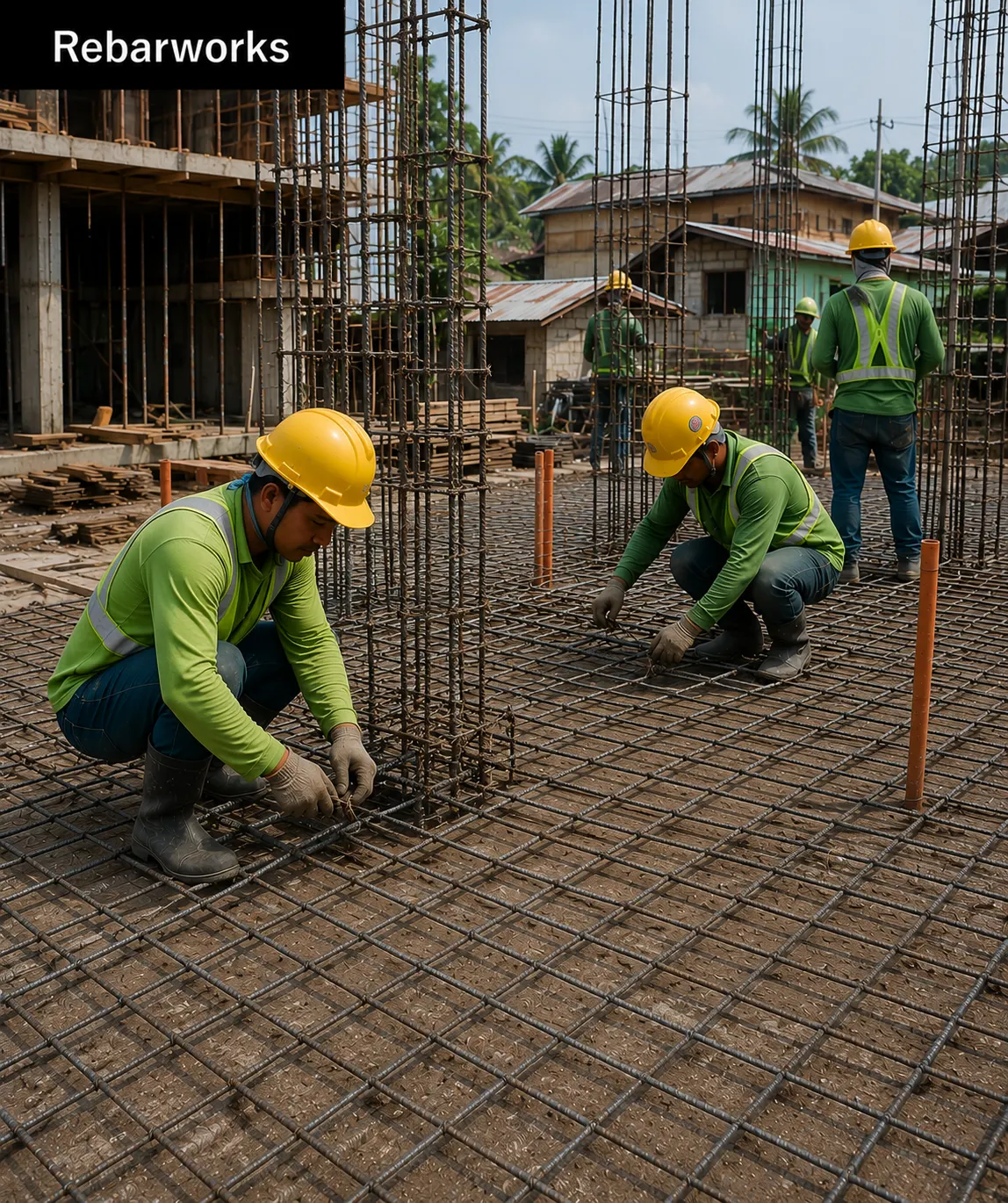
Footing reinforcement before the pour. The foundation is sized to the soil's bearing capacity and the load above — neither of which you can eyeball.
Every foundation decision comes down to a balance between the load coming down from the structure and the strength of the soil receiving it. A heavy building on strong soil and a light building on weak soil can need completely different foundations. That's why a foundation can't be copied from another project — and why the soil has to be investigated, not assumed.
Foundations split into two families: shallow (transfer load to soil near the surface) and deep (reach down to firmer soil below).
| Type | What it is | Typical use |
|---|---|---|
| Isolated / spread footing | A reinforced concrete pad under each column, tied together with foundation beams | The PH standard for low-rise houses on competent soil |
| Strip / wall footing | A continuous footing under a load-bearing wall | Perimeter and load-bearing CHB walls |
| Combined footing | One footing supporting two or more columns | Columns close together or near a property line |
| Mat / raft | One thick slab under the whole footprint, spreading load over a large area | Weaker soil, heavier loads, or closely spaced footings that would otherwise overlap |
When competent soil is too deep to reach economically with footings, the load is carried down to it by piles — either driven (precast, hammered in) or bored / cast-in-place (drilled and poured). Piles work by end-bearing (resting on a firm stratum) and/or friction (gripping the soil along their length). The diagram below shows the core decision a foundation engineer makes:
AEDO designs the right foundation from your actual soil data — spread footing, raft, or piles — sized to your loads and signed-and-sealed for your permit.
Get a Foundation Design →Piles cost more and take longer, so they're used when shallow foundations genuinely won't perform. The common triggers in the Philippines:
None of the above can be decided by looking at the ground. The engineer needs data — usually a soil boring test with the Standard Penetration Test (SPT), which reports the soil profile, water table, and the strength of each layer. That tells the engineer the safe soil bearing capacity and the depth at which firm soil is reached — the two numbers that decide your foundation. The same investigation gives the soil profile classification (SA–SF) that NSCP 2015 seismic design requires, and a soil report is commonly part of the building permit documents for many structures.
A soil boring test is a small fraction of a project's cost. Skipping it to "save money," then sizing footings for a bearing capacity the site doesn't have, is how buildings end up with differential settlement and cracking that costs many times more to chase — if it can be fixed at all. The foundation is the last place to value-engineer by guesswork.
Almost every foundation failure we're asked to assess traces back to soil that wasn't understood:
Foundations typically run a meaningful share of structural cost, and piles add to that — but the comparison that matters isn't footing vs. pile, it's the right foundation vs. a cracked building. The correct foundation for your soil is always cheaper than the repair for the wrong one.
Statutes, codes, official tools and references used or referred to in this article, linked to their source. Links open in a new tab.
Prices, cost bands and rate figures in this article are AEDO Construction's own market and practice figures for Philippine work unless a source is named beside them. Code and statute references above link to the primary text.
AEDO Construction provides geotechnical-aware foundation design — we work from your soil investigation (or arrange one), determine the safe bearing capacity, and design the right footing, raft, or pile system, signed and sealed and compliant with NSCP 2015. No guessing, no copied details.
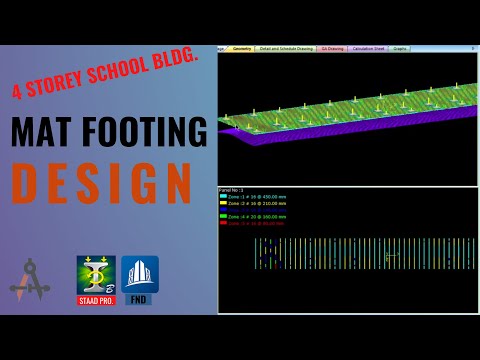
An engineer designs a mat foundation for a 4-storey school building in STAAD Foundation Advanced. From the AEDO YouTube channel, uploaded 2021-03-12.
For most low-rise houses on competent soil, the isolated (spread) footing — a reinforced concrete pad under each column, tied with foundation beams. Strip footings run under load-bearing walls. Where columns are close or soil is weaker, combined footings or a mat/raft are used. The right choice depends on soil bearing capacity and building load, which is why a soil investigation should come first.
When firm soil is too deep to reach economically with footings — soft or loose soil, reclaimed land, high-water-table or coastal sites, expansive or organic soils, and heavy or tall structures. Piles carry the load down through the weak upper soil to a firm bearing stratum, or develop capacity by friction. Liquefaction-prone sites in a seismic zone are a classic case.
NSCP 2015 Section 303.1 requires a foundation investigation at every building site, and an exhaustive geotechnical study for two storeys or more; for very small structures the engineer may use Table 304-1 presumptive values after inspecting the site (Section 304.2). A soil boring test with SPT gives the soil's bearing capacity, water table, and profile — the data that determines the safe foundation type and depth, and the soil classification NSCP 2015 seismic design needs. Designing a foundation without it is guessing.
Building on soft or uncompacted fill; footings sized for a bearing capacity the site doesn't have; differential settlement across different soils; foundations placed too shallow; and soil liquefaction under shallow foundations in earthquakes. Nearly all of it traces back to skipping the soil investigation.
Soil profile classification (SA–SF), seismic and load tables, and the full NSCP 2015 code — built by AEDO engineers for Philippine practice.
AEDO Construction designs geotechnical-aware foundations sized to your soil and loads — footing, raft, or piles — signed and sealed and NSCP 2015-compliant, ready for your building permit. We'll tell you what the ground can hold before a single footing is poured.