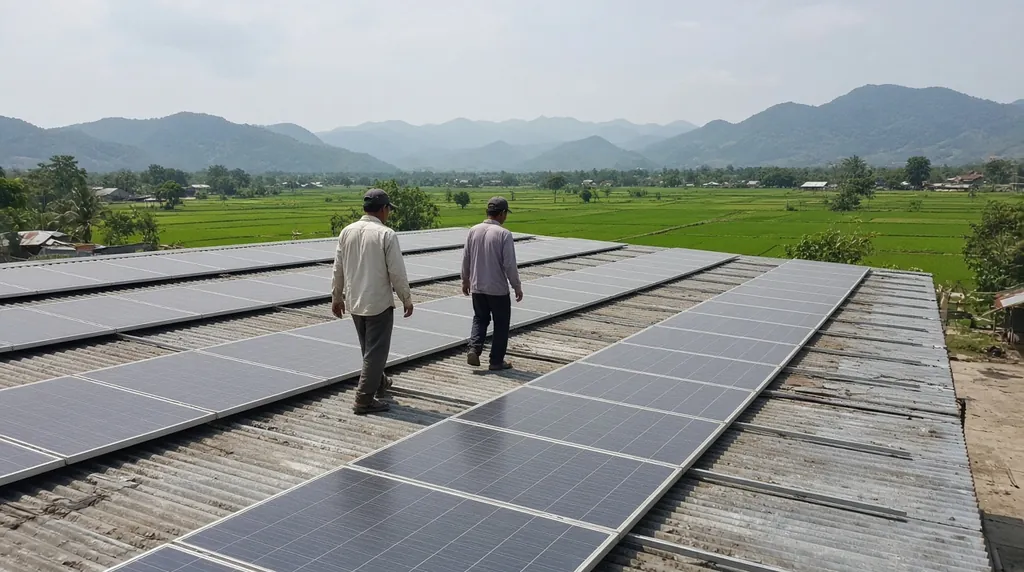
A mill runs its motors while the sun is up, so almost every kWh from this roof is used inside the building. That is the whole case for business solar. Illustrative photo.
Short answer: solar usually pays back faster for a business than for a home when the business uses its power while the sun is up, as a mill, office, school, clinic or warehouse does. A kWh used on site saves your full rate. A kWh exported under net metering earns only the utility's generation charge. The calculator's worked example, a rice mill or warehouse paying ₱150,000 a month, open six days a week with 75% of its use in daytime, comes out at a 73.8 kWp system (164 panels), about 86% of the output used on site, about ₱124,200 a month saved and a simple payback of about 2.5 to 3.5 years. Treat that as an example, not a forecast for your business: it borrows a Meralco household rate (₱14.7424/kWh) and our home-solar price range (₱50–70 per watt), because we have no sourced commercial figures. A business tariff is built differently. Larger accounts can pay a demand charge per kW on top of the per-kWh charges, solar cuts mainly the per-kWh part (section 5), and the energy rate you save can be lower than a household's overall rate, which stretches the payback. A commercial-size quote at a lower price per watt pulls it back. Put your own bill's energy rate and your installer's price in, and the result is yours. Two rules change the picture for bigger buildings. Net metering stops at 100 kW. Above that, or if you'd rather not export at all, the DOE's August 2026 circular on zero-export solar is the path, and for a business it still means a building permit (or the LGU's confirmation that the existing one is enough) and an ERC Certificate of Compliance.
Put your own bill, daytime share and roof in the calculator. It sizes the system to your daytime load and your roof, shows how much you'd use and export, gives the payback, and draws the array on the roof plane. Below it: why daytime load decides the payback, what the 2026 rules changed, demand charges, the old-roof problem, and what each type of business should watch.
Pick your type of business, enter your bill and your roof. The tool sizes the system to what you use in daytime and what fits on the roof, splits the output into used-on-site and exported, prices it and gives the simple payback. The 4.0 kWh/kWp/day yield, the 450 W panel and the ₱50–70/Wp range are the ones in our solar payback guide, which was written for homes. Planning numbers, not a quote.
One roof plane, eave at the bottom, ridge at the top, with the panel count from the calculator laid out in rows from the eave. The numbered tags match the key and the result rows.
Planning sketch only, not for construction. NTS. Edge setbacks, module gaps, walkways for cleaning and maintenance, rail spacing and attachment points are per design: they come from the racking datasheet and the NSCP Section 207D uplift check for your roof, not from this calculator. A real layout also avoids skylights, vents and shaded strips.
A solar kWh is worth one of two prices, and which one depends on when you use power, not on the panels.
A household is often empty at noon and busiest after sunset, so a good part of its solar goes out at the lower credit. A rice mill, an office, a school or a clinic does its work in the sunny hours, so most of the output is used inside. Same panels, same roof, higher value per kWh. That's the gap the figure below shows.
Two things the figure doesn't show, both of which the calculator does:
Three things in 2026 put solar on business owners' desks, and only one of them is about price.
The brownout catch. A grid-tied system without a battery does nothing during a brownout. The ERC net-metering interconnection standards say the system "should automatically disconnect" when there is no power from the utility, as our net metering guide quotes. If interruptions cost you more than the bill does, that's a hybrid battery or a standby generator question: see the hybrid vs grid-tie guide and the standby generator sizing guide.
For most small businesses this is the simple route. Section 10 of RA 9513, the Renewable Energy Act of 2008, has distribution utilities "enter into net-metering agreements with qualified end-users who will be installing RE system," subject to technical considerations and on request. The program covers systems of up to 100 kW: the DOE's April 2026 release says it "allows qualified consumers with renewable energy systems of up to 100 kilowatts (kW) to export excess electricity to the grid," and Section 4(j) of RA 9513 defines distributed generation as small generation entities "any one of which shall not exceed one hundred kilowatts (100 kW) in capacity." Ask your utility whether it reads that limit off the panels' kWp or the inverter's kW rating; the texts we read don't say.
The steps, documents and 2026 deadlines (the LGU's electrical permit, the final electrical inspection, the utility's evaluation and inspection, the Net-Metering Agreement and the meter) are in our net metering application guide. What matters for a business is the price of the surplus: the generation charge, not your full rate. Size for daytime use and treat the export credit as a bonus.
A cold-storage plant, a big mill or a mall roof can easily want more than 100 kW. Net metering doesn't cover that. The own-use route is a zero-export system, which the DOE dealt with in Department Circular No. DC2026-08-0017, "Policy Guidelines for Self-Generating Facility Zero-Export Solar Systems and Micro-Solar Systems for Own-Use," announced in the DOE's 20 August 2026 release. We read the circular's text. What it does:
What it does not do, and where some news summaries went too far:
The circular's other category, the Micro-Solar System, is a plug-in kit of at most 1 kW of panels and an 800 W micro-inverter (Section 3.2). Useful for a sari-sari store, irrelevant for a mill. If you want to sell or export power above 100 kW, that's a different regulatory path from either of these; ask your utility and the ERC, because we don't cover it here.
Bigger commercial and industrial accounts are often billed partly on demand: a charge on the highest kW drawn in the month, on top of the per-kWh charges. We haven't read a Philippine tariff schedule for this article, so check your own bill's line items for a demand or kW charge and ask your utility how it measures it. The engineering point holds either way:
The default case's 73.8 kWp is about 360 m² of panels (164 × 2.1 × 1.05 m). On a new pre-engineered building that's routine. On a 25-year-old mill roof with rusted purlins, it's the part of the project that decides whether the panels are still there after the next typhoon.
The calculator's drawing leaves the edge setbacks and walkways "per design" for this reason: they come out of the uplift check and the racking datasheet, and big arrays also need access lanes for cleaning and for fixing the roof under them.
The presets in the calculator are AEDO starting points, not measurements. Your bills and, ideally, a week of logged load beat any of them.
| Business | Calculator preset (daytime share, days) | What to watch |
|---|---|---|
| Rice mill, grain warehouse, workshop | 75%, 6 days | Big motors in daytime: good match. Harvest-season peaks and idle months change the yearly total; size on a full year of bills. Dryers and dust on the panels. See our rice mill and grain warehouse guide. |
| Office | 70%, 5 days | Aircon follows the sun. Weekends are pure surplus unless servers and fridges run. |
| School | 75%, 5 days | Long breaks in April to May and at Christmas. Under zero-export, that output is lost; under net metering it earns the lower credit. |
| Clinic | 65%, 6 days | Exempt from the ERC COC for zero-export under DC2026-08-0017 (Section 4.2). Critical loads need backup, not just solar. |
| Resort or small hotel | 35%, 7 days | Room aircon runs at night, so a large share of the load is after sunset. Daytime loads (kitchen, laundry, pumps, pool) are where solar fits. See our small hotel and inn cost guide. |
| Cold storage, ice plant | 33%, 7 days | A flat 24-hour load: 8 of 24 hours is 33% of the kWh. Solar covers the daytime third; the compressors work hardest in the hot afternoon, which helps. Often above 100 kW, so zero-export. See our warehouse and cold storage design brief. |
| Gas station, 24-hour store | 40%, 7 days | Canopy and store roofs are small, so the roof limit often governs. Fuel-area electrical rules apply to anything near the pumps; ask your PEE. |
Comparing installers? Our solar quote comparison checklist shows how to put two or three quotes side by side on price per kWp, the roof check and the permit lines.
Negros Oriental: AEDO supplies and installs solar, the same rule as our construction work: bill review, site survey, the roof structural check, system design with electrical plans signed and sealed by the professional electrical engineer on our team, permits, installation, commissioning and the NORECO II or NORECO I paperwork. There's no price list; we quote after the bill review and the survey. See solar installation in Dumaguete and Negros Oriental.
Everywhere else in the Philippines: we don't install. Our team sizes the system against your daytime load, checks the roof structure for the panel load and NSCP 207D uplift, reviews your electrical service, and reviews an installer's quote and layout before you sign; a local installer does the work. For an existing roof you're unsure about, the structural assessment is ₱5,000 flat for a site visit by a licensed engineer and a written report in 5 business days, with site visits in Negros Oriental, Cebu, Luzon and NCR. We don't process ERC COCs or give legal opinions.
Rules, read this week: DOE Department Circular No. DC2026-08-0017, Sections 2, 3, 4.2, 4.3, 5.1, 5.3, 6.1, 6.2, 7 and 13 (full text from the DOE's PDF); ERC Resolution No. 09, Series of 2013, Annex A Section 12 and Annex A-1 Section 8.3 (from the scan); RA 9513 Sections 4(j) and 10 and RA 7920 Section 31 (LawPhil); the DOE releases of 1 April and 20 August 2026. News, dated: Visayas grid alerts and capacity from the Daily Tribune, 3 September 2026. From our own guides: the 4.0 kWh/kWp/day yield, the 30-day month, the 450 W panel, the ₱50–70/Wp installed range and the ₱14.7424/kWh default rate (Meralco, September 2026) from the solar payback guide; the ₱9.7032/kWh export credit, an estimate of Meralco's September 2026 generation charge, from the net metering guide; the 2.1 × 1.05 m panel from the Dumaguete solar guide; NSCP 207D, GCr 1.5 and 0.15–0.25 kPa from the rooftop mounting guide. AEDO assumptions with no source, edit them: the daytime shares and operating days in the business presets (except the 33% for a flat 24-hour load, which is 8 of 24 hours), the 0% closed-day load, the ₱150,000 bill and the 40 × 12 m roof in the default case, and the 0 m setback. Borrowed, so treat with care: the ₱50–70/Wp range and the ₱14.7424 rate are for homes, and the export credit is an estimate from Meralco's household figures; a business tariff and a commercial-size quote will differ, which is why the worked example's 2.5 to 3.5-year payback is an illustration, not a benchmark for businesses.
Is solar worth it for a business in the Philippines?
For a business that uses most of its power while the sun is up, it usually pays back faster than home solar, but the number of years depends on your own tariff and quote. AEDO's calculator example, a rice mill or warehouse paying 150,000 pesos a month, open six days a week with 75% of its use in daytime, gets a 73.8 kWp system of 164 panels, uses about 86% of the output on site and saves about 124,200 pesos a month with net metering, for a simple payback of about 2.5 to 3.5 years. That example borrows Meralco's September 2026 household rate of 14.7424 pesos per kWh and AEDO's home-solar range of 50 to 70 pesos per watt. A business tariff, especially one with a demand charge, has its own energy rate, and a commercial-size quote has its own price per watt, so replace both with your bill and your quotes before relying on the payback.
Why does commercial solar pay back faster than home solar?
Because a business with daytime load uses its solar power as it is produced. A kWh used on site saves the full rate you pay per kWh. A kWh exported under net metering is credited at the utility's generation charge, which ERC Resolution No. 09, Series of 2013 Section 12 sets as the preliminary reference price, and that is only part of the full rate. A household that is empty at noon exports much of its output at the lower credit; an office, school, rice mill or clinic running in daytime exports little.
Can a business get net metering for a system above 100 kW?
No. The net-metering program covers renewable energy systems of up to 100 kW, which the DOE repeated in its April 1, 2026 release, and RA 9513 defines distributed generation as units not exceeding 100 kW. Above that, the common route for own use is a zero-export system that never exports to the grid, covered by DOE Department Circular No. DC2026-08-0017. Selling or exporting power above 100 kW is a different regulatory path; ask your utility and the ERC.
What does a zero-export solar system need under the DOE's 2026 circular?
DOE Department Circular No. DC2026-08-0017 covers zero-export own-use solar of any capacity. A grid-connected system needs a written notification to the utility using the circular's Annex A form, a building permit from the LGU unless the LGU verifies that the existing permit is enough, and a Certificate of Compliance from the ERC, except for households, clinics, hospitals and other medical facilities. The utility may not impose pre-installation clearances, technical permits or inspection fees. Any power that leaks to the grid earns no credit. The circular also requires compliance with the Philippine Electrical Code, so the electrical plans are still sealed by a professional electrical engineer.
Does solar reduce the demand charge on a commercial electric bill?
Not reliably. Where a tariff has a demand charge, part of the bill follows the highest power drawn in the month, and that peak can fall in a cloudy hour, early morning or after sunset, when the panels give little or nothing. Solar mainly cuts the energy part of the bill. If your bill has a demand charge, enter only the energy-related pesos per kWh and your bill's kWh in the calculator for a conservative result, and ask your utility how the demand charge is measured.
Can my old warehouse roof carry solar panels?
Often yes, but it has to be checked, and the check is mostly about wind uplift, not weight. NSCP 2015 has no solar clause, so a rooftop array is designed as rooftop equipment under Section 207D, where the vertical uplift coefficient starts at 1.5 for buildings with a mean roof height of 18 metres or less. On an old roof the weak links are usually rusted purlins, the fasteners into them and the purlin-to-truss connections. Those are fixed before the rails go on.
Does commercial solar work during brownouts?
A standard grid-tied system does not. The ERC net-metering interconnection standards say the system should automatically disconnect when the utility has no power, so a net-metered system goes dark in a brownout. Keeping a mill, cold room or clinic running needs a hybrid inverter with a battery, or a standby generator for the critical loads. Those are separate decisions with their own cost.
Does AEDO install commercial solar?
In Negros Oriental, yes: AEDO supplies and installs solar there and quotes after a bill review and a site survey, with no published price list. Everywhere else in the Philippines AEDO sizes and designs the system, checks the roof structure for the panel load and wind uplift, reviews the electrical service, and reviews an installer's quote, while a local installer does the work. Electrical plans are signed and sealed by the professional electrical engineer on AEDO's team, as RA 7920 requires.
Rules, releases and reports read for this article in October 2026. External links open in a new tab.
We did not read a Philippine commercial tariff schedule, so demand charges are described in general terms. We found no ERC implementing rules for DC2026-08-0017 as of 3 October 2026. The DOE's circular page lists publication in the Daily Tribune and BusinessWorld but gives no fixed date, so we date the circular by its number and the DOE's 20 August release. We did not read the Philippine Electrical Code's solar article, so it isn't cited by number. The per-watt range and default rate come from residential sources and are placeholders for a business. This article is general information, not a design, a quotation or legal advice.
Send 12 months of bills, roof photos and any quote you have. Our team will check the size against your daytime use, the roof against typhoon uplift, and the permit path you're on.