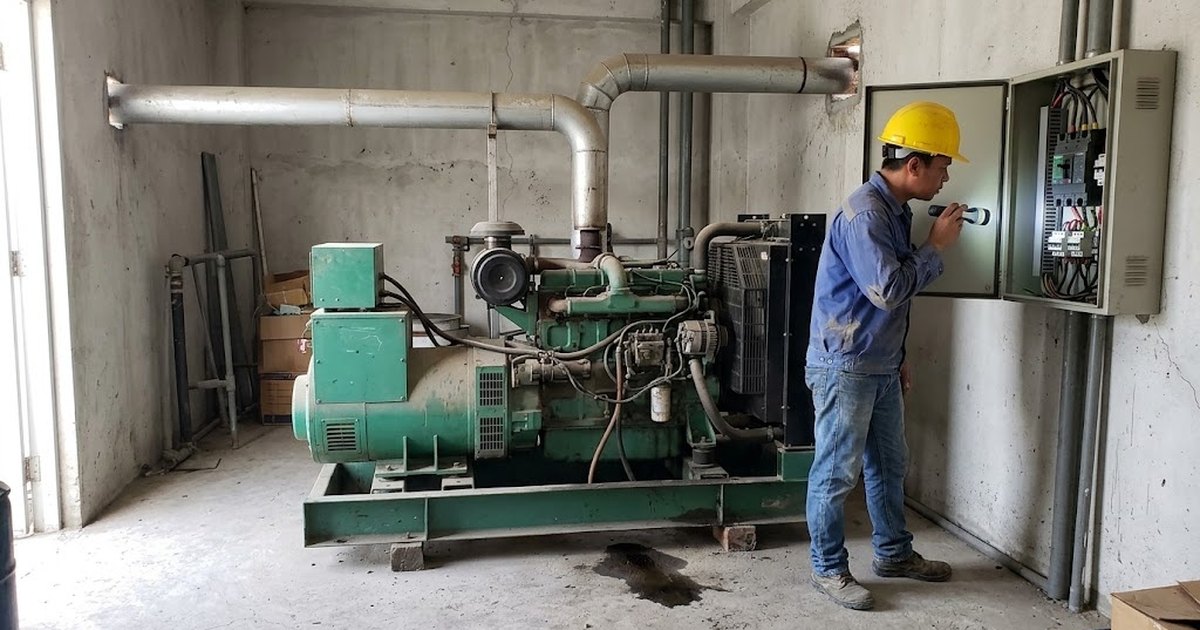
A commercial standby generator is sized from the critical loads it has to carry. Illustrative photo.
Short answer: a standby generator is sized to your critical loads, not your whole building — fire pumps, emergency lighting, exit signs, the fire alarm, and whatever business-critical equipment you choose to keep running, plus a margin for motor starting surge. For permit purposes, a generator sits in the same IRR fee bracket as transformers and UPS units, and before it operates it needs a Fire Safety Clearance from your local Fire Marshal. Get those three things right and the rest of the sizing is arithmetic.
The mistake owners make most often is asking "what generator do I need to run the whole building" instead of "what do I actually need to keep on when the grid drops." The first question buys a much bigger, much more expensive machine than the situation calls for. The second one is what a proper load study actually answers.
Adds up your critical loads, converts to kVA, applies a starting-surge margin, recommends a generator size, then runs it through the IRR Sec. 4(b) transformer/UPS/generator fee schedule.
A standby generator's job is narrow: keep life-safety systems running and, if the owner chooses, keep specific business-critical equipment alive until the grid comes back or a permanent supply is restored. That means the sizing exercise starts by listing only:
Everything else on the building's normal service — general lighting, most receptacles, air conditioning outside a server room, non-essential equipment — stays off the generator. That's the whole reason a critical panel and an automatic transfer switch exist: they carve the small slice of the building that matters in an outage away from the much larger slice that can wait.
Adding up critical running loads is the easy part. Motors are the complication: a fire pump or an elevator motor can draw several times its running current for the first second or two of startup, and the generator has to survive that spike without stalling or tripping. Common industry practice is to size the generator 20 to 25 percent above the calculated critical running load specifically to cover starting surge — but that's a planning range, not a fixed rule. The actual number depends on exactly what's on the critical panel, how many motors start together, and their individual locked-rotor characteristics. Confirm it with an electrical engineer's load study before you commit to a size.
Standby generator sizing is a completely different exercise from sizing your main electrical service. Total service sizing works from the building's entire connected load — every load on every panel — to size the main breaker, transformer and utility connection. Standby sizing works from a small, deliberately chosen subset of that load. If you haven't sized your total service yet, our electrical service sizing guide covers that separate calculation and its own IRR fee schedule.
Owners sometimes assume a generator gets its own, separate permit fee line. It doesn't. The IRR of the National Building Code of the Philippines (PD 1096), Sec. 4(b), assesses transformers, UPS units and generators together under one Total Transformer/UPS/Generator Capacity schedule — the IRR text is explicit that this total "shall include all" owner-installed transformers, UPS and gensets shown on the electrical plans. Your generator's kVA rating simply adds to whatever transformer or UPS capacity is already on the project, and the combined figure is priced against this table:
| Total transformer / UPS / generator capacity | Fee |
|---|---|
| 5 kVA or less | ₱40.00 |
| Over 5 kVA to 50 kVA | ₱40.00 + ₱4.00/kVA |
| Over 50 kVA to 300 kVA | ₱220.00 + ₱2.00/kVA |
| Over 300 kVA to 1,500 kVA | ₱720.00 + ₱1.00/kVA |
| Over 1,500 kVA to 6,000 kVA | ₱1,920.00 + ₱0.50/kVA |
| Over 6,000 kVA | ₱4,170.00 + ₱0.25/kVA |
Where the generator goes is its own set of decisions, and most of them are safety, not aesthetics:
The requirement that ties all of this together: under the Fire Code of the Philippines (RA 9514), a generator installation needs a Fire Safety Clearance from the local Fire Marshal's office before it operates. Specific clearance distances and allowable tank sizes are enforced locally and vary by fuel type and quantity — confirm them directly with the Fire Marshal for your site rather than assuming a generic table found online.
AEDO's role outside Negros Oriental. Nationwide, AEDO designs the electrical system, the generator room or enclosure, and specifies the equipment — signed and sealed drawings, coordinated with the fire protection design. A locally hired contractor does the physical installation under our remote oversight. In Negros Oriental, we design and build the installation ourselves.
How do you size a standby generator for a commercial building?
Start from the critical loads only, not the building's total connected load: life-safety loads like fire pumps, emergency lighting, exit signs and the fire alarm, plus whatever business-critical loads the owner wants kept running, such as a server room, refrigeration or select elevators. Add a margin for motor starting surge, since a fire pump or elevator can draw several times its running current on startup. The exact margin depends on what's on the panel and should be confirmed by an electrical engineer's load study, not by a rule of thumb alone.
Is a generator taxed the same as a transformer for building permit fees?
Yes. The IRR of the National Building Code (PD 1096), Sec. 4(b), assesses generators under the same fee bracket as transformers and UPS units — the schedule explicitly includes all owner-installed transformers, UPS and gensets shown on the electrical plans. A generator isn't a separate fee line item; it falls into the same Total Transformer/UPS/Generator Capacity table by its kVA rating.
Do I need a Fire Marshal clearance for a generator installation?
Yes. Under the Fire Code of the Philippines (RA 9514), generator fuel storage and installation require a Fire Safety Clearance from the local Fire Marshal's office before the unit operates. Specific clearance distances and allowable tank sizes are enforced locally and vary by fuel type and quantity, so confirm them with the Fire Marshal rather than assuming a generic online figure.
Does the generator need to power the whole building?
No. Standby generators are normally sized to critical and life-safety loads only, fed through a dedicated critical panel and an automatic transfer switch, not the full building's connected load. Sizing a generator to the whole building is usually far more machine, fuel and cost than the situation needs.
Statutes and codes referred to in this article, linked to their source.
Sizing methodology and margins in this article are general, honest engineering practice, not a quoted code table — every project still needs an electrical engineer's load study. Fee figures are quoted from the IRR text.
A critical-load list, a starting-surge check and a siting plan that clears the Fire Marshal — before you buy anything.