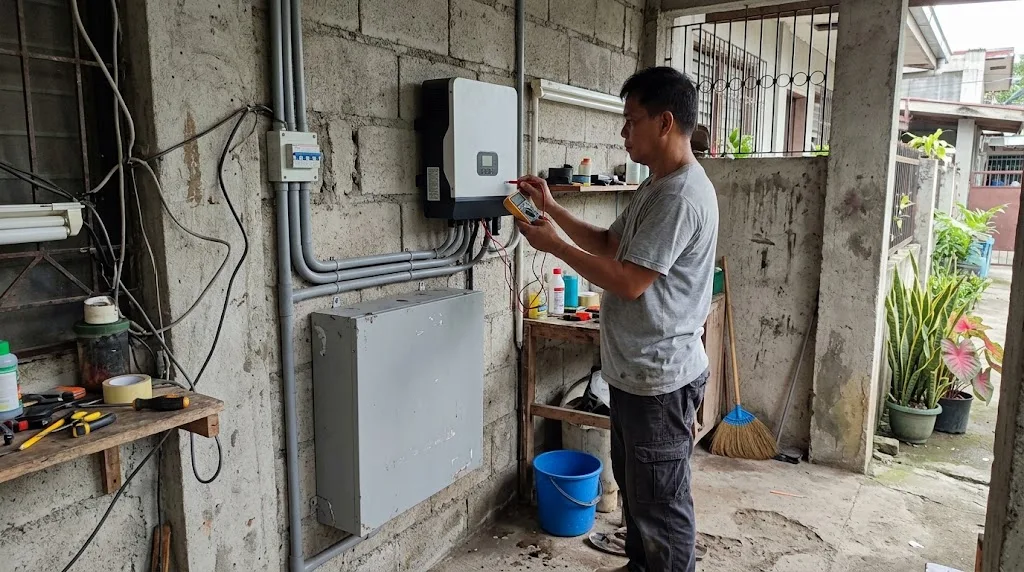
The inverter and battery on the wall decide what stays on in a brownout. The panels on the roof decide how fast the battery refills. Illustrative photo.
Short answer: if brownouts are rare where you live, a grid-tie system is the cheapest way to cut your bill, but it will not run your house in a brownout. The ERC's net-metering interconnection standards require a grid-connected system to detect an "island" and disconnect within two seconds, and to shut off whenever the utility's power is gone, so a lineman isn't hurt by your panels. If brownouts are a monthly or weekly thing, you want a hybrid: the same panels plus a battery and an inverter that can separate your backup circuits from the grid. Off-grid is for farms, islands and sites with no connection at all. For a typical brownout load (a refrigerator, lights, fans, TV and router for 4 hours, plus a half-horsepower pump for 30 minutes) the sizer below gives 2.4 kWh of backup energy, about 3.5 kWh of rated battery and an inverter of at least 1.2 kW continuous.
Put your own loads in the sizer. Below it: what each system does when the grid is up and when it's down, what a battery actually buys you, when a generator is the better answer, and who signs the plans.
Tell it how often the power goes out, then list what you want running and for how long. You get the backup energy, the battery you'd have to buy (rated kWh, not the brochure's best case), the inverter's continuous and surge duty, and the system type that fits, with the reasons. Wattages default to the figures in our generator sizing guide; your appliance nameplates beat them.
All three use the same panels. What changes is the inverter, whether there's a battery, and whether you're connected to the utility.
| Grid-tie | Hybrid | Off-grid | |
|---|---|---|---|
| Battery | None | Yes, sized for your backup loads | Yes, sized for every day plus reserve |
| Utility connection | Yes | Yes | None |
| Works in a brownout? | No. Shuts off within 2 seconds (ERC interconnection standards §7.2) | Yes, on the backup circuits, until the battery runs down | There's no grid to lose; runs until the battery runs down |
| Net metering possible? | Yes, up to 100 kW | Yes, up to 100 kW ("with or without battery energy storage", DOE) | No. The ERC rules apply to on-grid systems only (Sec. 3) |
| Upfront cost | Lowest | Grid-tie plus battery and a hybrid inverter | Highest per kWh used: bigger battery, bigger array, often a generator too |
| Fits | Stable grid, daytime use, bill-cutting | Frequent brownouts, work-from-home, a pump or fridge you can't lose | Farms, resorts on islands, sites with no line nearby |
For the cost of the panel side, our solar payback calculator uses a market range of ₱50 to ₱70 per watt-peak installed, for a grid-tied system without a battery. That's the base. A hybrid adds the battery and the hybrid inverter on top, and nobody should quote you a battery "per system" without saying its usable kWh.
If the power goes out at noon and the panels do nothing, that isn't a fault. It's the rule.
Net metering in the Philippines rests on Section 10 of RA 9513, the Renewable Energy Act of 2008, which directs distribution utilities to enter into net-metering agreements with qualified end-users. The ERC set the rules in Resolution No. 09, Series of 2013, and its annexed Net-Metering Interconnection Standards spell out what your system must do when the grid fails:
The reason is the same one our generator guide gives for transfer switches: a lineman working on a line he believes is de-energized can be hurt by power fed back into it from a house. A grid-tie inverter has no battery and no way to separate your house from the street, so its only safe move is to stop. A hybrid inverter is built to open its connection to the grid and keep running a separate backup circuit from the battery and panels. That's the whole difference, and it's why "can my grid-tie run in a brownout?" is answered with "not without changing the inverter and adding a battery."
Quotes are from the 2013 standards as published with Resolution No. 09. The DOE says the rules were amended by Resolution No. 06, Series of 2019, and news reports describe further amendments in ERC Resolution No. 15, Series of 2025. We couldn't read either amending text, so check with your utility whether any clause above has changed.
Where the grid is steady, a grid-tie system makes sense on its own. Where brownouts are frequent, the question isn't "solar or not" but "what do I need running when the line is dead?" Your utility's own notices are the best record of how often that is. NORECO II, the cooperative that serves Dumaguete, keeps separate pages on its website for power outages and unplanned outages. Scheduled interruptions can be planned around. The unplanned ones, and the long outages after a typhoon, are what a battery is really for.
Size for the outage you usually get, not the worst one. A battery big enough to ride out a week without power after a typhoon is a very large battery, and you'd pay for it every day to use it once or twice a year. A setup that makes sense for many homes: a battery for your usual brownout, and a generator (or patience) for the rare multi-day one. Our typhoon-readiness guide covers the rest of the house.
Three questions to answer before you talk to an installer:
A battery brochure gives you one number, usually the rated (nominal) capacity in kWh. What your house can use is less, for two reasons:
So the sums are:
| Step | Formula | Default case |
|---|---|---|
| Backup energy | Σ (watts × hours) | 250 × 4 + 300 × 4 + 400 × 0.5 = 2,400 Wh |
| Usable battery needed | backup ÷ efficiency | 2.4 ÷ 0.85 = 2.82 kWh |
| Rated battery to buy | usable ÷ DoD | 2.82 ÷ 0.80 = 3.53 kWh (3.5 rounded) |
| To still have it in year 10 | rated ÷ (1 − fade) | 3.53 ÷ 0.80 to 3.53 ÷ 0.65 = 4.4 to 5.4 kWh |
The last row comes from the same NREL study, which projected that "battery capacity may degrade by 20%-35% over 10 years at current rates" on the systems it tested. Your battery's warranty sheet will say what capacity it guarantees after how many years or cycles; read it before you decide whether to buy the extra now.
Backup hours work the other way: usable kWh × efficiency ÷ load in kW. A battery rated 5 kWh at 80% DoD gives 4 kWh usable; at 85% efficiency that's 3.4 kWh delivered, or about 5.7 hours of a 600 W fridge-lights-fans load. Put a 1 HP aircon (about 1,000 W) on the same battery and the total load is 1,600 W: about 2.1 hours. That's why aircon is the load that decides whether a battery is sensible or absurd.
The battery sets how long. The inverter sets how much at once. Two numbers matter, the same two our generator guide uses:
Inverters that can't ride a pump or aircon start will trip and drop the whole backup circuit. The fix is either a bigger inverter or taking that motor off the backup circuit. That choice is made when the backup panel is wired, which is why the backup circuit list belongs in the design, not on the installer's van on install day. The inverter also has to fit your service: our electrical service sizing guide explains how the main breaker and service are sized, and an old panel may need work first (see our rewiring guide).
A hybrid system doesn't give up net metering. The DOE's own primer on the program describes it as open to a renewable energy facility "not exceeding 100 kilowatts (kW) in capacity," installed on a distribution utility customer's premises, "with or without battery energy storage." Under Section 5 of the ERC rules, any end-user "in good credit standing in the payment of their electric bills" to the utility qualifies.
What the export is worth is easy to miss. Section 12 of the ERC rules sets the preliminary price for exported energy at the utility's monthly generation charge, based on its blended generation cost, and the DOE primer says the same: a peso credit "equivalent to the DU's blended generation cost, excluding other generation adjustments." That's only the generation part of your bill. When you use your own solar power instead of importing, you avoid the whole retail rate. So a kWh used at home is worth more than a kWh exported, and a battery that shifts noon solar to the evening is one way to use more of it yourself.
Under Section 15 of the 2013 rules, a negative balance (you exported more than you imported, in pesos) is credited to the next billing period. The ERC's 2025 amendments (Resolution No. 15, Series of 2025, as reported) allow credits to be banked and rolled over across current and future billing periods, and transferred to a new owner if the property is sold. The step-by-step application, the documents and the meter change are in our net-metering application guide.
One more point: net metering applies only to on-grid systems (Section 3 of the ERC rules). Off-grid has nothing to meter.
Off-grid is the right answer when there's no line to connect to, or when the connection would cost more than the system: a farm lot far from the nearest pole, a beach resort on a small island, a pumping station. It's the wrong answer for a house that already has a meter, because you'd be paying for a battery big enough to carry every night and every rainy week, instead of one sized for brownouts.
Sizing off-grid is harder because the sun has to refill the battery every day:
If you're building from scratch in the province, it can be worth pricing the utility connection first. A line extension quote and an off-grid quote side by side settle it faster than any calculator.
For backup alone, the generator's price is the easier one to pin down. Our generator guide puts 2,000 to 5,000 W units at roughly ₱30,000 to ₱70,000 and larger 5,000 to 10,000 W units at ₱70,000 to ₱150,000, as AEDO's market observation. We don't publish a battery price, so compare against a real quote, per usable kWh. The sizer shows the generator the same loads would need.
| Hybrid battery | Generator | |
|---|---|---|
| Switch-over | Automatic, by the inverter | Manual, or an automatic transfer switch at extra cost |
| Runs for | Until the battery is flat, refilled by the sun | As long as there's fuel |
| Noise, fumes | None | Yes; never run it indoors (see the generator guide's safety section) |
| Everyday value | Stores noon solar for the evening | None, it sits idle |
| Long outage after a typhoon | Weak: small battery, cloudy days | Strong, if you can buy fuel |
One sensible setup is both: a modest battery for the everyday brownout and a small generator for the week after a typhoon. For shops and clinics with bigger loads, see our commercial standby generator guide.
A solar system connected to your house wiring is electrical work, and the rules on who designs it are clear. RA 7920, the New Electrical Engineering Law, gives the Professional Electrical Engineer "the sole authority to seal electrical plans" (Section 31), and Section 34 requires that plans and specifications be "prepared by or under the responsible charge of, and signed and sealed by a professional electrical engineer," with the work done "in accordance with the Philippine Electrical Code." Our guide on who can sign building plans covers the other disciplines.
If you want net metering, the utility will ask for the same thing. NORECO II's net-metering page, for example, lists a "Duly approved Electrical Plan signed and sealed by a Professional Electrical Engineer," a Certificate of Final Electrical Inspection and Completion, and the product specifications of the inverter and panels among its requirements.
Then there's the roof. Panels on a roof in a typhoon zone are a wind-uplift problem more than a weight problem; our rooftop solar structural guide works through the NSCP 2015 Section 207D forces. A battery and inverter on a wall also need a sensible location: ventilated, out of the sun and the rain, and reachable. Before you compare installers, run their quotes through our solar quote comparison checklist.
What AEDO does. In Negros Oriental, AEDO supplies and installs solar PV: grid-tie, hybrid and off-grid, starting from a bill review and a site survey, with the roof structural check, the system design and electrical plans, the permit, the install, commissioning and help with the net-metering application. See our Dumaguete and Negros Oriental installation guide. Everywhere else in the Philippines, we do the engineering side: system sizing and design, the roof structural check, a review of your electrical service and panel, and an independent review of an installer's quote. We don't publish a solar price. The sizer shows market ranges; the real figure comes after the survey.
The islanding, reclosing, disconnect and on-grid rules are from ERC Resolution No. 09, Series of 2013 and its Net-Metering Interconnection Standards (Annex A-1), read from the published scan; the 100 kW limit, eligibility, "with or without battery" and blended-generation-cost credit from the DOE's net-metering primer (September 2022) and Sections 5 and 12 of the ERC rules; the 2025 amendments from news reporting. Plan sealing is from RA 7920 Sections 31 and 34. The 85% efficiency and 20-35% fade are from an NREL field study. Appliance watts, the 3 × motor surge, the 1.25 margin and the generator price bands are from AEDO's generator guide; the 4.0 kWh/kWp/day yield and ₱50-70/Wp range from our payback guide. The 80% depth of discharge is a placeholder you should replace with your battery's datasheet value.
Does grid-tie solar work during a brownout?
No. A grid-tie system without a battery shuts off when the grid goes down, even at noon in full sun. The ERC net-metering interconnection standards require the system to detect islanding and disconnect from the distribution system within two seconds, and to disconnect automatically when there is no power from the utility. That protects linemen working on a line they think is dead. To keep lights on in a brownout you need a hybrid system with a battery, an off-grid system, or a generator with a proper transfer switch.
What is the difference between hybrid and off-grid solar?
A hybrid system stays connected to the utility and adds a battery. On a normal day it runs your house, charges the battery and can export surplus under net metering. In a brownout it separates from the grid and runs your backup circuits from the panels and battery. An off-grid system has no utility connection at all, so the panels and battery must cover every day, including cloudy weeks, and many off-grid sites keep a generator for that. Off-grid is for farms, islands and sites with no connection, not for a house that already has a meter.
How big a battery do I need for a brownout?
Add up watts times hours for what you will run during one brownout, divide by the system efficiency, then divide by the depth of discharge the battery maker allows. For a refrigerator and lights, fans, TV and router for 4 hours plus a half-horsepower pump for 30 minutes, that is 2.4 kWh. At 85 percent efficiency and 80 percent depth of discharge you need about 3.5 kWh of rated battery. Aircon changes the answer fast: a 1 HP unit for 4 hours adds about 4 kWh by itself.
Can a hybrid solar system be net-metered in the Philippines?
Yes. The DOE describes net metering as open to renewable energy systems up to 100 kW with or without battery storage, installed on the premises of a distribution utility customer in good credit standing. Exported energy earns a peso credit at the utility's blended generation cost, not the full retail rate you pay for imported power, so using your solar power yourself is worth more than exporting it. An off-grid system has no grid connection and cannot be net-metered.
Is a solar battery cheaper than a generator for brownouts?
It depends on the quote. AEDO's generator guide puts a 2,000 to 5,000 watt unit at roughly 30,000 to 70,000 pesos. A battery's price depends on the installer and the product, and we don't publish one, so get it quoted per usable kWh and compare. A battery is silent, needs no fuel and switches over by itself, and it also stores midday solar for the evening. A generator runs as long as you have fuel, which matters for long outages after a typhoon. One sensible setup is a small battery for everyday brownouts and a generator for the long ones.
Does AEDO install solar panels?
In Negros Oriental, yes: AEDO supplies and installs solar PV there, after a bill review and a site survey. Everywhere else in the Philippines AEDO does the engineering side: sizing and design of the system, the roof structural check, a review of your electrical service and panel, and an independent review of an installer's quote. AEDO has no published solar price; the calculator shows market ranges and the real number comes after the survey.
Laws, rules and studies read for this article. External links open in a new tab.
We looked for the Philippine Electrical Code article on photovoltaic systems but could not read it from an official source, so no PEC article number is cited here. The 80% depth of discharge in the sizer is a placeholder, not a sourced figure. No battery or inverter price is given because we have no published source for one. This article is general information, not a design for your house.
Send us your bills, your must-run loads and a photo of your panel. A licensed engineer will size the battery and inverter from the loads, not from a package list.