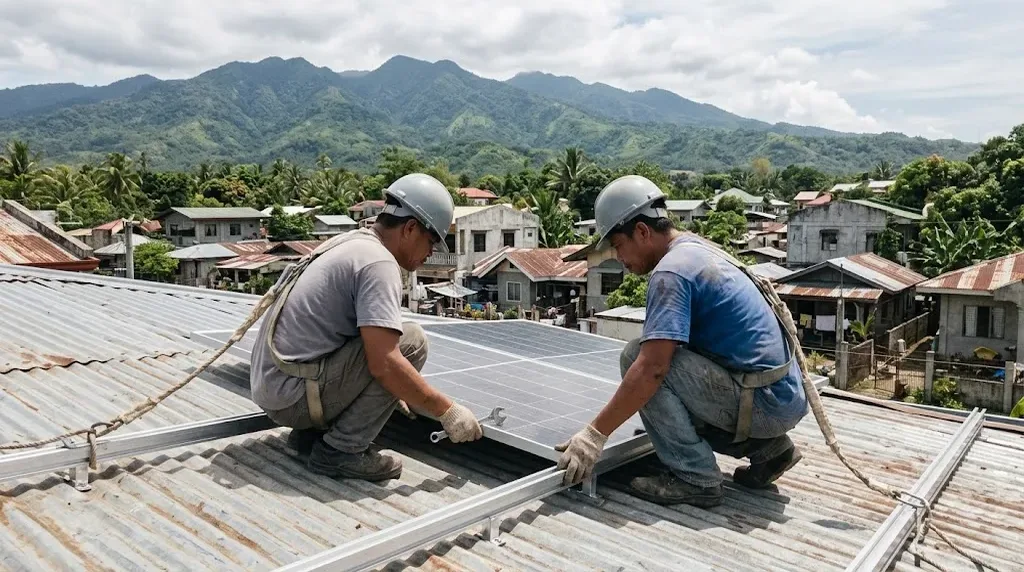
The rails go on only after the purlins under them have been checked for uplift. In typhoon country that check matters more than the panel brand. Illustrative photo.
Short answer: for a house or small shop in Dumaguete, Sibulan, Valencia, Bacong, Dauin, Bais or anywhere else in Negros Oriental, a grid-tied rooftop system without batteries costs about ₱50 to ₱70 per watt installed as a planning range. For a ₱5,000 monthly bill sized to cover about 70% of your use, the calculator below gives five 450 W panels (2.25 kWp), about ₱112,500 to ₱157,500, and 11 m² of panels on the roof. Rounding up to whole panels lifts the cover to about 80%. What that range leaves out is where local jobs go wrong: a roof that can't hold the array down in a typhoon, and a net-metering application that stalls at the co-op. AEDO installs solar in Negros Oriental, and our process starts with your bills and your roof, not a panel count.
Run your own bill through the calculator. It sizes the system, counts the panels, draws them on your roof plane and prices the range. Below it: which co-op serves your town, what drives the local price, why the roof check matters here, NORECO II's net-metering paperwork, and how an AEDO installation runs from survey to energization.
Enter your average bill and the roof plane you'd put panels on. You get the system size, the panel count, the panel area, whether the array fits, a plan of the layout, and the installed-cost range. The sizing method, the 4.0 kWh/kWp/day yield and the ₱50–70/Wp range are the same ones used in our solar payback guide. Planning numbers, not a quote.
One roof plane, eave at the bottom, ridge at the top, with the panel count from the calculator laid out in rows. The numbered tags match the key below.
Planning sketch only, not for construction. NTS. Module gaps, rail spacing, attachment points and edge setbacks are not set by this calculator: they come from the racking datasheet and the wind-uplift design for your roof, so they're marked "per design".
Negros Oriental has two electric cooperatives, and your net-metering application goes to whichever one sends your bill. NORECO II publishes its franchise area on its own website. NORECO I's is written into its franchise bill, House Bill No. 3329 of the 20th Congress, filed August 2025.
| Cooperative | Cities | Municipalities | Source |
|---|---|---|---|
| NORECO II | Dumaguete, Tanjay, Bayawan | Amlan, Pamplona, Sibulan, San Jose, Valencia, Bacong, Dauin, Zamboanguita, Siaton, Santa Catalina, Basay | NORECO II website (14 LGUs, 272 barangays) |
| NORECO I | Bais, Canlaon, Guihulngan | Mabinay, Manjuyod, Bindoy, Ayungon, Tayasan, Jimalalud, La Libertad, Vallehermoso | HB 3329, Section 1 |
So Dumaguete and the towns around it (Sibulan, Valencia, Bacong, Dauin, San Jose, Amlan) are NORECO II. Bais, where AEDO is based, is NORECO I, and so are Manjuyod and Canlaon, where we've built. Each co-op sets its own rates and runs its own technical evaluation. Section 5 covers NORECO II's published process; NORECO I didn't have a net-metering page we could find, so ask their office for the list before you buy anything.
We use one market range across all our solar posts: ₱50 to ₱70 per watt-peak installed for a grid-tied system without batteries, from our solar cost and payback guide. It's a planning band from published 2026 Philippine installer pricing, not an AEDO price list. We don't publish a solar price, because the things that swing a local job don't show up until someone is on your roof.
| Monthly bill (₱) | System at 70% cover | 450 W panels | Installed kWp | Planning range (₱50–70/Wp) |
|---|---|---|---|---|
| 3,000 | 1.19 kWp | 3 | 1.35 | ₱67,500 – ₱94,500 |
| 5,000 | 1.98 kWp | 5 | 2.25 | ₱112,500 – ₱157,500 |
| 8,000 | 3.17 kWp | 8 | 3.60 | ₱180,000 – ₱252,000 |
| 12,000 | 4.75 kWp | 11 | 4.95 | ₱247,500 – ₱346,500 |
| 20,000 | 7.91 kWp | 18 | 8.10 | ₱405,000 – ₱567,000 |
Calculator method at the payback guide's default rate of ₱14.7424/kWh (Meralco's September 2026 residential rate, not a NORECO rate) and 4.0 kWh/kWp/day. At your own NORECO rate the kWh, and so the size, shift.
What moves a local job above or below that band:
This province gets typhoons. When Odette crossed in December 2021, the NDRRMC's SitRep No. 44 records a landfall in La Libertad, Negros Oriental, at midnight on 17 December, Signal No. 4 over northern Negros Oriental, and 24,360 houses totally destroyed and 109,042 partially damaged in the province. In Dumaguete it logged 36 destroyed and 401 damaged, and a NORECO II outage from 16 December until the city was reported 100% energized on 29 December.
Two lessons for solar. First, a grid-tied system without a battery gives you nothing during an outage like that one: it's built to shut down when the grid is down. If the thirteen days matter more to you than the bill, you need a hybrid system, not a bigger grid-tie one. Second, the roof.
Our rooftop solar mounting guide goes through the code. The short version: NSCP 2015 has no solar clause, so an array is designed as rooftop equipment under Section 207D, where the vertical uplift coefficient starts at GCr = 1.5 (Section 207D.5.1, for a mean roof height of 18 m or less). The panels' weight, about 0.15 to 0.25 kPa by our estimate in that guide, is rarely the problem. The uplift is. It runs panel → rail → L-foot → fastener into the purlin → purlin-to-truss connection → truss, and the two links that fail in a retrofit are the fastener and that connection, neither of which was designed to be pulled upward.
So before we lay out a single rail, a licensed engineer checks the roof framing against the uplift for your site's wind speed, which comes from the NSCP wind map (our wind speed lookup reads it by location). Where members or connections fall short, the fix goes in first. That's also why the setback and attachment spacing in the calculator's drawing say "per design": they come out of this check, not a vendor's standard sheet.
Two details we look at on every coastal job here: every roof penetration gets the roofing maker's own flashing detail or a seam clamp that doesn't pierce, and aluminium rails are isolated from galvanised purlins so they don't corrode each other in salt air. Neither is a code clause; both are field practice, covered in the mounting guide. If the roof already leaks, fix it first; our roof leak repair guide covers that.
Solar is an electrical installation first. Three documents carry it, and NORECO II's net-metering application asks for all three:
Whether your LGU also wants a building permit for the mounting, alongside the electrical permit, is its call. Ask the Office of the Building Official at the start rather than after the rails are up. The roof check in section 3 is what you'd hand them either way.
The law. Section 10 of RA 9513, the Renewable Energy Act of 2008, says distribution utilities "shall enter into net-metering agreements with qualified end-users who will be installing RE system," subject to technical considerations and without discrimination, and leaves the interconnection standards and pricing to the ERC. We found only pending bills to amend it, no enacted amendment.
The ERC rules. The program covers systems up to 100 kW. On 27 August 2025 the ERC issued Resolution No. 15, Series of 2025, the 2025 Amended Rules Enabling the Net-Metering Program for Renewable Energy. As summarised by a Philippine law firm and the trade press (the ERC website blocked our reader, so we couldn't read the resolution itself): exported energy is credited at the utility's monthly generation charge, based on its blended generation cost; unused credits are banked and rolled over to later bills; the REC meter became optional; and utilities must post their hosting capacity per distribution transformer every quarter. Our net metering application guide goes through the rules in detail.
What that means for sizing: the generation charge is only part of your retail rate, so a kWh you export earns less than a kWh you use yourself saves. That's why the calculator defaults to covering 70% of your use. At 100% more of your midday output goes out at the lower credit.
NORECO II's own process, from its net-metering page:
NORECO II's page doesn't post processing times, and we don't guess them. The rules have changed more than once since the program started in 2013 (NORECO II's own list cites the 2019 amendment, ERC Resolution No. 6, Series of 2019, and the 2025 amendment came after it), so the co-op's current list is the one that counts. In NORECO I towns, ask NORECO I for its list first.
This is the one part of our solar work that's local. AEDO supplies and installs rooftop solar in Negros Oriental only, the same rule as our construction work. The figure above shows the eight steps; in plain terms:
Outside Negros Oriental we don't install. We still size and design systems, check the roof and the electrical service, and review installers' quotes nationwide; our solar quote comparison checklist shows what we look at. If you're weighing solar against a genset for brownouts, our backup generator sizing guide is the other half of that comparison. Planning a new house here with solar in mind? Our guide to building in Negros Oriental covers the local side of construction.
Straight answer on what we can't price from a blog: the system size (your bills set it, not ours), the battery if you want one, any roof repair or reinforcement from the structural check, any panel-board or service upgrade, any NORECO II upgrade cost that comes out of its Distribution Asset Study, and the exact panel and inverter models. The ₱50–70/Wp band tells you whether solar is in your budget. The survey tells you what your roof and your co-op will actually need.
What AEDO does on solar. In Negros Oriental, AEDO supplies and installs rooftop solar: bill review, site survey, the roof structural check, system design with PEE-sealed electrical plans, the permit, installation, commissioning and net-metering support with NORECO II or NORECO I. We quote a fixed price after the survey. Everywhere else in the Philippines, we size and design the system, check the roof and the electrical service, and review installers' quotes; a local installer does the work.
Service areas: NORECO II's website and HB 3329 (NORECO I). Net-metering requirements and the ₱1,500 COC fee: NORECO II's net-metering page. RA 9513 Section 10 and RA 7920 Section 31 from LawPhil. The 2025 ERC amendment is summarised from secondary sources because the ERC site blocked our reader. Odette figures: NDRRMC SitRep No. 44 (7 February 2022). The ₱50–70/Wp range, 4.0 kWh/kWp/day yield, 450 W panel size and the default rate (Meralco's September 2026 residential rate, used only as a placeholder) come from our solar payback guide; NSCP Section 207D, GCr 1.5 and the 5.5–6.5 m²/kWp and 0.15–0.25 kPa estimates from our rooftop mounting guide. The default panel size (2.1 × 1.05 m) is a typical 450 W module, not a specific product; use your own datasheet.
How much does solar panel installation cost in Dumaguete?
As a planning range, a grid-tied system without batteries runs about 50 to 70 pesos per watt installed, the same market range AEDO uses in its solar payback guide. For a 5,000-peso monthly bill sized to cover about 70% of your use, that is five 450 W panels, 2.25 kWp, or roughly 112,500 to 157,500 pesos. Batteries, a long cable run, roof repairs or reinforcement and a service upgrade are extra. AEDO gives a fixed price only after reviewing your bills and surveying the roof.
Which electric cooperative serves my town in Negros Oriental?
NORECO II lists its franchise area as Dumaguete City, Tanjay City, Bayawan City, Amlan, Pamplona, Sibulan, San Jose, Valencia, Bacong, Dauin, Zamboanguita, Siaton, Santa Catalina and Basay. NORECO I serves Bais, Canlaon and Guihulngan cities and Mabinay, Manjuyod, Bindoy, Ayungon, Tayasan, Jimalalud, La Libertad and Vallehermoso, per its 2025 franchise bill. Your bill shows which one you have, and net metering goes through that cooperative.
What does NORECO II require for net metering?
NORECO II's net-metering page lists a letter of intent to the General Manager, a certificate of good credit standing for existing customers, the application form, an approved electrical plan and an RE facility interconnection set-up both signed and sealed by a Professional Electrical Engineer, an approved electrical permit, the certificate of final electrical inspection, a valid ID, a location map, testing and commissioning data, the inverter and panel specifications, and a fixed asset boundary document. After its technical evaluation and field inspection come ERC Forms 1 and 2, the Net Metering Agreement and a 1,500-peso Certificate of Compliance fee paid to the ERC.
Will solar panels survive a typhoon in Negros Oriental?
They can, if the roof and the mounting are checked for wind uplift, not just weight. Typhoon Odette in December 2021 brought Signal No. 4 to northern Negros Oriental, and the NDRRMC counted 24,360 houses totally destroyed and 109,042 partially damaged in the province. On a rooftop array the panels are rarely the weak link; the fastener into the purlin and the purlin-to-truss connection are. NSCP 2015 Section 207D sets the uplift on rooftop equipment, and a licensed engineer checks the roof against it before the rails go on.
Does a grid-tied solar system work during a brownout?
Not on its own. A grid-tied system without batteries is designed to shut down when the grid goes down, so it gives you no power during an outage. If brownouts are your main problem, you need a hybrid system with a battery, which costs more and is priced separately after the survey.
Does AEDO install solar outside Negros Oriental?
No. AEDO supplies and installs solar only in Negros Oriental, the same rule as its construction work. Everywhere else in the Philippines AEDO sizes and designs the system, checks the roof structure and the electrical service, and reviews an installer's quote, while a local installer does the work.
Pages, laws and reports read for this article. External links open in a new tab.
NORECO II's site shows a current residential rate but doesn't label its billing month, so we haven't used it; type your own rate from your bill. We couldn't find a NORECO I net-metering page. We didn't read the Philippine Electrical Code's solar article, so it isn't cited. Process notes without a source are AEDO's practice, not a rule. This article is general information, not a design for your roof.
Send us your bills and a few roof photos. A licensed engineer will look at the size that makes sense, whether your roof is ready, and when we can survey.