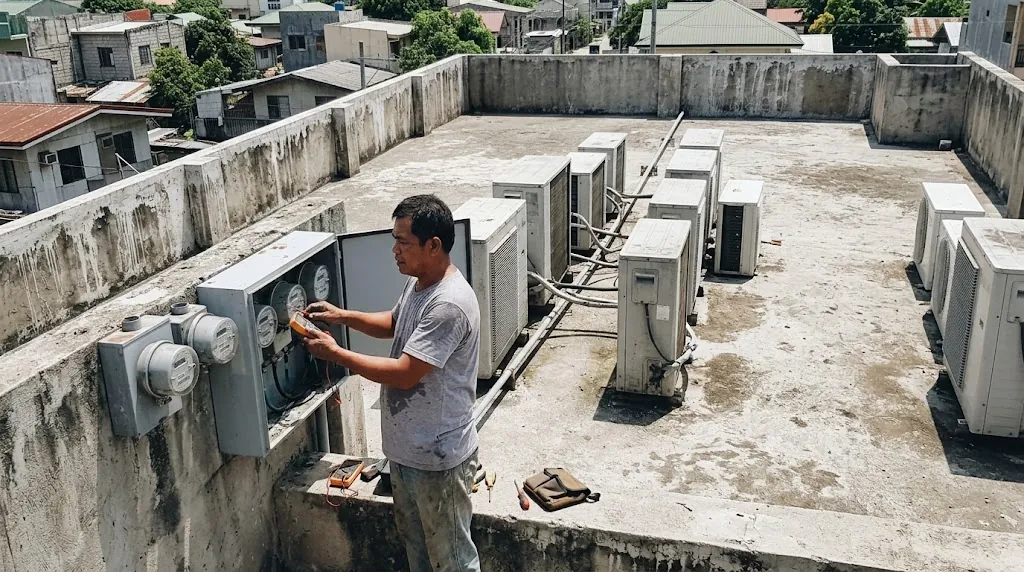
Start where the kWh go: the meter, then the aircon condensers on the roof that run all afternoon. Illustrative photo.
Short answer: in most air-conditioned Philippine buildings the aircon is the biggest slice of the bill. One published audit of a Philippine university office building found aircon at 63%, lighting at 23% and plug loads at 14%. So the order is: run the aircon less and at 24 °C (the setting the government now uses on itself), switch off what runs after hours, stop the roof and the west glass from heating the rooms, change fluorescent tubes to LED, replace old non-inverter units, and only then size solar for the smaller load that is left. For a 500 m² two-storey office paying ₱80,000 a month at ₱14.7424/kWh, the calculator below estimates about ₱237,000 a year from three measures it can compute from published figures (an inverter swap of every old unit, roof insulation over the top floor, LED tubes), before any savings from schedules or setpoints, which you enter yourself. On the legal side, DOE's commercial-sector circular puts a designated establishment in the commercial sector using more than 50,000 kWh a year (fuel included) in Type 1 or above, with reporting, energy-audit and energy-manager duties under RA 11285.
The calculator turns your bill into an end-use split, applies the measures you tick, and tells you where your building sits under DOE's rules. After it: why now, the fixes in order, the law, what the four-day week does and does not save, and what AEDO does and does not do.
Enter your monthly bill and rate. The calculator converts it to kWh, splits it into aircon, lighting and plug loads (change the split to match your building), then applies the measures you tick. Three savings are computed from published figures; the others are left at zero for you to fill in. A planning estimate, not an energy audit.
Three things changed in 2026. On 24 March the President declared a state of national energy emergency under Executive Order No. 110, citing the disruption of oil shipments from the closure of the Strait of Hormuz, in force for one year unless extended or lifted. On 6 March, Memorandum Circular No. 114 had already told national agencies and GOCCs to cut actual electricity and fuel use by 10 to 20%, keep aircon at 24 °C and adopt a four-day onsite week; LGUs were encouraged to follow, and DILG's MC 2026-023 asked them to. And in July, the DOE said the country's average power price reached ₱12.43 per kWh in June 2026, ahead of Singapore by about ₱0.09, with Visayas supply constraints a main driver (Philstar, 21 July 2026).
The Visayas grid is where that bites. NGCP reported 93 yellow and 30 red alerts on the Visayas grid from January to 3 September 2026, and warned of manual load dropping (rotating brownouts) during that day's red alert (Daily Tribune, 3 September 2026). In Negros Oriental, the provincial government went back to a four-day week from 28 September 2026 under Executive Order No. 58, which the reports describe as a temporary energy-conservation and cost-saving measure. Brownouts also mean generator hours, and generator fuel counts toward the consumption DOE uses to classify your building (section 6), so a smaller load helps twice: a smaller bill and a shorter, smaller genset run. For sizing a standby set, see commercial standby generator sizing.
Those are this year's news. The rest of this article is the part that does not change: where a building's electricity goes, and what cuts it.
Before buying anything, split the bill. A bill is just kWh times a rate, and the kWh go to a handful of end uses. The best Philippine figure we found for an office is a peer-reviewed energy audit of eight offices in a university office building (Chan, Arriola, Cuevas and Reyes, ASEAN Engineering Journal 11(1), 2021): aircon 63%, lighting 23%, plug-in loads 14%. We did not find a DOE end-use breakdown for Philippine commercial buildings, so treat that as one well-documented building, not a national average.
| Building | What usually changes the split |
|---|---|
| Office, LGU office | Closest to the audited 63 / 23 / 14. Server rooms and printers push plug loads up. |
| School | Classrooms that are not air-conditioned shift the share to lighting and fans; air-conditioned offices and labs behave like the office case. |
| Clinic | Medical equipment, sterilisers and refrigeration add plug and "other" load that runs whether people are in or not. |
| Small hotel or inn | Room aircon runs at night, water heating and laundry add "other" load, and lighting runs long hours in corridors. |
| Shop or retail | Display lighting and chillers or freezers take a bigger share; doors that stand open load the aircon. |
The quickest real split costs nothing: list every aircon, light and appliance with its nameplate watts and its hours, multiply, and compare the total with the kWh on the bill. If the two are far apart, something is running that nobody listed. For aircon nameplates and sizing, see our aircon tonnage guide; for the electrical side of the same list, electrical service sizing shows how connected load becomes a main breaker and a transformer.
This is AEDO's order, ranked by how soon each measure usually pays for itself: low-cost changes first, building work next, equipment after, solar last. It is a ranking by judgement, not a payback we calculated for your building, and where a cost is shown it is the band from our house-scale roof-heat guide.
| # | Measure | What it cuts | Cost reference |
|---|---|---|---|
| 1 | 24 °C, schedules, doors shut | Aircon run hours and load. MC 114 sets 24 °C for national government offices; DOE's tip sheet recommends 24 °C and cleaning filters and outdoor coils. | Mostly management time |
| 2 | After-hours shutdown of lights and plug loads | Plug and lighting kWh at night and on closed days | Timers and sub-switching, quote |
| 3 | Roof: ceiling insulation or radiant barrier, plus ventilation | Heat into the top floor, so aircon load there | ₱250 to ₱600 per m² of ceiling (house-scale band) |
| 4 | Shade the west and east glass | Solar gain through windows, so aircon load | ₱6,000 to ₱40,000 for a house west elevation |
| 5 | LED tubes and daylight zoning | Lighting kWh, and some aircon load, because every watt of light becomes heat in the room | Quote per fitting |
| 6 | Replace old non-inverter aircon | Aircon kWh for the same cooling | ₱35,000 and up for a bigger or additional house unit in our house guide; commercial units, quote |
| 7 | Demand and power factor, if your tariff bills them | Demand or power-factor charges on the bill (section 5) | Needs an electrical review |
| 8 | Solar PV | Daytime kWh bought from the utility | See our commercial solar guide |
Two cautions. First, do the envelope (roof, glass, sealing) before replacing aircon, because a cooler building may need smaller units, and buying first locks in the old size. Second, solar sits last for a reason: every kWh you stop using no longer needs a panel. Size solar on the bill you will have after the cheap fixes, not the bill you have today. For homes, the same arithmetic is in our solar payback calculator.
Aircon load is heat that came in from outside, through the roof, walls, glass and open doors, plus heat from the people, lights and equipment inside. The outside part is the one you can block once instead of paying for every month.
Roof check before you load it. Insulation, a radiant barrier and especially solar panels add weight and fixings to an old roof frame. If the purlins or trusses are rusted, fix that first: see rusty roof truss and purlin repair and rooftop solar structural mounting.
A household bill is mostly kWh. Some commercial and industrial bills also carry a demand charge (pesos per kW of the highest demand in the billing period) and adjustments tied to power factor. We did not read a rate schedule for your utility, so we give no figures here. Look at your own bill: if there is a line in ₱ per kW, a large share of it can come from a short peak, for example every aircon and pump starting at 8 a.m. Staggering start-up, and a review of power factor by the electrical designer, are then worth asking about. Any change to the electrical installation goes on plans signed and sealed by a registered electrical practitioner of the grade RA 7920 requires; see electrical safety inspection and why DOLE wants an accredited PEE.
RA 11285, the Energy Efficiency and Conservation Act, was approved on 12 April 2019. We read it on LawPhil and found no later law amending it. Its duties fall on designated establishments: private or public entities DOE identifies as energy-intensive based on their annual energy consumption in the previous year.
The thresholds changed for commercial buildings. Section 19 of the Act set Type 1 at 500,000 to 4,000,000 kWh a year and Type 2 above that, and said DOE may adjust them. DOE did, for the commercial sector, in Department Circular DC2023-12-0036 (signed 18 December 2023, published 3 January 2024). Its Section 8 table:
| Typology | Annual energy use, previous year (kWh equivalent) | What the circular asks |
|---|---|---|
| Other DEs | 50,000 and below | Encouraged, but not required, to submit the annual reports and to do a Level 1 energy audit |
| Type 1 | 50,001 to 500,000 | Annual EEC Report and Annual Energy Utilization Report through DOE's online portal; the EE practitioner in the Section 13 table (Certified Energy Manager); energy audit report in the first year of compliance and every three years (Level 1, walkthrough) |
| Type 2 | 500,001 to 4,000,000 | Same reports and practitioner; a Level 1 or Level 2 audit depending on past compliance, and an audit by an in-house auditor must be validated by a DOE-registered or certified ESCO, a certified energy auditor or a registered audit firm |
| Type 3 | 4,000,001 and more | Same as Type 2 |
Fifty thousand kWh a year is about 4,167 kWh a month, which at ₱14.7424/kWh is a bill of roughly ₱61,400 a month. A small hotel, clinic or office paying more than that on electricity alone is likely above it. Three details matter. Consumption counts fuel as well as electricity, converted to kWh equivalent (Section 11), so generator diesel adds to it. For a tenant with no fixed address of its own, the circular puts reporting on the building's property management unless the lease says otherwise (Section 4). And for condominiums and managed subdivisions, property management reports the residential areas and the common areas separately (Section 7). DOE classifies sub-sectors under the PSA's industry classification (Section 5), so if you are unsure whether a school or clinic is "commercial", ask DOE.
The Act's own list of obligations (Section 20) applies to designated establishments: an energy management system based on ISO 50001 or a similar framework, annual targets and measurement, monthly consumption records, an annual report by 15 April, an energy audit every three years by a certified energy auditor or an accredited ESCO, and a certified energy officer or manager. Government buildings: the Section 18 provisos say state-owned buildings and facilities (and, for retrofits, state-leased ones) comply with the Government Energy Management Program and other IAEECC guidelines, and in 2026 national agencies also carry MC 114's 10 to 20% reduction target.
The calculator above checks your annual kWh from the bill against the commercial-sector table. It counts electricity only, so add your generator fuel before relying on the result.
Section 18 of RA 11285 tells LGUs to implement energy measures through building permits: new construction and building retrofits shall comply with the minimum requirements of the Guidelines on Energy Conserving Design of Buildings, issued by DOE in consultation with DPWH. DOE adopted the 2020 edition through DC2020-12-0026, signed 22 December 2020 and effective 6 March 2021. Its Section 2 provides for revisions within three years. We found no DOE circular adopting a newer edition, but ask DOE or your building official which edition they apply before design starts.
How strictly a given Office of the Building Official checks these varies; ask yours at the start of design, not at submission. For the permit process itself, see building permit in the Philippines.
It saves the load that only runs when people are in: office lighting, computers, most aircon. It does not save the load that runs anyway: refrigerators, servers, security lights, water pumps, standby power. The four remaining days are longer, so some of the saving comes back. Neither MC 114 nor the reports of Negros Oriental's Executive Order No. 58 that we read put a number on it.
You can put a number on your own building in a week. Read the meter at closing on Thursday and at opening on Monday, and divide the difference by the number of closed days; then read it at the start and end of a normal working day. The closed-day use per day is your base load; if it is more than a small fraction of a working day, something is running for no one, and finding it is measure 6 in the calculator. This is also the honest way to fill in the percentages the calculator leaves blank.
What AEDO does and does not do. AEDO is not a DOE-certified energy auditor or an ESCO, and nothing on this page is an energy audit under RA 11285. What we do is the building side of a retrofit. The ₱5,000 structural assessment (a licensed-engineer site visit and a written report within 5 business days) answers whether an existing roof can carry insulation, a radiant barrier or solar panels. We design the retrofit: roof and ceiling build-up, shading, openings, and the aircon and lighting layout, with the electrical plans signed and sealed by the licensed Professional Electrical Engineer on our team, as RA 7920 requires, and the mechanical plans by the registered professionals the law requires. For contractors and developers running several projects at once, the ₱15,000-a-month design retainer covers ongoing design review and plan-checking. AEDO designs, checks and reviews nationwide and builds, including solar supply and installation, only in Negros Oriental. Elsewhere, a contractor you hire does the work, and we design it, review the contractor's proposal and check milestones. Solar and retrofit prices are quoted after a bill review and site survey; we publish none.
RA 11285 Sections 4, 18, 19, 20 and 21 and the approval date are from LawPhil. The commercial-sector typology, reporting, practitioner and audit rules are from the scanned text of DOE DC2023-12-0036 (Sections 4, 5, 7, 8, 11, 13 and 17). Coverage thresholds, envelope limits, design conditions, Table 38 lamp efficacies, Table 40 lighting power densities and the 1% renewable rule are from the 2020 Guidelines on Energy Conserving Design of Buildings, and the signing and effectivity dates from DOE's DC2020-12-0026 page. The 24 °C setting and 10 to 20% target are from MC No. 114 (LawPhil) and DILG Calabarzon's post on MC 2026-023; DOE's tip sheet (May 2022) also recommends 24 °C. The 63 / 23 / 14 split is from Chan et al., ASEAN Engineering Journal (2021). The ₱14.7424/kWh default is Meralco's September 2026 residential rate. The COP values, the 700 and 560 BTU/hr per m² roof figures and the cost bands are from our own roof-heat guide and are AEDO practice figures. The ₱12.43/kWh average is DOE as reported by Philstar; grid alerts are NGCP as reported by the Daily Tribune; EO 110 is from LawPhil; EO No. 58 is as reported by Daily Guardian and Digicast Negros. The savings percentages for setpoints, controls and plug loads are left for you to enter, because we found no Philippine source we could verify.
What uses the most electricity in a Philippine commercial building?
Usually the aircon. In a published energy audit of eight offices in a Philippine university office building (ASEAN Engineering Journal, 2021), air conditioning averaged 63% of power consumption, lighting 23% and plug-in loads 14%. That is one building, not a national average, and a hotel, clinic or shop will split differently. To know your own split, list every aircon, light and appliance with its wattage and hours, or have an energy auditor meter it. The calculator on this page starts from that 63/23/14 split and lets you change it.
Is my building a designated establishment under the Energy Efficiency and Conservation Act?
For the commercial sector, DOE Department Circular DC2023-12-0036 sets the typology by annual energy consumption in the previous year, in kWh equivalent, counting fuel as well as electricity: 50,000 kWh and below is Other DEs, 50,001 to 500,000 kWh is Type 1, 500,001 to 4,000,000 kWh is Type 2, and more than 4,000,000 kWh is Type 3. For the commercial sector this replaces the starting thresholds in Section 19 of RA 11285, which the law lets DOE adjust. Types 1 to 3 must submit their annual reports through DOE's online portal, assign the energy efficiency practitioner the circular requires (a Certified Energy Manager in its Section 13 table) and submit an energy audit report every three years. Other DEs are encouraged but not required to report. Confirm your own classification with the DOE.
Do new buildings have to follow an energy code in the Philippines?
Section 18 of RA 11285 says new building construction and building retrofits shall comply with the minimum requirements of the Guidelines on Energy Conserving Design of Buildings, implemented by LGUs through building permit issuance. DOE adopted the 2020 edition through Department Circular DC2020-12-0026, signed 22 December 2020 and effective 6 March 2021. The guidelines apply to new buildings with at least 112.5 kVA of total connected electrical load or at least 10,000 square metres of total gross floor area, and to expansions or modifications of existing buildings of that size. They list the documents to submit with the building permit application, such as envelope calculations and electrical plans. Ask your Office of the Building Official how it checks them.
What aircon temperature should an office be set to?
Memorandum Circular No. 114 of 6 March 2026 directs national government agencies and GOCCs to keep a standard thermostat setting of 24°C, and DILG MC 2026-023 asked LGUs to do the same. DOE's consumer tips also recommend 24°C. For new air-conditioned buildings covered by the Guidelines on Energy Conserving Design of Buildings, the indoor design condition is 25°C dry bulb and 55% relative humidity, within a 23 to 27°C band. None of these sets a mandatory thermostat for a private office, but 24°C is the figure the government uses on itself.
Does a four-day workweek cut the electricity bill?
It removes one day of operation, so the lights, computers and aircon that would have run that day stay off, but the four remaining days are longer. How much is saved depends on how much of the bill runs regardless of occupancy: refrigeration, servers, security lighting and standby loads keep going. Negros Oriental's provincial government re-adopted a compressed four-day week from 28 September 2026 under Executive Order No. 58 as an energy-conservation and cost-saving measure; the reports we read gave no savings figure. Compare your meter reading on a closed Friday with a working day to see what your own building saves.
Should we install solar first or fix efficiency first?
Fix efficiency first in most buildings. Every kWh you stop using no longer needs a panel to supply it, so cutting the aircon and lighting load first lets you buy a smaller system for the same share of the bill. For covered new buildings, the Guidelines on Energy Conserving Design of Buildings also ask that, initially, at least 1% of projected annual energy come from renewable systems such as solar PV or solar water heaters, and availing of DOE's Green Energy Option Program also satisfies this. Our commercial solar guide covers sizing once the load is down.
Can AEDO do the DOE-required energy audit?
No. Under Section 20 of RA 11285 the three-yearly energy audit of a designated establishment is done by a certified energy auditor or an accredited energy service company, and AEDO holds neither credential. What AEDO does is the building side: checking whether a roof can carry insulation or solar panels (the ₱5,000 structural assessment), designing retrofits with the electrical plans signed and sealed by the licensed Professional Electrical Engineer on our team, as RA 7920 requires, and the mechanical plans by the registered professionals the law requires, and, in Negros Oriental, building the work. Elsewhere we design and review, and a contractor you hire builds it.
Laws, DOE issuances, government notices and news reports read for this article in October 2026. External links open in a new tab.
We did not find a DOE end-use breakdown for Philippine commercial buildings, a published savings figure for the 24 °C setting, the four-day week or lighting controls, or your utility's commercial rate schedule, so none is used. We did not read the Philippine Green Building Code or any LGU ordinance. This is general information, not an energy audit, legal advice or a design for your building.
Send us twelve months of bills, the floor area, the roof type and photos of the aircon nameplates. Our team will tell you which measures to price first and whether the roof can take insulation or solar panels.