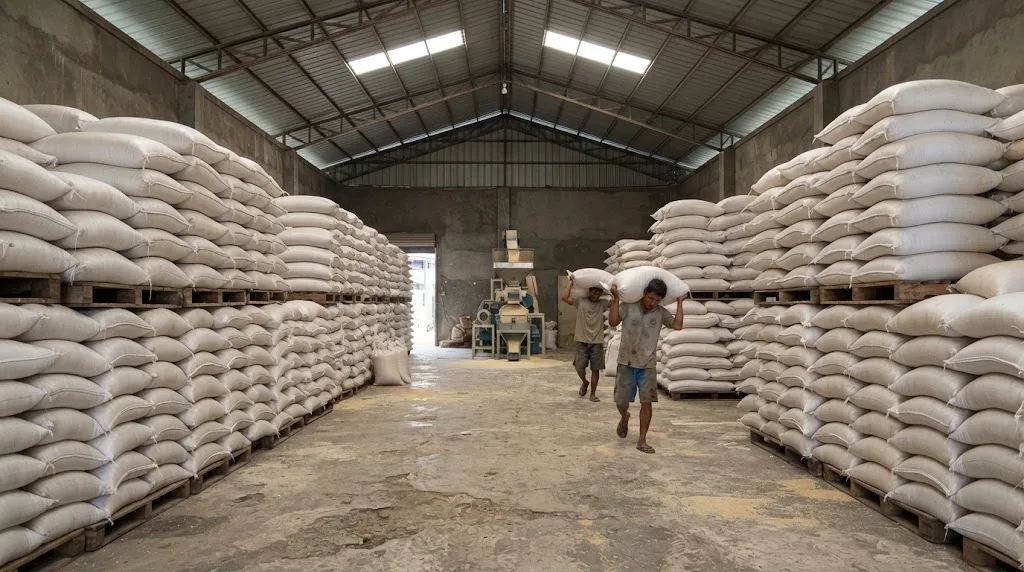
Most bodega problems are dimensional: stacks too high, aisles too narrow, no gap between the stack top and the roof frame. Illustrative photo.
Short answer: you do not have to guess how big the bodega should be. PNS/PAES 419:2015, the Philippine National Standard for warehouses for bag type storage of grains, already gives recommended building dimensions by bag count — 10 × 30 m for 10,000 bags, 20 × 60 m for 50,000, 25 × 78 m for 100,000 — along with stacking density (paddy 10 bags per m³), maximum stack heights, aisle widths, floor level, building height and a list of requirements most Philippine bodegas fail on. Construction cost then follows AEDO's published warehouse cost bands: roughly ₱14,000–₱22,000/sqm steel-frame, ₱22,000–₱32,000/sqm reinforced concrete, before milling equipment.
The calculator below goes from your milling capacity or target stock to a warehouse footprint, a stack-height check, a floor-load flag and a cost band.
Sizing follows PNS/PAES 419:2015 stacking densities, stack heights and spacing rules. Cost bands are AEDO's published 2026 warehouse estimates — the milling line itself is excluded.
PNS/PAES 419:2015 — Agricultural Structures: Warehouse for Bag Type Storage of Grains was adopted as a Philippine National Standard on the recommendation of AMTEC and PCAARRD-DOST, and it replaced the 2003 edition. It is short, specific, and it answers most of the questions a first-time bodega owner asks. In the standard's own language, "shall" is a mandatory requirement and "should" is a recommendation — worth remembering as you read the list below.
| What it specifies | The figure |
|---|---|
| Stacking density (bags per m³) | Paddy 10 · Rice 15 · Corn 12 |
| Recommended maximum stack height | Paddy 16 layers / 6 m · Rice 16 layers / 5.5 m · Wheat, barley and corn 18 layers / 4.57 m |
| Sack-material limit | Woven polypropylene shall not be stacked more than 3 m high (sacks slide); jute may be stacked up to 6 m |
| Clearance above stacks | Stack height shall not exceed wall height, and at least 1 m shall be left between the tops of stacks and the roof frames |
| Maximum pile dimensions (for fumigation sheets) | 7.3 m × 21.9 m × 4.5 m |
| Central pathway | 2 m wide, or not less than 1 m wider than the widest forklift used simultaneously |
| Side spacing | 1 m between piles, and a minimum 1 m between the pile edge and the wall |
| Building dimensions by capacity (50 kg bags) | 10,000 → 10 × 30 m · 30,000 → 16 × 48 m · 50,000 → 20 × 60 m · 100,000 → 25 × 78 m · 500,000 → 75 × 142 m |
| Height | 7 m from floor to eaves line, plus 2.5 m from eaves to apex |
| Floor | Elevated about 1 m above ground for truck loading; strong enough for heavy loads and vibration; smooth, crack-free, moisture-sealed |
| Roof | Clear inside span with no inside pillars; standard roof truss of 14.5 m span or larger; light-coloured reflective sheets; lateral and vertical wind bracing |
| Aeration | Air movement through stored grain at 0.05–2.28 m³/min per tonne for purposes other than drying |
Beyond dimensions, the standard imposes requirements that quietly decide whether the grain survives storage: the long axis should be oriented east–west or across the prevailing wind; there shall be no opening between wall and roof; internal wall surfaces shall be smooth and free from projections to avoid dust-laden ledges, with ledges shed at a minimum 60° where they cannot be avoided; walls shall be painted white inside (to make insect pests visible) and outside (to keep the building cool); a damp-proof barrier should be built into the base of the walls, with a 1 m concrete strip laid around the building; there shall be provisions for bird and rodent proofing and for fumigation; and there shall be at least two doors so stock can rotate on a first-in, first-out basis.
The standard ties the piling method to the grain's moisture content: bagged grain at 14% moisture or lower may be piled by the Chinese method, sacks side by side and one on top of the other; grain at 14.1% to 15% must use the Japanese method, which leaves ventilation space between bags so convective air currents can dissipate heat. That is a warehouse-operations rule with a building consequence — a bodega that will routinely take wetter grain needs more floor area for the same tonnage, because Japanese piling is less dense.
Under NSCP 2015 Table 205-1, storage occupancies carry a uniform live load of 6.0 kPa for light storage and 12.0 kPa for heavy storage. Bagged grain stacked to the heights above is a heavy-storage case: a 6 m paddy stack at the standard's own density is a serious floor pressure, and PAES 419 separately demands a floor "capable of withstanding heavy loads and vibrations". If you switch from floor stacking to pallet racking, the load case changes again — NSCP Table 205-2 treats storage racks over 2.4 m high as a special load with its own vertical total loads and lateral requirements, which is the subject of our racking floor load guide.
Two more structural points specific to grain:
The building is only half the project. PNS/BAFS PABES 303:2020 — Postharvest Machinery: Rice Mill – Specifications classifies mills by method of operation (single-pass or multi-stage) and by huller type (rubber roll or impeller), and sets performance criteria you can write straight into a supply contract:
| Criteria (milled rice) | Rubber roll, single pass | Rubber roll, multi-stage | Impeller type |
|---|---|---|---|
| Hulling efficiency, % minimum | 75 | 79 | 68 |
| Milling recovery index, minimum | 0.90 | 0.95 | 0.95 |
| Percent head rice index, minimum | 0.85 | 0.90 | 0.81 |
| Milling degree | Well milled | ||
| No. of paddy per kilogram of milled rice | 15 | ||
The same standard sets a maximum allowable noise level of 92 dB(A) and requires provision for ear protection — a number with building consequences, since it affects where you can put the mill house relative to an office, a residence or a neighbour, and whether you need acoustic treatment or separation distance. For brown rice, minimum hulling efficiency is 75% with a maximum of 20 paddy grains per kilogram.
AEDO's role on an agri-industrial build. Nationwide, AEDO designs the warehouse and mill house — structure, foundations for the milling line, floor slab for the real load, drainage and the site works that let trucks actually turn — and lays the building out to PNS/PAES 419:2015 rather than to a supplier's sketch. In Negros Oriental, AEDO builds it.
Using AEDO's published 2026 warehouse bands as the base, the items that move an agri-industrial project off the bottom of the band are consistent:
Every warehouse dimension, stacking density, stack height, clearance and building requirement above is quoted from PNS/PAES 419:2015, read in full for this article. Mill performance criteria and the 92 dB(A) noise limit are from PNS/BAFS PABES 303:2020. Floor live loads are NSCP 2015 Table 205-1 and Table 205-2. Cost bands are AEDO's published 2026 warehouse construction estimates, not a government or market index, and exclude the milling equipment, drying facility, site pavement and electrical service. Licensing and registration requirements for milling and grain trading change with policy — confirm the current position with your LGU and the Department of Agriculture before you build.
How big does a grain warehouse need to be in the Philippines?
PNS/PAES 419:2015 gives recommended dimensions by capacity in 50 kg bags: 10 × 30 m for 10,000 bags, 16 × 48 m for 30,000, 20 × 60 m for 50,000, 25 × 78 m for 100,000 and 75 × 142 m for 500,000. Above those, the standard recommends duplicating buildings — a 200,000-bag requirement becomes two 25 × 78 m buildings rather than one larger shed.
How high can sacks of palay be stacked?
Table 2 of the standard recommends 16 layers or 6 m for paddy, 16 layers or 5.5 m for milled rice, and 18 layers or 4.57 m for wheat, barley and corn. Two limits override: woven polypropylene sacks shall not be stacked more than 3 m high because they slide, while jute may go to 6 m; and stack height shall not exceed the wall height, with at least 1 m left between stack tops and the roof frames.
What floor live load does a grain bodega need?
NSCP 2015 Table 205-1 gives storage 6.0 kPa for light and 12.0 kPa for heavy. Bagged grain stacked metres high is a heavy-storage case, and PAES 419 separately requires a floor capable of withstanding heavy loads and vibrations, elevated about 1 m above ground for truck loading, smooth and free from cracks. With pallet racking over 2.4 m high, NSCP Table 205-2 adds a separate special load case.
What should I specify when buying a rice mill?
PNS/BAFS PABES 303:2020 sets minimum hulling efficiency of 75% (rubber roll single-pass), 79% (rubber roll multi-stage) and 68% (impeller type); minimum milling recovery index of 0.90, 0.95 and 0.95; and minimum percent head rice index of 0.85, 0.90 and 0.81. Maximum allowable noise is 92 dB(A), with provision for ear protection required.
How much does it cost to build a rice mill and bodega?
On AEDO's published 2026 warehouse bands, roughly ₱14,000–₱22,000 per sqm for a basic steel-frame structure and ₱22,000–₱32,000 per sqm for reinforced concrete, before the milling equipment, drying facility, truck pavement and electrical service. A grain warehouse sits toward the upper part of those bands because of the heavier floor, the ledge, the bird and rodent proofing and the aeration provisions the standard requires.
Philippine National Standards, structural code provisions and AEDO references used in this guide.
The mill-house footprint allowance, circulation uplift, buffer-stock logic and all peso figures are AEDO's own planning estimates. PAES 419 uses "shall" for mandatory requirements and "should" for recommendations — the distinction is preserved above. Business licensing and grain-trading registration requirements are outside the scope of this guide and change with policy; confirm them with your LGU and the Department of Agriculture.
Lay the building out to the national standard, not to a supplier's sketch.