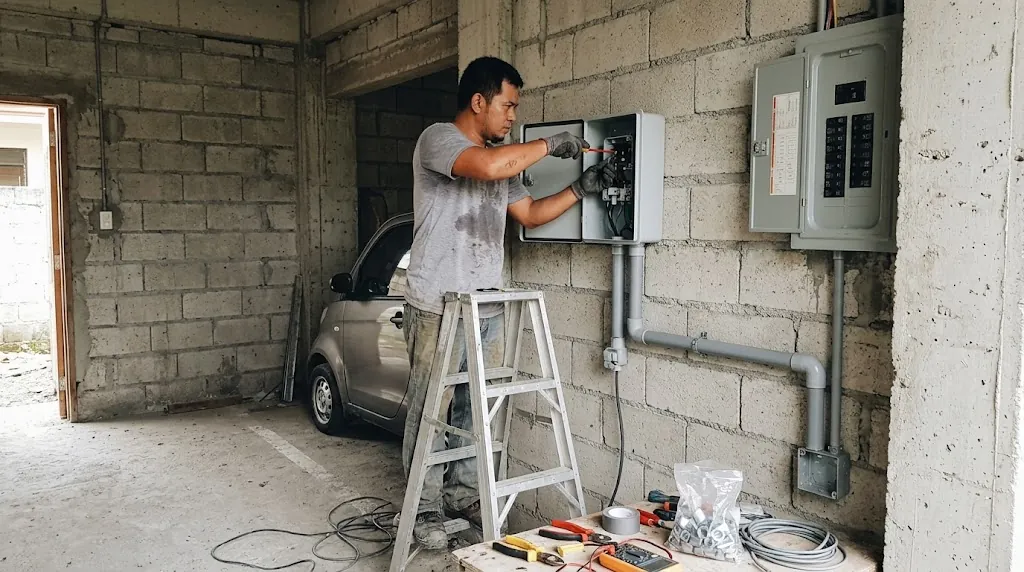
A wallbox going up at the head of a parking slot, with the conduit run back to the panel. The run length and the panel's spare capacity decide most of the job. Illustrative photo.
Short answer: a home wallbox sold as "7 kW" is a 32 A load on a 230 V single-phase supply (230 V × 32 A ≈ 7.4 kW), and it pulls that current for hours. Add it to what your house already draws at its busiest hour and compare the total with your main breaker. In our worked example, a house peaking at 4.8 kW (two tons of aircon plus 3 kW of other loads) draws about 24.6 A; the charger takes it to 56.6 A, which squeezes under a 60 A main, but with the 125% continuous-load allowance it needs 70.7 A. Verdict: review, not "plug it in." The charger goes on its own dedicated circuit (about 40 A for a 32 A unit), with ground-fault protection, on plans signed and sealed by a Professional Electrical Engineer (RA 7920, Section 34). For buildings, RA 11697 adds a parking rule: a building constructed after the law took effect with 20 or more slots should have at least 5% as dedicated EV slots, and existing buildings follow a timeframe set in the national EV roadmap.
The calculator below does that arithmetic for a house, condo, commercial building or gas station, gives you a verdict against your main breaker, counts the EV slots the law asks for, and draws a plan of the bay and the cable route from your inputs.
Enter your main breaker, what the building already draws at its busiest, and the chargers you want. You get the added current, the total against the main breaker with a verdict, the dedicated breaker per charger, the EV slots RA 11697 asks for, and a plan of the bay and cable route. A planning check, not an electrical design.
Drawn from the bay size, the cable run and the breaker results above. The numbered tags match the key and the badges in the results.
Planning sketch, not for construction. NTS: the bay is drawn to its own scale, the cable run is not. Conduit route, wire size, protection type, mounting height, the charger's position on the wall and any bollard or wheel stop are per design by a Professional Electrical Engineer and the charger manufacturer's installation manual. The vehicle outline is illustrative.
EVs stopped being rare this year. On September 15, 2026, GMA News reported the DOE's Energy Utilization Management Bureau director saying that of 270,124 vehicles sold in 2026, 66,685 (24.68%) were EVs, a count that includes hybrids: he put plug-in hybrids at almost 30% of them and hybrids at another 20%, with battery EVs the balance. The same report put registered charging points at 1,876 nationwide (878 AC, 470 DC and 528 battery-swapping stations).
On August 23, 2026, the Philippine Star reported that the DOE would issue a circular on charging stations in parking areas, anchored on Section 17 of RA 11697, with provisions for old buildings such as condominiums. "We haven't issued the circular yet because we have a lot of technical considerations," the director said then. The DOE had already put a draft, a Department Circular on identifying the specific private and public establishments for the mandated installation of charging stations, to a third public consultation on June 26, 2026, alongside a draft joint circular on streamlined permitting for charging stations. In the September 15 report he still spoke of both as circulars the DOE would issue. Sections 21 and 22 of the law's IRR let the DOE issue guidelines on the dedicated slots and on installing chargers in them, which is where such a circular fits. We found no issued circular as of October 3, 2026, so check the DOE's issuances page before you plan around it.
Hybrids that never plug in add no charging load. Everyone else, whether a household with one plug-in car or a mall with forty slots, runs into the same three questions: does the service have room, what does the circuit need, and what does the law ask.
What matters to your panel is current, in amps. On a single-phase supply, kW = 230 V × amps ÷ 1,000; on three-phase it is √3 × 400 V × amps ÷ 1,000. The table works that out for the usual sizes.
| Charger | Supply | Rating | Current per charger | Dedicated breaker at 125% (next standard size) |
|---|---|---|---|---|
| Portable cord set | 230 V, 1-phase | 10 A = 2.3 kW | 10 A | 12.5 A → 15 A |
| Wallbox, 16 A | 230 V, 1-phase | 16 A = 3.7 kW | 16 A | 20 A → 20 A |
| Wallbox sold as "7 kW" | 230 V, 1-phase | 32 A = 7.36 kW | 32 A | 40 A → 40 A |
| Wallbox, 11 kW | 400 V, 3-phase | 11 kW | 15.9 A per phase | 19.8 A → 20 A |
| Wallbox, 22 kW | 400 V, 3-phase | 22 kW | 31.8 A per phase | 39.7 A → 40 A |
| DC fast charger, 60 kW | 400 V, 3-phase | 60 kW | 86.6 A per phase | 108.3 A → 110 A |
The 32 A row is the common home wallbox: a European retailer's listing of the ABB Terra AC wallbox (part TERRA AC W7-T-0), for example, gives it as 7 kW, 32 A, single-phase. The 22 kW and 60 kW sizes are the two DPWH uses in its own EVCS guidelines (Department Order No. 136, Series of 2025, Section 4.2.3), which say a 60 kW DC charger needs a dry-type step-up transformer of at least 75 kVA and a 22 kW AC charger one of at least 30 kVA where an office's existing supply cannot support the charger's required voltage or capacity. "Next standard size" is from the list of standard breaker ratings in our service sizing guide; the 125% is that guide's continuous-load allowance. Treat the breaker column as a sanity check. The real rating, the wire and the protection type come from the Philippine Electrical Code and the charger's manual, applied by a Professional Electrical Engineer.
Charging time is the other half of the decision. A charger adds roughly its kW in kWh for every hour it runs, less losses, so a 7.4 kW unit puts in about 7 kWh an hour and a 2.3 kW cord about 2. Divide what you drive in a day by your car's consumption and you know how many hours you need. Often a smaller charger setting over the night is enough, and it is far easier on the service. For the panels-on-the-roof side of that question, see our solar EV charging guide.
Use the same chain as our electrical service sizing guide: load in kW, divided by power factor to get kVA, divided by voltage to get amps, times 1.25 for loads that run three hours or more, compared with the breaker. Charging runs for hours, so the 125% belongs on it. For the default case in the calculator (house, 230 V single-phase, 60 A main):
The weak link is the existing-load line. A guess of "2 tons and 3 kW" is fine for a first look, but a meter reading or a demand record is better, and on a commercial account the utility's demand data is better still. For buildings, the load schedule and the transformer matter as much as the main breaker; our sizing guide covers the transformer step. If the house wiring itself is old, fix that first: our rewiring guide covers the signs.
We are not quoting Philippine Electrical Code article numbers here, because we have not read the PEC text for this article. What the circuit has to meet is set by the PEC, as designed by a Professional Electrical Engineer. What we can point to in published Philippine documents:
Once it is in, a charger in a commercial building is part of that building's electrical installation, which has its own annual inspection. Our guides on the annual electrical safety inspection and on who may sign it cover that side.
Section 17 of RA 11697 (titled the "Electric Vehicle Industry Act" in its Section 1 and called the Electric Vehicle Industry Development Act, or EVIDA, in its IRR; it lapsed into law on April 15, 2022) and Section 21 of its IRR (approved September 2, 2022) say, in substance:
Read the definitions too. "Private buildings and establishments" in Section 4(v) covers residential, commercial and industrial structures owned or leased by private persons, with commercial and industrial ones counted where their goods and services are available to the public. The 5% floor needs 20 slots, so a house with a two-car garage is outside it; how the CREVI's proportional rule treats small residential parking we could not confirm.
The calculator rounds 5% up, because the law says "at least": 30 slots give 1.5, so 2 dedicated slots. That rounding is our reading.
Dedicated slots are not the same as chargers. Section 18 (IRR Section 22) leaves it to the CREVI to say when dedicated slots must actually get a charging station, installed either by the building owner, who has first priority, or by an accredited provider. Chargers in a building may be own-use or commercial-use. Gas stations have their own rule: Section 19 (IRR Section 23) says select stations identified in the CREVI shall designate dedicated spaces for commercial-use chargers, and a station so required will not get a DOE construction, operation or compliance permit unless the owner shows there is ample space for them. Our gas station cost guide covers the rest of a station.
Penalties. Section 28 sets a fine of ₱50,000 to ₱500,000, and possible suspension or revocation of permits, for violating Sections 17 to 23 among others; IRR Section 37 lists the violations.
Slot size. RA 11697 sets no EV slot size that we found. Our parking requirements guide reads Section 707 of the PD 1096 IRR as an average car slot of 2.50 m × 5.00 m for perpendicular or diagonal parking, and DPWH's own EVCS guidelines ask for a charging site with a minimum dimension of 2.5 m by 5 m, adding that "the site for EVCS shall not be considered a parking slot" and EVs may not park there when not charging (DO 136, Sections 4.1.3 and 4.1.4). Whether your LGU counts an EV slot toward the building's required parking is a question for the Building Official.
Condominiums and old buildings. This is the case the DOE called hard. The questions are the building's spare transformer and riser capacity, who pays for the meter or sub-meter (DPWH's guidelines ask for a separate meter or sub-meter on each of its own chargers, Section 4.2.4), the cable route from the electrical room to the parking level, and whether that route needs new openings in slabs or beams. That last one is a structural question; our condominium structural assessment guide covers how a building's structure gets checked. For new parking structures, see our multi-level parking building guide.
We did not read a BFP or RA 9514 IRR provision written for EV parking, so we give no fire-code requirement here. DPWH's guidelines point to Section 3.4 of the DOE's implementing guidelines on EVCS providers (the "ORSI" guidelines) for minimum fire prevention; we did not read that document. Practical points from DPWH DO 136 that make sense for any site:
Ask your local fire station what they want to see on the plans for a building with several chargers; it is cheaper to hear it before the permit than after.
What AEDO does. We check the load against your service, plan the charger location and cable route, and prepare the electrical plans with the Professional Electrical Engineer on our team, who signs and seals them as RA 7920 requires. We do this nationwide by remote review: send the panel photos, the bills or load schedule, the charger model and the parking layout. Supply and installation are done only in Negros Oriental. For a building, we also work out the RA 11697 slot count and the riser and transformer questions with you. We have no published EV charger price; we quote after we see the load data, the panel and the site. We do not process DOE accreditation or utility applications for you, and this page is not legal advice.
Before you pay for a charger and an installer, have these in hand:
If solar is part of the plan, our solar EV charging guide sizes the extra panels for a household, our commercial solar guide covers a business roof whose daytime load could include the chargers, and our guide to cutting a building's electricity bill covers the loads that compete with them.
Law, read this month: RA 11697, Sections 1, 4(d), 4(g), 4(h), 4(t), 4(v), 11(b), 17, 18, 19, 20, 23 and 28 (LawPhil; lapsed into law on April 15, 2022 without the President's signature; no amending act found); its IRR, Sections 15(b), 21 to 24, 37 and 38 (Supreme Court E-Library; approved September 2, 2022); RA 7920, Sections 31(a) and 34 (LawPhil; no amending act found). Issuances: DPWH Department Order No. 136, s. 2025 (EVCS guidelines for DPWH's own-use chargers, Sections 2 and 4.1.1 to 4.3.4) and DO No. 105, s. 2025 (Item 1112 specification); DTI-BPS product coverage under DAO 22-10, s. 2022; the DOE's June 17, 2026 notice of public consultation on the draft circular for establishments. Arithmetic and constants, from our electrical service sizing guide: kW ÷ power factor → kVA → amps, the 0.85 default power factor, the 125% continuous-load allowance, the IRR's 0.90/0.80/0.70 kW-per-ton aircon figures and the list of standard breaker sizes. Slot size: 2.50 × 5.00 m from Section 707 of the PD 1096 IRR as quoted in our parking requirements guide, and DPWH DO 136 Section 4.1.3. Charger ratings: current × voltage, computed; the 32 A "7 kW" wallbox from a retailer listing of the ABB Terra AC wallbox; the 22 kW and 60 kW sizes from DPWH DO 136. News: GMA News, September 15, 2026, and the Philippine Star, August 23, 2026, both quoting the DOE. Our own assumptions, edit them: the default scenario itself (60 A main, 2 tons of aircon, 3 kW of other loads, one charger, 2 slots, a 12 m run), treating a charger's kW as its kVA, spreading single-phase chargers evenly across three phases, rounding the 5% slot count up, and drawing the charger at the head of the bay.
Can my house's main breaker handle an EV charger?
Work it out in amps. A 32 A wallbox at 230 V draws 32 amps for hours. In our worked example, a house already peaking at about 4.8 kW (two tons of aircon plus 3 kW of other loads, at a 0.85 power factor) draws about 24.6 A, so the charger takes the total to about 56.6 A. That squeezes under a 60 A main breaker, but with the 125 percent continuous-load allowance used in our service sizing guide it needs about 70.7 A, so the verdict is review: a smaller charger setting, load management or a bigger service, decided by a Professional Electrical Engineer.
Do I need a permit to install an EV charger at home?
Plan on it. Section 34 of RA 7920 says no electrical installation may be undertaken unless the plans and specifications are signed and sealed by a professional electrical engineer and a construction permit is first secured, and the work must follow the Philippine Electrical Code. Under RA 11697 the LGU also issues the Certificate of Inspection to charging stations. Ask your Building Official which permit your municipality issues for a new dedicated circuit.
How many EV parking slots must a building provide in the Philippines?
Section 17 of RA 11697, repeated in Section 21 of its IRR, says private and public buildings constructed after the law took effect must designate dedicated parking slots for the exclusive use of EVs, and if there are 20 or more parking slots, there should be at least 5 percent dedicated EV slots of the total. Below 20 slots the number is left to the Comprehensive Roadmap for the Electric Vehicle Industry, and existing buildings comply within the timeframe in that roadmap. The LGU may not issue a construction or renovation permit until the section is complied with.
What size breaker does a 7 kW EV charger need?
A wallbox sold as 7 kW on a single-phase 230 V supply is a 32 A unit, since 230 V times 32 A is about 7.4 kW. Taking it as a continuous load at 125 percent, the method in our service sizing guide, gives 40 A, so the dedicated circuit would be on the order of a 40 A breaker. The conductor size, the protection type and the final rating come from the Philippine Electrical Code applied by a Professional Electrical Engineer and from the charger manufacturer's installation manual.
Does a condo or mall have to install chargers in the EV slots?
Not automatically. Section 17 of RA 11697 is about designating dedicated EV parking slots. Section 18 leaves it to the Comprehensive Roadmap for the Electric Vehicle Industry to say when those slots must be installed with charging stations, either by the building owner, who has first priority, or by an accredited charging station provider. As of mid-September 2026 the DOE said it would still issue a circular naming which establishments must install chargers, and we found none issued as of October 3, 2026.
What does AEDO do for EV charger installations?
We review the load against your service, plan the charger location and cable route, and prepare the electrical plans with the Professional Electrical Engineer on our team, who signs and seals them as RA 7920 requires. We do this nationwide by remote review. Supply and installation are done only in Negros Oriental. We have no published EV charger price; we quote after we see the load data, the panel and the site.
Laws, issuances and pages read for this article. External links open in a new tab.
We have not read the Philippine Electrical Code, the CREVI, the DOE's ORSI guidelines or any BFP provision on EV parking for this article, so no clause from them is quoted. We found no issued DOE circular on parking-area chargers as of October 3, 2026; the last report we read, on September 15, 2026, still spoke of it as forthcoming. This article is general information, not an electrical design and not legal advice.
Send the panel photos, the bills or load schedule, the charger model and the parking layout. Our team will tell you whether the service can take it, what the plans need to show, and how many EV slots the law asks of your building.