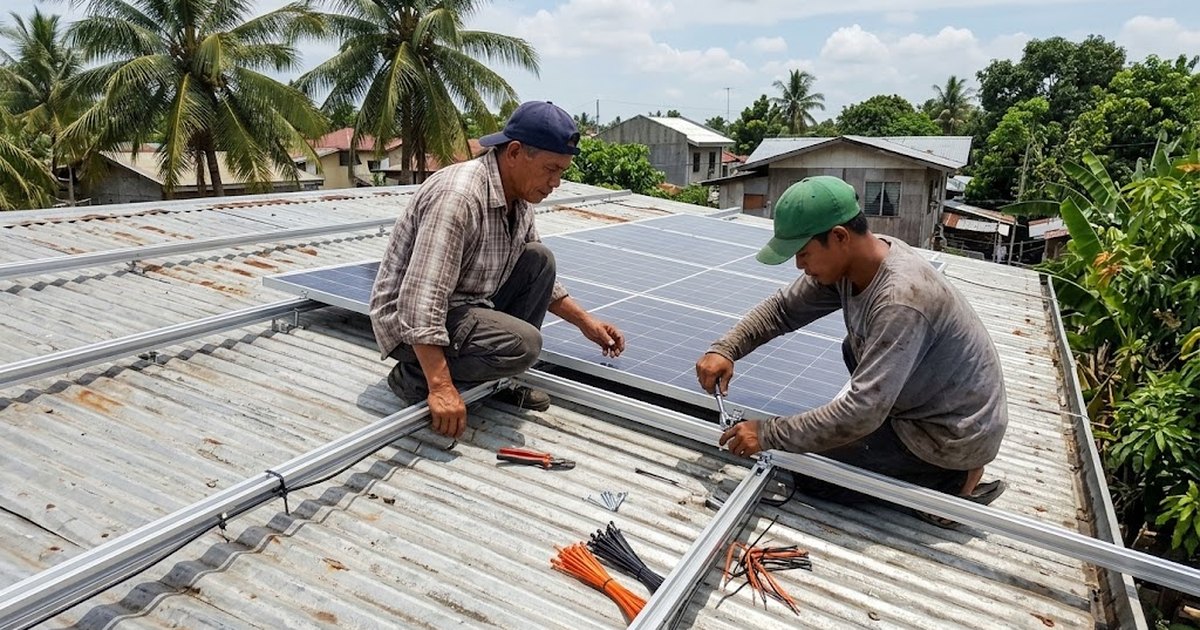
Roof condition and mounting come before panel count in any solar payback estimate. Illustrative photo.
Short answer: for a lot of households and small shops, yes — but the number that matters is yours, not a generic one from an ad. Two houses with the same roof size can have completely different payback periods because their bills are different. The calculator below takes your actual average bill, works out roughly how much power you use, sizes a system to offset a chosen share of that, and gives you an installed-cost band and a payback period in years — with the arithmetic shown, not hidden behind a "get a free quote" form.
This is a planning tool, not a quote. It tells you whether it's worth spending an afternoon getting real installer quotes and, separately, whether your roof and electrical panel can actually take the system size it comes back with — which is the part most online solar calculators skip entirely.
Enter your average monthly electric bill and pick how much of your usage you want to offset. Uses Meralco's September 2026 published residential rate (₱14.7424/kWh) as the default — change it if you're on a different utility or co-op.
Four steps, in order, and the calculator above shows the result of each one so you're not just trusting a black box:
The one number in this calculator that isn't a fixed rate or your own bill is how much energy a kilowatt-peak (kWp) of panels actually produces per day on an average Philippine roof. Real published output studies put this in the range of roughly 3.6-4.4 kWh/kWp/day across a full year, after accounting for panel losses, inverter efficiency, temperature derating, and the wet-season months where output drops noticeably. This calculator uses 4.0 kWh/kWp/day as a working planning figure — a touch optimistic for a shaded or poorly-oriented roof, a touch conservative for an unshaded, well-oriented one in a sunnier province. It is not a government-published figure; it's an engineering planning assumption grounded in the cited output range, and an installer's own production estimate for your specific roof orientation, tilt and shading should be treated as more accurate than this calculator's number.
Net metering is the arrangement that lets you export solar power you generate but don't use back to the grid and get a bill credit for it, instead of that power going to waste. It's established under Section 10 of Republic Act 9513 (the Renewable Energy Act of 2008), which directs distribution utilities to enter into net-metering agreements with qualified end-users on request. The Energy Regulatory Commission implements the detailed rules and amended them in 2025 to make credits bank and roll over across billing periods and be transferable to a new property owner — but credits are still not convertible to cash, and they're valued at the utility's blended generation rate, which is lower than the full retail rate you avoid by using solar power directly as you generate it.
That distinction matters for the calculator above:
The calculator's savings figure assumes the offset power is fully usable at the full rate, which holds cleanly for 50-70% offset and is optimistic at 100% unless you've confirmed net-metering export credits are actually available and roughly rate-equivalent for your situation.
AEDO's role in a solar decision. AEDO doesn't sell or install solar panels. What we check, as a structural and MEPFS engineering firm: whether your roof structure can carry the panel and mounting loads, whether your electrical service and panel have the spare capacity an inverter (and any battery) needs, and — if you already have a quote — whether the proposed system size and cost are reasonable for your actual usage. In Negros Oriental, this can be scoped as part of a design-build project alongside the installer's work. Outside it, it's a design and remote-oversight engagement — AEDO doesn't claim to physically install anything beyond Negros Oriental.
Is solar actually worth it for a typical Philippine home in 2026?
For most Meralco-area households with a monthly bill above roughly ₱3,000-4,000, the math tends to work: at 2026 installed costs and rates, a straightforward self-consumption system usually pays back in about 2.5 to 4 years, and panels are commonly warrantied for 20-25 years. Below that bill level, a system is often too small to be efficient to install, and off-grid or co-op-served areas can have different rates and net-metering availability, so the answer is bill-specific, not universal. Run your own number in the calculator above rather than relying on someone else's case.
How is the payback period in the calculator worked out?
It divides your bill by Meralco's published rate per kWh to get your monthly usage, takes the percentage of that usage you choose to offset, sizes a system against a planning-level daily energy yield per kWp, prices that system across a peso-per-watt installed range, and divides the installed cost by your estimated annual savings. Every step of that arithmetic is shown next to the result so you can check it, not just trust it.
What is net metering and do I need it for the payback to work?
Net metering, established under Section 10 of the Renewable Energy Act (RA 9513) and implemented through ERC rules, lets a qualified end-user export surplus solar generation to the grid and receive a bill credit for it. You only need it if your system is sized to produce more power than you use at some point in the day, which is common at high offset percentages. At lower offset settings, all the power is typically self-consumed as it's generated and net metering isn't required for the savings in this calculator to apply.
Does the payback period in the calculator include a battery?
No. The default calculation assumes a grid-tied system without battery storage, which is the lower-cost, faster-payback configuration most residential installs in the Philippines use. Adding batteries increases installed cost meaningfully and extends the payback period, but it also keeps essential loads running during an outage, which the payback math alone doesn't capture. Treat batteries as a separate decision layered on top of this number, not a footnote to it.
Does AEDO sell or install solar panels?
No. AEDO is a structural and MEPFS engineering firm, not a solar installer. What AEDO offers is the engineering side a solar quote usually skips: checking whether your roof structure can actually carry the panel and mounting loads, verifying your electrical panel and service capacity for the inverter and any battery, and giving a second engineering opinion on an installer's proposed system size before you sign. In Negros Oriental, AEDO can also manage that scope as part of a design-build project; outside it, this is a design and remote-oversight service, not self-performed installation.
Statutes, regulatory rules and current market figures used in this article and calculator. Links open in a new tab.
AEDO market observation, not a government figure: the ₱50-70/Wp installed-cost range and the 3.6-4.4 kWh/kWp/day output range used in the calculator were checked against current Philippine solar installer/market pricing guides published in 2026 (e.g. solarwise.ph, lakasolar.ph) and a 2025 output-data write-up (solaren-power.com), not a single official source. Treat both as planning-level figures — get an actual installer quote and production estimate for your specific roof before committing.
Before you sign a solar quote, know whether your roof and electrical service can actually take it.