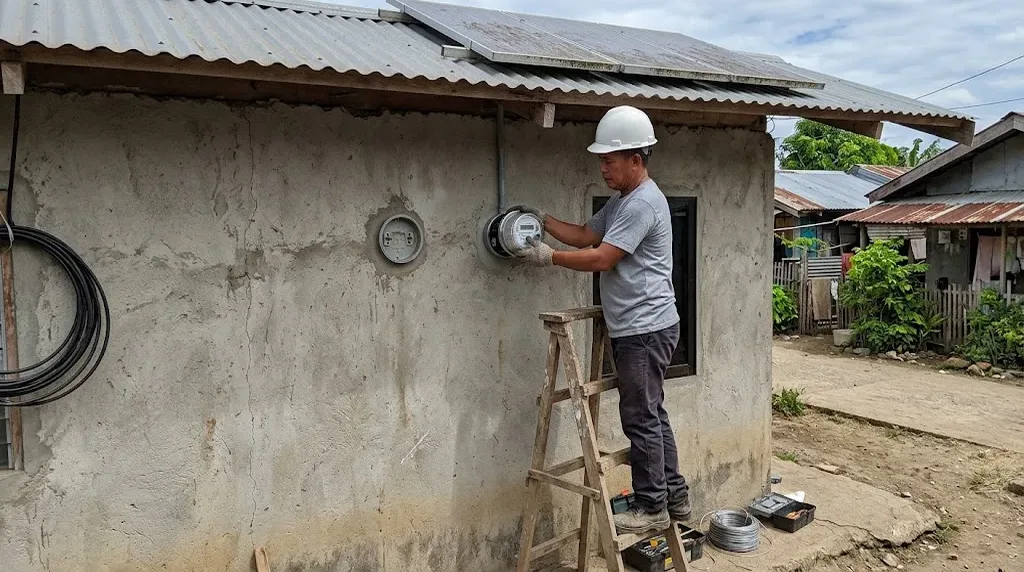
The meter swap is the last step, not the first. By the time the co-op's lineman arrives, the permit, the final electrical inspection and the co-op's own inspection are already done. Illustrative photo.
Short answer: you qualify if you're a utility or co-op customer in good credit standing putting an on-grid solar system of up to 100 kW on your own premises. The order is: electrical permit from the LGU (single line diagram signed and sealed by an electrical engineer), install, Certificate of Final Electrical Inspection, then the utility's application, its technical evaluation and site inspection, the Net-Metering Agreement and the bidirectional meter. Under JMC No. 001, s. 2026, signed in January 2026, the LGU has 3 working days for the permit and 7 for the final inspection certificate, or they're deemed approved. Since April 2026 the DOE has ordered utilities to finish in 10 working days, and LGUs to act on every net-metering permit in 3, while the EO 110 energy emergency lasts. The money part most people miss: an exported kWh is credited at the utility's generation charge, not your full rate. With our calculator defaults, a 2 kWp system on a 339 kWh a month house takes a ₱4,998 bill to about ₱3,229 without net metering and ₱2,064 with it.
The checker below scores how ready your paperwork is and estimates your bill with and without net metering. After it: who qualifies, each step and its clock, the documents, what you pay, what the credit is worth, and how it works with NORECO II and NORECO I in Negros Oriental.
Top half: tell us where your paperwork stands and get a readiness score, with the rule behind each item. Bottom half: your usage, system size and rates give an estimated monthly bill without solar, with solar but no net metering, and with net metering. Every rate is editable. Type the figures from your own bill.
Net metering comes from Section 10 of RA 9513, the Renewable Energy Act of 2008: "subject to technical considerations and without discrimination and upon request," distribution utilities must enter into net-metering agreements with qualified end-users installing a renewable energy system, and the ERC sets the interconnection standards and pricing. The same section gives the utility the Renewable Energy Certificate from your system. Four layers now sit on top of that law:
| Issuance | What it does | How we read it |
|---|---|---|
| ERC Resolution No. 09, Series of 2013 (27 May 2013) | The original Rules Enabling the Net-Metering Program, with the Net-Metering Interconnection Standards (Annex A-1) and the agreement form. The DOE says it took effect on 24 July 2013. | Read in full from the published scan |
| ERC Resolution No. 06, Series of 2019 | Amended the 2013 rules. The DOE's primer names it, and NORECO II's document list cites "Res. 6-2019". | Text not read; its effects are seen in the amended agreement form and NORECO II's list |
| ERC Resolution No. 15, Series of 2025 (27 August 2025) | Reported: credits banked and rolled over, transferable to a new owner, REC meter made voluntary, utilities must publish forms, processes and quarterly hosting capacity. | News-reported. The ERC site blocked our reader. The banking and transfer clauses do appear in the amended agreement form below. |
| JMC No. 001, Series of 2026 (DOE, DILG, DPWH; dated 13 January 2026) | LGU side: fixed documents, 3-working-day electrical permit, 7-working-day final inspection certificate, deemed approval, no extra requirements. | Read in full |
| DOE advisory under EO No. 110, s. 2026 (1 April 2026) | Utilities and co-ops: 10 working days, down from 20. LGUs: 3 working days for all net-metering permits. In force while the State of National Energy Emergency lasts. | Read on the DOE's site (press release) |
One more thing is moving. In July 2026 Power Philippines reported an ERC draft overhaul of the net-metering and distributed-energy rules (electronic signatures, no notarization, deemed approval if the meter isn't installed on time). That's a proposal as far as we could find, not a rule. Ask your utility which version it's applying on the day you file, because the utility's current list is the one that counts.
This is the sequence as the rules and NORECO II's published process lay it out. Your installer does much of the legwork, but the application is in your name and the agreement is signed by you.
For years the complaint was that applications sat for months. Two 2026 issuances put numbers on each office:
| Step | Who acts | Deadline | Source |
|---|---|---|---|
| Electrical permit | LGU Building Official | 3 working days ("Simple") | JMC 001 s. 2026, 6.1.1.3 |
| Certificate of Final Electrical Inspection | LGU Building Official | 7 working days ("Complex"); the DOE advisory puts "all net metering-related permits" at 3 working days while the EO 110 emergency lasts | JMC 001, 6.1.2.3; DOE advisory, 1 April 2026 |
| Processing the net-metering application, "including technical rectifications" | Utility or electric co-op | 10 working days, non-extendible (was 20), while the State of National Energy Emergency lasts | DOE advisory under EO No. 110, s. 2026 |
| Acknowledging your application as complete or not | Utility | 10 business days | 2013 Interconnection Standards, 5.4 |
| Submitting the signed agreement to the ERC, DOE and NREB | Utility | 5 days from execution | 2013 rules, Section 11 |
| Hazardous condition notice before disconnection | Utility to you | At least 3 days to fix it | 2013 rules, Section 10 |
When the LGU clock starts. Only on "receipt of the Application with complete documentary requirements and payment of fees and charges" (JMC 001, 6.4.1). An incomplete set doesn't start anything.
Deemed approved. If the LGU doesn't act in time, the application is "deemed approved" under Section 10 of RA 11032 (6.4.2). Your acknowledgment receipt and official receipt then serve as the basis for the utility and the ERC to proceed, and "Distribution Utilities shall not require LGU-issued permits or documents beyond those recognized under this JMC" (6.4.3). The LGU also "shall not impose additional documentary requirements" (7.4.3). If a permit is refused, suspended or revoked, you can appeal to the DPWH Secretary within 15 days (Section 9).
Is the 10-day utility deadline still on? The DOE says its April 2026 advisory "shall remain in force for the duration of the declared State of National Energy Emergency, unless sooner revoked." Ask your utility when you file. If the emergency has been lifted, the utility is back to the pre-EO 110 period of 20 working days the DOE mentions.
None of these clocks covers your installer. Getting the diagram signed, the equipment delivered and the fixes from the site inspection done is where real projects lose weeks.
For the LGU (JMC 001 fixes the list):
For the utility, each has its own list. NORECO II's, read on its site in September 2026, as an example:
| Stage | NORECO II asks for |
|---|---|
| Step 1, application | Letter of intent to the General Manager; Certificate of Good Credit Standing (existing customers); application form; electrical plan signed and sealed by a Professional Electrical Engineer; RE facility interconnection set-up signed and sealed by a PEE; electrical permit; Certificate of Final Electrical Inspection and Completion; valid ID; location map; data from testing and commissioning; inverter and solar panel product specifications; Standard Planning Data (Philippine Distribution Code); Fixed Asset Boundary Document |
| Steps 2 and 3 | Non-technical check, technical evaluation (Distribution Impact Study, and a Distribution Asset Study if an upgrade is needed), then field inspection, where NORECO II also decides the kWh meter |
| Step 4, completion | ERC Forms 1 and 2 (2 copies); notarized Net-Metering Agreement (5 copies); NORECO II certification of technical compliance; ₱1,500 Certificate of Compliance fee by manager's check to the ERC |
| Step 5 | Energization |
Who may sign the electrical plans is set by RA 7920; our RA 7920 license-tier guide explains PEE, REE and RME. And if your system needs a panel-board or service upgrade, the electrical service sizing guide covers how the main breaker and service are sized.
This is the part that decides whether net metering pays. Section 12 of the 2013 rules: "the DU's monthly generation charge, which is based on its blended generation cost, shall be used as the preliminary reference price in net-metering agreements." The amended agreement form says the same: "the DU's monthly generation charge, which is based on its blended generation cost, excluding other generation adjustments." The DOE's primer agrees. If you read somewhere that exports earn the full retail rate, that isn't what the rule text says, so we go with the rule as written and you should confirm the credit rate with your utility.
The generation charge is only one line of your bill. Transmission, system loss, distribution, supply, metering, taxes and subsidies sit on top of it. So:
Our default numbers. The import rate is Meralco's September 2026 overall residential rate, ₱14.7424/kWh, the same default as our payback guide. For the export credit we used Meralco's own advisories, because they give the generation charge: ₱9.2504 in July 2026, then up ₱0.0296 in August and up ₱0.4232 in September, which gives ₱9.7032/kWh. That's our arithmetic from three advisories, not a published September figure, and a billed generation charge can include adjustments the net-metering price excludes. So treat it as a close estimate and type your own utility's figure. With those two numbers an exported kWh is worth about 66% of a kWh you use yourself.
How the netting works. The net amount is your import subtotal minus the export subtotal and minus last month's credit, if any. Positive, you pay. Negative, it's "credited ... in the immediately succeeding billing period" (Section 15). The amended agreement form adds that "All the Net-Metering credits shall be banked, rolled-over and credited" to current and succeeding billing periods, and that credits transfer to a new owner if the property and system are sold, subject to the utility's requirements, possibly a new agreement and a conforme letter from the original owner. The form only credits bills; it doesn't provide a cash payout.
The design lesson: size for what you use in daytime and treat exports as a bonus. In the checker's default, halving the self-consumed share from 50% to 25% raises the net-metered bill from ₱2,064 to ₱2,367, even though the panels produce exactly the same kWh. Shifting laundry, pumping and aircon pre-cooling into the sunny hours is worth more than adding panels. Our quote comparison checklist shows how to catch an oversized quote.
Lifeline and senior-citizen discounts: the agreement form has the utility derive your actual consumption from the meters to decide lifeline-rate eligibility and the senior citizen subsidy, so eligibility follows what you actually consume, not only what the meter imports.
Your application goes to whichever co-op sends your bill.
| Co-op | Area (its own source) | Net-metering information |
|---|---|---|
| NORECO II, Dumaguete | Pamplona, Tanjay City, Amlan, San Jose, Sibulan, Dumaguete City, Valencia, Bacong, Dauin, Zamboanguita, Siaton, Sta. Catalina, Bayawan City, Basay (its Cooperative Profile) | Published five-step process and document list (section 5). Its site showed a current residential rate of ₱14.3522/kWh when we read it on 30 September 2026, without naming the billing month. |
| NORECO I | Cities of Bais, Guihulngan and Canlaon; Mabinay, Manjuyod, Bindoy, Ayungon, Tayasan, Jimalalud, La Libertad, Vallehermoso (House Bill No. 3329, 20th Congress, Section 1) | We didn't find a published net-metering page. Ask the office for its current list before buying equipment. |
Two things stand out in NORECO II's list. It asks for the electrical plan signed by a Professional Electrical Engineer, stricter than the "professional or registered" wording JMC 001 uses for the LGU's single line diagram. And it cites the testing and commissioning data under Resolution 6-2019. Both are the co-op's requirements, not LGU-issued documents, so as we read it the JMC's "no additional requirements" rule doesn't reach them. Plan for them.
We don't use NORECO rates as calculator defaults, because neither co-op's pages we read gave both a dated retail rate and the generation charge. NORECO II posts monthly generation charges on its site as images. Read your own bill: the generation charge line is your export credit.
For the local picture (cost ranges, typhoon exposure, how an installation runs here), see solar panel installation in Dumaguete and Negros Oriental.
What AEDO does. AEDO supplies and installs rooftop solar in Negros Oriental only, the same rule as our construction work, and for systems we install we prepare and follow through the NORECO II or NORECO I net-metering application. There's no price list: we quote after a bill review and a site survey. Anywhere else in the Philippines we don't install. We size the system against your bill, check the roof structure for the panel load and wind, review your electrical service capacity, and review an installer's quote and net-metering papers before you sign. The electrical plans themselves are signed and sealed by a licensed electrical engineer, as JMC 001 and your utility require.
Eligibility, the 100 kW limit, pricing, billing and the interconnection steps come from ERC Resolution No. 09, Series of 2013 and its Annex A-1, read from the scan. Meter cost, the DIS charge, banking, transfer and modification come from the amended Net-Metering Agreement form as posted by PENELCO. LGU documents and deadlines come from JMC No. 001, Series of 2026; the utility deadline from the DOE's 1 April 2026 advisory. ERC Resolution No. 15, Series of 2025 is described from news reports because we couldn't open the ERC's copy. The ₱9.7032 export default is our sum of three Meralco advisories. The 4.0 kWh/kWp/day yield is from our payback guide. The 50% self-consumption default is AEDO's planning assumption, not a sourced figure.
Who can apply for net metering in the Philippines?
Any customer of a distribution utility or electric cooperative who is in good credit standing in paying their electric bills, installing an on-grid renewable energy system on their own premises of up to 100 kW. The ERC rules (Resolution No. 09, Series of 2013) set the good-credit-standing rule in Section 5 and cap interconnection at 100 kW per account. The DOE's April 2026 advisory repeats the 100 kW limit. Off-grid systems are not covered, because the rules apply to on-grid systems only.
What documents do I need for a net metering application?
For the LGU, Joint Memorandum Circular No. 001, Series of 2026 limits the electrical permit to three copies of the Net-Metering Application Form and three sets of a single line diagram signed and sealed by a professional or registered electrical engineer, and the Certificate of Final Electrical Inspection to one Certificate of Completion. The utility then asks for its own list. NORECO II, for example, asks for a letter of intent, a certificate of good credit standing, its application form, the signed and sealed electrical plan and interconnection set-up, the electrical permit and final inspection certificate, a valid ID, a location map, testing and commissioning data, and the inverter and panel specifications. After inspection come ERC Forms 1 and 2, the notarized Net-Metering Agreement and a 1,500 peso Certificate of Compliance fee paid to the ERC.
How long does net metering approval take in 2026?
Under JMC No. 001, Series of 2026, the LGU has three working days for the electrical permit and seven working days for the Certificate of Final Electrical Inspection, counted from receipt of complete documents and payment, and an application not acted on in time is deemed approved. On April 1, 2026 the DOE ordered utilities and cooperatives to finish processing net-metering applications within a non-extendible 10 working days, down from 20, and LGUs to act on all net-metering permits within three working days, for as long as the State of National Energy Emergency under EO No. 110 stays in force. Add your installer's time and any fixes found at inspection.
How much is an exported kWh worth under net metering?
The utility's monthly generation charge, based on its blended generation cost and excluding other generation adjustments. That is Section 12 of the 2013 ERC rules and Section 5 of the amended Net-Metering Agreement form, which adds the words excluding other generation adjustments. It is only the generation part of your bill, so an exported kWh earns less than the full per-kWh rate you pay for power you import. Using AEDO's calculator defaults, a kWh used as it is produced saves about 14.74 pesos at Meralco's September 2026 residential rate, while an exported kWh earns roughly 9.70 pesos, an estimate of Meralco's September 2026 generation charge. Your utility's figures differ, so check your bill.
Do net metering credits expire?
Under the amended Net-Metering Agreement form, all net-metering credits are banked, rolled over and applied to your consumption in current and succeeding billing periods, and they transfer to a new owner if the property and the solar system are sold, subject to the utility's requirements and a conforme letter from the original owner. News reports tie these changes to ERC Resolution No. 15, Series of 2025. The agreement provides for credits against your bills, not a cash payout.
Do I have to pay for the bidirectional meter?
Partly. The amended Net-Metering Agreement form has the utility furnish and install the bi-directional meter, with the end-user who installs a renewable energy facility paying the difference in cost between the old meter and the new bi-directional meter. The utility may not charge extra for the Distribution Impact Study, but if the study shows the line or transformer must be upgraded, NORECO II, for one, says the upgrade fees depend on its Distribution Asset Study.
Is net metering worth it if the credit is lower than my rate?
Usually yes, as long as the system is sized mainly for what you use in daytime. Every kWh you use as it is produced saves the full rate; net metering adds a smaller credit for the surplus instead of throwing it away. In AEDO's default case, a 2 kWp system on a 339 kWh a month house with half the solar used on site, the bill falls from about 5,000 pesos to about 3,229 pesos without net metering and about 2,064 pesos with it. Oversizing to export more earns only the generation-charge credit on each extra kWh.
Laws, rules, forms and utility pages read for this article in September 2026. External links open in a new tab.
We did not read the text of ERC Resolution No. 06, Series of 2019 or No. 15, Series of 2025; where they matter, we used the amended agreement form and utility pages that implement them, or say "reported." We did not read the Philippine Electrical Code's solar article, so it isn't cited by number. The 50% self-consumption default and the ₱0 net-metering-charge default are AEDO planning inputs, not sourced figures. This article is general information, not legal advice or a design for your system.
Send us your bill, the proposed system size and the papers you already have. A licensed engineer will tell you what's missing and whether the system is sized for how you actually use power.