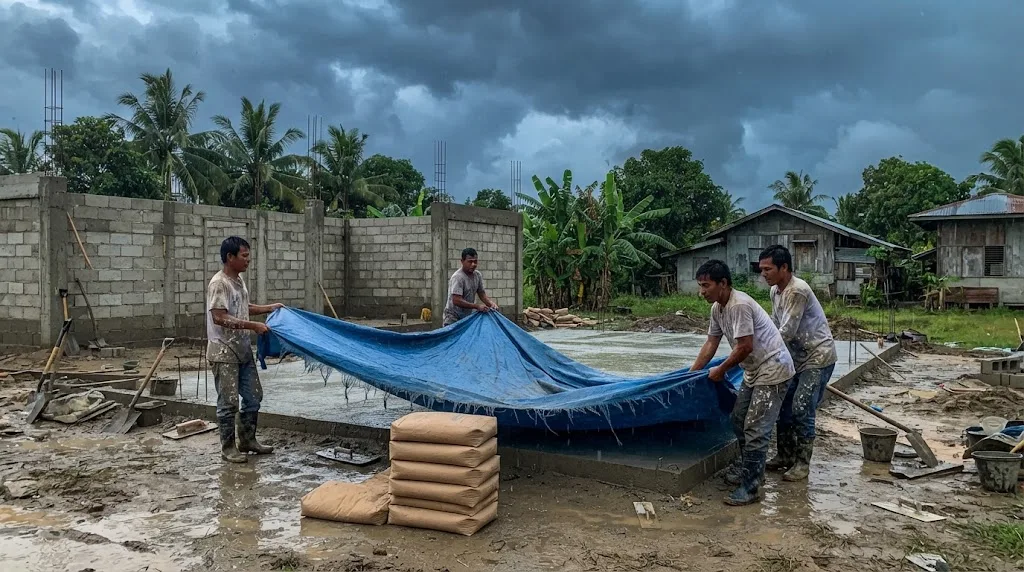
Tarps out before the cloud breaks. Fresh concrete and open cement bags are the two things on site that rain ruins fastest. Illustrative photo.
Short answer: build the parts rain can hurt in your area's driest months, and let the parts under the roof run into the wet ones. The rain-sensitive stretch of a house is excavation, footings, slab pours and the roof. Once the roof is on, plastering, tiles and ceilings barely notice the weather. The catch is that "the dry season" depends on where you are. PAGASA sorts the country into four climate types: western Luzon gets a real dry season from November to April, eastern Samar has no dry month at all, and Negros Oriental sits in between. For a 100 m² bungalow in Dumaguete starting in January, our planner gives about 123 days of site work plus a 13-day rain-delay allowance: 136 days, roof on by mid-March and done by May. Start the same house in June and the allowance grows to 19 days, with the footings and the roof landing in wet months. In Manila the gap is wider: 8 days for a January start, 28 for June.
The planner below builds that schedule for your station, your start month and your house. The sections after it cover the climate types, the phases rain actually delays, typhoons, curing concrete in the hot months, and working backwards from the permit.
Rainy days per month are PAGASA's 1991–2020 climatological normals for the station you pick: an average, not a forecast. Stage durations and how much a rainy day slows each phase are AEDO planning figures, not code values.
PAGASA's own summary is the one most people know: using temperature and rainfall, the country has two major seasons, the rainy season from June to November and the dry season from December to May, with the dry season split into a cool dry stretch from December to February and a hot dry one from March to May. That's a national average. Rainfall across the country runs from 965 to 4,064 mm a year, according to the same PAGASA page, and it doesn't fall in the same months everywhere.
So PAGASA also classifies places by rainfall pattern, the Modified Coronas climate classification. Its 2014 climate map, built from 1951–2010 records at 45 synoptic and 66 climatological stations, defines four types:
| Type | PAGASA definition (paraphrased from the climate map) | Examples read off the map | What it means for a start date |
|---|---|---|---|
| TypeI | Two pronounced seasons: dry from November to April, wet the rest of the year. Maximum rain from June to September | Metro Manila, Cavite, Batangas, Bataan, Pampanga, Tarlac, Zambales, Pangasinan, Ilocos, Antique, western Mindoro and western Palawan | The start month matters most here. Break ground November to January |
| TypeII | No dry season, with a very pronounced maximum rain period from December to February. Not a single dry month | Eastern Samar, Catanduanes, the Pacific coast of Quezon and Aurora, Surigao del Sur, Dinagat | Avoid December to February for footings and roofing. Budget the biggest allowance of any type |
| TypeIII | No very pronounced maximum rain period, with a short dry season of one to three months, either December to February or March to May | Negros Oriental, Negros Occidental, Cebu, Siquijor, eastern Iloilo, Capiz, Zamboanga City, Lanao del Sur | Aim the structure and roof at your one to three dry months. Check the local station for which ones |
| TypeIV | Rainfall more or less evenly distributed throughout the year | Bohol, Leyte, Biliran, Davao region, Misamis Oriental, Sarangani | No bad month and no great one. Plan a steady allowance and good site drainage |
The examples are our own reading of PAGASA's map, which colours provinces by type. Boundaries don't follow provincial lines: Iloilo is split between Type I on its western side and Type III on its eastern side, Samar is Type II on the Pacific side and Type IV on the western, Samar Sea side, and Bulacan, Laguna and Nueva Ecija straddle Types I and III. If your lot sits near a boundary, look at the map yourself (it's linked in the sources) or use the nearest station's rainy days.
The climate type tells you the pattern. PAGASA's climatological normals give you the numbers: 30-year averages per station. The column that matters for a builder is the number of rainy days, which PAGASA defines as a 24-hour period, 8 AM to 8 AM, with at least 1 mm of rain. These are the 1991–2020 normals the planner uses.
| Station (type) | Jan | Feb | Mar | Apr | May | Jun | Jul | Aug | Sep | Oct | Nov | Dec | Year |
|---|---|---|---|---|---|---|---|---|---|---|---|---|---|
| Port Area, Manila (I) | 4 | 3 | 3 | 3 | 9 | 14 | 19 | 19 | 18 | 14 | 10 | 8 | 124 |
| Borongan, E. Samar (II) | 25 | 20 | 19 | 17 | 16 | 17 | 16 | 12 | 14 | 18 | 23 | 26 | 223 |
| Dumaguete, Negros Or. (III) | 11 | 8 | 7 | 5 | 8 | 12 | 14 | 11 | 12 | 13 | 11 | 12 | 124 |
| Mactan, Cebu (III) | 12 | 9 | 7 | 5 | 9 | 13 | 15 | 13 | 14 | 15 | 12 | 14 | 138 |
| Tagbilaran, Bohol (IV)* | 12 | 10 | 9 | 8 | 9 | 12 | 12 | 10 | 10 | 15 | 15 | 14 | 136 |
| Davao City (IV) | 11 | 9 | 9 | 9 | 13 | 14 | 13 | 12 | 11 | 12 | 12 | 11 | 136 |
*PAGASA's Tagbilaran sheet covers 1991 to March 2013, not the full 1991–2020 period.
Two things jump out. Manila and Dumaguete both average 124 rainy days a year, but Manila packs them into June to October and has almost none from January to April, while Dumaguete spreads them out and never drops below 5 a month. And the wettest station isn't close: Borongan's December averages 775.7 mm over 26 rainy days. Rain amounts matter too. Manila's August normal is 476.1 mm, Dumaguete's wettest month, October, is 158.6 mm. Divide one by the other and an average rainy day in Manila in August brings about 25 mm, twice the roughly 12 mm of one in Dumaguete in October.
Not every stage cares about the weather. This is how we rate them when we plan a house, and it's the rating the planner uses. It's site practice, not a code classification.
| Phase | Rain sensitivity | What rain does to it |
|---|---|---|
| Excavation and footings | High | Pits fill with water and the sides slump. The bottom has to be pumped and cleaned before the lean concrete and footing go in, or you pour onto mud |
| Slab pours (ground slab, elevated slab, roof deck) | High | Heavy rain on fresh concrete washes out paste and adds water at the surface. You don't start a big pour with a storm coming, so a doubtful day is a lost pour day |
| Roof framing and sheeting | High | Wet steel and wet sheets are dangerous to work on, and nobody should be on a roof in strong wind. Every day the roof isn't closed, the interior waits |
| Columns, beams, CHB walls | Moderate | Forms and rebar can be worked between showers. Fresh mortar and column pours still need cover, and wet blocks shrink and crack the wall as they dry |
| Exterior plaster and painting | Moderate | Rain on fresh render or paint means redoing it. Interior painting is fine |
| Plaster, tiles, ceilings, MEP inside | Low | Under a closed roof these carry on. Only access, deliveries and the damp slow them down |
This is why "dry season or wet season" is the wrong question. The useful question is: which months will my footings, pours and roof fall in? A house that breaks ground in February in a Type I area and finishes its roof by April has done its rain-sensitive work in the best months, even if the tiling drags into August. Our stages of house construction guide has the stage-by-stage checklist that sits behind these durations.
Put that together and you get the one rule that decides most start dates: get the structure up and the roof closed before your wet months arrive. For a 100 m² bungalow that's roughly the first 9 to 11 weeks of site work. For a 140 m² two-storey house, with a slab pour and a second lift of columns in the middle, it's four to five months.
In a Type I area the rule is almost the whole answer. Break ground in November, December or January, and a bungalow's roof is on before the first May rains. Start in June and the footing pits fill every afternoon. In a Type III or IV area the rule still holds, but the reward is smaller, because no month is truly dry and none is as wet as Manila's August. That's honest news for Negros: the start month matters, just not as much as the internet makes it sound.
PAGASA's tropical cyclone page puts the numbers plainly: an average of 20 tropical cyclones enter the Philippine Area of Responsibility each year, with about 8 or 9 of them crossing the Philippines, and the peak of the typhoon season is July through October, when nearly 70% of typhoons develop. PAGASA's climate page adds that typhoons generally move northwest, which spares Mindanao from a direct hit by most of them.
Rain slows you down. Wind can undo work. The practical rules we follow for typhoon months outside Mindanao:
The planner's rain allowance covers ordinary rainy days. It doesn't model a typhoon shutdown, a week of cleanup, or damaged materials. If your roof falls in the typhoon peak, carry extra float on top. Our typhoon-resistant construction guide covers the connections that keep a roof on, and the typhoon season readiness checklist covers existing houses.
The dry months aren't free either. PAGASA's climate page describes March to May as the hot dry season, with May the warmest month nationally, and says it's especially uncomfortable then because temperature and humidity both peak. Dumaguete's normals put the average daily maximum at 31.9°C in May. That's good weather for pouring and bad weather for curing, because the surface of a slab dries out in an afternoon.
The code is specific. We read these clauses from our NSCP 2015 copy:
| NSCP 2015 clause | What it says |
|---|---|
| §426.5.3.2 (a) | Concrete other than high-early-strength shall be maintained at a temperature of at least 10°C and in a moist condition for at least the first 7 days after placement, except if accelerated curing is used |
| §426.5.3.2 (b) | High-early-strength concrete: the same, for at least the first 3 days |
| §426.5.5.2 (b), Concreting in Hot Weather | Handling, placing, protection and curing procedures shall limit concrete temperatures or water evaporation that could reduce strength, serviceability and durability of the member or structure |
On a house site in April that means: pour early in the morning, cover the slab with wet sacks or plastic once it can take it, and keep it wet for the whole seven days, including the Sunday nobody wants to come in for. Ponding or wet burlap are both fine. A slab left to bake on day two and three is the one that shows fine cracks later. If you're buying ready-mix, our ready-mix concrete price guide covers ordering and pour sizes; for site-mixed concrete see the concrete mix ratio guide.
The code's curing clause doesn't say "pray for rain". Light rain on a slab that has already set is harmless curing water. Heavy rain in the first hour or two, before the surface has set, is not: it washes out paste and leaves a weak, dusty top. Keep plastic sheeting on site for every pour in the wet months, and don't start a large pour with a storm on the forecast. That's practice, not a code clause.
Most owners pick a start month and then find out the permit isn't out. Under Section 301 of PD 1096 and the same section of its Revised IRR, no one may construct, alter, repair, convert or add to a building without first obtaining a building permit from the Building Official. So the real first date on your schedule is the permit application, and that needs signed and sealed plans before it.
Our rule of thumb: file one to two months before the month you want to break ground, and three if the design isn't finished. For a Type I November start, that means the plans are sealed by August or September, in the middle of the rains. Design is desk work; rain doesn't slow it down.
Every house contract should say how weather delays are handled. The two common failures are opposite: a contract with no weather clause at all, so every rainy day becomes an argument, and a contract where "force majeure" quietly covers any day it drizzled. We'd rather write a number in.
This is contract practice we recommend, not a legal requirement. Have your lawyer look at the wording if the contract is large.
Cement doesn't need rain to spoil. Damp air through a torn bag is enough to form lumps, and a lumped bag belongs in a pathway slab, not a column. Site practice we follow, not a code rule:
Our house construction materials list covers what goes on the site and when; ordering in stages also helps cash flow.
We don't have survey data on this, so treat it as practical observation rather than numbers. Two holiday stretches affect a Philippine house schedule more than the weather does in some months:
Some owners also report that crews are easier to book in the wet season, when fewer houses start. That's plausible but varies by town, and we haven't measured it. The same goes for material prices: we haven't seen a reliable seasonal pattern worth planning around, so we don't claim one. Our house construction cost guide has the current per-square-metre planning ranges, and if you're still deciding whether to build at all, see build or buy a house.
Negros Oriental is Type III on PAGASA's map. The Dumaguete station's 1991–2020 normals show the pattern: 1,322.6 mm and 124 rainy days a year, with the driest stretch from February to May (8, 7, 5 and 8 rainy days, April lowest at 49.1 mm) and the wettest months July (14 days) and October (13 days, 158.6 mm). That's drier than the other Visayas stations in the table: Mactan (1,685.0 mm), Tagbilaran (1,554.3 mm) and Borongan (4,594.3 mm). Dumaguete's station is on the coast at about 7 m elevation; inland and upland towns may see a different pattern, and PAGASA has no normals sheet for them.
For a 100 m² bungalow, the planner puts the best start month in the Dumaguete pattern at March (12 days of allowance), with January and February one day behind at 13: the footings and roof fall in the February-to-May dry stretch. For a 140 m² two-storey house the structure takes longer, so December or January is best (26 days each), with the roof closed around the start of June. Given the one-to-two-month permit lead, the paperwork for a January start should be filed in November. Our waterproofing cost guide covers the roof deck and wet-area membranes that should go in before the wet months if your roof is a slab.
AEDO's role on a house schedule. Nationwide, AEDO prepares the complete design package (architectural, structural, electrical and plumbing), builds the programme with the rain allowance and permit dates, and can provide remote oversight of the contractor you hire locally. In Negros Oriental, AEDO designs and builds it, and schedules the footings and roof into the drier months. See our design and build service.
Seasons, climate types, annual rainfall range, humidity, temperature and typhoon tracks are from PAGASA's Climate of the Philippines page and its 2014 climate map (Modified Coronas classification, 1951–2010 data). Rainy days and rainfall per month are PAGASA climatological normals, 1991–2020 (Tagbilaran 1991 to March 2013). The tropical cyclone figures are from PAGASA's Tropical Cyclone Information page. Curing rules are NSCP 2015 Sections 426.5.3.2 and 426.5.5.2, read from our copy of the code. Permit rules are PD 1096 and its Revised IRR, Sections 301 and 305, and RA 11032 Section 9(b). Stage durations, rain-loss factors, the wet/dry thresholds and the contract and storage advice are AEDO planning practice.
Is it better to build a house in the dry or the wet season in the Philippines?
Start so that the excavation, footings, slab pours and roof all happen in your area's drier months, and let the plastering, tiling and ceilings run into the wet months under the finished roof. For most of Luzon's western side (PAGASA climate Type I) that means breaking ground from about November to January. In a Type III area like Negros Oriental the rain is spread more evenly, so the start month matters less: our planner gives a 100 sqm bungalow in Dumaguete about 13 days of rain-delay allowance starting in January, against 19 days starting in June.
When is the rainy season in the Philippines?
PAGASA describes two major seasons for the country as a whole: the rainy season from June to November and the dry season from December to May. But PAGASA also classifies four climate types by rainfall pattern. Type I has a dry season from November to April. Type II has no dry season and its heaviest rain from December to February. Type III has only one to three dry months. Type IV has rainfall more or less evenly spread through the year. Check your own province's type before you pick a start month.
How many typhoons hit the Philippines each year?
PAGASA says an average of 20 tropical cyclones enter the Philippine Area of Responsibility each year, with about 8 or 9 of them crossing the Philippines, and that the peak of the typhoon season is July through October. PAGASA also notes that most typhoons move northwest and spare Mindanao from a direct hit. For construction, the months to avoid for roofing and open structures outside Mindanao are July to October.
How long should concrete be cured in hot weather?
NSCP 2015 Section 426.5.3.2 requires concrete other than high-early-strength to be kept at a temperature of at least 10 degrees C and in a moist condition for at least the first 7 days after placement, or at least 3 days for high-early-strength concrete, unless accelerated curing is used. Section 426.5.5.2 adds that in hot weather the handling, placing, protection and curing procedures shall limit concrete temperatures or water evaporation that could reduce strength, serviceability and durability. In the hot dry months that means keeping the slab wet, not letting it dry out in the afternoon sun.
How far ahead should I apply for a building permit?
Apply one to two months before the date you want to break ground, and have the signed and sealed plans ready before that. RA 11032 caps processing at 7 working days for complex transactions and 20 working days for highly technical ones, counted from a complete application and extendable once, and many LGUs release a residential permit in about 2 to 4 weeks. Returned plans and missing documents are what push it past a month. Do not pull the permit too early either: under Section 305 of PD 1096 and its IRR, a permit expires if the work is not started within one year of issuance, or if it is suspended or abandoned for 120 days.
Agency pages, data sheets, codes and laws read for this article. External links open in a new tab.
The province examples are AEDO's reading of PAGASA's climate map, and boundary areas can straddle two types. Rainy days are long-term averages, not a forecast for any year. Stage durations, the rain-loss factors (50%, 30% and 10% of a rainy day), the wet and dry thresholds, and the contract, storage, typhoon-month and holiday advice are AEDO planning practice, not code values. We found no reliable data on seasonal labour availability or material prices, so none is claimed.
Get the design, the permit dates and the build programme drawn up together, so the footings and the roof land in your driest months and the contract already has the rain days in it.