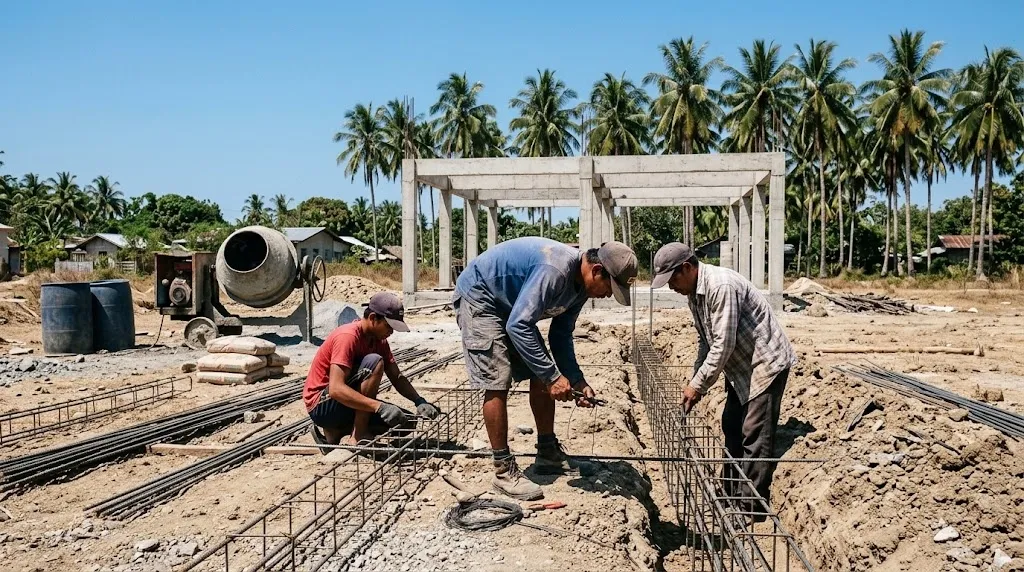
Clear sky: a workable week, not a promise for the season. Illustrative photo.
If you are about to break ground in Dumaguete, Bais, Tanjay or anywhere else in Negros Oriental, PAGASA's latest word sounds like good news for a builder. Its El Niño page, updated 21 October 2026, rates the event strong to very strong, says most climate models keep it going until the first quarter of 2027 with a peak before the end of 2026, and warns that its impacts may continue through the first half of 2027. PAGASA's drought assessment issued 1 October already had Negros Oriental under drought as of September. That is a long workable window for some of the job. For the rest of it, the same weather is the problem.
Below, the stages of a house are sorted into the ones a long dry stretch helps and the ones it hurts, with what the sources do and do not promise. The planner lays your own start date against PAGASA's window. There is no drawing on this page, because a schedule is not geometry.
Enter your start date and house. The tool lays AEDO's seven building stages end to end in dry-weather weeks, adds your slippage allowance, and shows which stages finish inside the window you set. The window defaults to the end of the first half of 2027, the period through which PAGASA says El Niño's impacts may continue; most models end the event itself in the first quarter. It is not a statement that no rain will fall. A planning aid, not a forecast.
Six documents carry the news. We opened each of them again on 5 November 2026.
Put those together and you get a pattern, not a calendar. Below-normal rain is the lean for most of the country into early 2027, and for Negros Oriental PAGASA's outlook takes the province off the list for the end of October and November, then brings dry conditions back from December. None of the six says rain returns in a particular month, and none says a particular week will be dry. Dumaguete's own normals show why that matters: in an ordinary year every month has at least five rainy days.
Dry ground is the plain benefit. Excavation does not fill with water, footing pits stay open, and the crew does not stop for a shower every afternoon. In the AEDO stage table behind the planner, site preparation, the elevated slab and the roofing system are the three stages rated high for rain sensitivity. Those are the ones a dry stretch helps most:
Hot, dry, windy air pulls water out of anything that is supposed to cure. That includes concrete, mortar, plaster and tile bedding. This section is our reasoning from how those materials work, not a quotation from PAGASA or a code; where a figure comes from a document we say which one.
| Stage (AEDO table) | Rain sensitivity | In a long dry stretch |
|---|---|---|
| Site prep, excavation, footings | High | Gains: open pits, no pumping. Loses on backfill: soil compacts best near an optimum water content. ASTM D698's scope is the relationship between moulding water content and dry unit weight of soil. Bone-dry fill needs water added to compact, which means a water supply and a plan for it. Footing concrete still needs its curing water. |
| Ground-floor columns and CHB walls | Moderate | Mixed. Mortar and column concrete dry out quickly in hot, dry air. Our how-long guide's table keeps moist curing going for 7 days on columns even after the side forms come off. |
| Elevated slab | High | Gains on rain delays, loses on the pour. A slab has the widest face to sun and wind, so it is where early drying and surface cracking show first. Where the plans give no stripping strength, props stay under it about 7 days and under the beams about 14 days, per the ACI 347-04 fallback in our formwork guide, and the surface must stay damp through that time. |
| Upper columns and roof beam | Moderate | Same curing demand as the ground floor, higher up where wind is stronger. |
| Roofing system | High | Gains: the most workable stage in a dry spell. No curing water needed. Still sized for the next strong cyclone. |
| Plaster, tiles, ceilings | Low | Loses. Plaster coats and tile bedding mortar lose water fast to dry air and need damp curing and wetting of the CHB first (cement plaster over thirsty block cracks early). It is the biggest labour stage, so it spends the most weeks in hot, dry air. See our CHB plastering guide for the cost side. |
| Painting, fixtures, punch list | Moderate | Gains for exterior paint. Check the paint data sheet for temperature, humidity and substrate-moisture limits. New plaster still has to cure before it is coated. |
The Philippine rules for hot-weather concrete are in your designer's specification and in the concrete standards the NSCP adopts, and we are not going to restate numeric limits here that we did not read. What we can say plainly is the thing owners miss: a dry spell does not remove the curing requirement, it makes it harder to meet. The pour that fails in a dry year usually fails quietly, with fine cracking or a dusty surface a few weeks later, and nobody connects it to the date it was poured.
PAGASA's own outlook lists water resources among the climate-sensitive sectors that dry spells and droughts can hit. For a building site that turns into three practical questions to answer before the first pour:
Write the answers into the contract or the bill of quantities, with a named person responsible for keeping slabs damp. We deliberately give no litres per square metre here: the amount depends on your mix, your curing method and the weather on the day, and we did not find a Philippine figure we could stand behind.
An owner who hears “dry until mid-2027” can make two opposite mistakes. One is to rush the structure so the roof is on before the rains, and to skip steps to do it: thin curing, early stripping, a pour in the hottest hour of the day. We would rather see a roof go on a month later over a slab that cured properly than a month earlier over one that cracked. The other mistake is to relax, because “it won't rain”, and leave a roof open or materials uncovered.
Both fail on the same fact. The forecast is a tendency. PAGASA's 7 October advisory says above-normal rain can still come with tropical cyclones and other rain-bearing systems, its July outlook expects three to six tropical cyclones in October to December, and a news report of the July advisory gives PAGASA's view that some cyclones may still reach typhoon or super typhoon strength. Dumaguete's normals show five or more rainy days even in the best month. Keep your tarps, your covered cement storage and your roof-to-wall connections as if the forecast were wrong. Our typhoon-resistant construction guide and typhoon season house check cover the connections.
A third mistake is financial. Starting early to catch a window with an unfinished design, an unready permit or money for half the job leaves a half-built shell standing through the stage you wanted to protect. The permit rules in our how-long guide say a building permit can lapse if work does not start within a year of issue or is suspended or abandoned for 120 days, so pulling the permit early to “lock in” a start date can cost you the permit.
If a whole province hears the same forecast, a lot of owners will try to start at the same time. That is our expectation, not data, and we have no count of permits or demand to show it. It still affects what you control: order cement, steel, blocks and roofing early enough that they are on site when the crew needs them, and book the plaster and tile crew for the stage that comes last, not the one that starts first. Keep cement off the ground and covered; heat does not make bagged cement forgiving of damp.
Then add float. The planner's slippage allowance is there for that, and the verdict row is blunt about it: if the roof lands after the window end at your start date, a month of slip puts the open roof into whatever weather follows. Our best-time guide explains how to write a rain-delay allowance into a contract, and the how-long guide shows the holds no crew can shorten. If you are building a court slab rather than a house, the same logic applies to paint: see our court painting schedule, which uses the same Dumaguete normals.
Negros Oriental: AEDO designs and builds here, the same design-build and construction service as our other work, with the stage order, the curing plan and the site water plan written into the programme. See our Dumaguete and Bais pages for where we work. We quote after a plan review or site visit.
Everywhere else in the Philippines: we do not build. We design and seal the drawings, review a contractor's programme remotely, and check milestones on site. The Single Milestone Check is from ₱7,500 per visit (project oversight), and a pour or a roof close-in is a sensible milestone.
PAGASA itself: the El Niño page (updated 21 October 2026), the drought and dry spell assessment (issued 1 October 2026), El Niño Advisory No. 5 (issued 7 October 2026), the July to December 2026 outlook, the Climate of the Philippines page (dry season December to May, hot dry March to May) and the Dumaguete 1991 to 2020 normals (rainy days per month, 124 a year, 1,322.6 mm). News reports of PAGASA briefings: GMA for the 81% and 97% figures, the July drought list with Negros Oriental and Siquijor, the dry-spell and drought definitions and the cyclone remark; Philstar Life for the 23 September advisory. Standard: the ASTM D698 scope page, for the moisture-density relationship in compaction. AEDO's own numbers: the seven stage weeks, the 0.6 area exponent and the rain-sensitivity ratings from our how-long-to-build guide; the 15% slippage allowance is an assumption with no source. Our reasoning, not a document: how hot dry air treats curing, plaster and tile bedding, and the guess that crews will be busy. Not found: a Negros Oriental line in the July outlook PDF, any PAGASA date for the return of normal rain, a 2026 water rationing notice for the province, and a Philippine figure for site curing water per square metre. Watch two things: the 97% figure comes from the July GMA report, not the 23 September advisory or the current PAGASA page, and the GMA drought listing was a July forecast; PAGASA's own October file is the current word for the province.
Will it stay dry in Negros Oriental until the middle of 2027?
Nobody can promise that. PAGASA's El Niño page, updated 21 October 2026, says most models keep El Niño going until the first quarter of 2027 and that its impacts may continue through the first half of 2027, which describes the ocean-and-air pattern, not a rain gauge reading. PAGASA's drought assessment of 1 October had Negros Oriental under drought as of September, off the list for the end of October and November, then dry again from the end of December to drought by the end of February and March 2027. We found no PAGASA line that gives a month when normal rain comes back, so plan the window as a tendency and carry float.
Is a long dry season a good time to build a house in Negros Oriental?
It is good for the stages that dislike rain: excavation, footings, roofing and exterior painting. It is harder on the stages that need water: concrete curing, masonry mortar, plaster and tile bedding, plus the moisture needed to compact backfill. Dumaguete's PAGASA normals for 1991 to 2020 show no month under five rainy days even in a normal year, so this is a shift in odds, not a switch from wet to dry.
Can I pour concrete in the dry season without extra care?
No. Hot, dry and windy conditions pull water out of fresh concrete faster, and the slab surface is the most exposed part. Plan a water source on site, a curing method you can keep going for the full moist-cure period our how-long guide gives (at least 7 days for ordinary concrete), and pour in the cooler hours. Your designer's specification governs the exact requirements.
If El Niño means fewer typhoons, do I still need a typhoon-ready roof?
Yes. PAGASA's July outlook still counts 3 to 6 tropical cyclones for October to December, and a GMA report of PAGASA's July advisory says some can reach typhoon or super typhoon strength. Fewer storms is the expectation, not a promise. A roof put up in a quiet season has to survive the next strong one, so tie it to the walls as if it were a wet year.
Should I start the foundation now to beat the rains?
Start when the permit, the plans, the money and the materials are ready, not because of a forecast. A rushed start with unfinished design, thin curing or an owner who runs out of money mid-build costs more than a few wet weeks. A building permit can also lapse if work does not start within a year or stops for 120 days, so do not pull it early just to have it.
Does AEDO build houses in Negros Oriental?
Yes, in Negros Oriental only, and we can lay the stages out against the weather for your lot. Outside the province we do not build: we design and seal the drawings, go through your contractor's programme remotely, and visit at milestones, starting at 7,500 pesos per Single Milestone Check visit.
Documents read for this article in October and November 2026. External links open in a new tab.
We could not find a Negros Oriental line in the text of PAGASA's July outlook PDF; the province's drought status comes from PAGASA's own assessment issued 1 October 2026. We found no PAGASA statement that says when normal rainfall returns, no 2026 water rationing notice for Negros Oriental and no Philippine figure for curing water per square metre. The El Niño window in the planner is PAGASA's persistence statement, not a rainfall forecast. This article is general information, not a design, a construction specification or a quotation.
Send the lot, your plans or sketches and the month you want to start. Our team will lay out the stages against the weather outlook and tell you where to protect the curing, the backfill and the roof date.