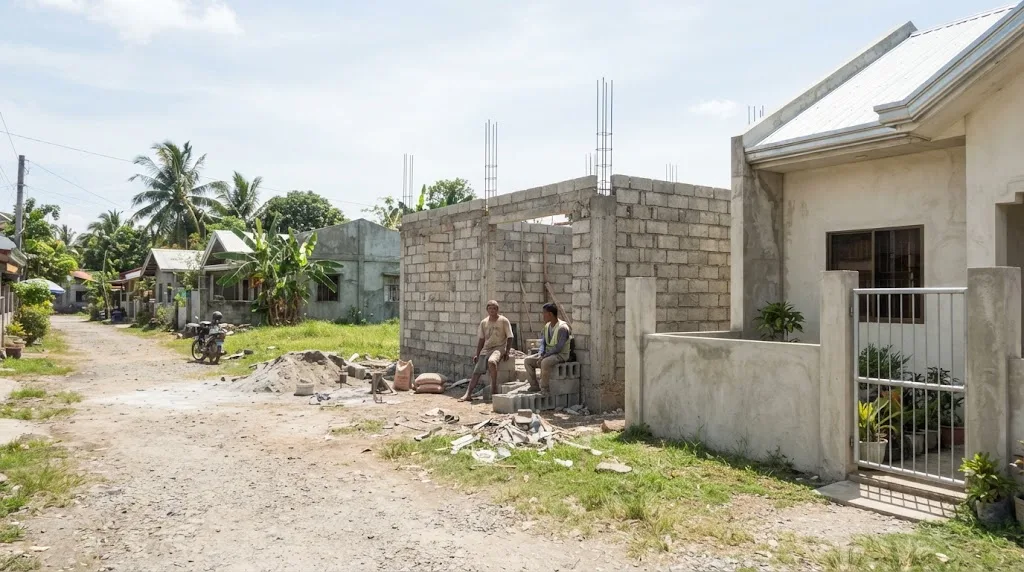
A finished house on one side, a bungalow going up on the lot next door. Two roads to the same front door, and they don't cost the same. Illustrative photo.
Short answer: it depends on where you are and how much house you want. In a Negros Oriental city, building usually comes out cheaper once you count everything. Take an 80 sqm economy-finish bungalow on a ₱600,000 lot. On our 2026 planning rates the build route lands at about ₱2.51M to ₱3.24M all-in. That covers the lot's transfer taxes, survey, fill, plans, permits, construction (with the builder's overhead and contingency already inside the per-sqm rate) and nine months of rent while you wait. It doesn't cover a septic tank, fence or gate, which a resale house usually already has. A ₱3.2M resale house of the same size, with 10% set aside for repairs, comes to about ₱3.64M to ₱3.65M. In big cities the answer often flips. Land is the expensive part there, and a developer who buys it in bulk and builds forty identical small houses can beat what you'd pay building one. Building wins on size, lot choice and quality control. Buying wins on speed and knowing the price on day one.
The calculator puts both routes side by side with your own numbers. After it: each cost stack line by line, the transfer taxes as the law actually writes them, cost per usable square metre, move-in time, financing and resale.
Tax rates are read from the NIRC, the TRAIN law and the Local Government Code. Construction, design, permit, survey, fill, utility and registration figures are AEDO 2026 planning rates, not quotations. The default is an illustrative Negros Oriental case; put in the real lot price and the real listing you're comparing.
People ask it as one question, but it's really two. The first is about land: who buys it, how much of it, and at what price. The second is about the house: how well it's built, how big, and who takes the risk of it costing more than planned. Buying a house and lot bundles both into one price. Building splits them, which gives you more control and more bills.
Where building tends to win:
Where buying tends to win:
The honest answer is to price both with real numbers, and that's what the calculator is for. What follows is where each line in it comes from.
The per-sqm construction rate everyone quotes is only the biggest line. These are the others, in the order you'll pay them.
| Line | What it covers | AEDO 2026 planning figure |
|---|---|---|
| Lot | The price in the deed | Your number |
| Lot transfer costs | Documentary stamp tax, local transfer tax, Registry of Deeds registration, notarial and certification costs (section 4) | DST 1.5% + transfer tax up to 0.5–0.75% + a registration and notarial allowance of 0.5–1% |
| Relocation survey | A geodetic engineer re-locating the corners so you build inside your own lot | ₱15,000–35,000 for an ordinary residential lot |
| Fill and compaction | Raising a low lot above the road, placed and compacted in layers | Fill ₱450–800/m³ delivered, bought 20–25% loose over the finished volume (the calculator uses 20%), plus ₱180–320/m³ to spread and compact |
| Plans | Architectural, structural, electrical and sanitary sets, signed and sealed | 8–12% of construction cost |
| Permits | Building permit and ancillary permits, clearances and LGU charges | ₱30,000–80,000 for a house |
| Construction | Structure, masonry, roof, doors and windows, rough-ins, finishes | Economy ₱20,000–26,000/sqm · standard ₱27,000–38,000 · mid-high ₱38,000–55,000; two storeys about 10–20% more for the same area (the calculator uses 15%). The builder's overhead and a 10–15% contingency are already inside these bands |
| Utility connections | Power service entrance and meter, water connection | ₱20,000–50,000 |
| Septic tank, perimeter fence, gate | Site development that isn't in the per-sqm bands. A resale house usually already has them | Not in the calculator; add them if your lot has none (see our septic tank sizing and perimeter fence cost guides) |
| Rent while building | The house you live in until this one is ready | Your rent × months to move in |
The construction bands are the ones in our house construction cost guide and cost per square metre guide, and the 8–12% for plans matches our house design fee guide. For a reality check from our own area: an actual completed bungalow in Bais City came in at about ₱19,000 per sqm direct cost, built by an owner-hired local crew with no exterior paint and ceilings only over the living room and master bedroom. That's below our economy band because it leaves out a contractor's overhead, supervision and the finishes most people expect. It's a useful floor, not a quote.
Survey and fill are the two lines people forget. A boundary you guessed at is the most expensive mistake you can make on a lot, so budget the relocation survey before you pour a footing. Fill is where cheap lots stop being cheap. A 150 sqm lot raised 30 cm needs about 45 m³ of compacted fill, around ₱32,000 to ₱58,000 on our rates, and a lot below a flooding road can need a metre or more plus a drainage line. Our lot filling guide runs that number properly, retaining walls included.
Storeys matter less than people think. For the same floor area on a lot where both fit, a bungalow is usually a little cheaper, since the second storey brings a suspended slab, a stair and a heavier frame. The bungalow vs two-storey guide has the side-by-side.
Buying looks like one number. It isn't, and the extras depend on who's selling.
| Line | New, from a developer | Resale, from an owner |
|---|---|---|
| Price | Price list, usually on a payment scheme | Negotiated, usually one deed |
| VAT | 12% on a house and lot above ₱3.6M; ask whether the price list already includes it | None when the seller isn't in the real estate business |
| Capital gains tax | Not applicable to a developer's sale of its inventory | 6% on the seller's side, if the deed keeps it there |
| DST, transfer tax, registration | Usually charged to the buyer, often as a "transfer fee" or "miscellaneous" line | Commonly paid by the buyer; check the deed |
| Repairs | Punch-list items the developer should fix at turnover | Roof, plumbing, wiring, termites, cracks: the calculator uses a % you choose |
| Hidden-defect risk | Lower on a new house, but the finishes hide as much as they show | Higher, and the legal window to claim is short (section 6) |
| Inspection before you pay | AEDO's pre-purchase structural assessment: ₱5,000 flat, written report in five business days | |
For a resale house, the repair allowance is the number to argue about. A 10% default is a planning figure for a house that's sound but tired. A house with a leaking roof, an unpermitted second floor or diagonal cracks at the window corners can need a lot more, and that belongs in your offer price, not your surprise budget. Our structural checklist for buying a house tells you what to look at before you commit, and our house renovation cost guide has per-sqm bands if the repairs turn into a renovation.
Every lot you buy to build on, and every house you buy instead, goes through the same transfer. We read each rate from the law itself.
| Charge | Rate and base | Legal source | Who the law puts it on |
|---|---|---|---|
| Capital gains tax | 6% final tax on the gross selling price or the current fair market value, whichever is higher | NIRC Sec. 24(D)(1) | The seller: it's a tax on gains "presumed to have been realized" by individuals selling real property held as a capital asset |
| Documentary stamp tax | ₱15 for the first ₱1,000 and ₱15 per additional ₱1,000 or fraction, which is 1.5%, on the price or fair market value, whichever is higher | NIRC Sec. 196, as amended by RA 10963 (TRAIN) Sec. 69 | Either party: Sec. 173 charges "the person making, signing, issuing, accepting, or transferring" the document |
| Local transfer tax | Not more than 50% of 1% (0.5%) of the consideration or fair market value, whichever is higher, set by the province's revenue ordinance. Cities may go up to 50% above the provincial maximum, so up to 0.75% | Local Government Code (RA 7160) Sec. 135 and Sec. 151 | The seller: Sec. 135 makes it the seller's duty to pay within 60 days of the deed |
| Registration fees | On the Land Registration Authority's schedule for the Registry of Deeds | LRA schedule (we did not read a primary copy, so no figures here) | Registration expenses fall on the seller by default (Civil Code Art. 1487) |
| VAT (developer sales only) | 12% of the gross selling price. A house and lot at not more than ₱3,600,000 is exempt, adjusted from ₱3,199,200 from January 1, 2024 | NIRC Sec. 106 and Sec. 109(1)(P) as amended by TRAIN; BIR RR No. 1-2024 (January 10, 2024) | The seller, who builds it into the price |
A few things behind that table matter for your budget.
On a ₱3,200,000 resale house in a city: DST ₱48,000, transfer tax up to ₱24,000, plus registration and notarial costs the calculator allows at 0.5–1% (₱16,000–32,000). The seller's capital gains tax would be ₱192,000. On the ₱600,000 lot for the build route: DST ₱9,000, transfer tax up to ₱4,500, plus ₱3,000–6,000 for registration and notarial costs. All of these assume the price is at least the government's valuation.
Divide each all-in total by the floor area you'd actually live in. In the default example the build route works out to about ₱31,400 to ₱40,500 per sqm including the lot, and the resale house to about ₱45,500 to ₱45,700 per sqm. Three traps when you compare listings this way:
This is also where developer stock can win in a city. Its per-sqm number includes land bought wholesale and a design built many times over. If a developer's house fits your family, and the per-sqm all-in is lower than the build number, buying is simply the better deal. There's no engineering reason to build for its own sake.
This is where building earns its keep. When you build, you can see the rebar before the concrete goes in, check the column sizes against the plans, and refuse a hollow block wall with half-filled cores. The Revised IRR of PD 1096 (Sec. 308) requires the owner to engage a licensed architect or civil engineer for full-time inspection and supervision of the construction, and that person works for you. When you buy, all of that is buried behind plaster and paint.
The law gives a buyer less protection than most people assume:
So a crack you could have seen is yours from the day you sign, and a warranty claim for a hidden one has to be filed within six months of turnover. Other remedies, like fraud, exist but are slower and harder to prove. Have the house inspected before you pay. It's the one piece of leverage the law leaves a buyer. Our structural assessment service does this for ₱5,000 flat, with a written report you can take into the price negotiation.
Building has its own risk, and it's the mirror image: cost and schedule overrun. That's why the per-sqm bands on the build side carry a 10–15% contingency inside them, and the buy side needs none. A buyer knows the price on day one. A builder knows it at turnover.
No law sets a construction schedule, so these are AEDO planning durations for a small house in Negros Oriental:
Time is money here in a very literal way. Nine months at ₱8,000 rent is ₱72,000 that goes nowhere, and a build that slips three months adds another ₱24,000. If you're already renting, set the months honestly in the calculator. If you're living with family and paying nothing, set rent to zero, and building gets relatively cheaper.
Pre-selling developer units are a third path we don't model. You pay while it's built, sometimes over years, and you carry the delivery risk that a builder carries, without the control.
Both Pag-IBIG and the banks lend for both routes, but the two loans behave differently. The figures below are the ones in our house construction loan guide, which lists its sources. Confirm the current terms with the lender, because they change.
| Building (construction loan) | Buying (purchase loan) | |
|---|---|---|
| Pag-IBIG | Loan proceeds can finance any one or a combination of: a residential lot of up to 1,000 sqm, a house and lot (new or old), construction on a lot owned by the borrower or a relative, and home improvement (Circular No. 403, the Affordable Housing Program guidelines). Ceiling raised to ₱10M in May 2026, terms up to 30 years, at least 24 monthly contributions, monthly amortization not more than 35% of gross monthly income | |
| Banks (BPI, Metrobank, BDO published programs) | Up to 80–90% of property value, terms up to 20–25 years, rates of roughly 6.25% to 12% depending on bank and fixing period | |
| What the lender prices the loan on | A construction cost estimate and bill of materials, plus the plans | The deed of sale and the lender's appraisal |
| Collateral | The lot being built on: for banks usually a titled lot you already own; Pag-IBIG allows a combined lot-purchase-plus-construction loan, and its Affordable Housing Program also accepts a close relative's lot | The house and lot you're buying |
| How it's released | Commonly in stages tied to inspected progress | Once, to the seller, at closing |
The practical difference is cash. To borrow for construction, banks normally want the lot titled in your name first, so the lot is usually paid out of savings or a separate lot loan. Pag-IBIG is more flexible: its Affordable Housing Program guidelines (for lower-income members) allow construction on a lot owned by a relative, who signs the mortgage with you as co-mortgagor (up to the second civil degree by blood or the first by marriage), and a lot purchase plus construction in one loan. Then your contractor's payment schedule has to follow the lender's release schedule, not the other way around. A purchase loan is simpler: one appraisal, one release, one deed. If your savings cover the lot but not the house, building with a construction loan works well. If they cover only a down payment, buying is often the only route open.
The calculator leaves out interest on both sides. A long build means you pay interest on released tranches while still paying rent, so if you finance the build, the gap narrows a little in buying's favour.
We won't put a number on appreciation. It depends on the town, the street and the decade, and nobody can promise it. A few things hold anywhere, though:
Run the calculator with real numbers first. Then, if it's close:
AEDO's role on a build or a purchase. Nationwide, AEDO prepares the complete permit set (architectural, structural, electrical and plumbing), the itemized bill of materials that Pag-IBIG and the banks size a construction loan on, and remote construction oversight of the local contractor you hire. We also do pre-purchase structural assessments for ₱5,000 flat. In Negros Oriental, AEDO designs and builds the house itself. We don't build outside Negros Oriental; everywhere else it's design plus remote review. See our design-build service.
Capital gains tax and the principal-residence exemption are NIRC Sec. 24(D), with the escrow procedure in RR 13-99 as amended by RR 14-2000; documentary stamp tax is Sec. 196 as amended by RA 10963 Sec. 69, with Sec. 173 on who pays; VAT is Sec. 106 and Sec. 109(1)(P) as amended by RA 10963, with the ₱3,600,000 threshold from BIR RR No. 1-2024. The local transfer tax is RA 7160 Sec. 135, with the city rate ceiling from Sec. 151. The tax base rules are RA 12001 Secs. 18, 29, 31 and 38. Buyer protections are Civil Code Arts. 1487, 1561 and 1571; the owner's full-time supervision duty is Sec. 308 of the Revised IRR of PD 1096. Pag-IBIG loan purposes, the 24-contribution rule and the 35% cap are from Pag-IBIG Circular No. 403 (Affordable Housing Program guidelines); the ₱10M ceiling is from May 2026 news reports; bank terms are from our house construction loan guide and its sources. Construction bands (with overhead and a 10–15% contingency inside them), the two-storey factor, design and permit allowances, survey and fill rates, utility connections, registration allowance, durations and the repair percentage are AEDO 2026 planning figures. The Bais City ₱19,000/sqm figure is an actual completed AEDO-area job, direct cost only.
Is it cheaper to build or buy a house in the Philippines?
It depends on where and how big. In a Negros Oriental city, building usually wins once you count everything: for an 80 sqm economy-finish bungalow on a ₱600,000 lot, AEDO 2026 planning figures put the build route at about ₱2.51M to ₱3.24M all-in, including lot transfer costs, survey, fill, plans and permits, construction with overhead and contingency inside the per-sqm rate, and nine months of rent. A ₱3.2M resale house of the same size with 10% for repairs comes to about ₱3.64M to ₱3.65M. In big cities, where land is the expensive part, a developer's small house-and-lot is often cheaper per square metre than anything you can build on a lot you buy yourself. Building wins on size, lot choice and quality control; buying wins on speed and certainty of price.
What taxes do you pay when you buy a house or lot in the Philippines?
Four government charges apply to an ordinary sale. Capital gains tax of 6% under Section 24(D) of the NIRC, a tax on the seller's presumed gain. Documentary stamp tax of ₱15 per ₱1,000, or 1.5%, under Section 196 as amended by the TRAIN law. Local transfer tax under Section 135 of the Local Government Code, at not more than 0.5% in a province and, under Section 151, up to 0.75% in a city. And Registry of Deeds registration fees on the LRA schedule. The taxes are computed on the higher of the price and the government's valuation of the property. If you buy from a developer, 12% VAT applies to a house and lot priced above ₱3.6 million under BIR Revenue Regulations No. 1-2024.
Who pays capital gains tax and transfer costs, the buyer or the seller?
The law puts most of them on the seller, but the deed decides. Capital gains tax is imposed on the seller's gain. Article 1487 of the Civil Code says the expenses for the execution and registration of the sale are borne by the vendor unless there is a stipulation to the contrary, and Section 135 of the Local Government Code makes it the seller's duty to pay the transfer tax. In practice many deeds of sale shift documentary stamp tax, transfer tax and registration to the buyer while the seller keeps capital gains tax. Agree it in writing before you sign. The calculator assumes that common split, so the buyer carries DST, transfer tax and registration.
Can I use a Pag-IBIG loan to build a house instead of buying one?
Yes. Pag-IBIG's housing loan covers lot purchase, house construction and home improvement, not only buying a finished house, up to a ₱10 million ceiling from May 2026 and terms of up to 30 years. The difference is the paperwork and the cash flow. A construction loan needs the lot title (usually yours; Pag-IBIG's Affordable Housing Program also accepts a close relative's lot), the building plans and a construction cost estimate with bill of materials; Pag-IBIG can also finance the lot purchase and the house together in one loan. A construction loan is usually released in stages as inspected work progresses. A purchase loan is released once, to the seller, at closing. The big banks' published programs lend for both, at 80% to 90% of the property value.
How long does it take to build a house compared with buying one?
Plan on about nine months from buying the lot to moving in for a small bungalow in Negros Oriental: a month or two for the lot, survey and fill, one to two months for plans and the building permit, and around six months of construction. These are AEDO planning durations, not a rule. A ready-to-occupy or resale house is usually yours in two or three months, mostly loan processing, the transfer and any repairs. Every extra month of building is another month of rent, which the calculator adds to the build side.
Laws, regulations and references read for this article. External links open in a new tab.
Registry of Deeds fees follow the Land Registration Authority's schedule, which we could not read from a primary copy for this article, so no fee figures are given; the calculator uses a registration and notarial allowance of 0.5–1% of the price as an AEDO planning figure. Your province's or city's actual transfer tax rate is set by its revenue ordinance and may be below the legal ceiling. Durations, the repair percentage, utility connection costs, the rent default and the default lot and house prices are AEDO planning figures or illustrative inputs, not market surveys.
Send us the lot you're looking at and the house you'd otherwise buy. We'll price the build properly and tell you what to look for in the house for sale.