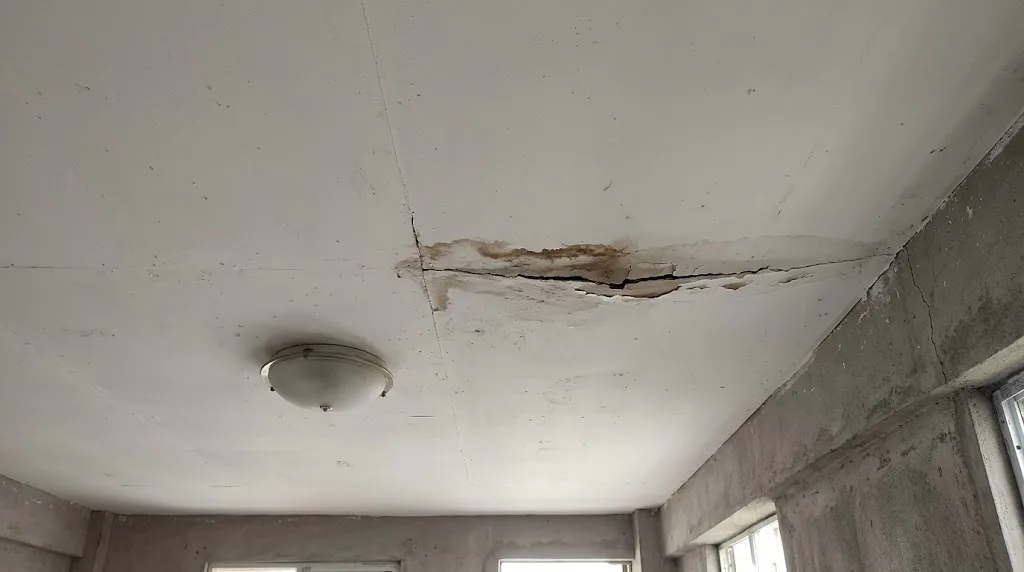
A stain that follows a board joint usually means water is sitting on the board from above. Fix the leak before the ceiling. Illustrative photo.
Short answer: a new ceiling on metal furring, supplied, installed and painted, works out to roughly ₱627-1,059 per sqm in gypsum board, ₱681-1,127 per sqm in fiber cement board, and ₱484-793 per sqm in PVC panels (no painting needed). A typical 20 sqm bedroom in gypsum comes to ₱12,540-21,182. Tearing out an old ceiling and working above 3 meters add to that. Those figures come straight out of the calculator below, so you can change the area, board, framing and job type and see every line item.
If your ceiling is sagging, fix the reason before you price the boards. A new ceiling under a roof that still leaks, or on wood framing that termites are still eating, will sag again. The checker further down helps you sort out which one you're dealing with and how urgent it is.
All three hang on the same kind of frame. What changes is how each board handles water, heat and pests, and how it's finished.
| Gypsum board | Fiber cement board | PVC panel | |
|---|---|---|---|
| Typical ceiling thickness | 9 mm or 12 mm (USG Boral) | 3.2-6 mm for ceilings (Excelcon); 4.5 mm is common retail | 8 mm, 250 mm × 2.95 m panels (Wilcon) |
| Moisture | Standard board is for areas where water resistance is not required; USG Boral's room chart suggests a moisture-resistant board for wet areas | SHERA lists its European boards as immune to water damage, with the 8 mm board suited to ceilings and soffits; ask your local supplier about the board you're buying | Some panels listed for indoor and outdoor use (Wilcon); commonly used on eaves (Excelcon) |
| Fire | Standard board is not a fire-rated product; fire-rated boards are a separate type (USG Boral, Gyprock) | SHERA's European boards are rated non-combustible, A1 under EN 13501-1; that rating doesn't automatically carry to other brands or local 4.5 mm boards, so ask for the actual board's rating | No fire classification published on the retail listings we checked; ask for a test report |
| Termites | Framing is the risk, not the board | SHERA lists its European boards as termite resistant; confirm for the local board | Framing is the risk, not the panel |
| Finish | Taped, jointed and painted for a seamless look | Painted; joints usually visible or covered | Prefinished, no painting |
| Best suited to | Bedrooms, living rooms, hallways | Kitchens, CRs, laundry areas, eaves and soffits | Eaves, carports, budget ceilings where a panel look is fine |
A few things that table doesn't say out loud. Gypsum's paper face is the weak point once it gets wet, which is why USG Boral's room chart suggests its WetStop moisture-resistant board for wet areas and Gyprock describes its moisture-resistant boards as having a core treated to resist moisture and humidity. Even those are meant for wet rooms, not for direct exposure to a roof leak. Fiber cement still takes on water (SHERA lists water absorption under 35% for its European board), so a soaked board has to dry out before you paint it. The SHERA ratings in this table are for SHERA's European product range; Hardiflex and other boards sold locally publish their own data, so ask the supplier for the rating of the exact board you're buying. And PVC's appeal is that it's prefinished and cheap to install, but it's a plastic, so we'd want a fire test report in hand before lining a whole kitchen with it.
Most Philippine board ceilings hang from a light steel grid. Carrying channels, the heavier members, are hung from the roof or floor framing. Metal furring channels clip under them at closer spacing, and the boards screw to the furring. Gyprock's ceiling installation guide (an Australian guide dated 2008) sets furring at 450-600 mm maximum centres depending on the board, and 450 mm in high-humidity or external areas: its standard 10 mm board gets 450 mm, and 600 mm applies to 13 mm and some other 10 mm boards. It doesn't cover the 9 mm boards common here, so the calculator uses the tighter 450 mm. Top cross rails and suspension points sit at 1,200 mm maximum. USG Boral's Philippine brochure says ceiling framing should follow the framing manufacturer's recommendation, with board screws no more than 200 mm apart at sheet ends.
Older houses often use wood framing instead. It works, but it's the part termites go after, and the same Gyprock guide caps timber ceiling framing spacing too. Excelcon, a ceiling supplier, notes metal furring is preferred over wood for its resistance to moisture, termites and warping.
Enter the ceiling area and pick the board, framing and job type. Each row is a separate line item, and the total is the exact sum of the rows shown.
Almost every sagging ceiling we see comes down to one of four things.
Tick everything you can see from below without climbing into the ceiling. It's a screening tool that points you at the likely cause and how urgent it is, not an inspection.
When a sagging ceiling is a safety issue. If the ceiling is wet, bulging, cracking, growing, or a fan or fixture is pulling down, deal with it today. Keep people out from under it, move valuables, put a bucket under any drip, and switch off the circuit for any light or fan in that section. Stop the leak or call for roof repair first. If it's bulging with water, don't poke it yourself when the bulge is large or near wiring or lights. A slight, dry, old sag that hasn't changed in months is usually a framing or fastening problem you can plan around. If the sag comes with soft or sagging roof framing, cracked beams, or termite damage in structural wood, it's no longer just a ceiling job. Read structural damage warning signs and have an engineer check the framing first. Damp walls under the same leak are covered in our damp wall and peeling paint guide.
How much does a new ceiling cost per square meter in the Philippines?
With new metal furring framing, supplied and installed, our calculator gives about ₱627-1,059 per sqm for painted 9mm gypsum board, ₱681-1,127 per sqm for painted 4.5mm fiber cement board, and ₱484-793 per sqm for PVC panels, which don't need painting. A 20 sqm bedroom ceiling in gypsum comes out at ₱12,540-21,182. Board and framing prices are from Philippine retailer listings checked on 2026-09-16, labour uses AEDO's published daily rates, and the waste allowance and crew output per day are AEDO market estimates. Removing an old ceiling and working above 3 meters add to that.
Which is better for a ceiling: gypsum board, fiber cement board or PVC?
It depends on the room. Standard gypsum board gives the smoothest painted finish for dry indoor rooms, but USG Boral positions its standard board for areas where water resistance is not required, and its room chart suggests a moisture-resistant board for wet areas. Fiber cement board suits wet areas, eaves and soffits: SHERA rates its European boards non-combustible (A1 under EN 13501-1) and termite resistant, but that doesn't automatically apply to other brands or local 4.5mm boards, so ask the supplier for the rating of the board you're buying. PVC panels come prefinished and some are listed for indoor and outdoor use, which is why they're common on eaves, but the retail listings we checked don't publish a fire classification, so ask the supplier for a test report before using them indoors in large areas.
Why is my ceiling sagging?
The usual causes are water, termites, framing that was spaced too wide, and heavy fixtures hung from the board. A brown ring or soft patch at the low point points to a roof or plumbing leak soaking the board. Mud tubes, powdery wood or wings near wooden framing point to termites. A wavy sag running in lines across a dry ceiling points to over-spaced or under-fastened framing; Gyprock's Australian installation guide calls for furring channels at 450-600 mm maximum centres depending on the board, and 450 mm in humid areas. A sag centred on a light or ceiling fan means the fixture is hanging from framing that was only designed to carry the ceiling itself.
Is a sagging ceiling dangerous?
It can be. If the ceiling is wet, bulging, cracking or growing, or a fan or light fixture is pulling down, act today. Keep people out from under it, move valuables, put a bucket under any drip, and switch off the circuit for any light or fan in that section. Stop the leak or call for roof repair first. Don't poke or push a large water bulge, or one near wiring or lights, yourself, because a waterlogged board can let go all at once. A slight, dry, old sag that isn't changing is usually a framing or fastening problem you can schedule, not an emergency.
Can I replace only the damaged ceiling boards instead of the whole ceiling?
Yes, if the framing above is still straight, dry and sound, and the leak or termite problem has been fixed first. Replacing boards on existing framing avoids the framing material and roughly halves the install labour in our calculator. It won't work if wood framing is termite-damaged or steel framing is rusted, and new boards rarely match old paint exactly, so plan to repaint the whole room's ceiling rather than just the patch.
Should I use wood or metal framing for a ceiling?
For most Philippine houses, metal. Galvanized metal furring doesn't feed termites and supplier Excelcon notes it is preferred over wood for its resistance to moisture, termites and warping. If you do use timber, keep the framing within the board maker's spacing (450-600 mm maximum centres depending on the board, 450 mm in humid areas, in Gyprock's Australian guide), use dry, treated lumber, and deal with any termite activity in the house first.
Manufacturer documents first, then retailer price listings (all checked 2026-09-16), then AEDO's own guides. External links open in a new tab.
AEDO market estimates, not from a published list: 10% board waste; crew output of 10-15 sqm/day (new framing and boards) and 20-30 sqm/day (boards only); hangers, wall angle, clips and screws ₱40-70/sqm; joint tape and jointing compound at board joints ₱40-80/sqm; removal output 15-30 sqm per helper-day; haul-out and disposal ₱30-60/sqm; scaffolding ₱25-50/sqm plus a 20% premium on install and painting labour above 3 m. Retail prices differ by branch and change often; confirm with your local supplier.
A licensed engineer checks the framing, the roof above and any termite or water damage, then gives you a repair scope you can price with confidence.