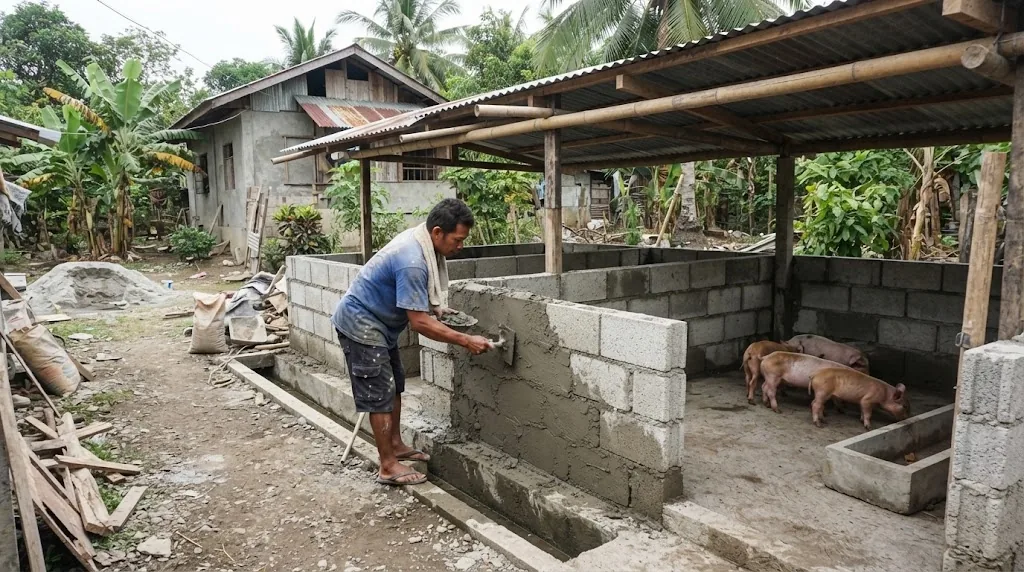
The floor slope and drain channel matter more than the walls. Get them right before the pens fill. Illustrative photo.
Short answer: a simple 10-slot backyard piggery, concrete floor, half-height CHB walls, basic GI roof, wash-down drain and water line, runs roughly ₱43,000–₱66,000. A basic 50-bird chicken coop, concrete or elevated slatted floor, wood-and-mesh framing, roof, roosting fixtures and a water line, runs roughly ₱14,150–₱23,450. Both scale with capacity, not floor area alone, because the drain, water line and partitioning cost also grow with the number of slots or birds.
Before you pour anything, two things trip up more backyard raisers than the construction itself: the floor has to actually drain toward a catch pit or the pen turns into a mud-and-waste pool by the second week, and the siting/permit question, because a backyard build that ignores it can get a stop-work order from the barangay after the concrete is already down. Enter your numbers below, then read the siting section before you commit to a site.
Pick piggery or poultry, enter your capacity, and each row below is a literal quantity × rate. The total is the exact sum of the rows shown.
Both structures are simple, low-rise, open-sided builds, so the money goes into four things: a floor that drains instead of pooling, low walls or framing to keep animals in and predators/strays out, a light roof for shade and rain cover, and the plumbing/drainage rough-in that turns daily cleaning from a chore into a five-minute hose-down. None of it needs the structural weight of a house, which is exactly why owner-built versions without engineering input often skip the one detail that actually matters: floor slope.
| Structure | Typical backyard scale | What drives the cost |
|---|---|---|
| Fully concrete piggery pen | 5–20 slots | Floor area, wall height/length, drain and catch pit; simplest to hose down |
| Partially slatted piggery pen | 5–20 slots | Same as above plus slat/framing over the pit; drier pigs, more upfront cost |
| Floor-type poultry house | 30–100 birds | Floor area at ~0.10 sqm/bird, framing/mesh walls, roosting fixtures |
| Elevated slatted poultry house | 30–100 birds | Support posts and slatted floor, less manure contact, easier under-house cleanout |
Not the walls or the roof, the floor slope and the roof overhang. A level floor means every wash-down leaves standing water, which is exactly the breeding ground for flies and the smell that gets a neighbor to file a barangay complaint. A roof with no eave past the wall line lets driven rain straight into the pen, keeping the floor wet even between hose-downs. Both are cheap to get right at construction and expensive to retrofit after the concrete is down.
There is no single distance rule written specifically for a backyard-scale pen, but there are fixed national figures for stockades built for commercial purposes. The Code on Sanitation of the Philippines (PD 856, 1975) implementing rules, Section 8.6.7, set fixed siting distances for a livestock stockade intended for commercial purposes: at least 100 meters (328 feet) from any place of human habitation, at least 25 meters from ground or surface drinking water sources, and at least 500 meters from national roads and highways. A separate national order also sets fixed distances, BAI Administrative Order No. 4, series of 2004, "Regulating the Distance Between Poultry and Livestock Farms in the Philippines," which requires at least 1 kilometer between farms and from the boundary of built-up areas, and 1 kilometer for poultry farms or 3 kilometers for commercial swine/cattle feedlots from national highways. Read both for what they are: written for a stockade or farm intended for commercial purposes, not explicitly a backyard pen with a handful of pigs or a few dozen birds in your own yard, where a 100-meter or 1-kilometer setback would rule out nearly every residential lot, but neither order states a backyard-scale exemption either, so don't assume they flatly don't apply to a larger backyard operation.
For household-scale raising, the practical answer is your barangay and municipal government. Under the Local Government Code (RA 7160), LGUs have the authority to regulate nuisances and issue the business and sanitary permits a piggery or poultry operation needs, and most barangays and municipalities set their own distance figures, often in the tens of meters from a neighbor's dwelling and from any water source, through local ordinances rather than national law. Those figures genuinely vary by municipality. Rather than repeat a number here that may not apply where you are, confirm the actual distance and permit list with your barangay captain and your municipal agriculture or veterinary office before you commit to a site, not after the pen is built.
Expect two documents at minimum: a barangay clearance for the specific use, and a sanitary permit from the municipal health office, both renewable annually in most LGUs we've seen. Some municipalities also require registration with the municipal agriculture office for disease-monitoring purposes. None of this is unique to large operations; it's just rarely enforced at backyard scale until a neighbor complains.
On wastewater: the Philippine Clean Water Act (RA 9275) generally prohibits discharging pollutants, including untreated animal waste, directly into a water body. A backyard pen doesn't need an industrial treatment plant, but it does need somewhere for wash-down water and manure to go that isn't a creek, canal or storm drain, a catch pit or holding tank you empty and manage, with solid manure composted or dried before it's used or sold as fertilizer. If your lot sits near a stream, irrigation canal or shares runoff with neighbors, that's worth raising with your municipal agriculture office or the DENR field office before you build, not something to guess at.
Building on Negros Oriental soil? Flood-prone or low-lying lots need the pen floor raised well above the highest water mark you've seen on that lot, on top of the drainage slope covered above. If you're not sure whether your site floods or how the soil will bear a slab, our lot hazard check guide and a site visit answer that before you pour anything.
How much does it cost to build a small backyard piggery in the Philippines?
For a simple 10-slot backyard pen with a concrete floor, half-height CHB partition walls, a basic GI roof, a wash-down drain and water line, budget roughly ₱43,000–₱66,000, or about ₱4,300–₱6,600 per slot, based on AEDO market estimates and our published CHB and plastering rates. A partially slatted pen with a wash pit underneath costs more per slot than a fully concrete floor. Site work, a deeper catch pit, or a longer building run the price up further.
How much does a backyard poultry house or chicken coop cost to build?
A simple 50-bird floor-type coop with a concrete floor, wood-and-mesh framing, a basic roof, roosting fixtures and a water/feeder line runs roughly ₱14,150–₱23,450, or about ₱280–₱470 per bird, as an AEDO market estimate. An elevated slatted-floor house costs a bit more per sqm of floor but usually needs less concrete overall, and it keeps birds off wet ground, which matters in the rainy season.
How far does a piggery need to be from my house or my neighbor's?
For a livestock stockade intended for commercial purposes, the Code on Sanitation of the Philippines (PD 856) IRR, Section 8.6.7, does set fixed distances: at least 100 meters (328 feet) from any place of human habitation, at least 25 meters from ground or surface drinking water sources, and at least 500 meters from national roads and highways. A separate national BAI order (Administrative Order No. 4, s. 2004) sets its own, larger distances, at least 1 kilometer from built-up areas and 1 to 3 kilometers from national highways. Both are written for stockades and farms intended for commercial purposes, not explicitly for a backyard pen with a handful of pigs, so for a household-scale pen the real answer is whatever your barangay ordinance or municipal sanitary code sets on top of these national floors, check with your barangay and municipal agriculture or veterinary office before you build.
Do I need a permit to raise pigs or chickens in my backyard?
Most LGUs require a barangay clearance and a sanitary permit from the municipal health office before a piggery or poultry pen operates, even at backyard scale, under the framework of the Code on Sanitation (PD 856) and the Local Government Code's authority for LGUs to regulate nuisances and issue business or sanitary permits. Requirements, fees and exact distance rules vary by municipality, so confirm the specific list with your barangay and municipal agriculture or veterinary office before you start building.
What's the difference between fully concrete and slatted pig pen flooring?
A fully concrete floor, sloped toward a drain, is hosed down and the wash water carries manure to a catch pit or holding tank. A partially slatted floor has a gap section, usually wood or bamboo slats, over a shallow pit so manure and urine drop through and the pigs stay drier and cleaner on top, at the cost of a pit to empty and slightly higher construction cost per slot. Either way the floor needs a slope so wash-down water actually drains instead of pooling.
How do I manage piggery wastewater and manure legally?
Don't let wash-down water or manure drain straight into a creek, canal or your neighbor's property. The Philippine Clean Water Act (RA 9275) generally prohibits discharging pollutants into water bodies without treatment, and this is the point most backyard raisers skip. For household scale, route wash-down water to a catch pit or holding tank, compost or dry solid manure before it's used or sold as fertilizer, and keep the setup out of the path of runoff into any waterway. For anything beyond household scale, or if you are near a stream or irrigation canal, ask your municipal agriculture office or DENR field office whether your setup needs anything more formal before you build.
Legal and regulatory references used in this article. External links open in a new tab.
CHB partition/perimeter wall pricing is taken from AEDO's own CHB & plastering cost guide (₱650–₱950/sqm, 4-inch wall). Our roofing cost guide (₱1,200–₱2,600/sqm, full house-grade assembly) is cited for context only; the lighter agricultural roof priced in the calculator is an AEDO market estimate. Concrete pen/coop flooring, slats and framing, drainage/catch pit, roosting/nesting fixtures and water/feed line rough-in are AEDO market estimates, not figures from a published price list, and the 1.2 sqm/slot and 0.10–0.12 sqm/bird space allowances used in the calculator are commonly used backyard-scale planning figures, not a specific cited DA-BAI regulation we could independently verify a primary document for — confirm your exact stocking density with DA-BAI or your municipal agriculture/veterinary office.
Get the floor slope, drainage and siting right before you pour concrete, not after the smell complaint.