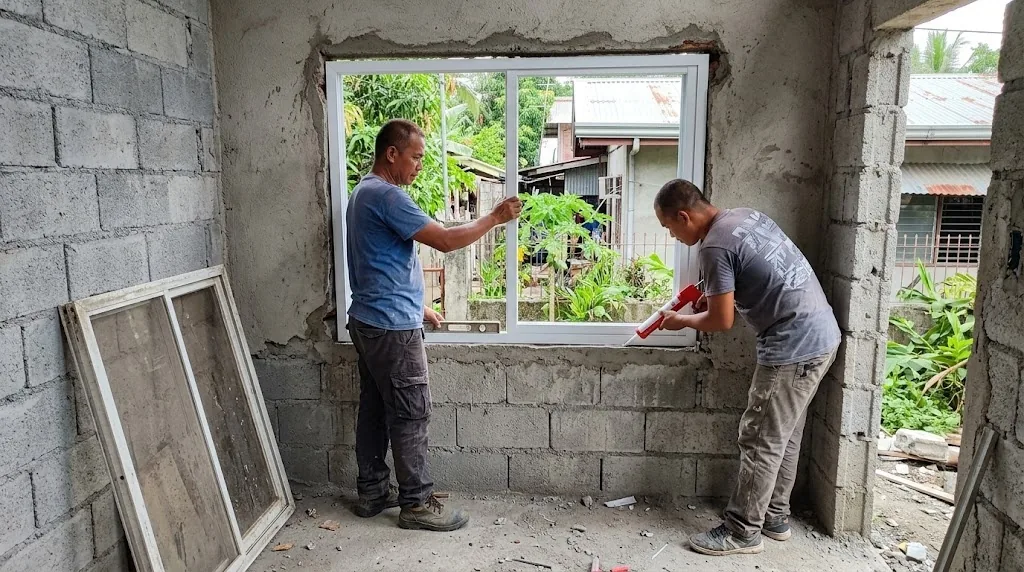
The sealant line and the sill slope decide whether a new window leaks, more than the frame material does. Illustrative photo.
Short answer: a standard aluminum sliding window runs about ₱3,500 to ₱5,000 per square meter installed, with clear glass at the low end and tinted or tempered glass toward the top. A uPVC frame costs more. For a small house with six windows and four doors, all replacing old units, the calculator below gives ₱61,214 to ₱82,834. The bigger risk isn't overpaying for the frame. It's paying for new windows that leak exactly like the old ones because the sill, sealant and weep holes were never fixed.
Two code rules also catch people during a renovation. Every room without artificial ventilation needs window openings of at least 10% of its floor area, and every bedroom needs one window a person can actually climb out of. Both are covered below, and the calculator checks the first one for you.
Add one row per window or door size. Each row is priced separately, and the total is the exact sum of the lines shown. It's a planning range, not a quote.
There's no single best frame. There's the best frame for your wall, your budget and how close you are to the sea. Here's how the common options compare for a Philippine house.
| Frame | What it costs | Near salt air | Termites | Upkeep |
|---|---|---|---|---|
| Aluminum (powder-coated or analok) | Baseline. ₱3,500-5,000/sqm installed for a standard slider (GlassInstallerPH). Wilcon lists a ready-made P.Tech 1200×1200 mm gray slider at ₱7,989. | Doesn't rust like steel, but a thin or scratched finish and plain steel screws corrode first | Not affected | Clean tracks, replace rollers and wool-pile seals, reseal perimeter |
| uPVC | Higher. The calculator uses 1.25-1.6× the aluminum rate (AEDO market estimate; no published PH price list found) | Profile doesn't corrode; check that hinges, rollers and any steel reinforcement are rated for coastal use | Not affected | Low. Gaskets and hardware are the wear parts |
| Wood (hardwood or engineered) | 1.1-1.5× the aluminum rate for windows (AEDO market estimate). Wilcon lists a Gudwood solid engineered door, 900×2100 mm, at ₱6,250 | Salt isn't the issue; trapped moisture is. Unsealed end grain at the sill rots first | Exposed. Keep bottom jambs off wet floors and treat any wood that touches masonry | Highest. Repaint or reseal regularly, especially sills and bottom rails |
| Steel doors | Wilcon lists a P.Tech steel door, 800×2100 mm, at ₱11,740 | Rusts wherever the paint is chipped, so touch up early | Not affected | Keep paint intact, especially the bottom edge |
Why the Wilcon price looks higher than the installed rate. The Wilcon P.Tech 1200×1200 mm slider at ₱7,989 works out to about ₱5,548 per sqm for the unit alone, which is above GlassInstallerPH's ₱3,500-5,000 per sqm installed. They aren't the same thing: one is a branded ready-made unit sold at retail in fixed sizes, the other is a fabricator's rate for a window made to fit your opening, quoted for Metro Manila, Calabarzon and Cebu. The calculator uses the fabricator installed rates for every window so the basis stays consistent, and shows the Wilcon units only as a retail reference.
In the coastal towns of Negros Oriental, the frame material usually matters less than what's bolted to it. A good aluminum frame fixed with ordinary steel screws will stain and loosen at the screws long before the frame gives up. Ask what the fasteners and hardware are made of, and don't accept an answer of "standard".
Ordinary float glass (annealed) is the cheapest, and it breaks into long sharp shards. Pilkington describes its toughened (tempered) glass as up to five times stronger than ordinary glass of the same thickness, breaking into small blunt-edged fragments when it does break. Laminated glass is two or more sheets bonded with a plastic interlayer, usually PVB; it may crack on impact but the glass stays held in place. That's the difference that matters: tempered glass is stronger and safer to break, while laminated glass stays in the frame after it breaks.
| Glass | Price per sqm | Use it for |
|---|---|---|
| Clear annealed | ₱600-900 | High, small windows away from where people walk |
| Tempered | ₱1,200-1,800 | Glass doors, low windows, large panes, bathrooms |
| Laminated | ₱2,200-3,500 | Where a broken pane must stay in the opening: exposed large panes, security, noise |
Prices: GlassInstallerPH 2026 glass table, fetched 2026-09-16.
The building code's glass rules, from the 2004 Revised IRR of PD 1096, Rule XVIII:
What about typhoon wind? We're not giving a glass-thickness table here, and you should be wary of anyone who gives you one without asking where you live and how high the window is. Wind pressure on a window depends on the basic wind speed at the site, exposure, height and where on the wall it sits, all set by the National Structural Code of the Philippines (NSCP 2015, Volume I, published by the Association of Structural Engineers of the Philippines). For large panes, sliding glass doors, upper floors or open coastal sites, have the glazing and its frame designed by an engineer. Our NSCP wind load guide explains how that pressure is worked out, and typhoon-resistant construction covers the rest of the house.
Window size: 10% of the floor area. PD 1096, Section 808: every room not provided with artificial ventilation shall have windows with a total free area of openings equal to at least ten percent of the floor area of the room, opening directly to a court, yard, public street or alley, or open watercourse.
At least 1.00 sqm, with a lower ratio for toilets. The 2004 Revised IRR, Section 808, repeats the 10% rule and adds that the opening shall not be less than 1.00 sqm. Toilets, baths, laundry rooms and similar rooms need windows of at least 1/20 of their floor area. The IRR as printed gives that smaller opening's minimum as "240 sq. millimeters", a figure too small to be meaningful, so confirm the reading with your building official.
Don't shrink windows in a renovation. PD 1096, Section 801(c): no building shall be altered so as to reduce the relative area of windows to less than what the Code requires. Closing a window for a new cabinet, or swapping a big window for a small one, counts.
Bedroom escape window (Fire Code). The 2019 RIRR of RA 9514, Section 10.2.14.6, for single and two-family dwellings: every sleeping room shall have at least one outside window that opens from inside without tools, keys or special effort, with a clear opening of at least 560 mm wide and 800 mm high, and a sill no more than 1,220 mm above the floor. The exception is a room with two doors giving separate ways out, or a door leading directly outside. The same section sets exit access from sleeping rooms to the outside at no less than 900 mm wide, and doors in the escape path at no less than 700 mm clear width.
Windows as emergency exits, and grills (IRR of PD 1096). Section 808 of the 2004 Revised IRR says that in locating window openings, it should be borne in mind that in extreme emergencies windows must serve as emergency egress or rescue access. Such windows shall open from inside without tools and have a clear opening at least 820 mm wide and 1 m high, and the bottom of the opening should not be more than 820 mm from the floor. Where storm shutters, screens or grilles are used, they shall have a quick-opening mechanism that opens from inside and doesn't drop to the ground. These figures are larger than the Fire Code's, so a new bedroom window sized to the IRR covers both.
A quick example: a 3 × 4 m bedroom is 12 sqm, so it needs 1.20 sqm of window opening. A single 1.2 × 1.0 m two-panel slider is 1.20 sqm of frame but only about 0.60 sqm opens, so it doesn't clearly pass on openable area. Two sliders, or a casement of the same size, would. The calculator runs this check on the openable area, because the code talks about the free area of openings. For a toilet, bath or laundry room, pick that room type and it uses 1/20 of the floor area instead.
Most "leaking window" calls aren't a frame problem. The water comes in at the joint between the frame and the wall, or it collects on a sill that drains the wrong way. Wind-driven rain during a typhoon pushes water sideways and even upward, so small gaps that stay dry in ordinary rain start leaking the moment the wind picks up.
| What you see | Likely cause | What actually fixes it |
|---|---|---|
| Water pooling on the inside sill in heavy rain | Blocked weep holes, worn seals, or a sill sloping inward | Clear the weeps and replace seals first; regrade the outside sill if it's flat |
| Damp patch or bubbling paint below the window | Water running back under the sill into the CHB | Add a drip groove, re-slope the sill, reseal the perimeter, then repair the plaster |
| Wood jamb soft at the bottom, or termite tunnels | Rot from trapped water, or termites reaching the wood | Replace the jamb; switch to a non-wood jamb where it sits on a wet floor or wall |
| Rust streaks from grills staining the wall | Paint failure where the grill is fixed into masonry | Wire-brush, prime and repaint, or replace badly rusted bars before they loosen |
| Slider hard to open, rattles in wind | Worn rollers and wool-pile seals | Replace rollers and seals; the frame is often fine |
| Frame moves when pushed | Failed anchors or crumbling plaster at the fixings | Re-anchor into solid material; if the wall around it is cracked, have it checked first |
If your house also runs hot, window choice ties in with shading and roof insulation. Our why is my house so hot guide ranks those fixes, and the house renovation cost guide covers the rest of a renovation budget.
Replacing a window in its existing opening doesn't change the wall. Cutting a new opening or widening one does. If the wall carries a beam or roof, or the opening lands next to a column, it needs a proper lintel and may need an engineer to look at it before anyone starts cutting. The new-opening line in the calculator is a budget for a simple CHB partition or infill wall, not a structural change.
How much does it cost to replace the windows and doors of a house in the Philippines?
For a small house with four 1.2 x 1.2 m aluminum sliding windows with clear glass and grills, two 0.6 x 0.6 m awning windows, one steel main door, two bedroom doors and one CR door, all replacing old units, the calculator on this page gives ₱61,214 to ₱82,834. That includes installation and removal of the old units. The window rates come from a published 2026 Philippine installer price table that already includes old frame removal, the doors are Wilcon online prices, and the grill, door hardware and door removal lines are AEDO market estimates. Prices were checked in Metro Manila, Calabarzon and Cebu sources, so get a local quote before you budget in Negros Oriental.
Is uPVC better than aluminum for a house near the sea?
Both can work near the sea, and both cost more to get wrong than to get right. uPVC doesn't corrode, but the steel reinforcement inside some profiles and the hinges, rollers and screws still can. Aluminum doesn't rust the way steel does, but a thin or damaged finish and plain steel screws in contact with it will show corrosion first near salt air. What matters more than the frame material is the finish quality, non-corroding hardware and fasteners, and a sill that sheds water. uPVC also costs more: the calculator uses 1.25 to 1.6 times the aluminum installed rate, an AEDO market estimate, because we couldn't find a published Philippine uPVC price list.
Do I need tempered or laminated glass for my windows?
Use safety glass anywhere people can walk into it or fall against it: glass doors, low fixed panels, and shower enclosures. The 2004 Revised IRR of PD 1096, Rule XVIII Section 1805, lists shower and bathtub enclosures as needing shatter-resistant glass such as fully tempered glass at least 4.8 mm thick or laminated safety glass at least 6.4 mm thick. Tempered glass is up to five times stronger than ordinary glass of the same thickness and breaks into small blunt pieces, per Pilkington. Laminated glass may crack but the plastic interlayer holds the pieces in place, which is why it's the better pick where a broken pane must stay in the frame. For glass thickness against typhoon wind, have an engineer size it for your site.
How big do my windows have to be under the building code?
Section 808 of PD 1096 requires every room without artificial ventilation to have windows with a total free area of openings of at least 10 percent of the room's floor area, opening directly to a court, yard, street, alley or open watercourse. The 2004 Revised IRR adds that this opening must not be less than 1.00 square meter, and sets toilets, baths and laundry rooms at 1/20 of their floor area. So a 12 sqm bedroom needs at least 1.20 sqm of window opening. Section 801 also says you can't alter a building so the window area drops below that minimum, which matters when a renovation shrinks or closes a window.
Can I put fixed grills on bedroom windows?
Fixed grills on every bedroom window can trap people in a fire. The 2019 RIRR of the Fire Code, Section 10.2.14.6, requires every sleeping room in a single or two-family dwelling to have at least one outside window that opens from inside without tools or keys, with a clear opening of at least 560 mm wide and 800 mm high and a sill no higher than 1,220 mm, unless the room has two separate doors out or a door leading directly outside. The 2004 Revised IRR of PD 1096, Section 808, also says windows must be able to serve as emergency exits, and grilles on them shall have a quick-opening mechanism that opens from inside. A hinged, lockable grill panel on one bedroom window covers both.
Why does water leak under my window sill during heavy rain?
Usually because the outside sill is flat or slopes back toward the wall, there's no drip groove under its edge, the perimeter sealant has cracked or was never continuous, or the weep holes in the bottom frame track are blocked. Wind-driven rain then sits in the track or runs back under the sill and soaks into the CHB below, which is why the damp patch often shows up under the window inside rather than at the frame. A new frame won't fix it if the sill and sealant stay the same, so fix the detailing at the same time.
Laws, standards, manufacturer data and prices used in this article, primary sources first. External links open in a new tab.
AEDO market estimates, not figures from a single published price list: uPVC frame factor (1.25-1.6× aluminum), wood frame factor (1.1-1.5×), grills (₱1,200-2,200/sqm), door jambs, locks and hinges where the Wilcon door doesn't include them (₱300-4,000 per door depending on type), old door removal and disposal (₱500-1,300), new window opening (₱2,600-4,600) and new door opening (₱3,700-6,650), and the openable-area fractions used in the natural-light check. Wilcon and GlassInstallerPH prices are from Metro Manila and other large-market sources; delivered and installed prices in Negros Oriental may differ.
A licensed engineer looks at why the window leaks or loosens before you pay for a new unit that fails the same way, and tells you whether a new opening is safe to cut.