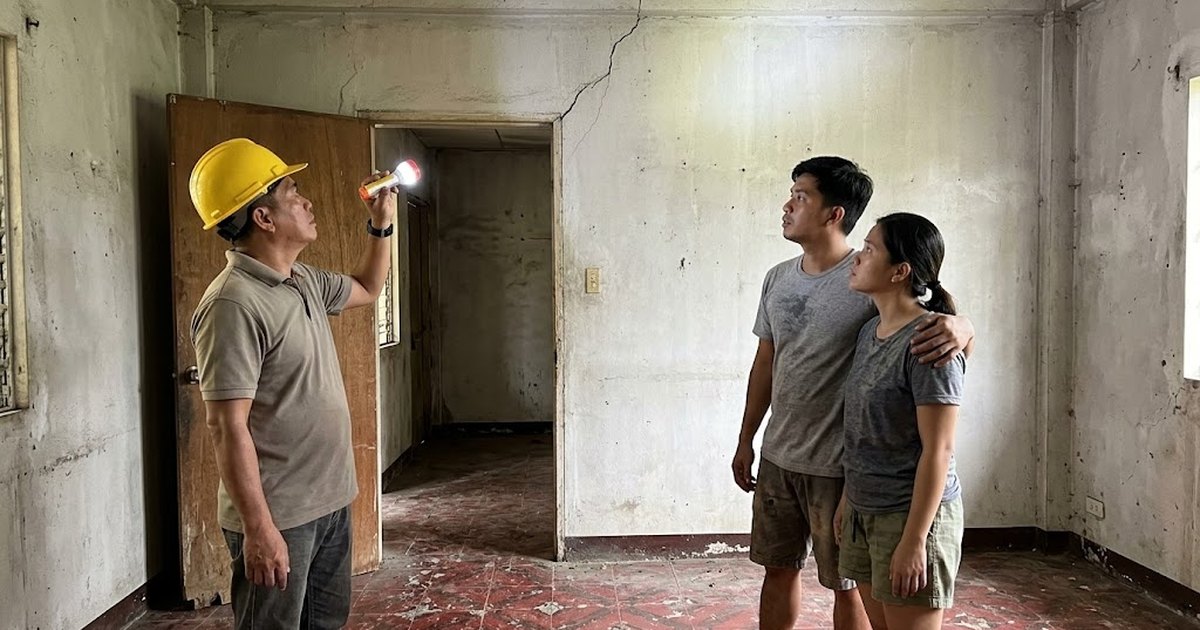
Look past fresh paint. Cracks, stains and sagging lines tell you more than the listing does. Illustrative photo.
Short answer: the law gives a Philippine house buyer far less protection than most people assume. The seller's warranty covers hidden defects only, and any action on it is barred six months from delivery. A defect you could have seen is never covered at all. That combination means the inspection you do before signing is not an extra — it is the protection.
Article 1561: the seller answers for hidden defects that make the thing unfit for its use — "but said vendor shall not be answerable for patent defects or those which may be visible." Article 1571: actions arising from those provisions "shall be barred after six months, from the delivery of the thing sold." Visible defect, no claim. Hidden defect, six months. There is no third option where you find out later and someone else pays.
Ask for all six in writing, early, and read the refusal as information. A seller who has them produces them in a day.
The gap between document 6 and the house in front of you is where the money is. A set of plans showing a bungalow, and a two-storey house on the lot, is not a paperwork problem. It is a structural one. Our occupancy permit guide covers what regularising that costs and how long it takes.
Article 1723 comes up in every conversation about buying an older house, usually misremembered. Here is what it actually says.
The engineer or architect who drew the plans is liable for damages if, within fifteen years from completion, the structure collapses because of a defect in those plans and specifications or defects in the ground. The contractor is likewise responsible if the edifice falls within the same period through defects in construction, inferior materials, or a violation of the contract terms. If the engineer supervised the construction, they are solidarily liable with the contractor. Acceptance of the building after completion does not waive the cause of action, and the action must be brought within ten years following the collapse.
The trigger is collapse. Not cracking, not settlement, not a leaking roof, not a house that turned out worse than it looked. And the liability runs against the professionals who designed and built it, not against the person selling it to you. Article 1723 is a remedy for a catastrophe. It is not a fifteen-year warranty that transfers with the title, and it will not help you argue about a beam that sags.
Walk the house with this open. It returns a proceed, investigate or walk-away verdict, tells you which flags are paperwork and which are structure, and bands what the remediation is likely to cost so you can put a number on your offer. Legal points are cited; cost bands are AEDO practice.
Do it in daylight, after rain if you can arrange it, and do it twice — once for the house and once for the ground it sits on.
Our structural damage warning signs guide goes deeper on reading each defect, and the column sizing guide covers what a two-storey house should actually have under it. If the lot itself is the question rather than the house, start with the free lot hazard checks instead.
| Finding | What it really is | Effect on the deal |
|---|---|---|
| No certificate of occupancy | Unsigned-off or altered construction | Regularise before closing, at the seller's cost |
| Undocumented added storey | Unverified load path on original footings | Assessment before the offer; outcomes range from strengthening to demolition |
| Cracking at beam-column joints | Frame distress, not finish | Engineer's opinion is mandatory before any offer |
| Widespread settlement signs | Foundation or ground problem | Usually the most expensive repair on any house |
| Exposed, corroding reinforcement | Section loss in members you rely on | Repair scope grows with every wall you open |
| History of flooding | A permanent site condition | Price it as a design problem, not a cleaning problem |
One habit is worth more than all of these. Get the report before you make the offer. A written condition survey is the only document that turns "it needs work" into a number a seller can respond to, and it costs a fraction of the difference it usually makes to the price.
The warranty provisions are quoted from the Civil Code of the Philippines, Republic Act 386: Article 1561 for the seller's responsibility for hidden defects and its express exclusion of patent or visible ones, Article 1566 for the seller being answerable even when unaware, Article 1567 for the buyer's election between withdrawing and demanding a proportionate reduction of the price with damages, and Article 1571 for the six-month bar running from delivery. The fifteen-year collapse liability, the ten-year period to sue following a collapse, and the rule that acceptance does not waive the cause of action are Article 1723. The ₱5,000 flat assessment with a five-business-day written report is AEDO's published price. Everything in the scorecard's repair bands is AEDO practice, labelled as such, and none of it is code.
Can I sue the seller if the house turns out to be structurally defective?
Only within a narrow window, and only for defects you could not have seen. Article 1561 of the Civil Code makes the seller responsible for hidden defects that render the thing unfit for its intended use, but it says in the same sentence that the seller is not answerable for patent defects or those which may be visible. Article 1571 then bars any action arising from those provisions six months from the delivery of the thing sold. So a crack you could have looked at is your problem from the day you sign, and even a genuinely hidden defect stops being actionable half a year after delivery. Inspecting before you pay is not caution, it is the only leverage the law leaves you.
Does the fifteen-year liability of the engineer protect me as a buyer?
Less than people assume. Article 1723 makes the engineer or architect liable for damages if within fifteen years from completion the structure collapses because of a defect in the plans and specifications or in the ground, and the contractor liable if the edifice falls within the same period because of defects in construction, inferior materials or a violation of the contract. The action must be brought within ten years following the collapse. Read the trigger carefully. It is collapse, not cracking, not leaking and not disappointment, and the claim runs against the professionals who built it rather than against the person selling it to you. It is a remedy for a catastrophe, not a warranty you inherit with the title.
What documents should I ask for before buying a second-hand house?
Six. The certificate of title and the latest tax declaration so ownership and coverage can be checked, the approved subdivision or relocation plan so the boundaries can be plotted, the building permit, the certificate of occupancy, and the approved plans as built. The occupancy permit is the one most often missing, and its absence usually means either the house was never signed off or it was altered after it was. Ask for all six in writing and treat a refusal as information rather than an inconvenience.
The house has a second floor that is not on the plans. How bad is that?
Potentially the most expensive thing on the property. A storey added after the fact sits on a foundation and columns that were sized for the original building, and unless the addition was designed by an engineer the load path was never checked. It is also unpermitted construction, so the paperwork has to be regularised before an occupancy permit can be issued or a clean sale registered. Treat an undocumented vertical addition as a reason to commission a structural assessment before the offer, not after, because the two possible answers are a modest strengthening bill and a demolition.
Which cracks actually matter?
Pattern matters more than width. Fine map cracking on a plastered surface is usually shrinkage. Diagonal cracks running from the corners of windows and doors, stepped cracks following the mortar joints of a block wall, and cracks concentrated at the junction of beams and columns are the ones that suggest movement rather than finish. Add the corroborating signs before deciding anything is serious: floors that slope, doors and windows that bind, separation at the junction between an extension and the original house, and rust staining or spalled concrete exposing reinforcement. Two or more signs together, or one severe one, is the threshold for having an engineer look.
Is a pre-purchase structural assessment worth it?
On a purchase running into millions, a licensed-engineer assessment is one of the cheapest decisions available. AEDO charges five thousand pesos flat for a site visit, a visual condition survey and a written engineering opinion delivered within five business days. Its value is not only in finding defects. A written report is also the document that supports a reduced offer, and it is far easier to renegotiate a price with a condition survey in hand than to recover a repair cost from a seller after the six-month window in Article 1571 has closed.
Every statute, code and official tool used or referred to in this guide, linked to its primary source. Links open in a new tab.
The ₱5,000 assessment fee is AEDO's published price. All repair and regularisation bands in the scorecard are AEDO practice figures, not code or statutory amounts.
₱5,000 flat. A site visit, a visual condition survey and a written engineering opinion in five business days — in time to change the price rather than to regret it.